
More Entries from Tom’s Audiophile Notebook
In 2007 we did a shootout for The Four Seasons on RCA and noted the following:
For those of you with better tube gear, the string tone on this record is sublime, with that rosin-on-the-bow quality that tubes seem to bring out in a way virtually nothing else can, at least in my experience.
Our experience since 2007 has changed our view concerning the magical power of tubes to bring out the rosiny texture of bowed stringed instruments.
We have in fact changed our minds completely with respect to that rarely-questioned belief.
It’s a classic case of live and learn, and represents one of the bigger milestones in audio that we marked in 2007, a year that in hindsight turns out to have been the most important in the history of the company.
 Everything changed dramatically for the better for us sometime in 2005. That’s when we discovered the transistor equipment we still use to this day.
We found a low-power integrated amp made in the 70s that was vastly superior to our custom-built tube preamp and amp. We had an EAR tube phono stage at that time, which we quite liked.
UPDATE 2025
We recently hooked up our old 834p phono stage in the system and did not like the sound at all.
Things change. Boy do they ever!
In 2007 we auditioned the EAR 324P transistor phono stage and immediately recognized it would take our analog playback to an entirely new level, one we had simply never experienced before and really had never thought could possbily exist.
We make no claims whatsoever for any other transistor equipment of any kind, almost all of which in my experience is not at all good. The sound of these two units in combination is dramatically faster, more transparent, more free from smear, more dynamic and more resolving than any tube equipment we know of.
It is, simply put, much more musically truthful.
In the simplest terms, it sounds more like live music and less like recorded music.
It is precisely this quality that is the hardest to find in all of audio.
It is also the one quality of our system that, more than any other, makes it possible to do the kind of work we do.
Our equipment lets us hear the naked sound of the record being played, as uncolored and unadorned as we can manage.
It also has another benefit, one whose importance cannot be overstated — it actually does sounds a great deal more like live music than any other we’ve heard.
Yes, we know, we haven’t auditioned every piece of tube gear in the world. There may indeed be something out there with even more of the qualities we recognize in live music than we are currently capable of reproducing with our transistor equipment.
We remain open-minded as always, but intensely skeptical. This is a powerful combination that has served us well over the 37 years we have been in the business of selling records to audiophiles.
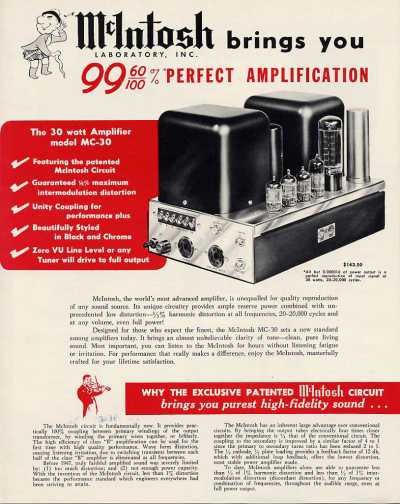
Yes, for a while I actually owned a pair of Mac 30 amps, much like the ones you see pictured. They started building them in 1954. Steve Hoffman was a big fan. We spent a fair amount of our time together tube-rolling back in those days. Based on some of the recent interviews I’ve read, it seems he appears to still be a big fan of their sound.
Like the fellow who bought his first boat, buying a pair of Mac 30s was the second best day of my life, exceeded only by the day I got rid of them.
They were not 99.60% perfect by any stretch of the imagination. To this day they are the most colored and inaccurate — albeit the most Tubey Magical — amp I have ever heard in my life, and I have heard plenty.
If this is your idea of good sound, you should consider the very real possibility that you might be wasting your time on this blog. Colored and inaccurate are not what we are going for at The Skeptical Audiophile.
The fellow who owns this company makes a very good living producing and selling records with an abundance of those two qualities, and we’re having none of it. The success of his company is the surest sign that audiophile record collectors have systems that are fundamentally failing every test of fidelity and in need of a great deal of reform.
Our advice: Get better equipment, learn to listen to it critically, and then come back so that you can discover for yourself that what you are reading here is true.
Further Reading