too-smooth-modern

Whether made by DCC, Analogue Productions or any other label, starting at some point in the mid-’90s many remastered audiophile pressings started to have a tonality problem that we found insufferable right from the get-go: they are just too damn smooth.

The bulk of the heavy vinyl reissues we’ve played, in addition to being too smooth, suffer from numerous other shortcomings that rob the music of its life and energy.

Thick, opaque, veiled, recessed and lacking in ambience, this is what we hear on one modern remastered record after another. It may be someone’s idea of “analog,” but it sure isn’t ours.

Driving My Car into a Ditch

Hot Stamper Pressings of the Music of The Beatles Available Now

Mobile Fidelity made a mess of Drive My Car on their Half-Speed mastered release of Rubber Soul in 1982.

Perhaps it’s more accurate to say Stan Ricker, MoFi’s go-to mastering engineer, did.

He equalized out far too much upper midrange and top end.

What fuels the energy of the song are the cow bell, the drums and other percussion. Instead of a scalpel, Mobile Fidelity took a hatchet to this slightly bright track, leaving a dull, lifeless, boring mess.

Some Parlophone copies may be a little bright and lack bass, but at least they manage to convey the musical momentum of the song.

Even the purple label Capitol reissues can be quite good. A bit harsher and spittier, yes, but in spite of these shortcomings they communicate the music, which ought to count for something.

As much as I might like some of the MoFi Beatles records [not so much anymore], and even what MoFi did with some of the other tracks on Rubber Soul, they sure sucked the life out of Drive My Car.

We all remember how much fun that song was when it would come on the radio. Playing it on a very high quality stereo should make it more fun, not less.

If you’ve got a Rubber Soul with a Drive My Car that’s no fun, it’s time to get another one.

By The Way

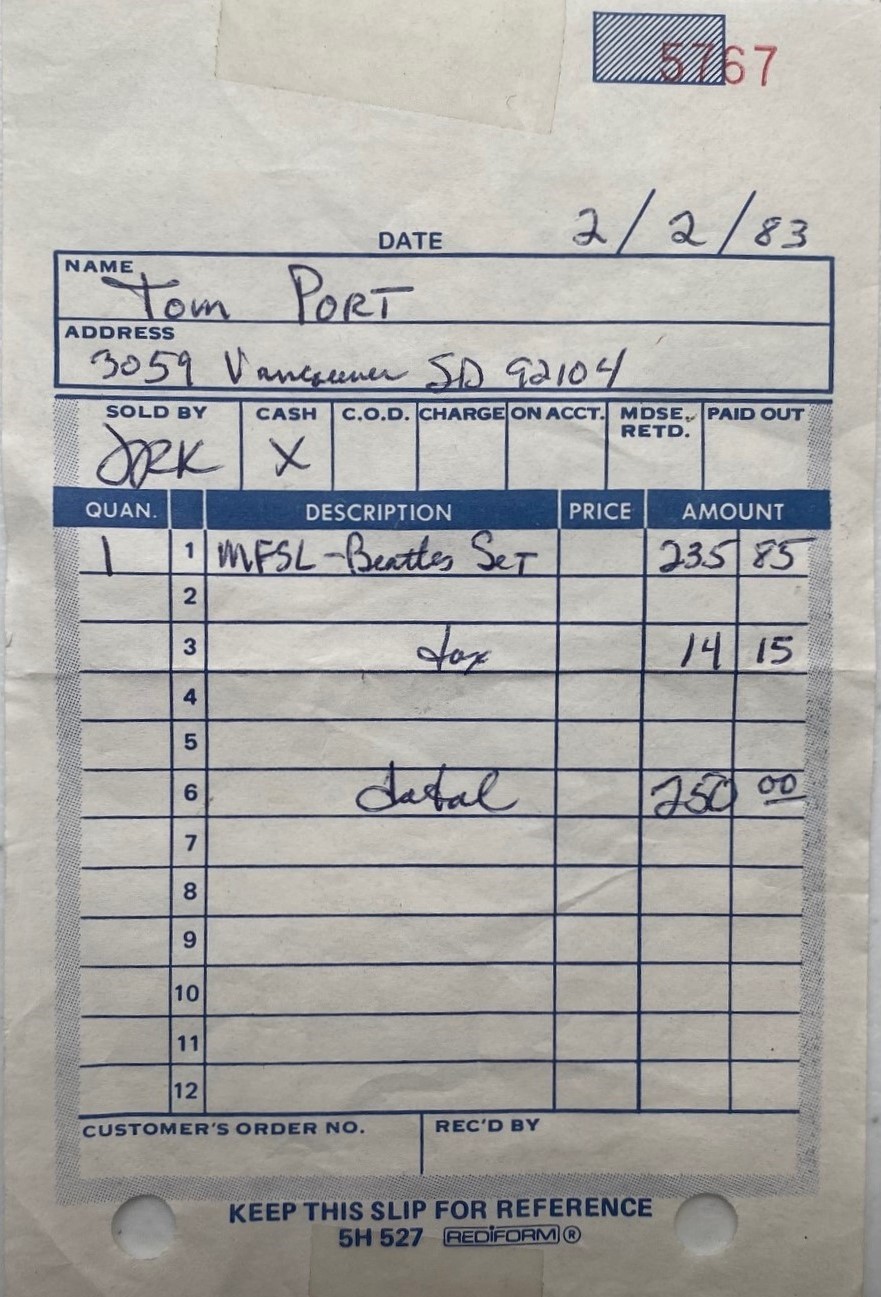
The best $250 — to the penny! — I ever spent on records is the price I paid for my brand new, still-in-the-shipping-carton MoFi Beatles Box. I ordered it in 1982 when I first learned of it, and it finally came the next year. I already owned all The Beatles albums MoFi had done to date, including the UHQR of Sgt. Pepper, which, like a fool, I got rid of once the set came out.

(more…)

Jazz Impressions of Black Orpheus Is a Bloated Mess at 45 RPM from Hoffman, Gray and Kassem

Hot Stamper Pressings of Jazz Piano Recordings Available Now

We played an amazing Hot stamper copy that got the bottom end on this album as right as we’ve ever heard. The contribution of the bass player was clear and correctly balanced in the mix, which we soon learned to appreciate was fundamentally important to the rhythmic drive of the music.

The bass was so tight and note-like you could see right into the soundstage and practically picture Monte Budwig plucking and bowing away.

This is precisely where the 45 RPM pressing goes off the rails.

The bloated, much-too-heavy and poorly-defined bass of the Heavy Vinyl remaster makes a mess of the Brazilian and African rhythms inherent in the music. If you own that $50 waste of money, believe me, you will not be tapping your foot to Cast Your Fate to the Wind or Manha de Carnival.

Our rule of thumb: he better the system, the more second-rate Hoffman’s remastered records will sound when they aren’t just terrible.

Is this the worst version of the album ever made? That’s hard to say.

But it is the worst sounding version of the album we’ve ever played, and that should be good enough for any audiophile contemplating spending money on this kind of trash. Take our advice and don’t do it.

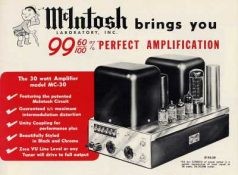
If you like the sound of old McIntosh tube equipment like the Mac 30s shown here, a sound Steve Hoffman apparently cannot get enough of, these remastered records have your name all over them.

We don’t sell junk like this, but every other audiophile record dealer does, because most of the current group of mastering engineers making records for audiophiles have somehow gotten into their heads that this is the way records should sound.

We’ve been telling them they are wrong about that for years now, that good records have never sounded this way, but the collectors and audiophiles of the world keep buying their wares, so why should they listen to us?

If you want to know what a properly-mastered, properly-pressed copy sounds like, we put the last one up in 2023.

(more…)

L.A. Woman Is a Disaster on German Heavy Vinyl, Part One

Hot Stamper Pressings of the Music of The Doors Available Now

There was a German 180 gram pressing of L.A. Woman that was so bad, I called this commentary from 2005 The Audiophile Apocalypse. [Minor edits have been made since then.]

The fact that some audiophiles and audiophile reviewers appeared to like this pressing was a sign that, to me at least, The End Is Near, or May Be. There is no hope for audiophiles if they can’t tell a good record from a bad one, and this is clearly a bad one.

If this isn’t a good example of a pass/not-yet record, I don’t know what would be.

As noted at the top, this commentary was written a long time ago. Much of our thinking about the recordings of The Doors has evolved since then, having played scores of their records in shootouts and learned something new from practically each one. Click here to read more.

Dateline: January, 2005

When I first played it I thought there must be something wrong with my stereo. There was no deep bass. (This recording has amazing deep bass.) The sound was upper midrangey and distorted. There was no extreme top at all.

This surprised me, as I had heard that this was supposed to be a good record.

What I heard coming off the copy that I was playing was pure garbage. I was confused.

So I grabbed a couple of DCC Doors pressings. The first one I played was Waiting For The Sun, my favorite on DCC. Ahh, that’s more like it. Sweet, open, plenty of bass, extended highs, Steve Hoffman’s beautifully liquid midrange — everything I expected to hear on his version was there just exactly the way it should be.

So I knew it wasn’t my stereo. Then I pulled out the DCC LA Woman. What’s the difference you ask? Well, the DCC has a top end. Listen to the cymbals. They ring sweetly and correctly. You can hear that the tape hiss sounds correct, a sure sign that the top end is accurate.

The midrange is a bit recessed compared to the German pressing. Steve says he took out a half DB in the upper mids. There’s distortion on the vocals and he was trying to soften the effect. It might have been better to leave it flat, but either way is preferable to the boosted, aggressive, edgy upper midrange to be found on the German pressing.

The German LP sounds like something playing over the radio. AM, not FM. Part of the problem is that there’s no lower midrange on the German pressing to properly balance out the vocals. Perhaps it’s not on the tape they used. I’m guessing it probably isn’t.

But any mastering engineer worthy of the name should know how to fix a problem like that. Steve did. Apparently this German fellow did not.

And worst of all, there is no deep bass on this record AT ALL. The whole lower octave is missing. Now to be fair, the DCC LP has the same problem. There’s no lower bass on it either. That’s why I don’t recommend that you listen to LA Woman on vinyl. I don’t know of any copy that sounds right.


UPDATE 2025

This was true in 2005 because we had yet to do the work it takes to find the right copies, the ones with plenty of bass and everything else too. I think it took us another ten years to find the pressings with the right stampers. Scroll to the bottom of this listing to see our notes for the copy that won our last shootout in 2024.

(more…)

Music From Peer Gynt – Another Cisco Disaster

Hot Stamper Pressings of the Music of Edvard Grieg Available Now

An audiophile hall of shame pressing from Cisco / Impex /  Boxstar / Whatever.

Pretty bad, on a par with the transistory, shrill crap Classic Records had been dishing out for years, but in the opposite direction tonally: it’s dull and dead as a doornail.

I often mention on this blog that Cisco’s releases (as well as DCC’s) had to fight their way through Kevin Gray’s transistory, opaque, airless, low-resolution cutting system. We discuss that subject in more depth here.

Our favorite recording of Peer Gynt is the one by Otto Gruner-hegge and the Oslo Philharmonic from 1959.

(more…)

The CBS Half-Speed of Off the Wall Is a Joke

Hot Stamper Pressing of the Music of Michael Jackson Available Now

Sonic Grade: F

Pure MUD. No top end whatsoever!

I remember when we audiophiles looked down our noses at CBS Half-Speeds because they weren’t pressed in Japan and sold at a notable discount to the offerings of Mobile Fidelity and their competitors.

But we were so desperate back then for top quality pressings that we bought them anyway!

Are audiophiles any less desperate today? They seem pretty desperate to me. They approach these new Heavy Vinyl records naively instead of skeptically, assuming they will be better sounding in exactly the same way I assumed the Half Speeds I was buying forty years ago would be better sounding.

The more things change…

If you are buying these modern pressings, take the advice of some of our customers and stop throwing your money away on Heavy Vinyl and Half-Speed masters.

At the very least let us send you a Hot Stamper pressing — of any album you choose — that can show you what is wrong with your copy. And if for some reason you disagree that our record sounds better than yours, we will happily give you all your money back and wish you the best.

(more…)

With Abraxas, MoFi Manages to Disgrace Itself Even Further

Hot Stamper Pressings of the Music of Santana Available Now

The remastered Abraxas never got past the first elimination round; it had to have been one of the worst half-speeds I have ever heard. Dead, dead, dead as a doornail.

Is it the worst version of the album ever made? Hard to imagine it would have much competition.

Santana’s first album on MoFi is a record we admit to having liked a bit when it first came out. Since then we have changed our minds. It’s just too damn compressed and lifeless. The Whomp Factor on this pressing is Zero. Since whomp is critical to the sound of Santana’s music, it’s Game Over for us. The review below is exactly what we wrote at the time the record came in. We tried to like it, but it’s clear to us now that we tried to like it too hard. Please accept our apologies.

I noted in my old blog: “But now I would have to say that the MoFi LP is far too lifeless to be acceptable to anyone, even those with the worst kinds of audiophile BS systems.”

(more…)

Sgt. Peppers on Heavy Vinyl – The Reviewers from 1982 Blow It Again

beatlessgtHot Stamper Pressings of Sgt. Peppers Available Now

You might agree with some reviewers that EMI’s engineers did a pretty good job with the new Pepper.

In the March 2013 issue of Stereophile, Art Dudley weighed in, finding little to fault on this title but being less impressed with most of the others in the new box set.

His reference disc? The MoFi UHQR. Gadzooks!

Oh, and he also has some old mono pressings and a domestic Let It Be. Now there’s a man who knows his Beatles. Fanatical? Who can blame him? We’re talkin’ The Beatles for Chrissake!

When I read the reviews by writers such as these I often get the sense that I must’ve fallen through some sort of Audio Time Warp and landed back in 1982.

How is it that our so-called experts evince so little understanding of how records are made, how variable the pressings can be, and, more importantly, how absolutely crucial it is to understand and implement rigorous protocols when attempting to carry out comparisons among pressings.

Critically comparing LPs is difficult and time-consuming.

It requires highly developed listening skills that I could not possibly have had because I had no clue as to what they were or how to go about acquiring them.

I see no evidence that the audiophile reviewers of today are better at it than I was in 1982, and I was terrible.

What does one well-known reviewer have to say, keeping in mind that he’s using his original British pressing for comparison? I quote at length — without prejudice so to speak — so there can be no misunderstanding. (Emphasis added.)

(more…)

Add Made in Japan to the List of Ridiculously Bad DCC Titles

Hot Stamper Pressings of the Music of Deep Purple Available Now

What a murky mess. The sound is dead as a doornail.

It’s yet another audiophile record hall of shame pressing, a Heavy Vinyl disaster if there ever was one.

Is it the worst version of the album ever made?

That’s hard to say. But it is the worst sounding version of the album we’ve ever played, and that should be good enough for any audiophile contemplating spending money on this kind of trash. Take our advice and don’t do it.

If you like the sound of old McIntosh tube equipment such as the Mac 30s shown here, a sound Steve Hoffman apparently cannot get enough of, DCC is the label for you.

We don’t sell junk like this, but every other audiophile record dealer does, because most of the current group of mastering engineers making records for audiophiles have somehow gotten into their heads that this is the way records should sound.

We’ve been telling them they are wrong about that for years now, that good records have never sounded this way, but the collectors and audiophiles of the world keep buying their wares, so why should they listen to us?

What a Fool Believes

I used to like some of the DCC vinyl titles just fine too. Didn’t play them very often, but I liked what I heard when I did.

Then my stereo got a lot better. Eventually it became obvious to me what was wrong with practically all of the Heavy Vinyl pressings put out by that label. (That story from 1998 gets told in some detail here.)

Heavy Vinyl

The good Heavy Vinyls can be found in this group, along with other Heavy Vinyl pressings we liked or used to like.

The bad Heavy Vinyls can be found in this group. And those in the middle end up in this group.

Audio and record collecting (they go hand in hand) are hard. If you think either one is easy you are very likely not doing it right, but what makes our twin hobbies compelling enough to keep us involved over the course of a lifetime is one simple fact, which is this: Although we know so little at the start, and we have so much to learn, the journey itself into the world of music and sound turns out to be both addictive and a great deal of fun.

(more…)

What to Think When a New Version of Graceland Is Completely Unrecognizable?

Hot Stamper Pressings of the Music of Paul Simon Available Now

Where did this thick, dull, bloated, opaque turd come from?

Having played at least 50-75 copies of the album over the last ten years, I can honestly say I have never heard one that sounded like this new version (maybe some record club copy we picked up by accident did, can’t say it never happened).

Can that possibly be a good thing?

Well, in favor of that proposition, I guess you could say it sounds less like a CD now.

On the other side of the ledger, it now sounds a great deal more like a bad LP.

We listen to piles of pressings of Graceland regularly. We know what the album generally sounds like, the range from bad to good, and we know what qualities the very best copies must have in order to win one of our shootouts.

Above all the one thing Graceland has going for it sonically is CLARITY. It can be open and spacious, tonally correct, with punchy, tight bass and present, breathy vocals. The best of the best copies have all these qualities, but the one quality any good copy must have is clarity, because that’s what’s good about the sound of the record. Without clarity the music doesn’t even work.

The new version has been “fixed.” It got rid of all that pesky grit and grain and CD-like sound from the original digital mix by simply equalizing them away.

Cut the top, cut the upper mids, boost the lower mids and upper bass and voila – now it’s what Graceland would have sounded like had it been all analog from the start, AAA baby!

Or at least analog for those who don’t know what good analog sounds like.

But it never was all analog, and trying to make it sound that way just ruins the one quality that it actually had going for it — clarity.

VTA

You can adjust your VTA and other table settings until you’re blue in the face, you’ll never get this pressing to sound right, and you’ll certainly never get it to sound very much like any Sterling original pressing I’ve ever heard.

The digital spit and grit is still there, under the darker EQ. And now it’s even worse — Simon’s voice has a thick, dull blanket over it, but you can still hear the spit underneath it.

You could probably take the CD and equalize it to sound like this record. But what would be the point?

The Bright Side

Well, perhaps there is a point to this equalization madness.

The CD already exists. It has a sound.

The original record has a sound too, and it’s a fairly common LP in the used bins. You could buy two or three for not that much money and try to find one you like better than the vinyl version you probably already own.

(more…)

The Electric Recording Company Does My Favorite Things No Favors

Hot Stamper Pressings of the Music of John Coltrane Available Now

My Favorite Things happens to be one of our favorite Coltrane records, but we much prefer the stereo pressing of the album. (This is almost always the case when an album has been recorded in stereo, as My Favorite Things was in 1960, later released on Atlantic vinyl in 1961.)

We even tell you what to listen for to help you separate the best pressings from the merely good ones: the piano.

A solid, full-bodied, clear and powerful piano. As we focused on the sound of the instrument, we couldn’t help but notice how brilliant McCoy Tyner is. This may be John Coltrane’s album, but Tyner’s contribution is critically important to the success of My Favorite Things.

The engineering duties were handled by Tom Dowd (whose work you surely know well) and Phil Iehle, who happens to be the man who recorded some of Coltrane’s most iconic albums for Atlantic: Giant Steps (1960) and Coltrane Jazz (also in 1961).

Our last shootout for My Favorite Things was in 2018, not exactly yesterday, but in our defense let me just say that we have done plenty of other Coltrane albums from this period and feel as though we would have no trouble recognizing the sound his engineers were going for.

Unfortunately for those of you who have bought into the idea that the Electric Recording Company produces records with audiophile quality sound, you will find an utterly alien My Favorite Things, one nobody has ever heard before and one that no audiophile should want anything to do with.

Allow us to lay out the specifics of our complaints:

Notes for Side One

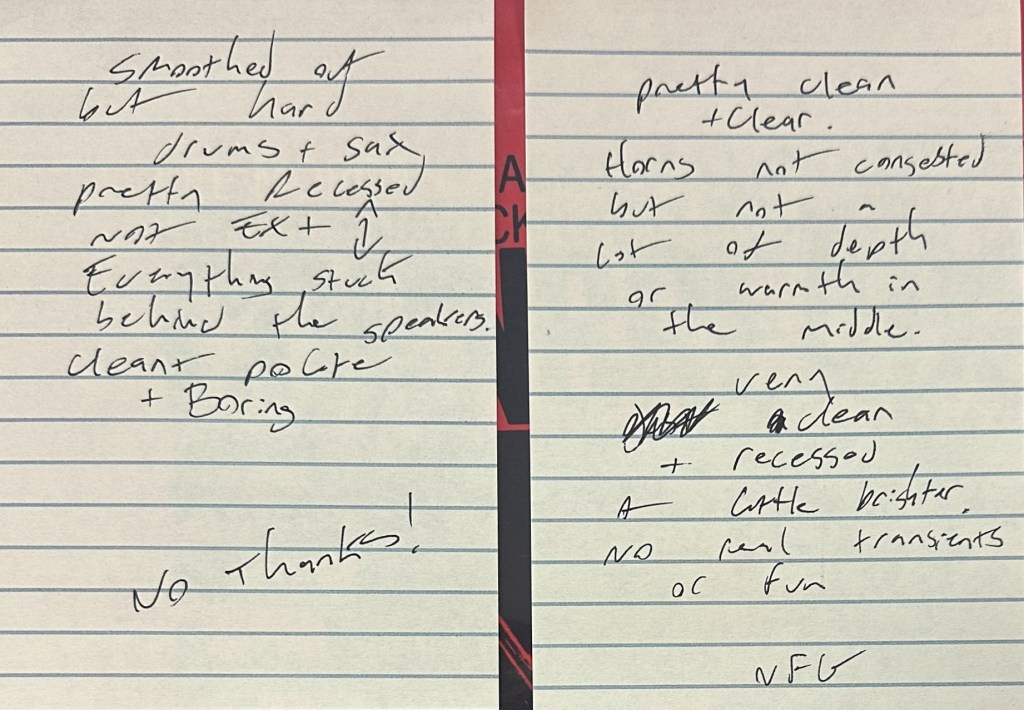
  • Big and full but smeary, flat and dull sax
  • No space or depth anywhere
  • Bloated bass
  • A mess

Notes for Side Two

  1. Side two is even worse
  2. Where is the breathy detail of the sax?

Electric Recording Company

We’ve played a few other ERC releases produced by the gentleman who owns The Electric Recording Company, a Mr. Pete Hutchison.

As you no doubt know, we would not be correct in using the term “mastered.” He does no mastering. He does “transferring.” He transfers the tapes to disc and puts them in nice jackets of his own design.

(more…)