test-orchestral

Some of our favorite orchestral test discs.

Compression Works Its Magic on The Christmas Eve Suite

Hot Stamper Pressings of the Music of Rimsky-Korsakov Available Now

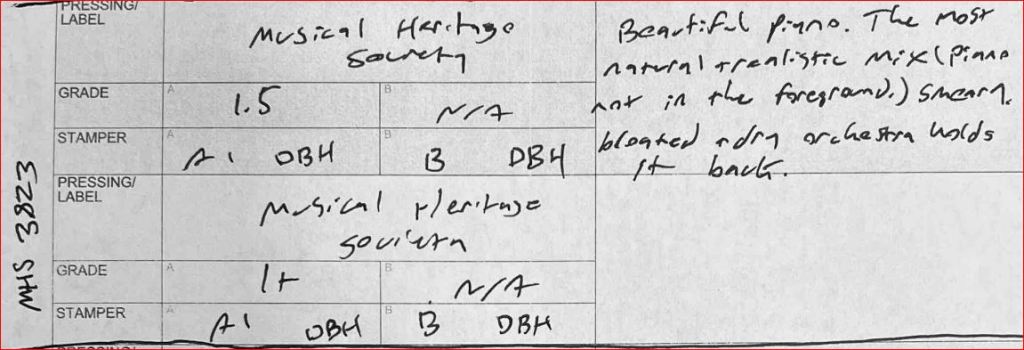
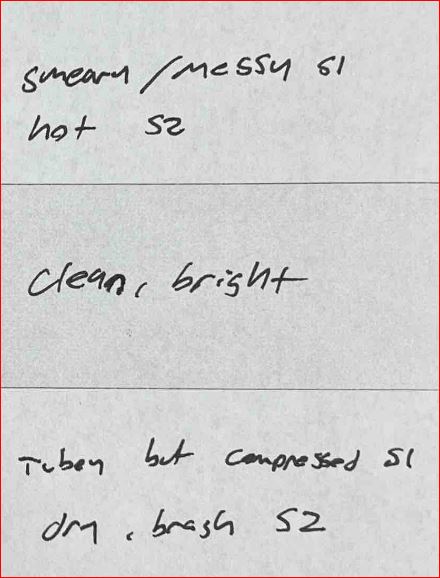
Some notes about the compression effects we heard on side two of a Blueback pressing of The Christmas Eve Suite album back in 2012. We wrote:

Side two is even more transparent and high-rez than side one. The texture on the strings and the breathy quality of the woodwinds make this a very special pressing indeed.

The horns are somewhat smeary and do get a bit congested when loud.

There is more compression on this side two than there was on the best copy we played, and that means low level detail is superb, but louder parts, such as when the more powerful brass instruments come in, can present problems.

Note how good The Flight of the Bumble Bee sounds here.

Compression is helping bring out all the ambience and detail in the recording, and there’s no downside because the orchestra is playing softly, unlike the piece that precedes it.

A classic case of compression having sonic tradeoffs.

(more…)

This Sibelius Violin Concerto Was Big and Lush but…

Hot Stamper Pressings Featuring the Violin Available Now
We love the way RCA recorded Heifetz back in the day, the day in this case being 1960. We usually have a good supply of vintage Heifetz titles on the site at all times. They often have our favorite performances, and the best copies, as the notes for the one below make clear, can have absolutely amazing sound.

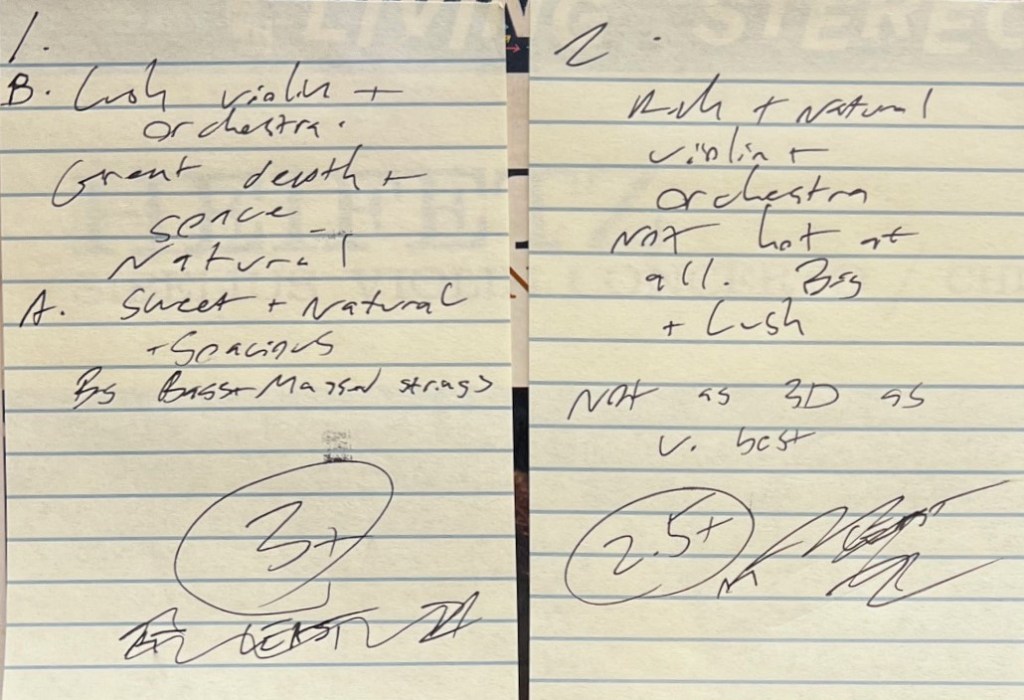
As you can see from the notes, side one of a recent shootout winning copy was doing everything right.

However, we had a side two that was slightly better than the side two you see here. When we played the two best copies back to back, this side one came out on top, earning a grade of 3+, but the side two of another copy showed us there was even more three-dimensionality to be discovered in the recording than we thought. Consequently this side two was dropped a half grade to 2.5+.

This is exactly why we do shootouts. If you really want to be able to recognize subtle (and not so subtle!) differences between pressings, you must learn to do them too.

(more…)

Azimuth – A Little Can Make a Lot of Difference

Robert Brook runs a blog called The Broken Record, with a subtitle explaining what the aim of his blog is:

A GUIDE FOR THE DEDICATED ANALOG AUDIOPHILE

We know of none better, outside of our own humble attempt to enlighten that portion of the audiophile community who love hearing music reproduced with higher fidelity and are willing to go the extra mile to make that happen.

Here is Robert’s latest posting. He recently spent some time with our favorite recording of the Beethoven First Piano Concerto, and needless to say, he’s glad he did.

AZIMUTH: A LITTLE Can Make A LOT of Difference!

You may enjoy our piece on azimuth and other aspects of turntable setup in this posting from many years ago.

Lately we have been writing quite a bit about how pianos are good for testing your system, room, tweaks, electricity and all the rest, not to mention turntable setup and adjustment.

(more…)

What to Listen For on Eine Kleine Nachtmusik

Hot Stamper Pressings of the Music of Mozart Available Now
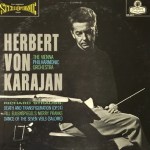
On most copies the strings are slightly drier and more harsh and steely than one would want, occasionally turning strident in the louder passages.

As always, proper VTA adjustment — by ear — is critical to getting the strings to sound their best.

More advice on setting your VTA.

An extended top end helps the harmonics of the stringed instruments immensely.

Here are some other records that are good for testing string tone and texture.

The more resolving copies will show you more of the hall, which greatly adds to the sense that you are listening to live music, not a record.

(more…)

Borodin’s Symphonies – Phenomenal Richness in the Lower Registers

Hot Stamper Pressings of the Music of Borodin Available Now

This commentary was written way back in 2005. Still holds up though.


The Borodin title you see pictured has demonstration quality orchestral sound of the highest order.

The performance by Ansermet is definitive, IMHO, and this recording ranks in the Top Ten Decca/ Londons we’ve ever played.

The powerful lower strings and brass are gorgeous. Ansermet and the Suisse Romande get that sound better than any performers I know. You will see my raves on record after record of theirs produced in this era.

No doubt the wonderful hall they record in is the key. One can assume Decca engineers use similar techniques for their recordings regardless of the artists involved. The only real variable should be the hall.

Ansermet’s recordings with the Suisse Romande have a richness in the lower registers that is almost unrivaled in my experience.

(more…)

Does Your Pressing of Death and Transfiguration Have These Shortcomings?

More of the Music of Richard Strauss

Many of the later pressings of CS 6211 were not competitive with the earlier pressings, something we had no idea was true until we actually did the shootout.

This is why we do our shootouts with every kind of pressing we can find that has any hope of sounding good to us.

(This is of course something that cannot be predicted with much certainty. What we are saying is simply that we do not expect the German, Dutch, Japanese and such like pressings from other countries outside the UK to do well because they have almost never done well in the past, not for Decca recordings anyway.)

The notes on the left in the box are for the copies that did not do as well as our best copies.

If your copy of the album has any of the shortcomings we mention, and you would like a better pressing to play, rest assured we will have something for you down the road, as this is our favorite for both performance and sound.

Stamper Information

The stampers of the pressings that consistently came in last in our shootout had the mastering marking of L, which signifies the work of George Bettyes. He has done good work in the past, but odds are that any pressing of this title mastered by L is going to be inferior to those that are not.

Our advice: stick with E and G.

As is sometimes the case, there is one and only one set of stamper numbers that consistently wins our shootouts for CS 6211.  Here are some of the others we’ve discovered through the shootout process.

Our notes for an exceptionally good sounding copy from the last shootout can be seen below.

(more…)

The Grieg Piano Concerto – With a Correctly Sized Piano for a Change

More of the music of Edvard Grieg (1843-1907)

This Shaded Dog pressing has exceptionally lively and dynamic sound on side two, which earned an A++ grade and plays quietly to boot.

The sound is BIG and BOLD enough to fill up your listening room and then some.

The piano is clean and clear, the strings are rich and textured.

And his performance of this work is superb, as is his performance of the shorter coupling works on side two (which actually have the best sound here). 

This is wonderfully recorded music. It has a very natural orchestral perspective and superb string tone.

It also boasts a correctly-sized piano, which is quite unusual for Rubinstein’s recordings in our experience.

Some of the titles we’ve auditioned that had noticeably over-sized imaging can be found here.

(more…)

The Carmen Ballet – As Tough a Test Disc As Any We Know

Hot Stamper Pressings of the Music of Georges Bizet Available Now

If I had only one record to bring to someone’s house in order to evaluate their equipment, a killer copy of this Bizet-Shchedrin record would certainly be at the top of my list. (Here are some others.)

If you can make this record sound the way it should, your stereo is cookin’.

If you are having problems, this record will show them to you in short order.

Many copies are bright in the upper-midrange, sounding as nasally and artificial as a bad Mercury or London. Many lack weight down low. The lower strings and heavier percussion play a crucial role in balancing out the upper strings and lighter percussion, so without enough going on down low, the sound skews upwards in an artificial way.

If your copy has either of these problems don’t use it to set up or tweak anything in your system.

Use one of our Hot Stampers, the hotter the better.

The sound of the best copies is rich, full-bodied, incredibly spacious, and exceptionally extended up top. There is a prodigious amount of musical information spread across the soundstage, much of it difficult to reproduce. Musicians are banging on so many different percussive devices (often at the back of the stage, exactly where they should be) that getting each one’s sonic character to clearly come through is a challenge. And when you’ve met it, a thrill.

If you’ve done your homework with VTA, Azimuth, Anti-Skate and Tracking Weight, this is the record that will make clear just how much you’ve accomplished.

The recording has tremendous transients and dynamics. Be prepared to have trouble tracking it. In that respect it’s a prime candidate for table, cartridge and system tweaking.

If you have the kind of big system that a record like this demands, when you drop the needle on the best of our Hot Stamper pressings, you are going to hear some amazing sound.

(more…)

On Dvorak’s Ninth, Big Brass Is Key to the Sound of the Best Pressings

More of the music of Antonin Dvorak (1841-1904)

What do all the best pressings all have in common?

There the ones with brass that is both powerful and weighty. That’s the sound that has the drive and energy to move the listener. As a rule, the tympani too will sound right when the brass has the air-moving power it should. The same is true for the lower strings.

Without fullness, richness and clarity in the area below the midrange, neither the sound nor the music can succeed. Many of the pressings we auditioned early on in an elimination round could not reproduce the brass with much weight; consequently they did not make it to the shootout.

(Sibelius’ Finlandia is the same way; it needs real weight down low. The huge brass opening of the piece is breathtaking on the best copies.)

More  of our favorite orchestral recordings with especially weighty brass

(more…)

Big Speakers and Loud Levels Bring Out the Power of the Orchestra

Hot Stamper LPs that Sound Their Best on Big Speakers at Loud Levels

The darker brass instruments like tubas, trombones and french horns are superb here. Other Golden Age recordings of the work, as enjoyable as they may be in other respects, do not fully reproduce the weighty quality of the brass, probably due to limiting, poor eq, poor miking, or some combination of the three.

The brass on this record has a power like practically no other.

It’s also tonally correct. It’s not aggressive. It’s not irritating. It’s just immediate and powerful the way the real thing is when you hear it live. That’s what really caught my ear when I first played the recording.

There is a blast of brass at the end of Catacombs that is so big and real, it makes you forget you’re listening to a recording. You hear every brass instrument, full size, full weight. I still remember the night I was playing the album, good and loud of course, when that part of the work played through. The power of it was truly startling.

Back then I had the Legacy Whisper speaker system, the one with eight 15″ woofers. They moved air like nobody’s business. If you want to reproduce the power of the trombone, the loudest instrument in the orchestra, they’re the speaker that can do it.

Some of Ansermet’s recordings with the Suisse Romande are absolutely the best I’ve ever heard. It was a magical combination of the right hall, the right engineers, the right orchestra and the right technology — the pure tube ANALOG technology of the 50s and 60s!

Dynamics

Another thing this recording has going for it is dynamic power. This is a dynamic piece of music. Few recordings I have ever heard have the dynamic contrasts that this one does. It really gets loud when it needs to. The best pressings sound completely uncompressed. Although I’m sure there has to be compression of one kind or another, the listener is rarely made aware of it.

Dynamics such as these are thrilling. They let the music come alive.

(more…)