8-2024

Saint-Saens / Chabrier / Danse Macabre / Espana and More

More of the music of Camille Saint-Saens (1835-1921)

More of the music of Emmanual Chabrier (1841-1894)
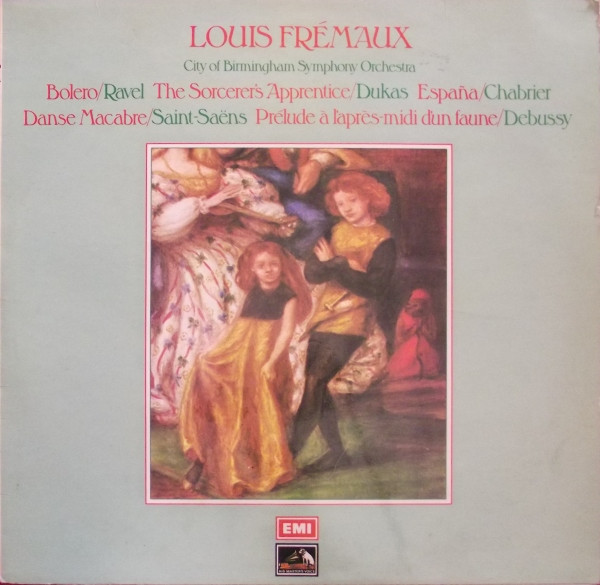
  • An outstanding EMI import pressing of these sublime orchestral works with Double Plus (A++) sound from first note to last
  • Both of these sides are bigger and richer than most of what we played – they’re super clean and clear, tonally correct from top to bottom, and have all of the weight of the orchestra down low
  • If you want a classical record to test your system and demo your system, this copy is for you!
  • This Demo Disc Quality recording should be part of any serious Orchestral Music Collection. Others that belong in that category can be found here.
  • There are about 150 orchestral recordings we think offer the best performances with the highest quality sound. This record is certainly deserving of a place on that list.

Orchestral Showpieces

Who can resist these sublime orchestral works? To quote an infamous (around here) label, “they are an audiophile’s dream come true.”

The sound is clear, with wonderful depth to the stage. These recordings may just be the ideal blend of clarity and richness, with depth and spaciousness that will put to shame 98% of the classical recordings ever made.

Clean bottom and lower mids. Zero smear. They’re so full-bodied and rich, yet clear and clean, and spread out on such a huge stage, these sides may become your go-to reference disc for Orchestral Reproduction.

One More Thing

This is the kind of record that will make you want to take all your Heavy Vinyl classical pressings and put them in storage. None of them, I repeat: not a single one of them, can ever begin to sound the way this record sounds. (The worst of them can be found here. If these 30-odd Heavy Vinyl titles sound good to you, something is definitely wrong somewhere.)

(more…)

Borodin’s Symphonies – Phenomenal Richness in the Lower Registers

Hot Stamper Pressings of the Music of Borodin Available Now

This commentary was written way back in 2005. Still holds up though.


The Borodin title you see pictured has demonstration quality orchestral sound of the highest order.

The performance by Ansermet is definitive, IMHO, and this recording ranks in the Top Ten Decca/ Londons we’ve ever played.

The powerful lower strings and brass are gorgeous. Ansermet and the Suisse Romande get that sound better than any performers I know. You will see my raves on record after record of theirs produced in this era.

No doubt the wonderful hall they record in is the key. One can assume Decca engineers use similar techniques for their recordings regardless of the artists involved. The only real variable should be the hall.

Ansermet’s recordings with the Suisse Romande have a richness in the lower registers that is almost unrivaled in my experience.

(more…)

On King Crimson’s Red Album, How Good Are the Polydor Pressings?

Hot Stamper Pressings of the Music of King Crimson Available Now

Harsh and congested.

Not remotely competitive with the British originals.

Clean copies on the UK Island label may be hard to find, but they are the only game in town if you are serious about sound.

Want to find your own killer copy?

Consider taking the following moderately helpful advice.

As of 2024, shootouts for this album should be carried out:

How else can you expect to hear the record sound its best?

Based on our experience, Red sounds better:

That’s about it. They are neither easy nor cheap to find, but they are definitely the best sounding.

There’s more collecting help where that came from. Click on the top link below to learn about the pressings that win shootouts.

(more…)

Cognitive Dissonance Defined

More Basic Concepts and Realities Explained 

Wikipedia’s entry for cognitive dissonance:

Cognitive dissonance is a psychological term describing the uncomfortable tension that may result from having two conflicting thoughts (cognition) at the same time or engaging in behavior that conflicts with one’s beliefs. In simple terms, it can be the filtering of information that conflicts with what one already believes, in an effort to ignore that information and reinforce one’s beliefs. In detailed terms, it is the perception of incompatibility between two cognitions, where “cognition” is defined as any element of knowledge, including attitude, emotion, belief, or behavior.

The theory of cognitive dissonance states that contradicting cognitions serve as a driving force that compels the mind to acquire or invent new thoughts or beliefs, or to modify existing beliefs, so as to reduce the amount of dissonance (conflict) between cognitions. Experiments have attempted to quantify this hypothetical drive. Some of these have examined how beliefs often change to match behavior when beliefs and behavior are in conflict.

In popular usage, it can be associated with the tendency for people to resist information that they don’t want to think about, because if they did it would create cognitive dissonance, and perhaps require them to act in ways that depart from their comfortable habits. They usually have at least partial awareness of the information, without having moved to full acceptance of it, and are thus in a state of denial about it.

This guy was comfortable with his penchant for Mobile Fidelity pressings, a sad story if ever I’ve heard one, but one we can all learn from. (And I have to admit I was every bit as clueless myself back in the my nascent audiophile days.)

Empiricism

Some approaches to this audio hobby tend to produce better results than others. When your thinking about audio and records does not comport with reality, you are much less likely to achieve the improvements you seek.

Without a good stereo, it is hard to find better records. Without better records, it is hard to improve your stereo.

You need both, and thinking about them the right way, using the results of carefully run experiments — not feelings, opinions, theories, received wisdom or dogma — is surely the best way to acquire better sound.

An empirically-based approach to audio will surely result in notable improvements to the quality of your playback.

This will in turn make the job of recognizing high quality pressings — the ones you find for yourself, or the ones we find for you — much, much easier.

(more…)

Letter of the Week – “Big, warm, mushy and limp”

Hot Stamper Pressing of the Music of Joni Mitchell Available Now

One of our good customers had this to say about some records he played recently:

Hey Tom, 

I just had to drop you a brief note, to say THANK YOU, for your writings regarding DCC pressings many years back.

I was just going back through them on your site, after I unearthed my DCC pressings this afternoon and gave a couple of them (i.e., Elton’s Madman; Joni’s Court and Spark) a spin – as I recall y’all being the first to speak truth in the face of overwhelming adoration regarding these (when they first were released).

OMG. They are COMPLETELY lifeless, with ZERO energy!

Big, warm, mushy and limp, yes.

Probably sound comforting (at some level) on a low-budget lean solid state system. [High-budget ones too I would venture to guess.]

But on a system with any level of transparency and truth-to-pressing, YIKES. It just made me sad.

THEN, I went online, and checked the current PRICES for these pressings (of which I own several sealed), and I got SUPER HAPPY! People are paying some serious coin for these turkeys – so I can be well rid of them, and take that cash and buy some more of YOUR awesome pressings! Win-win! 👍😊

Warmest regards,

Steve

Steve,

I should say right off the bat that I think the DCC of Court and Spark is not a bad sounding record, at least the copy I had wasn’t bad sounding last time I played it. Your mileage apparently varied.

Madman I hope to write about before too long. I found my DCC copy to be lean in the lower midrange, and missing much of the Tubey Magic that makes that recording so special (along with many others by Elton from that era).

A few more thoughts:

The sound I think you are hearing that you refer to as lifeless and lacking in energy is really the result of Kevin Gray’s lousy cutting chain. The sound you hear on your DCC albums is precisely the sound I had heard on this DCC album many years ago. Played back-to-back with the properly-mastered, properly-pressed originals, the DCC was shockingly lacking in many of the most important qualities a record should have. Eventually Paul and Judy that showed me what a fool I had been.

Low resolution cutters like the ones used to cut the DCC discs sound dead and boring, even when the mastering choices are good ones and no obvious compression is being used.

Kevin Gray famously does not have a way to put compressors into his chain, as my friend Robert Pincus at Cisco found out when he cut 52nd Street and could not get some aspects of it to sound right, unable as he was to add compression in the mastering the way Sterling had.

That’s what it needed and that’s what it didn’t get. Kevin don’t play dat.

I have been beating this long-dead horse for about fifteen twenty years now. Any time I actually do play one of the DCC records these days, it usually sounds worse than I remember it.

(more…)

Way Back in 2007 We Discovered the Hottest Meddle Stampers of Them All

Hot Stamper Pressings of the Music of Pink Floyd Available Now

UPDATE 2020

This review from 2007 describes our experience of having stumbled upon the right stampers for Meddle. To this day, only these stampers and no others have won the many shootouts we’ve done for the album in the ensuing years, perhaps as many as a dozen shootouts or more.

These stampers are also very hard to find, which is why you may not have seen a copy of Meddle hit the site in a while. If we could find them, believe me, we would have them up all the time, as this is one amazing sounding album.

To see more albums with one set of stampers that consistently win shootouts, click here.

Want to find your own shootout winner?

Scroll to the bottom to see our advice on doing just that.


This Harvest Green Label British Import pressing has a side one that goes FAR beyond anything we’ve ever heard for this album. We had no choice but to award this side one the very rare A with FOUR pluses. We’ve never given any side of any other Pink Floyd record such a high grade, so you can be sure that you’ve never heard them sound this amazing.

  • Our lengthy commentary entitled outliers and out-of-this-world sound talks about how rare these kinds of pressings are and how to go about finding them.
  • We no longer give Four Pluses out as a matter of policy, but that doesn’t mean we don’t come across records that deserve them from time to time.
  • Nowadays we often place them under the general heading of breakthrough pressings. These are records that, out of the blue, reveal to us sound that fundamentally changes what we thought we knew about these often familiar recordings.
  • When this pressing (or pressings) landed on our turntable, we found ourselves asking “Who knew?
  • Perhaps an even better question would have been “how high is up?”

(more…)

This Craft Pressing Was Definitely Born Under a Bad Sign

Hot Stamper Pressings of Electric Blues Albums Available Now

About a year ago we played the Craft pressing (CR00513) that had come out in 2023.

We have audition notes for lots of these dreadful Heavy Vinyl pressings sitting around. Sometimes they sit around for years. Obviously we are in no hurry to put them up.

The notes I took for the Craft pressing of Lush Life that Geoff Edgers played me still has not been posted, and he played me that record all the way back in 2022. For those of you who can’t wait for the complete review, I told him it sounded like a CD and proceeded to take it off the turntable.

At the time, I don’t think he understood how that could even be possible. He’d visited Bernie Grundman and read all the rave reviews for his work in the audiophile press. What do you mean his record sounds like a CD? Who the hell do you think you are anyway?

Geoff knows what that means now. I will leave it at that.

We were not surprised to find that the sound of this Craft pressing was terrible. Whoever this Jeff Powell is, I admit I’ve never heard of him, if you see his name on a remastered record, you might want to consider that if he can make a record that sounds this bad, he may not know what he is doing.

This strikes us as a safe bet.

Our notes for the album comprise all of five words. They read:

  • Not good
  • Blurry and congested

As you can see, we didn’t feel the need to spend too much time with it. When a record shows you right off the bat how badly mastered it is, we move on pretty quickly.

We admitted to having liked the Sundazed pressing when it came out in the late-90s, something that you can imagine embarrasses us no end now. In our defense, let me just say 1998 was a long time ago, before we had ever heard a properly cleaned, really good sounding original pressing.

We know how good the originals can sound. We’ve played them. What we have not been able to do is to find enough quiet, good sounding copies to do a shootout. Even at more than a hundred bucks a pop, it’s the rare copy that does not go back to the seller for excessive noise and groove damage. This record was not bought by audiophiles to play on expensive equipment.  The opposite of that demographic cohort would be closer to the truth.

As for the record collecting public, one guy on Discogs thought it didn’t sound good, but for some reason he gave it three stars anyway. Our review would have been one star out of five, assuming that even the worst sounding record must get at least one star. The other three who reviewed the album seemed to really like it.

(more…)

Better Sounding Records? Lucks Explains a Lot

Hot Stamper Pressings of Rock and Pop Albums Available Now

UPDATE 2024

This commentary was written many years ago. It concerns a subject which does not get nearly enough discussion in the audiophile community: the subject of luck in audio and records.

Back in the 70s I was very lucky to have bought some exceptionally good pressings of albums that quickly became personal favorites and have remained so ever since.

This album and others like it were the reason I chose to keep going deeper into audio, which, to be honest, pretty much sums up my life story.

No skill was involved in finding these records. No real knowledge either. It was all just dumb luck. Perhaps you will agree with me that much of life seems to work that way.


Silk Degrees

Most copies severely lack presence and top end. Dull, thick, opaque sound is far too common on Silk Degrees, which may account for some audiophiles finding the Half-Speed an improvement.

Despite all the bad sound I found for this album, I kept buying copies of this record in the hopes that someday I would find one that sounded good. I remember playing this record when it came out in 1976 and thinking that it sounded very good. So how is it that all the copies I’m playing sound so bad, or at the very least, wrong?

Well, the answer to that question is not too complicated. When you get the right pressing, the sound is excellent.

I must have had a good one 40+ years ago, and that’s why I liked the sound. Something similar happened to me with Ambrosia’s first album.

The copy I had picked up at random when I bought the album new in 1976 just happened to have very good stampers. (Keep in mind that we don’t like to call a record Hot until it has gone through the shootout process, a subject we discuss in some depth here.)

When you consider that Hot Stampers for both of those records are pretty unusual, I would say I was very lucky to get good sounding copies of those two masterpieces while everyone around me was buying crap.

To be clear, when I was buying these records, and even as late as when I wrote this commentary twenty years ago, I had much less revealing components and the much lower standards that typically accompany them.

(The longer I have spent in this hobby, the more obvious it is to me that the two go together. This tendency helps to explain, better than any other single reason — although lots of other things are involved — the audiophile preference for remastered pressings of questionable quality.)

So what do you hear on the best copies?

(more…)