snare-test-class

Here are a handful of orchestral recordings which we’ve found to be good for testing the sound of the snare drum. Transparency is key to reproducing the instruments which are situated at the back of the stage, for both the pressing itself and the system on which it is playing.

This Tsar Saltan Is Diffuse, Washed Out, Veiled, and Vague

Hot Stamper Pressings of the Music of Rimsky-Korsakov Available Now

Sonic Grade: C (at most)

Year ago we cracked open the Speakers Corner pressing of The Tale of Tsar Saltan in order to see how it would fare in a head to head comparison with a pair of wonderful sounding Londons we were in the process of shooting out at the time. Here are the differences we heard.

The soundstage, rarely much of a concern to us at here at Better Records but nevertheless instructive in this case, shrinks roughly 25% with the new pressing. Depth and ambience are reduced by about the same amount.

But what really bothered me was this:

The sound was just so vague.

There was a cloud of musical instruments, some here, some there, but they were very hard to SEE. On the Londons we played they were clear. You could point to each and every one. On this pressing that kind of pinpoint imaging was simply nowhere to be found. (Here are some other records that are good for testing vague imaging.)

Case in point: the snare drum, which on this recording is located toward the back of the stage, roughly halfway between dead center and the far left of the hall. As soon as I heard it on the reissue I recognized how blurry and smeary it was relative to the clarity and immediacy it had on the earlier London pressings we’d played. I’m not sure how else to describe it — diffuse, washed out, veiled — just vague.

(Here are some other records that are good for testing the sound of the snare drum.)

This particular Heavy Vinyl reissue is more or less tonally correct, which is not something you can say about many reissues these days. In that respect it’s tolerable and even enjoyable. I guess for thirty bucks it’s not a bad deal.

But… when I hear this kind of sound only one word comes to mind, a terrible word, a word that makes us recoil in shock and horror. That word is DUB. This reissue is made from copy tapes, not masters.

Copies in analog or copies in digital, who is to say, but it sure ain’t the master tape we’re hearing, of that we can be fairly certain. How else to explain such mediocre sound?

Yes, the cutting systems being used nowadays to master these vintage recordings aren’t very good; that seems safe to say.

Are the tapes too old and worn?

Is the vinyl of today simply not capable of storing the kind of magical sound we find so often in pressings from the 50s, 60s and 70s?

Could the real master tape not be found, and a safety copy used to master the album instead?

To all these questions and more we have but one answer: we don’t know.

We know we don’t like the sound of very many of these modern reissues and I guess that’s probably all that we need to know about them. If someone ever figures out how to make a good sounding modern reissue, we’ll ask them how they did it. Until then it seems the question is moot. (Someone did, which proves it can be done!)

Back in 2011 we stopped carrying Heavy Vinyl and most other audiophile LPs of all kinds. (These we like.)

So many of them don’t even sound this good, and this kind of sound bores us to tears.

(more…)

What Do You Mean by “These Swan Lake Highlights Sound Like Live Music”?

Hot Stamper Pressings of the Music of Tchaikovsky Available Now

Kenneth Wilkinson engineered this album of Swan Lake Highlights for Decca in 1961 (one of the truly great years for top quality analog recordings).

Judging by the best pressings we played in our shootout, he did a great job. Knowing his work the way we do, this was to be expected. There are about 50 of his recordings for which we have done Hot Stamper shootouts, probably more than for any other engineer, and there are sure to be more added in the years to come.

It’s as wide, deep, and three-dimensional as any, which is, of course, all to the good, but what makes the sound of these recordings so special is the timbral accuracy of the instruments in every section.

Highlights of the recording include huge amounts of bass; a clear snare at the back of the hall (a good test for transparency, of both the record and of your system and room); full-bodied horns and strings, which never become blary or shrill; and of course huge amounts of space.

This is the kind of record that will make you want to take all your heavy vinyl classical pressings and put them in storage. They cannot begin to sound the way this record sounds. (Before you put them in storage or on Ebay please play them against this pressing so that you can be confident in your decision to rid yourself of their mediocrity.)

Quality record production is a lost art, and it’s been lost for a very long time.

(more…)

For Arcana, Speed Is Key

Hot Stamper Pressings on Decca and London Available Now

This is a recording that allows your speakers to disappear completely like practically no other. A powerful Test Disc as well. Use this one to check your speed and staging, subtle changes in your equipment can have a big effect on recordings like this

Incredible sound for this CRAZY 20th Century music, featuring wild and wacky works which rely almost exclusively on percussion (not one, not two, but three bass drums!). My favorite piece here may be Ionisation, which uses real sirens (the Old School ones cranked by hand) as part of Varese’s uniquely specialized instrumental array.

But the main reason audiophiles will LOVE this album is not the music, but the SOUND. Ionisation has amazing depth, soundstaging, dynamics, three-dimensionality and absolutely dead-on tonality — it’s hard to imagine a recording that allows your speakers to disappear more completely than this one.

It also makes a superb test disc. Subtle changes in your equipment can have a big effect on recordings like this.

The instrumental palette is large and colorful, giving the critical listener plenty to work with.

And this copy is perfect for testing because is is nearly FLAWLESS in its sound. No other copy could touch it. Many copies are not especially transparent, spacious or three-dimensional, and lack extension on both ends of the frequency spectrum.

The SPEED of the percussion is also critical to its proper reproduction.

No two pieces of electronics will get this record to sound the same, and some will fail miserably.

If vintage tube gear is your idea of the ultimate in sound, this record may help you to better understand where its shortcomings lie.

(more…)

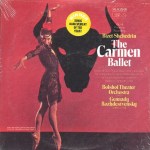
The Carmen Ballet – As Tough a Test Disc As Any We Know

Hot Stamper Pressings of the Music of Georges Bizet Available Now
If I had only one record to bring to someone’s house in order to evaluate their equipment, a killer copy of this Bizet-Shchedrin record would certainly be at the top of my list. (Here are some others.)

If you can make this record sound the way it should, your stereo is cookin’.

If you are having problems, this record will show them to you in short order.

Many copies are bright in the upper-midrange, sounding as nasally and artificial as a bad Mercury or London. Many lack weight down low. The lower strings and heavier percussion play a crucial role in balancing out the upper strings and lighter percussion, so without enough going on down low, the sound skews upwards in an artificial way.

If your copy has either of these problems don’t use it to set up or tweak anything in your system.

Use one of our Hot Stampers, the hotter the better.

The sound of the best copies is rich, full-bodied, incredibly spacious, and exceptionally extended up top. There is a prodigious amount of musical information spread across the soundstage, much of it difficult to reproduce. Musicians are banging on so many different percussive devices (often at the back of the stage, exactly where they should be) that getting each one’s sonic character to clearly come through is a challenge. And when you’ve met it, a thrill.

If you’ve done your homework with VTA, Azimuth, Anti-Skate and Tracking Weight, this is the record that will make clear just how much you’ve accomplished.

The recording has tremendous transients and dynamics. Be prepared to have trouble tracking it. In that respect it’s a prime candidate for table, cartridge and system tweaking.

If you have the kind of big system that a record like this demands, when you drop the needle on the best of our Hot Stamper pressings, you are going to hear some amazing sound.

(more…)

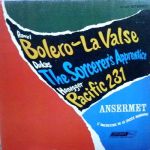
Ravel and Ansermet Produce The Best Bolero on Vinyl

Hot Stamper Pressings of the Music of Maurice Ravel Available Now

Here are some comments from a Hot Stamper listing we did years ago.

The sound is clear, with wonderful depth to the stage.

As a rule, the classic ’50s and ’60s recordings of Ansermet and the Suisse Romande in Victoria Hall are as big and rich as any you may have ever heard.

These recordings may just be the ideal blend of clarity and richness, with depth and spaciousness that will put to shame 98% of the classical recordings ever made.

Side One

Bolero (Ravel)

Tubey and clear, with both the snare and the flute coming from so far back in the hall. OUTSTANDING energy and dynamic power.

Turn it up and it really comes to life like LIVE MUSIC. It’s big, wide and believable. We loved it.

Side Two

The Sorcerer’s Apprentice (Dukas)

ZERO compression. ZERO distortion when loud. Which means it has ZERO compressor distortion, something not five out of a hundred Golden Age recordings can claim. Nice extended top too.

There is depth and richness to beat the band, as well as clarity and tonal correctness that let you forget the recording and just enjoy the music. This piece is not quite as transparent as the Ravel, but still has earned every one of its Three Pluses.

The timbre of the brass is right on the money. As we have noted before, the brass of the Suisse Romande is some of the best to have ever been committed to analog tape.

Again, this side had OUTSTANDING energy and dynamic power the likes of which we think you may never have heard.

La Valse (Ravel)

Boasting some of the best sound of the three works we played on this copy. Again, with that wondrously huge hall adding a sense of space that will allow your speakers to disappear. The performers are not too close, which is very much in keeping with live music.

In his tribute to Ravel after the composer’s death in 1937, Paul Landormy described the work as follows:

“….the most unexpected of the compositions of Ravel, revealing to us heretofore unexpected depths of Romanticism, power, vigor, and rapture in this musician whose expression is usually limited to the manifestations of an essentially classical genius.”

We Was Wrong about Billy the Kid in 2011

Living Stereo Titles Available Now

The rave review you see below was written in 2011. Recently we played a stack of copies of the album and realized that we was wrong about it.

As you may have noticed, this is a regular feature of The Skeptical Audiophile.

Live and Learn is our motto, and progress in audio is a feature, not a bug, of record collecting at the most advanced levels.

(“Advanced” is a code word for having little to no interest in practically any remastered pressing marketed to the audiophile community. If you want to avoid the worst of them, we will gladly help you do that.)


Our Review from 2011

Super Hot Stamper sound on BOTH sides, with side one so energetic and exciting it would easily qualify as a Demo Disc. This title is almost impossible to find in anything but beat up condition. Records like these got played over and over and few survived the ten grams of stylus pressure and mis-aligned cartridges of the day.  

The Big Sound

Side one is a bit recessed sounding at the beginning but it soon comes to life.

The drums and snares are HUGE in this recording, way at the back of the hall where they belong.

The sound just jumps out of the speakers — believe me, not many Living Stereo pressings from 1958 can do that.

If you like your exciting music to have exciting sound, this pressing will do the trick.

A++ is our grade. The loudest massed string passages can be a bit much, but they are tolerable. Many pressings of this album that we’ve played in the past have pretty much been unlistenable.

Rodeo

So dynamic! — you better have your stereo working at the top of its game or this side is going to be hard to sit through. The close-miked xylophone will give your arm and cart a real workout. If you have precise control over your setup, this may be a good record to fine tune it with. VTA is of course ultra-critical on vintage classical albums such as this.

The quieter passages fare best, showing off the Living Stereo Tubey Magic to full advantage.

Hoe-Down sounds like it may be slightly worn; either that or its got some compressor distortion problems.

With Big Bold sound such as this, the engineers had to walk a very fine line in order to balance the dynamic power of the music without letting the quietest passages disappear. (Nowadays loud orchestral music is either dynamic and shrill or compressed to death.)

(more…)