test-orchestral

Some of our favorite orchestral test discs.

A Simple Listening Test Makes It Easy to Judge Pressings of Scheherazade

Hot Stamper Orchestral Pressings Available Now

The Classic reissue of LSC 2446, as well as the Analogue Productions version from 2013 (the original 33 is the only one I have played, mastered by Ryan Smith at Sterling), are both disasters for many reasons, but they do have one specific failing that is easy to recognize.

Both pressings are worth further discussion and analysis because they provide an easy test that can show you how wrong they are.

When reading the commentary below, keep in mind that what is bad about the Classic Records reissue from 1995 is what is bad about the Analogue Productions remaster put out many years later.

As I noted for some of the Classic Heifetz titles a while back, for all I know the CDs for his Living Stereo recordings may have better sound. That’s probably the first place to go, considering Classic’s rather poor track record regarding the remastering of his music.

Case in point: The Living Stereo CDs I own (both the CD and the SACD) of Scheherazade are dramatically better than the awful Classic Records pressing of it.

Audiophiles who don’t notice what is wrong with the Classic pressing need to get hold of a nice RCA White Dog pressing to see just how poorly the Classic stacks up. (They could even find one that’s not so nice and listen through the surface noise. The difference would still be obvious.)


UPDATE 2025

It has been many years since a White Dog pressing won a shootout. In our last listing for a Hot Stamper White Dog pressing in 2024, we noted:

Now that we know which stampers have the potential to win our shootouts, the right Shaded Dog originals have lately been coming out on top, although the White Dog pressings can still sound quite good, just not as good.

No White Dog earned a higher grade than 2+, and none of the three WD pressings we had on hand earned 2+ on both sides.

Our notes for the various sides of the WD pressings read: “a bit brash, sometimes squawky, dry and bright,” and the like.

Those of you looking for the best sound should stick to the Shaded Dog label originals. They are rich and lush in a way that the WD reissues in our experience never are. I used to swear by the WD reissues, but I see now how wrong I was. My judgments were colored by a darker, less revealing stereo than the one we use now, and that makes all the difference in the world.


Back to LSC 2446

The solo violin in the left channel at the opening of the first movement should be all it takes to hear what is wrong with the modern remastered pressings.

Anyone has ever attended a classical music concert will have no trouble recognizing that the violin on any of the Heavy Vinyl pressings, including the Analogue Productions pressing, is completely wrong and sounds nothing like a violin in a concert hall would ever sound.

And I mean ever.

No matter where you might be sitting.

No matter how good or bad the hall’s acoustics.

The violin on these Heavy Vinyl pressings is dark, it’s veiled, and it’s overly rich, as well as lacking in overtones.

Solo violins in live performance never sound like that.

They are clear, clean and present. You have no trouble at all “seeing” them, no matter where you sit.

(more…)

Massed Strings and Brass Section Are Difficult to Reproduce

More of the Music of Jacques Offenbach

UPDATE 2020

Our favorite recording of the work now is this one: Fistoulari recorded for Readers Digest.


It’s also an excellent record to test with. As you no doubt know, there is a lot of “action” in this piece of music.

To get the strings and the brass to sound lively yet natural is a bit of a trick. (It doesn’t help that the polarity is reversed.)

When I first played this record many years ago, I was none too happy about the string tone. After making a few tweaky adjustments, the strings became much clearer and more textured. The overall presentation still sounded rich, but was now dramatically more natural and relaxed.

It was this record that made me realize some of the changes I had made to my stereo back then had caused it to have a certain hi-fi-ish quality, which seemed to work fine on the popular and jazz recordings I was using as test discs at the time.

But the reproduction of classical music is the ultimate challenge for any stereo.

(more…)

London Orchestral Records from the 70s and the Problem of Opacity

Decca and London Hot Stamper Pressings Available Now

The average copy of this 1976 recording has that dry, multi-miked modern sound that the 70s ushered in for many of the major labels, notably London and RCA.

How many Solti records are not ridiculously thick and opaque? One out of ten? If that. We’re extremely wary of records produced in the 70s; we’ve been burned too many times.

And to tell you the truth, we are not all that thrilled with most of what passes for good sound on Mehta‘s London output either, especially those recorded in Royce Hall. If you have a high-resolution system, these recordings, like those on Classic Records Heavy Vinyl that we constantly criticize, leave a lot to be desired.

Opacity is a real dealbreaker for us. Most of the classical records we play from later eras simply do not have the transparency essential to transporting us from our listening room into the concert hall.

One thing you can say about live classical music, it is never opaque. (It can be dry though. Some concert halls have that sound.)

No recording in our experience — our experience having been informed by playing thousands upon thousand of them — can ever be remotely as transparent as live music.

If you have any doubts, next time you come home from the concert hall, take a moment to put on a favorite recording of the same music. You may be in for quite a shock.

Other Deccas and Londons that we’d cleaned and played and found to be disappointing can be seen here.

For more on the subject of opacity on record, click here.

Here are some of the other records we’ve discovered that are good for testing string tone and texture.

(more…)

Tchaikovsky – The Violin That Ate Cincinatti

More of the music of Peter Ilyich Tchaikovsky (1840-1893)

More Hot Stamper Pressings Featuring the Violin

Our review for the MHS pressing of the famous concerto was entitled: The Violin That Ate Cincinatti

Yes, it may be oversized, but it’s so REAL and IMMEDIATE and harmonically correct in every way that we felt more than justified in ignoring the fact that the instrument could never sound in the concert hall the way it does on this record — unless you were actually playing it (and even then I doubt if it would be precisely the same sound — big, but surely quite different).

This is where the mindless and all but fetishistic embrace of “the absolute sound” breaks down completely. Recordings that do not conform to the ideal sound of the concert hall are not necessarily bad or wrong. Sometimes — as we think might be the case here — records with this sound can actually be more involving than their more “natural” counterparts.

This is especially true for rock and jazz, but it can also be true — at least to some degree — for classical music as well. If you don’t agree with us that the sound of the violin on side two of this pressing is more musically involving than it is on side one, you may of course return it for a full refund.

Remastering 101

MHS remastered the original 1967 Melodiya tape in 1979 in order to produce this record, dramatically improving upon the sound of the version that I knew on Angel, which shouldn’t have been too hard as the Angel is not very good.

Wait a minute. Scratch that. MHS didn’t cut the record, an engineer at a mastering house did. Fortunately for us audiophiles, the job fell to none other than Bill Kipper at Masterdisk.

Once Masterdisk had done their job, MHS proceeded with theirs, pressing it on reasonably quiet vinyl and mailing it out to all their subscribers.

Can you imagine getting a record this good in the mail? It boggles the mind. Of course Reader’s Digest did something very similar in prior decades, and some of their pressings are superb, but I can’t think of a single one that sounds this good or plays this quietly. [That is no longer true, we have played some awfully good ones.]

For a subscription service record label release, this one raises the bar substantially. Hell, for a recording of the work itself this copy raises the bar. It’s without a doubt one of the best recordings of the Tchaikovsky Violin Concerto I’ve ever heard, and I’ve heard a score of them if not more.

(more…)

The Vintage Vinyl Sound You Won’t Find on Modern LPs and CDs

Classical Living Stereo Titles Available Now

Here is the kind of record that will make you want to take all your heavy vinyl classical pressings and put them in storage. 

It’s also proof positive that Decca’s choice of Kingsway Hall as a recording venue was a good one. The full range of colors of the orchestra are here presented with remarkable clarity, dynamic contrast, spaciousness, sweetness, and timbral accuracy.

If you want to demonstrate to a novice listener why modern recordings are so consistently unsatisfactory, all you have to do is play this record for them. In our experience, no CD and no Heavy Vinyl pressing ever sounded like this.

The richness of the strings, a signature sound for Decca in the Fifties and Sixties, is on display here for fans of the classical Golden Age. It’s practically impossible to hear that kind of string sound on any recording made in the last thirty years (and this of course includes practically everything pressed on Heavy Vinyl).

It may be a lost art, but as long as we have these wonderful vintage pressings to play, it’s an art that is not lost on us. I don’t think the Decca engineers could have recorded this music much better than they dhave here — it has all the orchestral magic one could ask for, as well as the clarity and presence that are missing from so many other vintage Golden Age records.

(more…)

Star Wars, Close Encounters and Other Multi-Miked Messes

Decca and London Hot Stamper Pressings Available Now

This Mobile Fidelity LP contains the music of Star Wars and Close Encounters, conducted by Zubin Mehta. The MoFi pressing is far more transparent than the London pressings we have auditioned of the album, even the ones half-speed mastered by Stan Ricker himself.

Yes, he cut the original Londons! At Half Speed! (We’ve also played some later pressings not mastered by Stan, of course. Who can predict which version would sound the best?)

It’s still one of the better MoFi remasters, all things considered. The music, to these ears, has always been hi-fi-ish schlock, and the recording itself is too multi-miked to be taken seriously. It sounds far too much like a bad Phase IV recording, and we know whereof we speak when it comes to Phase IV, good or bad. We’ve played them by the score.

This famous record from the Top Seven of the TAS Super Disc List has the same problem, but I never hear anybody mention it. Why that is I cannot imagine, other than our favorite explanation for just about everything that seems to fly under the audiophile radar, or perhaps a better description would be flying over the heads of the self-appointed audiophile cognoscenti, our old standby, reviewer malpractice.

Bottom line, a loser, but the original Londons in our experience are even worse!

For more on the subject of opacity on record, click here and here.

(more…)

Dialing in the Anti-Skate with Massed Strings

Hot Stamper Pressings of Orchestral Spectaculars Available Now

I once adjusted my anti-skate while playing this very album, at the time dialing it in to what I thought was a “T.” 

Over the years I’ve found that the best test for fine anti-skate adjustment is massed strings, and not just at the end of a side but right at the part of the record in which the anti-skate has been engaged. This will vary with different arms.

When you have all the rosiny texture, the high-end harmonic extension, the least shrillness and the widest and deepest staging, you are there, assuming that tracking weight, azimuth and VTA are correct as well.

Four variables to mess with is admittedly a bitch, but having the right record to test with is absolutely critical as well. Maybe we should call it five variables.

And if I only had one record to bring to someone’s house in order to evaluate their equipment, this would certainly be a top choice. If you can make this record sound the way it should, your stereo is cookin’. If you are having problems, this record will show them to you in short order.

(more…)

Violin Recordings and the Problem of Smear

Hot Stamper Pressings of Living Stereo Titles Available Now

This Shaded Dog pressing of LSC 2129 had practically no smear on either the violin or the orchestra.

Try to find a violin concerto record with no smear.

We often say that Shaded Dogs, being vintage All Tube recordings, tend to have tube smear.

But what about the 70s transistor mastered Red Label pressings – where does their smear come from?

Let’s face it: records from every era more often than not have some amount of smear.

And we can never really know what accounts for it.

The key thing is to be able to recognize it for what it is.

(We find modern records, especially those pressed at RTI, to be quite smeary as a rule. They also tend to be congested, blurry, thick, veiled, and ambience-challenged. For some reason most audiophiles — and the reviewers who write for them — rarely seem to notice these shortcomings.)

Of course, if your system itself has smear it becomes that much harder to hear the smear on your records.  Practically every tube system I have ever heard had more smear than I could tolerate – it comes with the territory. And high-powered transistor amps are notoriously smeary, opaque and ambience-challenged. Our low-powered, all-transistor rig has no trouble showing us the amount of smear on records, including those that have virtually none.

Keep in mind that one thing live music never has is smear of any kind. Live music is smear-free. It can be harmonically distorted, hard, edgy, thin, fat, dark, and all the rest, but one thing it can never be is smeary.

That is a shortcoming unique to the reproduction of music, and one which causes many of the pressings we sell to have their sonic grades lowered.

(more…)

Behind the Scenes of One of My Favorite Recordings – Citizen Kane

More of the Music of Bernard Herrmann in Stock

An orchestral dreadnought such as this requires mastering and pressing of the highest quality. The music by its very nature taxes the limits of LP playback itself, with deep bass notes; incredible dynamics from every area of the stage; masses of strings playing at the top of their registers with abandon; huge drums; powerful brass effects — every sound an orchestra can produce is found on this record, and then some.

Kenneth Wilkinson was the engineer for these sessions in glorious Kingsway Hall.

It’s yet another remarkable disc from the Golden Age of Recording, in this case extending all the way into the ’70s.

You will hear plenty of sounds that defy description, that’s for sure. Some of the time I could not even imagine what exotic instrument could possibly be making the sound I was hearing. The remarkable document pictured below will show you some of them.

(more…)

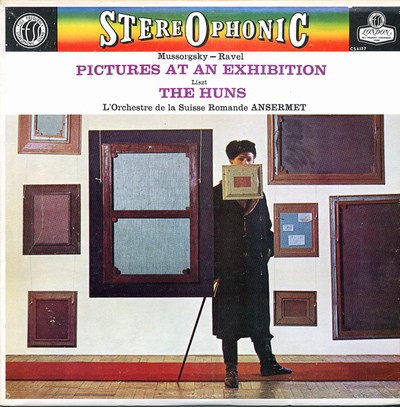
A Couple of Key Tracks to Play on Pictures at an Exhibition

Living Stereo Titles Available Now

This is a very old listing so take it for what it’s worth.

This TAS List record with a Super Hot stamper side one has some of the best sound we have ever heard for the Shaded Dog Reiner/CSO Pictures, and side two, although it starts out a little weak, gets going soon enough and earns a Super Hot Stamper sonic grade as well.

Side one is open and natural in the best Living Stereo tradition, with rich lower strings that have virtually no Golden Age smear.

Turn it up and listen for the big cymbal crashes — that’s the sound we love. It’s so good it even allows me to enjoy Reiner’s performance, never one of my favorites.

Side One

A++, transparent and free from smear, not many copies are going to beat this one! A little more top would have been nice.

Listen to: Samuel Goldenburg und Schmuyle

Superb sound! The brass and strings on this part of the work are as good as it gets. No smearing of the brass — it’s clean and clear like it is in the concert hall. We’re so used to hearing it wrong that it takes a record like this to remind us how good a full brass choir can really sound. (more…)