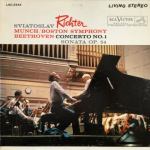
 More of the Music of Ludwig van Beethoven
Notes from a recent shootout.
This pressing has the real Living Stereo magic in spades, but unlike most of the RCA concerto recordings, Richter, the brilliant soloist featured here, is not overly spotlighted, hence the much more immersive “concert hall” sound.
The piano is part of the orchestra, and properly sized, allowing the contributions of the other musicians in the orchestra to be heard more clearly, laid out as they are elegantly across a huge and deep Boston Symphony Hall stage.
All of which adds up to a top quality piano concerto recording in every way.
When it comes to clarity in orchestral music, there is nothing that comes close to the sound of a live performance.
However, some records, this one especially, give you the sense that you are hearing it all.
Audio may be an illusion but it can be a very convincing one.
The spaciousness and three-dimensionality of the recording are also exceptional. Through the efforts and skill of the RCA engineers, that striking openness in the recording is somehow combined with an electrifying immediacy in the sound of the piano, no mean feat. One rarely hears both, except of course live (and not always even then).
There may be other performances of merit, but I know of no recording of this music with better sound. If you are demonstrating naturalistic sound, not bombastic Hi-Fi spectacularity, this pressing more than qualifies as a DEMO DISC.
What to Listen For
What typically separates the killer copies from the merely good ones are qualities that we often look for in the records we play: transparency. Transparency allows you to hear into the recording, reproducing the ambience and subtle musical cues and details that high-resolution analog is known for.
(Note that most Heavy Vinyl pressings being produced these days seem to be seriously Transparency Challenged. Lots of important musical information — the kind we hear on even second-rate standard-weight pressings — is simply not to be found.)
Solid weighty sound for a piano concerto recording is critically important as well. The piano has to be big, powerful, and solid, as massive as a boulder, just the way it can be in the concert hall. In this respect it helps to have Sviatoslav Richter pounding away on the instrument of course.
Side One
Amazing – big and rich without a touch of smear on the strings or the percussive piano. The piano is right sized and that is unusual indeed in our experience.
Dynamic as all get out, with lively horns and a piano that is clear and present. Tonally correct, in a big hall, the sound is Hard To Fault.
The piano is so clear, yet the orchestra is as rich and smooth as one could possibly ask for. No smear, no congestion, no bandwidth limitations – this is the sound of the master tape. No modern reissue — digital or analog — will ever be able to reproduce more than a fraction of the sound found on this pressing.
Side Two
Big, lively and less congested that most of the copies we played. Side one had no smear, this side has a touch, but the sound is wonderful nevertheless.
Listen to the woodwinds on this side; they are glorious. You will have a hard time finding better sound for that section of the orchestra on other recordings.
 Robert Brook runs a blog called The Broken Record, with a subtitle explaining what the aim of his blog is: