
lacks-transparency

These 20+ vintage records lack transparency. They are difficult to “hear into.”

The best properly-cleaned vintage pressings are usually quite transparent.

Which means that the records listed here are not particularly good pressings, or the recordings themselves lack this important quality.

Either way, they are best avoided by those looking for top quality sound.

Grieg & Liszt / Piano Concertos / Rubinstein

Hot Stamper Pressings of the Music of Grieg Available Now

UPDATE 2026

This is a very old review of LSC 2429, which we ourselves may no longer agree with.

If you see this record in the bins for cheap, give it a try, but don’t pay a lot on our say-so.

Our two favorite recordings of the Grieg Piano Concerto are the Decca with Lupu and Previn from 1973 and Rubinstein’s for RCA in 1962. Either one should be superior to the Living Stereo Shaded Dog we review here.


The strings are RICH in the best Living Stereo tradition, but unlike so many classical pressings we play, the tubey magical string tone comes with virtually no tube smear. The textures and overtones are fully intact.

(more…)

“KEV” Didn’t Have a Clue How to Master Teaser and the Firecat

Hot Stamper Pressings of the Music of Cat Stevens Available Now

In 2025, in preparation for a new shootout, we ordered a copy of Teaser from overseas that supposedly had the right stampers — we know what they are and we are only interested in copies with the right ones — and were sent this “KEV” pressing by accident.

Accident is right — whoever KEV is, he sure has no business mastering records if the one we played is anything to go by.

Discogs has an entry for it, current price around $10. (Apparently the word got out about the sound of this miserable pressing.)

  • This release is the pink ring Island Label. No Sterling etchings. (KEV) in matrix.
  • Side 1 has 9514 hashed out and 9154 etched above
  • Matrix / Runout (A-side runout. etched): ILPS 9154A-1K 1 KEV B
  • Matrix / Runout (B-side runout. etched): ILPS 9154B-1K 1 KEV B

Our notes read:

  • Loud, congested and hot.
  • Big, wonky bass.
  • Opaque and so compressed that it pumps.

And the best line of all:

  • Not too different sounding from the 2021 remaster that’s on Spotify. (!)

I looked up that 2021 release, mastered at Abbey Road Studios, and it appears they remixed it for some reason, as those who work at Abbey Road are wont to do, the result of which seems to be one disaster after another.

(more…)

The Mono Recut of Revolver from 1981 Is a Ripoff

Hot Stamper Pressings of Revolver Available Now

A great sounding record in stereo, potentially anyway, but this later reissue in mono is so awful it deserves a special place in our hall of shame.

My notes for side one: hard, sour, no bass.

Side two: dumbass small mono, so unclear.

Is it the worst version of the album ever made? That’s hard to say. There is no shortage of competition, that’s for sure.

But it may be the worst sounding version of the album we’ve ever played, and that should be good enough for any audiophile contemplating spending money on this kind of rubbish.

We love the mono mix of For No One, but not when it sounds like this.

The only Beatles vinyl we offer on our site are stereo pressings. Our reasons for doing this are straightforward enough.

The Beatles records in mono, contrary to the opinion of audiophiles and music lovers alike, virtually never have the presence, energy and resolution found on the best stereo copies. If your stereo cannot resolve all the information on the tape, sure, Twin Track Stereo (used on the first two albums, hard-panned multi-track afterwards) ends up sounding like some of the instruments are stuck in the speakers, hard left and hard right, with nothing but a hole in the middle.

But there is a great deal of information spreading into the middle when we play those records here, and nothing feels stuck in the speakers that doesn’t sound like it was supposed to be heard coming directly from one of the speakers.

It is our contention that the best audio equipment, properly tweaked, can show you a world of musical information that exists only on the stereo pressings, information that the mono mixes mostly obscure.

(more…)

Another Unimpressive Reissue Pressing of Coltrane’s Music — What Is Going On?

Hot Stamper Pressings of the Music of John Coltrane Available Now

We had an early Blue Label Prestige mono pressing that was not as awful as the original Yellow Label mono we played, but it’s not very good either. Our grade for a record that earns one plus on both sides is passable.

Which means you could play it, maybe even enjoy it, but you would have no idea just how well Rudy Van Gelder recorded the sessions in 1958 that went into the making of the album, which as you know was not compiled for release until 1962.

As you can see from the notes above, it was crude, smeary and thick. We don’t sell records that sound like that.

I can’t say that most modern remastered records are crude, although some of them are, but a great many we’ve played are smeary, and almost all of them are thick — that is, lacking in transparency — to some degree. That last quality — a lack of transparency — may be the most irritating of all, a subject we discuss here.

(A great many records we’ve auditioned over the years are good for testing transparency. Those wanting to improve this aspect of their playback should consider making use of them.

(more…)

This Blueback Was Somewhat Opaque and Crude – Does that Surprise You?

Hot Stamper Pressings of the Music of Felix Mendelssohn Available Now

Presenting our latest findings from 2023:

For our most recent shootout, the original we played earned grades of 1.5+ on both sides, a grade that is the absolute minimum for a Hot Stamper pressing to be listed on the site now.

Our best reissues killed it.

The 3D/3E stampers of our early Blueback copy can probably be beaten by others — assuming there are others — but this is just not a good bet for us when it comes to Mendelssohn’s famous Third Symphony, not when there are so many other pressings with superior sound.

Our favorite performance with top quality sound is made from the same recording you see here, but on a certain budget reissue that has much better sound.

It’s very possible that the Speakers Corner Heavy Vinyl pressing from 2003 pictured below would beat the original we describe. We make no claims that it doesn’t, or wouldn’t.

Our claim would be that a properly-mastered, properly-pressed version of the album is very unlikely to be bested by something from Speakers Corner, or any other label making records during the last thirty years.

What I would have played against the Speakers Corner pressing in 2003 would have been an original London Blueback, and maybe a Stereo Treasury or two. Both of them would have been obvious choices, and I was stuck making obvious choices because I simply did not understand enough about classical records at the time to do otherwise.

I confess I knew very little about the recording of the 3rd symphony back in those days, and I certainly didn’t know how good some of the right reissues could sound.

Obviously we needed to do a great deal more research and development, which we began to undertake over the course of the next twenty years in a much more serious way, making one discovery after another.

And that all happened out of the love for great sounding music on vinyl, and, every bit as importantly, because we get paid to do it.


(more…)

We Expected Better from Frühbeck De Burgos, But We Didn’t Get It

Hot Stamper Pressings of Orchestral Spectaculars Available Now

We love the skill De Burgos brings to orchestral showpieces such as these, but the sound is not up to par for us. We’ve heard better. A lot better.

Bolero is shrill at the climax and the whole of side two was dull and opaque.

This EMI from 1976 might be passable on an old school system, but it was much too unpleasant to be played on the high quality modern equipment we use.

There are quite a number of other records that we’ve run into over the years with similar shortcomings. Here are some of them, a very small fraction of what we’ve played, broken down by label.

Note that there is no list of EMI’s. There are simply too many bad ones to make listings for.

  • London/Decca records with weak sound or performances
  • Mercury records with weak sound or performances
  • RCA records with weak sound or performances

The EMI classical albums we have reviewed to date can be found here.


Label:   His Master’s Voice – ESD 7019
Released:   1976

Ravel – Bolero
Chabrier: Espana – Rhapsody For Orchestra

Prokofiev – Symphony No.1 In D Major (Classical)

Stravinsky: Fireworks, Op.4
Stravinsky: Circus Polka (1942) (Composed For A Young Elephant)

(more…)

This Beethoven Ninth Started Out with Two Strikes Against It

Hot Stamper Pressings of the Music of Beethoven Available Now

MoFi took the shortcomings of a mediocre-at-best Decca recording from 1972 and made them even worse by means of their ridiculously misguided mastering decisions and wacky cutting system.

They should not have chosen this performance of the Ninth Symphony in the first place, and they certainly should not have added the treble they chose to add, which they did to this title and to every classical recording they remastered without regard to whether or not the recording needed brightening. None that I know of did. Try telling that to the brain trust running MoFi.

(They hired this guy to do their one-step digitally remastered pressings and from the get-go he’s been giving audiophiles the most ridiculously phony sounding records that collectors with way too much money can buy.)

The Decca recording of the Ninth from 1972 is opaque, lacks size and space, and comes off as a bit flat and dry.

Like practically every later Decca pressing we play, it’s passable at best.

Londons and Deccas from this era (1972 in this case) rarely sound very good to us.

Here is what we specifically don’t like about their sound.

If you want to know what’s wrong with the Mobile Fidelity pressing, take the above faults and add some others to them.

Start with an overall brighter EQ, add a 10k boost for extra sparkly strings, the kind that MoFi has always been smitten with, and finish with the tubby bass caused by the half-speed mastering process itself.

Voila! You are now in the presence of the kind of mid-fi trash that may have fooled some audiophiles way back when but now sounds as wrong as the records this ridiculous label is still making today.

Here are some other pressings with bright string tone that are best avoided by audiophiles looking for top quality sound.

1981 Was a Long Time Ago

Old school audio systems are notorious for being dark, dull and lacking in transparency. They might need bright records in order to sound good, but high quality modern systems do not.

If these two MoFi pressings sounds right to you, you are very likely living with one of those old school systems and it is long past time to get rid of it.

(more…)

The Reissues Consistently Beat the Originals on this Mystery Mercury

Hot Stamper Pressings of Mercury Classical Records Available Now
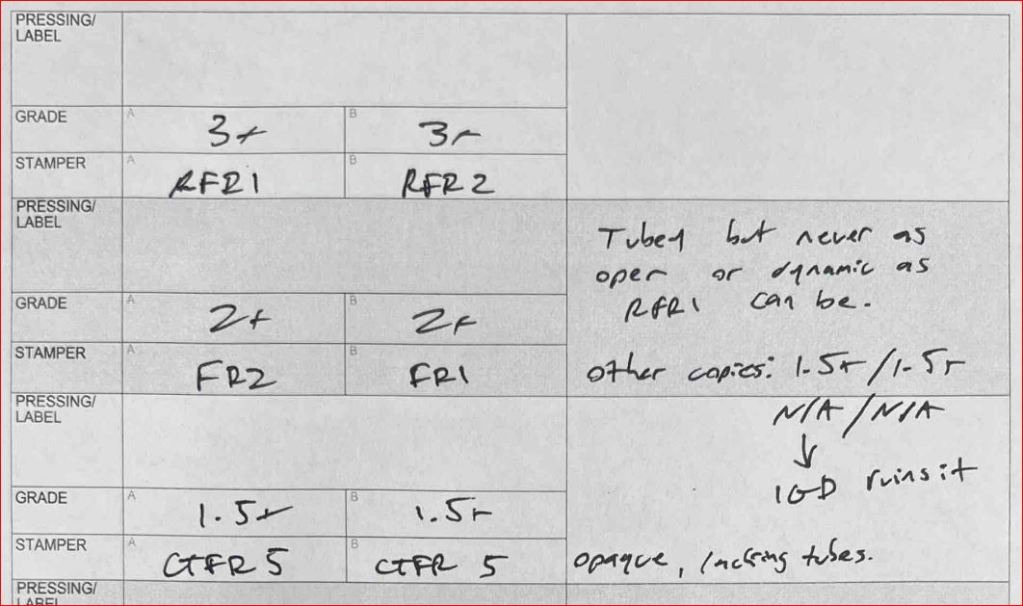
For Mercury classical and orchestral recordings, the original FR pressings on the plum labels are the way to go, right? 

In some cases, yes. We talk about how much better the FR pressings for The Firebird are compared to the much more common, and still quite good, M2 reissue pressings here.

The stamper numbers you see below belong to a different album.

The notes for the FR originals we played read:

  • Tubey but never as open or dynamic as RFR-1 can be.

The better of the three FR pressings we played was not a bad sounding record, earning a grade of 2+. They’re just not as good sounding as the RFR reissues, which, of course, are the ones that win shootouts.

Something to keep in mind: A Super Hot Stamper Mercury orchestral record is guaranteed to be dramatically better than any Heavy Vinyl reissue ever made.

(more…)

Maazel’s Pines of Rome Is Another Title Not Fit for a Super Disc List

Hot Stamper Pressings of The Pines of Rome Available Now

Sonic Grade: C (at best)

I found a bit of commentary in a listing for Scheherazade, and right away it was clear to me that the shootout we did for that title showed us a recording that had much in common with the one we had done more recently for The Pines of Rome.

Here it is, with the necessary changes having been made.

We did a monster shootout for this music in 2021, one we had been planning for more than twenty years. On hand were quite a few copies of the Reiner on RCA; the Ansermet on London; the Maazel on Decca and London (the Decca being on the TAS List), the Kempe on Readers Digest, and quite a few others we felt had potential.

The only recordings that held up all the way through — the last movement being a real Ball Breaker, for both the engineers and musicians — were those by Reiner and Kempe. This was disappointing considering how much time and money we spent finding, cleaning and playing about twenty or so other pressings.

We learned from that first big go around something that we think will remain true for the foreseeable future: the 1960 Reiner recording with the Chicago Symphony on RCA just can’t be beat.

Could other pressings be better sounding? Of course they could.

Would we ever buy another copy? Not a chance.

The notes for the Decca pressing I played, mastered by G, Ted Burkett, can be seen above.

Hey, here’s an idea.

Why don’t you buy a bunch of them and see if any of them do not have the problems described on my notes.

If you find a good one, please let me know the stampers so I can go out and find one myself.

The above is of course all in good fun. We both know that there is not a snowball’s chance in hell that anyone reading this commentary is going to go out and buy some Decca pressings of The Pines of Rome, clean them up, play them one by one and then critique their strengths and weaknesses.

The most likely thing is that, if you have any Decca pressing of Maazel’s Pines, it’s sitting on a shelf collecting dust. Odds are it has not been played in a very long time.

Which should tell you something. Good records get played and bad ones sit on shelves.

(more…)

This Tsar Saltan Is Diffuse, Washed Out, Veiled, and Just So VAGUE

Hot Stamper Pressings of the Music of Rimsky-Korsakov Available Now

Sonic Grade: C (at most)

Year ago we cracked open the Speakers Corner pressing shown here in order to see how it would fare up against a pair of wonderful sounding Londons we were in the process of shooting out at the time.

Here’s what we heard in our head to head comparison.

The soundstage, rarely much of a concern to us at here at Better Records but nevertheless instructive in this case, shrinks roughly 25% with the new pressing. Depth and ambience are reduced by about the same amount.

But what really bothered me was this:

The sound was just so VAGUE.

There was a cloud of musical instruments, some here, some there, but they were very hard to SEE. On the Londons we played they were clear. You could point to each and every one. On this pressing that kind of pinpoint imaging was simply nowhere to be found. (Here are some other records that are good for testing vague imaging.)

Case in point: the snare drum, which on this recording is located toward the back of the stage, roughly halfway between dead center and the far left of the hall. As soon as I heard it on the reissue I recognized how blurry and smeary it was relative to the clarity and immediacy it had on the earlier London pressings we’d played. I’m not sure how else to describe it — diffuse, washed out, veiled — just vague.

(Here are some other records that are good for testing the sound of the snare drum.)

This particular Heavy Vinyl reissue is more or less tonally correct, which is not something you can say about many reissues these days. In that respect it’s tolerable and even enjoyable. I guess for thirty bucks it’s not a bad deal.

But… when I hear this kind of sound only one word comes to mind, a terrible word, a word that makes us recoil in shock and horror. That word is DUB. This reissue is made from copy tapes, not masters.

Copies in analog or copies in digital, who is to say, but it sure ain’t the master tape we’re hearing, of that we can be fairly certain. How else to explain such mediocre sound?

Yes, the cutting systems being used nowadays to master these vintage recordings aren’t very good; that seems safe to say.

Are the tapes too old and worn?

Is the vinyl of today simply not capable of storing the kind of magical sound we find so often in pressings from the 50s, 60s and 70s?

Could the real master tape not be found, and a safety copy used to master the album instead?

To all these questions and more we have but one answer: we don’t know.

We know we don’t like the sound of very many of these modern reissues and I guess that’s probably all that we need to know about them. If someone ever figures out how to make a good sounding modern reissue, we’ll ask them how they did it. Until then it seems the question is moot. (Someone did, which proves it can be done!)

Back in 2011 we stopped carrying Heavy Vinyl and most other audiophile LPs of all kinds. (These we like.)

So many of them don’t even sound this good, and this kind of sound bores us to tears.

(more…)