full-sheet

Shootout Winning Stampers for La Boutique Fantasque Revealed

Hot Stamper Pressings of the Music of Rossini Available Now

UPDATE 2026

Our current favorite recording of La Boutique Fantasque is the one Solti recorded for Decca in 1957.

It belongs to that very special group of roughly 150 orchestral recordings which have the potential to offer the discriminating (and well-heeled) audiophile the best performances of major works with by far the highest quality sound.

Modern remastered pressings simply compete with the best pressings of these landmark recordings.

The Fiedler (LSC 2084) is still a very good record, but we no longer see much reason to carry it when the Solti is better in almost every way (and quieter as a rule to boot).

Below we have reproduced our full stamper sheet, including the Shootout Winning stampers, which happen to be 3S/4S for this album.

(more…)

Is It Hard for You to Imagine Similar Stampers Sounding So Different?

Hot Stamper Pressings of Living Stereo Recordings Available Now

Subtitle: it’s also hard to imagine that space and time are two aspects of the same reality, spacetime, but that’s why we employ rigorous scientific methods to test our theories and — in some cases — prove ourselves wrong.

We here at Better Records like testing records. We want to know if the predictions we make about the titles we play are accurate, which is simply to say, do they match the data derived from our blinded shootouts?

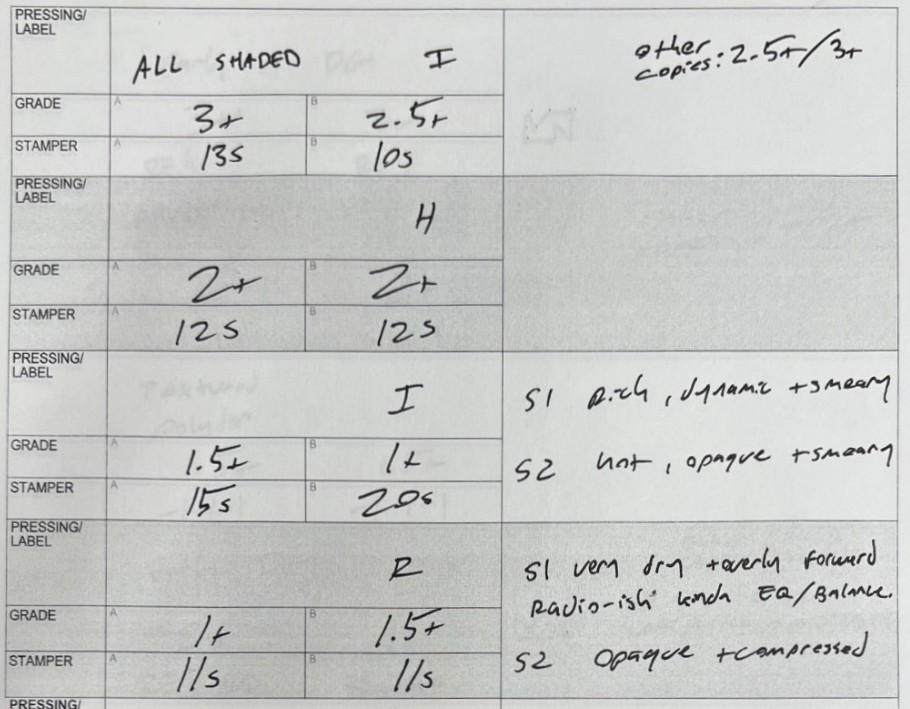
In the case of the stampers for this mystery title, it turns out that whatever intuitions we may have had going in would have been no help at all. Who could possibly predict that, for sound quality on side one, 13s would substantially beat 12s, 12s would beat 15s, and that 15s would beat 11s.

Side two was even wackier: 10s badly beat 12s, 12s beat 11s, and 11s beat 20s.

I can detect practically no pattern in these numbers, on either side. They seem pretty random.

But we don’t have a problem with random numbers because the person sitting at the table playing the record and the person in the listening chair grading the sound of that record never know what the stampers are for any of the records they are playing. This should be standard practice, but it seems nobody in the audiophile world practices it but us and Robert Brook.

(more…)

Shootout Winning Stampers for Rhythms of the South Revealed

Hot Stamper Pressings of Exotica and Bachelor Pad Recordings Available Now

There are some records that, no matter how amazing the sound, and how good the music is, simply will not find favor with our customers. This is one of them. I happen to like the music, and the sound is shockingly good, a true Demo Disc for those of you with big speakers pulled well out from the back wall in a spacious, heavily treated room like the one you see below.

We are most likely not going to be doing shootouts for this title in the future, so we thought we would share with everyone what we know about the record, which boils down to which stampers have the potential to do well and which do not.

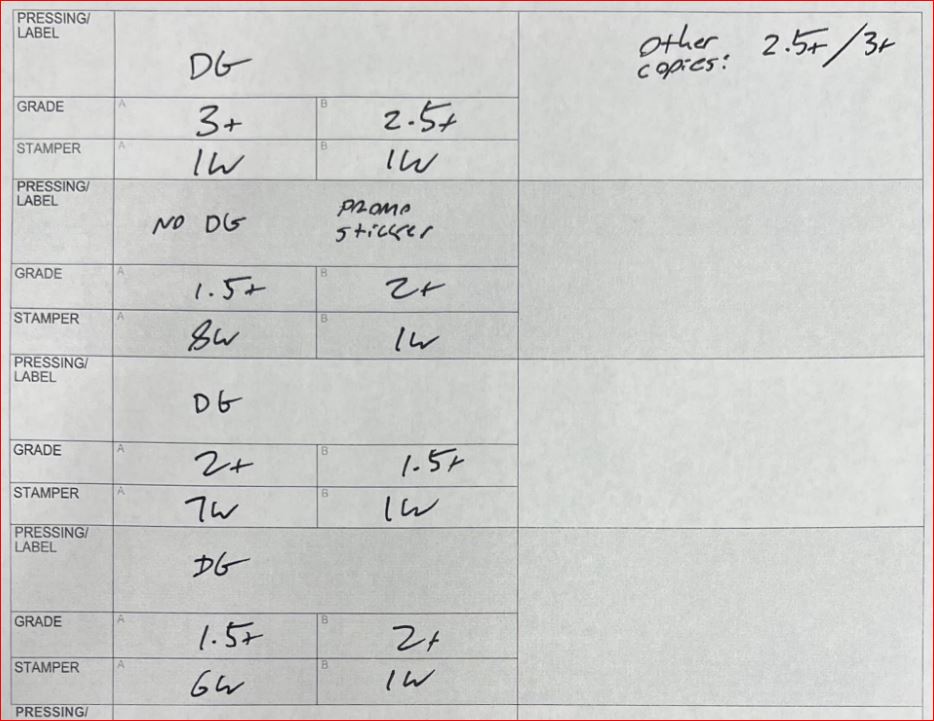
As you can see, Stan Goodall did a much better job mastering the early Blueback London pressings for Decca than Jack Law.

What information can you rely on when trying to find the best sounding pressings?

The originals all have the same Blueback cover.

In this case, the stamper numbers are the only way to separate the potential winners from the sure losers.

11/2023 Ros, Edmundo Rhythms of the South (PS 114 London) early Blueback 3 3 1E 1E other copies: 2.5/2, 2/2.5
11/2023 Ros, Edmundo Rhythms of the South (PS 114 London) early Blueback 1.5 1 2D 2D s1 dry, flat, trashy. s2 smeary, messy, boring
RE ABOVE: I FOUND THIS IN A BOX. THOUGHT IT SOUNDED REALLY GREAT, ESP. T1, S1

Jack Law’s cutting for side one was

(more…)

3s Can Have Amazingly Good Sound, or 3s Can Have Mediocre Sound

Hot Stamper Pressings of Living Stereo Recordings Available Now

But how can you tell which 3s copies sound amazing and which 3s copies don’t?

Below you will see the stamper sheet for a shootout we did not long ago.

A lot of our stamper sheets look like this one, close to half I would guess.

As you can see, the stampers and the sound are all over the map. This is not the least bit unusual in our experience. It’s simply the nature of records — they tend to come off the press with very different sound depending on factors that no one seems to understand very well, not even us!

Note that the album you see pictured is not the record we did the shootout for.

(more…)

It’s Already So Good, How Could It Get Any Better?

Hot Stamper Pressings of the Music of Berlioz Available Now

You may have noticed that most of the time when we give out the stampers for the top copies of an album, we do not identify the title of the record that has those Shootout Winning stampers.

As you can imagine, our huge investments in research and development make up a big part of our costs, costs that accrue over the course of years, decades even, and that must eventually be passed on to our customers.

But this title is an exception, because we are telling you straight out that the 1K pressings of CS 6101, Music of Berlioz, are the way to go.

It turns out that both the early Decca pressings (SXL 2134) and the London Bluebacks were cut by Tony Hawkins.

It’s unfortunate that this record did not sell well when it came out in 1959, which explains why we could find no evidence of copies with any stampers other than 1K.

Not that the work of any other mastering engineers was in any way needed. Mr. Hawkins did a wonderful job on the copies we played than managed to reproduce the glorious, Golden Age All Tube analog sound of the master tape, which may sound  tautological as all get out but I assure you is not.

No, sadly for us, that glorious sound could be found on one and only one pressing, the one we graded 3+/3+.

No other pressing earned a top grade on either side. Whatever caused the amazing pressings to come out differently from the very good ones happened in the plating and pressing stages of manufacturing, an area that did not involve the work of any of the Decca mastering engineers.

(more…)

What Can You Learn from a Mercury Shootout Like This One?

Hot Stamper Pressings of Mercury Classical Recordings Available Now

The short answer is that you can’t learn much from this shootout, because we’re not telling you which title the stampers you see below belong to.

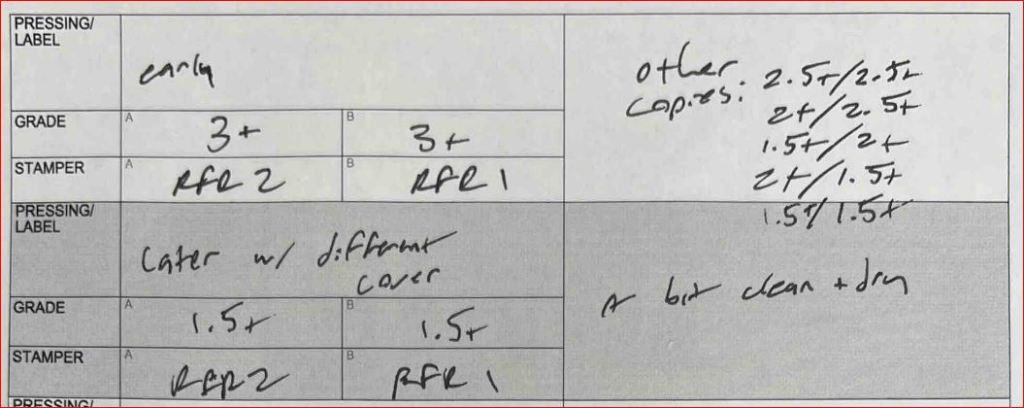
Be that as it may, in the case of this mystery title the conventional wisdom turns out to be correct — the earlier numbered pressings did better than the later numbered pressings, and the early labels did better than the later labels.

That happens a lot, and we are happy to admit that it does. Why? Because the experimental evidence — the datasay that is what happened.

As usual for posts in which the stamper sheet from a shootout is reproduced in its entirety, the stamper numbers shown below will belong to a different album than the one you see pictured.

These can be found under the heading of Mystery Stampers. Most of these posts will illustrate something to be learned from a Hot Stamper shootout, but because the information reveals the shootout winning stampers, the actual title of the record is rarely revealed.

Much more useful stamper information can be found using this link, which includes plenty of stamper numbers for specific titles that are best avoided by audiophiles looking for top quality sound. In addition, we post the winning and losing stampers for some titles that are an unreliable guide to good sound. Unreliable stampers are also quite common.

The right stampers are only one of the many reasons some copies win our shootouts and others don’t, but in the case of this rare Mercury, a record that we only had four copies of, the RFR-2/2 stampers were clearly the best, with no other set of stampers coming close. The best of the others earned grades no better than 2+/2+.

One lesson that was clear was that the best stampers were, to quote our reviewer, “a step up!”

(more…)

RE-2 Wins Our Shootouts for this Jimmy Smith Recording

Hot Stamper Pressings of Large Group Jazz Recordings Available Now

What happens when all the stampers are RE-2?

This is precisely the problem we were faced with on the Jimmy Smith Verve album you see pictured to the left and whose stamper sheet is shown below.

What information can you rely on when trying to find the best sounding pressings? The stamper numbers are no help.  There were some markings in the dead wax for the 3+ copies that were different from the copies that earned lower grades, but they are hard to read and most sellers we buy from would struggle to identify them.

No, on this record there was really nothing to go by other than the sound.

From our shootout panel’s point of view, this is the only way it can possibly work.

(more…)

Here Are the Shootout Winning Stampers for SR 90435

Hot Stamper Pressings of Mercury Living Presence Records Available Now

You may have noticed that when we give out the stampers for the top copies, we rarely identify the title of the record with those Shootout Winning stampers.

As you can well imagine, our sizable investments in research and development over the course of decades make up a big part of the costs we must pass on to our customers.

However, in the case of Mercury SR 90435, knowing the Shootout Winning stamper numbers is not going to get you very far (which is of course the only reason we can afford to give out this information).

You will actually need a pile of copies with those stampers in order to find one worthy of a 3+ White Hot stamper grade.

Obviously, knowing the “right” stamper information in this case gets you in the ballpark, but it won’t help you hit the grand slam home run you were hoping for. To do that you have to clean and play at least five copies the way we did.

Hot Stamper shootouts may be expensive, they may be a lot of work, but our experience tells us there is simply no other way to find the highest quality pressings. They’re the ones that earn the 3+ grades, not the 1.5+ grades, regardless of their stamper numbers, labels, mastering engineer credits or country of origin.

As we have been saying for more than twenty years, for title after title, when you clean them right and play them right, they might all look the same, but rarely if ever will they sound the same.


Changes for 2024

Beginning in 2024 we decided to make available to our readers a great deal of the pressing information we’ve compiled over the last twenty years, under these headings:

(more…)

The Reissues Consistently Beat the Originals on this Mystery Mercury

Hot Stamper Pressings of Mercury Classical Records Available Now

For Mercury classical and orchestral recordings, the original FR pressings on the plum labels are the way to go, right? 

In some cases, yes. We talk about how much better the FR pressings for The Firebird are compared to the much more common, and still quite good, M2 reissue pressings here.

The stamper numbers you see below belong to a different album.

The notes for the FR originals we played read:

  • Tubey but never as open or dynamic as RFR-1 can be.

The better of the three FR pressings we played was not a bad sounding record, earning a grade of 2+. They’re just not as good sounding as the RFR reissues, which, of course, are the ones that win shootouts.

Something to keep in mind: A Super Hot Stamper Mercury orchestral record is guaranteed to be dramatically better than any Heavy Vinyl reissue ever made.

(more…)

What Lessons Can We Take from this Columbia Shootout?

Hot Stamper Pressings of Vintage Columbia Albums Available Now

Recently we conducted a shootout for one of our favorite Columbia recordings, one that we had auditioned many times before and for which we knew the music and the general quality of the sound well.

It’s not the record you see pictured.

For now we’re keeping the title a mystery, consistent with the idea that we give out plenty of stamper information on this blog, including some of the worst ones we’ve had the misfortune to run into, but rarely do we feel the need to give out the really good ones. After decades of doing this kind of work, the time and effort that has gone into finding them is beyond calculation.

When we do give out the best stampers, as is the case here (3BA baby!), we make a point of keeping the title under wraps.

We are not the least bit interested in putting ourselves out of business.

The discussion for today revolves around the idea held by a great many audiophiles that the original White Print 360 label pressings are going to be the best sounding for any title that was made starting with that label in the early-60s.

(The Black Print 360 mono is an example of the mono labels being a bit behind the times as far as I can tell.)

Note that we did not bother to put any of the 70s Red Label Columbia pressings in the shootout. We’ve been down that road with this title before, and we have yet to hear one worth the vinyl wasted on it.

Columbia, like most labels, seems to have made very little effort with the sound quality of their reissues. Perhaps it was the result of all the bad transistor equipment in the studios by the time the 70s rolled around, but that would be speculation on my part, as well as something that would be very hard to find evidence for one way or the other.

We did find one Monk record that sounded better on the Red Label reissue, and readers of this blog should easily be able to find out which one it is by reading our many reviews for Monk’s recorded output.

We have two new lists for those who would like to know which Columbia labels win shootouts — one for 6-Eye winners and one for 360 Label winners.

What interests me in these findings is the following:

  • Both of our shootout winning copies had the same stampers. Can that really be a coincidence?
  • The shootout winner for side one is 3BA.
  • Two copies with stampers very similar to that one, 3AB, did noticeably worse, 2+ and 1.5+.
  • And the worst of the White Print 360 Label pressings barely earned a Hot Stamper grade at all.
  • They are on the same original label as the other copies, but for some reason they don’t sound as good. Why is that?

If an audiophile collector were to go to Discogs, find a nice clean copy on the early label and buy it, he might find that he know owns a top quality sounding copy, a pretty good sounding copy, or a not-nearly-as-good sounding copy as he’d hoped for, depending on his luck.

And what would he know about the quality of the recording? About that thing that audiophiles and record collectors seem to reference so often, “the master tape,” as if they have any way of knowing about the sound of a tape they have never come into contact with.

Just Assume

If he had a killer 3BA, wouldn’t he just assume that for some reason the recording must be amazing and consider himself lucky to find such a wonderful record to play.

Why one set of stampers sounds so much better than another set, or the same or a similar set on a different pressing, is a mystery, and it’s one that we confidently predict will never be solved.

Does anyone have a practical way to get around the reality that allows one set of stampers to sound great and the same or a similar set of stampers to sound no better than very good, if that?

Well, we can’t say there is a practical way, but we do know of an impractical one. We’ve been practicing and refining that one for more than twenty years.

We just play lots and lots of copies of the albums to find out how they sound.

(more…)