mystery-title

Some Blue Notes with New York Labels Just Cannot Be Beat

Hot Stamper Pressings of Blue Note Recordings Available Now

Warning: the record you see pictured is not the record we are discussing in this commentary.

Our shootout in 2024 involved all the most important Blue Note labels for this mystery title. New York, Liberty, Black B, White B, all present and accounted for, and all with RVG in the dead wax. (For those who want to know which labels to avoid on Blue Note, you will have to dig through our voluminous reviews and commentaries.)

We don’t need to tell you that those early pressings take us years to find, and cost us a pretty penny — at least the ones that are in audiophile playing condition do — when we can even manage to get hold of them.

And we probably return at least half of what we buy, doubling the trouble of getting a shootout going.

Some folks who produce Heavy Vinyl Blue Note reissues and some of those who review them will tell you that Rudy did not know how to master a record properly. They don’t think his pressings should sound very good to audiophiles, assuming the equipment these audiophiles own is of the highest quality, the way they assume theirs is.

(more…)

Which Is More Important – The Label or the Stamper Numbers?

Hot Stamper Pressings Featuring the Violin Available Now
In this case, since the label is different but the stampers are the same, it’s the label that tells you how good your pressing may — heavy accent on the may — sound.

Lately we’ve been having exceptionally good luck with the early label pressings of many of the London violin concerto records we’ve done shootouts for, especially those performed by Ruggiero Ricci.

However, the notes you see below do not belong to the wonderful Sibelius record pictured here.

They belong to another London record. We give out lots of bad stampers on this blog, but almost never do we give out the good ones. (When we do give out the best stampers, we usually keep the title a mystery, as is the case of the record here. To see the other titles whose Shootout Winning stampers have been revealed, please click here. The list to date is short but not to worry, more are on their way.)

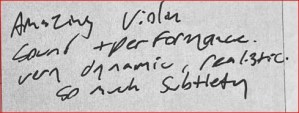
The amazingly good sounding pressing on the early label took the recording to another level. Our shootout notes read:

  • Amazing violin sound and performance.
  • Very dynamic and realistic.
  • So much subtlety.

Scroll down to see out Key Takeaways from this shootout.

(more…)

WW, LW, JW? Which Stampers Sound the Best?

Hot Stamper Pressings of Rock and Pop Albums Available Now
UPDATE 2026

In 2005 we acquired more than a dozen sealed copies of a popular Warner Bros. title, how I don’t remember. (For now we are keeping that title, and even the band that recorded it, a mystery. It might have been The Doobie Brothers, but then again, it might not.)


Our story goes like this:

Knowing that no two of these pressings would sound exactly the same, we decided to crack them open, clean them up and play them.

2005 was very early in the development of Hot Stamper Shootouts. By 2007 we were much better at them, and not coincidentally, that is also the year we decided that Heavy Vinyl pressings were just not good enough for us to bother selling.

All three of the major stamper prefixes for Warners were represented in the various matrix numbers: WW, JW and LW. Once we started to play them it quickly became clear that most copies of this record just do not sound very good.

The typical copy is hard, midrangy, opaque, dull and badly lacks Tubey Magic.

Only one of the prefixes — WW, JW, LW — actually has any hope of sounding good, and surprisingly it’s not the one I would have expected it to be. Live and learn, right?


We liked either JW or WW back in 2005, I don’t remember which, but the evidence we compiled over the ensuing twenty years contradicted that finding.

Live and learn is right, because since the dark days of 2005, we have done this shootout many times, at least five by my count, and it turns out that the stampers we tend to like are exactly the ones we tend to like in general for Warner Bros.

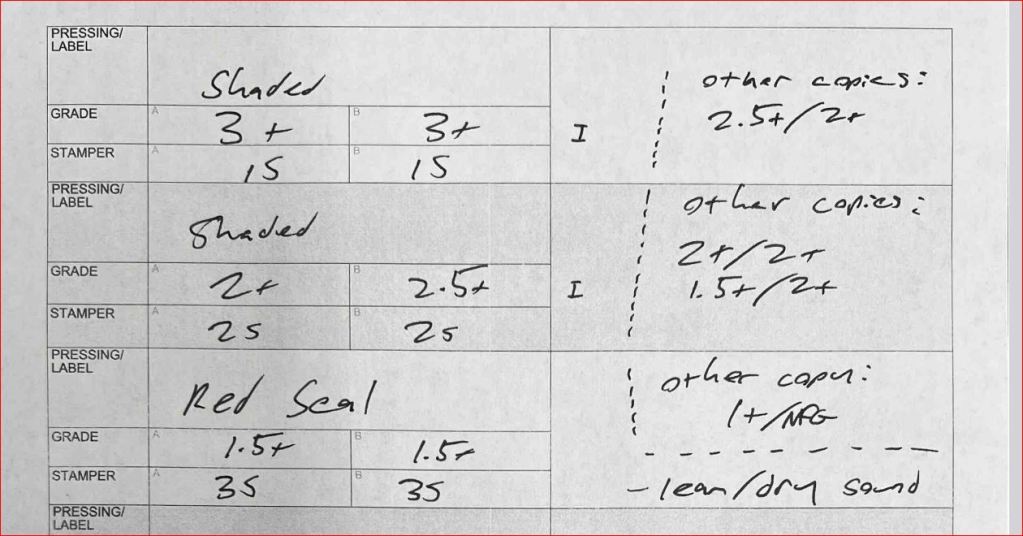
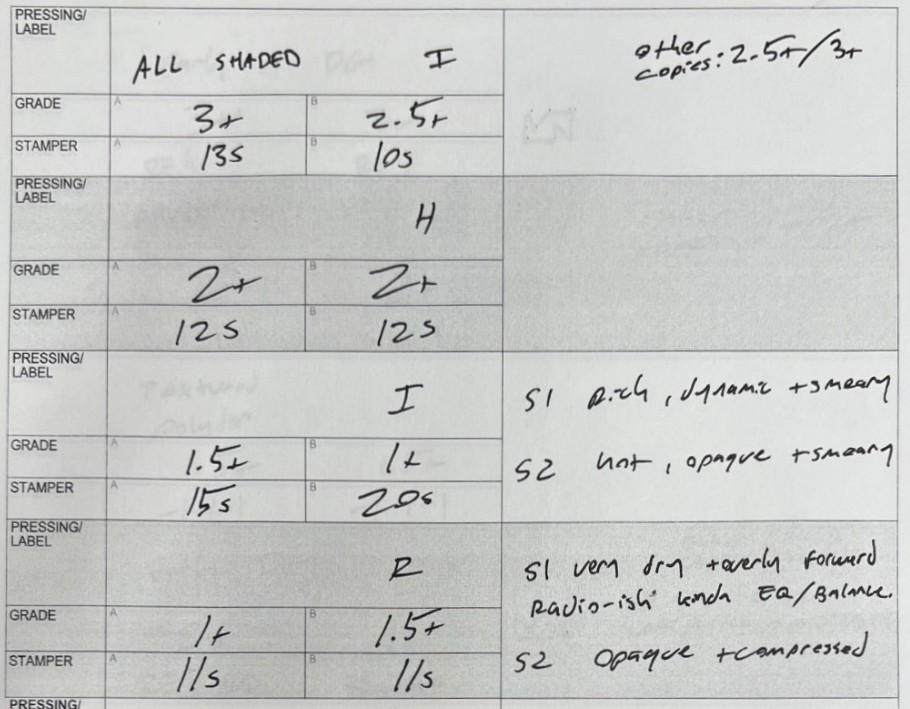
Here is the full stamper sheet from a shootout we did not long ago laying out the stampers we like for this mystery title: LW, with low numbers.

(more…)

Is It Hard for You to Imagine Similar Stampers Sounding So Different?

Hot Stamper Pressings of Living Stereo Recordings Available Now

Subtitle: it’s also hard to imagine that space and time are two aspects of the same reality, spacetime, but that’s why we employ rigorous scientific methods to test our theories and — in some cases — prove ourselves wrong.

We here at Better Records like testing records. We want to know if the predictions we make about the titles we play are accurate, which is simply to say, do they match the data derived from our blinded shootouts?

In the case of the stampers for this mystery title, it turns out that whatever intuitions we may have had going in would have been no help at all. Who could possibly predict that, for sound quality on side one, 13s would substantially beat 12s, 12s would beat 15s, and that 15s would beat 11s.

(more…)

3s Can Have Amazingly Good Sound, or 3s Can Have Mediocre Sound

Hot Stamper Pressings of Living Stereo Recordings Available Now

But how can you tell which 3s copies sound amazing and which 3s copies don’t?

Below you will see the stamper sheet for a shootout we did not long ago.

A lot of our stamper sheets look like this one, close to half I would guess.

As you can see, the stampers and the sound are all over the map. This is not the least bit unusual in our experience. It’s simply the nature of records — they tend to come off the press with very different sound depending on factors that no one seems to understand very well, not even us!

Note that the album you see pictured is not the record we did the shootout for.

(more…)

What Can You Learn from a Mercury Shootout Like This One?

Hot Stamper Pressings of Mercury Classical Recordings Available Now

The short answer is that you can’t learn much from this shootout, because we’re not telling you which title the stampers you see below belong to.

Be that as it may, in the case of this mystery title the conventional wisdom turns out to be correct — the earlier numbered pressings did better than the later numbered pressings, and the early labels did better than the later labels.

That happens a lot, and we are happy to admit that it does. Why? Because the experimental evidence — the datasay that is what happened.

As usual for posts in which the stamper sheet from a shootout is reproduced in its entirety, the stamper numbers shown below will belong to a different album than the one you see pictured.

These can be found under the heading of Mystery Stampers. Most of these posts will illustrate something to be learned from a Hot Stamper shootout, but because the information reveals the shootout winning stampers, the actual title of the record is rarely revealed.

Much more useful stamper information can be found using this link, which includes plenty of stamper numbers for specific titles that are best avoided by audiophiles looking for top quality sound. In addition, we post the winning and losing stampers for some titles that are an unreliable guide to good sound. Unreliable stampers are also quite common.

(more…)

So You Actually Think an OJC Can Beat an Original Black Label Contemporary?

Hot Stamper Pressings of Contemporary Jazz Albums Available Now
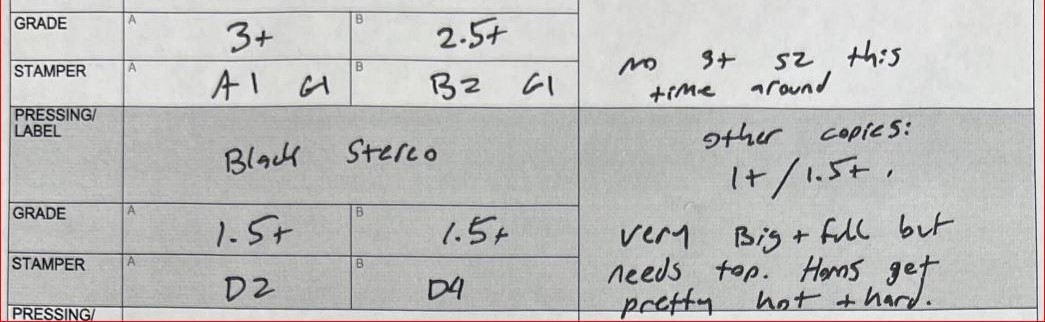
Yes, we think that, because that’s what the evidence from our most recent shootout in 2025 showed us.

As you can see from the stamper sheet below, the A1/B2 stampers of our OJC, in a blinded test, came out on top.

Better mastering equipment? Better mastering skills? Better vinyl? Better pressing methods?

Who the hell knows?

Better yet, what audiophile or record collector with a lick of sense would even pretend to know?

Not us, that’s for sure. At this point we are very comfortable not having answers for the unanswerable questions we posed above.

But don’t rush off to buy the OJC of the Sonny Rollins record you see pictured. This commentary has nothing to do with that record. (more…)

Does 1s Sound Great or Does It Sound Good (but Hot, Dry and Crude)?

Hot Stamper Pressings of Living Stereo Recordings Available Now
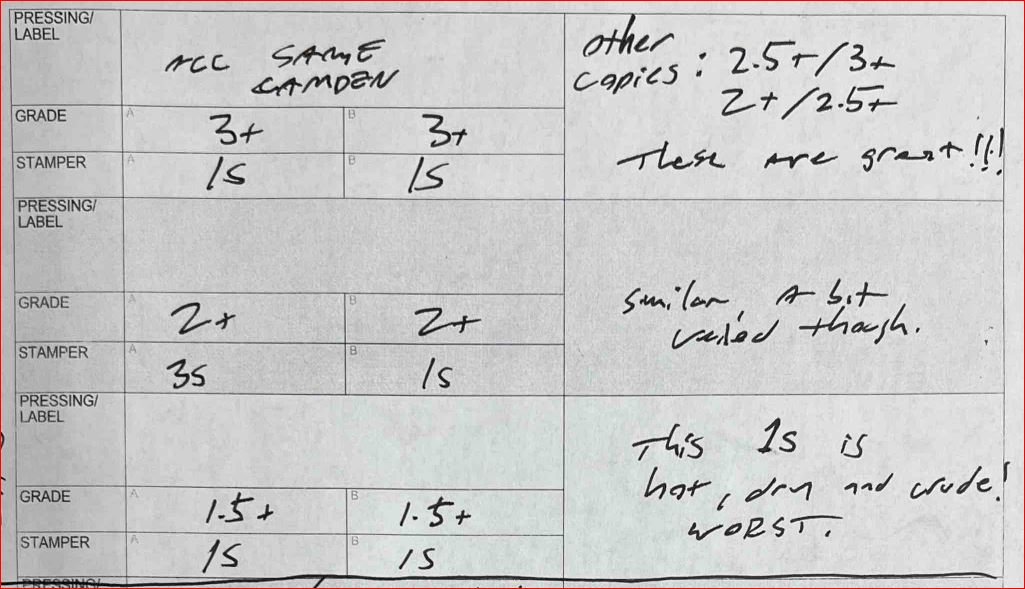

Below you will see the complete stamper sheet for a shootout we did recently.

Note that the album you see pictured is not the record we did the shootout for.

We are not revealing what record had these stampers and earned these grades for the simple reason that we rarely if ever give out the specific information that identifies the best sounding pressing of any album.

As I’m sure you can understand, we want you to buy the copy with the Hottest Stampers from us, not find one on your own! We’re happy to be moderately helpful, but naturally we find it necessary to draw the line somewhere, and giving out “the shootout winning stampers” is where we choose to draw it.

(more…)

Sometimes the Earliest Stampers Just Cannot Be Beat

Hot Stamper Pressings on Decca & London Available Now
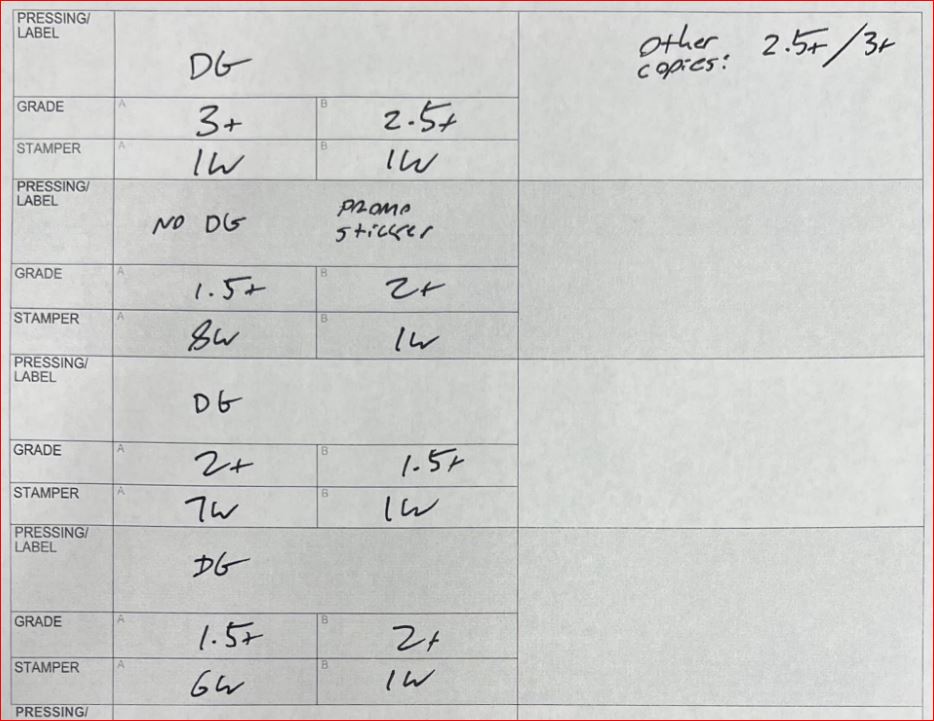
We recently posted a lengthy commentary about conventional wisdom in an attempt to make the case that, although the most common record collecting approaches are more often right than wrong, there is simply no way to know what approach will produce the best results for any given title.

Rather than post one exception after another — easily done, since we know literally hundreds of them — we are happy to admit that the generally accepted record collecting rules of thumb* work well for most records, with the definition of “most” being “more than half the time.”

In the case of this Mystery London, the received wisdom turns out to be right on the money. (As per our policy, please note that the Mahler album you see pictured is not the record we are discussing in this post.)

What conclusions can we draw from this information?

We would be very surprised if the earlierst pressings cut by Harry Fisher (1W/1W) can be beaten for sound. It’s possible, of course, and we will naturally continue to buy pressings with other stampers, if for no other reason than the fact that they are far more plentiful than the first pressings.

(more…)

The Dutch Pressings Can Sound Good, Sure, But Great? Not a Chance

Hot Stamper Pressings of British Blues Rock Albums Available Now

Below you will see part of a stamper sheet that was generated for a shootout we did recently.

Please note that the album you see pictured — Cream’s Goodbye — is not the one we are discussing here. What it has in common with the mystery record we are writing about is both albums were made by British rock bands, both were recorded in England, and both sound their best on the pressings that were made in the UK.

For years we would buy any and all copies of this album on the early Polydor label as long as they looked original and had TML in the dead wax. The band was British, the production was British, but for some reason all the early pressings were mastered by The Mastering Lab right here in the states. Apparently somebody involved in the production thought they could do the best job, and they were probably right.

(The Mastering Lab was one of the great mastering houses in the 70s and 80s. There is no one alive today who can make a record remotely as good sounding as the ones they produced by the thousands in those days. If you know of any, please contact me at tom@better-records.com.)

Woops

Then we noticed that some of the Red Polydor pressings said “Made in Holland” on the label. We also noticed that the Holland pressings were never the winners of our shootouts.

It’s not as if they weren’t very good sounding pressings. They could earn grades of 2+ on both sides, as two of the seven copies shown below did, but most of the time their grades were a bit lower than those, and never as good as the best Brits.

Our appreciation of these facts, facts that had been staring us in the face for a decade or more, was lacking. We didn’t connect dots that were so obvious it was hard to miss them. Why I have no idea.

Eventually, after more shootouts had shown us again and again the limitations of the Dutch pressings, the penny dropped and we finally saw the labels for what they were: a clue to what pressings could win and what pressings couldn’t. Mind you: Every record still had to go through a shootout, and the person hearing and evaluating the record had no idea which of the two countries it might have been made in. But now we knew to pay a premium for the Brit-pressed records and only buy the Dutch at the right price.

Why did we keep at it until we had if figured out? Because we get paid to.

(more…)