detail-trap

Detail on Crosby, Stills and Nash – Holy Grail or Audio Trap?

Hot Stamper Pressings of the Music of Crosby, Stills, Nash and (Sometimes) Young

Detail may be the Holy Grail to some audiophiles, but listening for the details in a recording can be a trap we too easily fall into unless we are on our guard.

Tonal balance is the key.

Without correct tonal balance, no judgments about the details of the recording have any real value. 

A case in point: As good as the Classic Heavy Vinyl pressing is, the guitar at the opening of Helplessly Hoping tells you everything you need to know about what’s missing. The guitar on the better Hot Stamper domestic copies has a transparency and harmonic integrity that cannot be found on Classic’s version.

The Classic Records pressing gets the tonal balance right, but their guitar lacks the subtlety and harmonic resolution of the real thing.

I’m laboring here to avoid the word “detail,” since many audiophiles like bright, phony sounding records because of all their wonderful detail. Patricia Barber’s albums come to mind, along with scores of audiophile pressings. 

The MoFi guys and the CD guys are constantly falling into the trap of being impressed by the phony detail in some recordings.

The solution is to get the sound tonally balanced first, then see how much detail you have left.

Detail is not the end-all and be-all of audio. Those who think it is have systems that are sure to fall apart at louder levels. If the sound of your system on your best pressings doesn’t get better as it gets louder, you are failing one of the most important tests in all of audio, the turn up your volume test.

(more…)

This Carmen Ballet Is a Great Test Disc for Shrill, Gritty Strings

Hot Stamper Pressings of the Music of Georges Bizet Available Now

UPDATE 2025:

I’ve added some tubes-versus-transistors commentary at the bottom of this posting.


This Angel Melodiya pressing of Bizet’s Carmen, rearranged by Soviet composer Rodion Shchedrin for strings and 47 percussion instruments, has two incredible sides. Demo Quality Sound barely begins to do it justice. If you have the system to play it, this copy is a KNOCKOUT.

But boy is it a difficult record to reproduce. You better have everything working right when you play this one — it’s guaranteed to bring practically any audiophile system to its knees.

Speed, resolving power and freedom from distortion are what this record needs to sound its best.

Is your system up to it? There’s only one way to find out.

And if you have any peaky audiophile wire in your system, the kind that is full of detail but calls attention to itself, you are in big trouble with a record like this.

More than anything, this is a record that rewards your system’s neutrality.

Testing

This is a superb Demonstration Disc, but it is also an excellent Test Disc. The sound of the best copies is rich, full-bodied, incredibly spacious, and exceptionally extended up top. There is a prodigious amount of musical information spread across the soundstage, much of it difficult to reproduce.

Musicians are banging on so many different percussion instruments (often at the far back of the stage, or, even better, far back and left or right) that getting each one’s sonic character to clearly come through is a challenge — and when you’ve met it, a thrill. If you’ve done your homework, this is the kind of record that can show you what you’ve accomplished.

On the best copies the strings have wonderful texture and sheen. If your system isn’t up to it (or you have a copy with a problem in this area), the strings might sound a little shrill and possibly gritty as well, but I’m here to tell you that the sound on the best copies is just fine with respect to string tone and timbre. You will need to look elsewhere for the problem.

(more…)

I Misunderstood – Clarity Was Never the Point

Hot Stamper Pressings of Live Recordings Available Now

Some audiophiles get worked up listening for details in their favorite recordings. I should know; I was as guilty as anyone of that behavior.

But is that where the music is – in the details? Lots of details come out when one copy is brighter than another. Brighter ain’t necessarily better. Most of the time it’s just brighter

Listening for the details in a recording can be a trap, one that is very easy to fall into if we are not careful or don’t know better.

801 Live isn’t about clarity. It’s about the sound of a rock concert.

It’s about the raw power of one of the most phenomenal rhythm sections ever captured in performance on analog tape.

That’s what makes it a good test disc. When you play the hardest rocking tracks, the harder they rock, the better.

Next time you try out some audiophile wire or a new tweak, play this record to make sure you haven’t lost the essential energy, weight and power of the sound. This album doesn’t care about your love of detail. It wants you to feel the energy of the band pulling out all the stops. If the new wire or the new tweak can’t get that right, it’s not right and it’s got to go.

(more…)

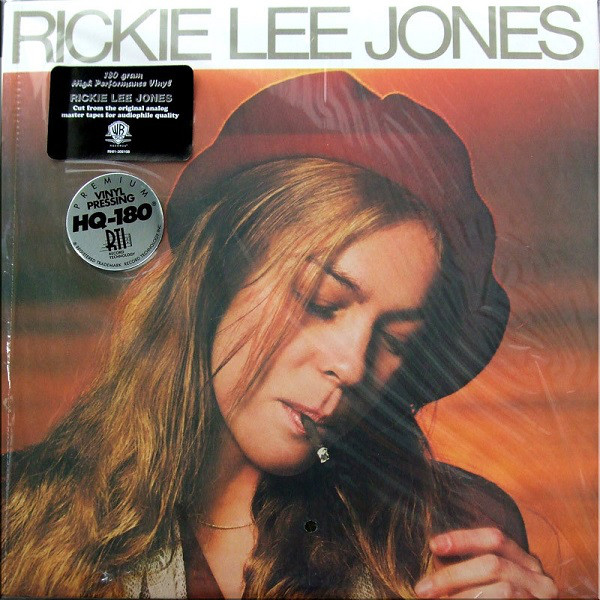
Rickie Lee Jones on Rhino Records – Not Our Idea of Good Sound, and We Hope Not Yours

Hot Stamper Pressings of the Music of Rickie Lee Jones Available Now

We were fairly unimpressed with the Rickie Lee Jones on Warners that came out a few years back [2008 in fact, time flies!].

It has that same phony modern mastering we find so unappealing on the Heavy Vinyl reissue of Blue. (We seem to be pretty much alone in not liking that one, and we’re proud to say we still don’t like it. We encourage you to play The Blue Game and maybe you’ll see why we feel the way we do.)

We liked the new Sweet Baby James Hoffman and Gray cut. We note in our review that:

Hoffman and Gray can take pride in this Sweet Baby James. It’s some of the best work I’ve heard from them to date. If more DCC and Heavy Vinyl reissues sounded like this, we wouldn’t be so critical of them. Unfortunately they don’t, and there are scores of pages of commentary on the site to back up that statement for those of you interested in the subject.

We went on to say

The amazing transparency and dynamic energy of the best originals will probably never be equaled by an audiophile pressing like this. (It hasn’t happened yet and we remain skeptical of the possibility.) Considering that this pressing is sure to beat most reissues, imports and other such like, we have no problem heartily recommending it to our customers, especially at the price.

So, What’s Wrong With Rickie Lee?

Simple. They took a somewhat artificial, hi-fi-ish, close-miked, heavy-on-the-reverb recording and made it sound even more artificial, phony and hi-fi-ish (but less-heavy-on-the-reverb; there is always a noticeable loss of resolution in these modern mastering jobs).

What were they thinking?

The best copies have warmth, richness and sweetness to balance out the more unnatural elements in the recording. Copies with these qualities are not that common, but we’ve run across plenty of them in our shootouts and proudly offered them for sale, where of course they sold quickly for lots of money. Major league audiophile appeal, this one. In its day it was heavily demo’ed in every stereo store in town, and for good reason — the sound positively jumps out of the speakers.

It’s a Trap

The average copy of this album is a sonic disaster, akin to the average copy of Famous Blue Raincoat or — gulp, even worse — Graceland. If you’re a detail freak, this Rhino pressing may be just what you are looking for. It’s got detail all right.

But all that phony detail obscures what is wrong with the sound. Overly detailed sound is a trap that is all too easy to fall into.

Plenty of recordings designed to appeal to audiophiles strike us as being phony in this way. Stan Ricker cut a lot of overly-detailed records for Mobile Fidelity in the 70s and 80s, records that may have sounded fine on the lo-rez stereos of that era (like the one I owned), but are positively painful to play on the top quality equipment that is available (but rare) today. [1]

I would hope that the audiophile community would have developed their listening skills to a level sufficient to recognize what this pressing doesn’t have — warmth, richness and sweetness — but I get the feeling I will be proved wrong yet again in that regard.

This Performance Is High?

Rhino Records has really made a mockery of the analog medium. Rhino bills their releases as pressed on “180 gram High Performance Vinyl.” However, if they are using performance to refer to sound quality, we have found the performance of their vinyl to be quite low, lower than the average copy one might stumble upon in the used record bins.

The CD versions of most of the LP titles they released early on are far better sounding than the lifeless, flat, pinched, so-called audiophile pressings they released starting around 2000. The mastering engineer for this garbage actually has the nerve to feature his name in the ads for the records. He should be run out of town, not promoted as a keeper of the faith and defender of the virtues of “vinyl.”

If this is what vinyl sounds like I would switch to CD fast enough to make your head spin.

And the amazing thing is, as bad as these records are, there are people who like them. I’ve read postings on the internet from people who say the sound on these records is just fine.

Their Grateful Dead titles sound worse than the cheapest Super Saver reissue copies I have ever heard.

The Yes Album sounds like a cassette, a mere ghost of the real thing.

(more…)

Smooth or Detailed, Which Is the Right Sound for Jackson Browne’s Debut?

The real trick with this album is in striking the right balance between richness and presence. A White Hot Stamper from years back made me change my mind about this recording. I used to think it was dull, but I was wrong. I used to think that even the best copies of this recording sounded rolled off on the top end. I no longer believe that to be true. On the best pressings the top end is correct for this music.

It took the right pressing to show me the error of my ways.

Side one of that copy was rich and full and sweet as can be. Playing side two I noticed more transparency and clarity, especially in the guitars and voices. It seemed to have correct highs, highs that were a little soft on the first side.

But the more I listened, the less I liked it. It started to sound more like a record and less like music. Going back and forth between sides one and two, it was obvious that side one had less clarity because it had the kind of richness and fullness that made all the musicians and their instruments sound real in a way that wasn’t happening on side two.

Side two had clarity, it had transparency, but it kept reminding me that it was a recording.

Side one allowed me to forget that I was playing a record.

When the music started, my attention was completely focused on the songwriting and the performing. Aspects of the recording were lost in my enjoyment of the music. I kept thinking what a great album this is, not what a great recording it is. That tells me that both the recording engineer and the mastering engineer did their jobs right. They created a sound that best served this music.

I think if an audiophile label had produced a version of this album that sounded like side two, most audiophiles would love it. They would hear detail that they’d never heard before. (It’s my belief that the original Asylum master tape has been lost, so the details of which we speak can be heard on these good originals and nowhere else.)

But, fooled into listening for details in the music rather than the music as a whole, they would never know how RIGHT the album can really sound.

The best of our Hot Stampers are the ones that have the right sound for this music.

Two CDs that Sound Nothing Like Their Vinyl Counterparts

Reviews and Commentaries for Sticky Fingers

Reviews and Commentaries for Back in Black

I made the mistake of buying both Back in Black and Sticky Fingers on CD to listen to in the car, and both are a disaster — no bass, no rock weight, with boosted upper mids, no doubt in a misguided attempt to provide more “clarity” and “detail.”

But trying to achieve more clarity at the expense of the rock and roll firepower that makes both of these albums Must Own Rock Records is beyond foolish.

These albums did not need a new sound or a more modern sound. The sound of the original pressings of both of them is superb, as close to faultless as you are likely to find in this world.

Mobile Fidelity managed to get more transparency in the midrange for their pressing, and look what it got them: our award for the worst version ever.

On both of these CDs, even in the car I couldn’t get past the third song.

If this is what the digital lovers of the world think those albums actually sound like, they are living in some kind of parallel universe.

The best pressings on vinyl sound nothing like them. In fact the best pressings sound so good they are on our Rock and Pop Top 100. Rest assured that you don’t get to be on our Top 100 with anemic, upper midrangy sound.


New to the Blog? Start Here

(more…)

Audiophile Wire Testing with Jethro Tull and His Friend Aqualung

Hot Stamper Pressings of the Music of Jethro Tull Available Now

… who seems to have a rather nasty bronchial condition…

[This commentary is from 2008 or so I’m guessing. Still holds up though.]

Like Heart’s Little Queen album, Aqualung presents us with a Demo Disc / Test Disc that really puts a stereo through its paces, assuming it’s the kind of stereo that’s designed to play an album like Aqualung.

Not many audiophile systems I’ve run across over the years were capable of reproducing the Big Rock Sound this album requires, but perhaps you have one and would like to use the album to test some of your tweaks and components. I used it to show me how bad sounding some of the audiophile wire I was testing really was.

Here’s what I wrote:

A quick note about some wire testing I was doing a while back. My favorite wire testing record at the time (2007)? None other than Aqualung!

Part One

Here’s why: Big Whomp Factor. Take the whomp out of Aqualung and the music simply doesn’t work, at all. To rock you need whomp, and much of Aqualung wants to rock.

(more…)

I Once Fell Into a Common Audiophile Trap – Legrand Jazz Helped Me Find My Way Out

More Vintage Hot Stamper Pressings on Columbia Available Now

This 2005 commentary discusses how easy it is to be fooled by tweaks that seem to offer more transparency and detail at the expense of weight and heft. Detail is everything to some audiophiles, but detail can be a trap that’s easy to fall into if we do not guard against it.

The brass on this wonderful Six Eye Mono pressing of the album set me straight. [Since that time I have not been able to find mono pressings that sounded as good as I remember this one sounding. That sh*t happens.]

I was playing this record today (5/24/05) after having made some changes in my stereo over the weekend, and I noticed some things didn’t sound quite right. Knowing that this is an exceptionally good sounding record, albeit a very challenging one, I started playing around with the stereo, trying to recapture the sound as I remembered it from the last copy that had come in a few months back.

As I tweaked and untweaked the system around this record, I could hear immediately what was better and what was worse, what was more musical and what was more Hi-Fi. The track I was playing was Night In Tunisia, which has practically every brass instrument known to man, in every combination one can imagine.

Since this is a Mono pressing, I didn’t have to worry about issues like soundstaging, which can be misleading, or perhaps distracting is a better way to describe the problem.

I was concerned with tonality and the overall presentation of the various elements in the recording.

To make a long story short, I ended up undoing all the things that I had done to the system over the weekend! In other words, what improvements I thought I had made turned out not to be improvements at all. And this is the album that showed me the error of my ways.

Brass instruments are some of the most difficult to reproduce, especially brass choirs.

(more…)

Testing for Whomp Factor with Love Alive

heartlittl_1501_1187219026Hot Stamper Pressings of the Music of Heart Available Now

Heart’s Little Queen has long been a favorite Test Disc. It works especially well as a test for something we here at Better Records like to call whomp — the energy found at the low end of the frequency spectrum. Some call it slam, we prefer whomp.

The commentary is here to help guide you as you make changes to your system, insuring that you end up with more whomp without sacrificing equally important qualities found in the midrange and top end of your system.

Reality Check Parts One and Two

Take the song Love Alive.

The beginning section is chock full of lovely and quite subtle details (such as the autoharp and tabla) that seem to lose their magic on most systems. The autoharp is rich and chimey, and the tabla has some real low end extension. The recorders and flutes that join them are breathy and sweet, while the acoustic guitars heard throughout display all the tubey-magical harmonic richness found on our favorite Hot Stamper recordings, from the Eagles first album to Teaser and the Firecat. These qualities easily get lost in the sauce if you’re listening to the average copy, or the typical audiophile stereo.

That’s Part One of the test — the opening.

Part Two — For Those Who Are About to Rock

Now listen to the intensity of the toms as they break into the rock section. The sound is ENORMOUS and POWERFUL. I hope your woofers are in shape cause they’re about to get the workout of their lives. The Whomp Factor on the best copies is OUT OF THIS WORLD.

That’s what makes this such a great Test Disc. You can’t listen for just detail on a song like this.

For Part One, yes, detail is good. For Part Two, detail is almost (but not quite) irrelevant. You need weight, fullness, richness, freedom from distortion, dynamics, power, slam — all the stuff that comes under the heading of Whomp Factor.

(more…)