con-wis

Many audiophiles are inclined to believe the conventional wisdom they receive from other enthusiasts.

Some of it is right, some of it is wrong, but if you don’t know how to critically listen to records for yourself, you will never be able to tell which is which.

You’ll be stuck with the approaches most audiophiles use — guessing and assuming. Neither are a reliable method for getting at the truth.

Who Knew that Dylan Could Sound This Good in 1983?

Hot Stamper Pressings of the Music of Bob Dylan Available Now

This vintage copy of Infidels could not be beat. Big and rich, with correct tonality from top to bottom, strong bass and plenty of space, this copy sounded just right to us.

Our post-it notes tell the album’s story. (By the way, if you like reading our post-it notes, we’re putting more and more of them on the blog these days. We talk about the importance of taking notes  as part of the shootout advice we share. This post will help you with the basics.)
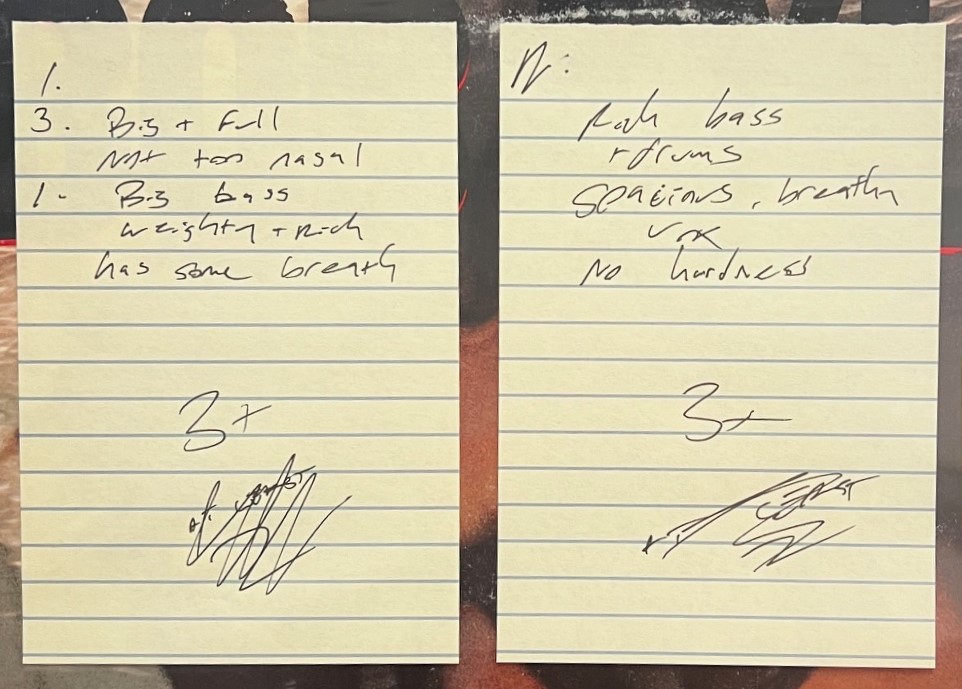
Side One

Track Three

    • Big and full
    • Not too nasal

Track One

    • Big bass
    • Weighty and rich
    • Has some breath

Side Two

Track One

    • Rich bass and drums
    • Spacious breathy vocals
    • No hardness

What We Learned

What do these notes have to tell us, other than this is a much better recording than it’s given credit for?

On side one, the vocals have a tendency to get nasally, sounding like Dylan is singing through his nose, not his mouth, a common problem with Dylan records from every era.

Also. when we say “has some breath, ” that basically means that most pressings on side one are not especially breathy in the mids, but this one is better in that department.

Not that the original grade was “at least 2,” and after going through all the copies, it turned out nothing could be beat this one. Some breath was probably more breath than any other side one we played.

On side two, the sound had “no hardness, ” and again, that simply means plenty of copies, maybe all the other copies, suffered from hardness in the vocals. “At least 2” turned into our Shootout Winner when no other copy could beat it.

Who Knew?

Has any other audiohile reviewer ever said a kind word about this album, other than us of course?

Not that I know of.

And we’re as guilty as any of them in assuming that 1983 was not a good year to be recording Dylan and expecting audiophile quality sound.

But we were proven wrong once again, by the only method that can possibly be relied upon to supply the truth: experimentation.

(more…)

Do All the Early Stamper Shaded Dog Pressings of this Title Sound Good?

Hot Stamper Pressings of Living Stereo Recordings Available Now
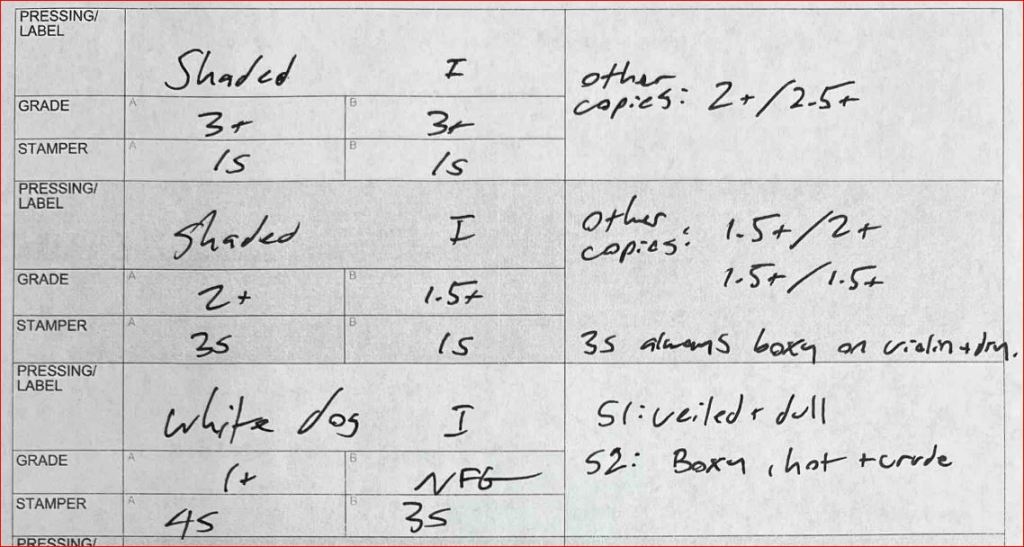
Below you will see the complete stamper sheet for a shootout we did recently.

Note that the album you see pictured — LSC 2265 — is not the record we did this particular shootout for.

We are not revealing what record had these stampers and earned these grades for the simple reason that we rarely if ever give out the specific information that identifies the best sounding pressing of any album.

As I’m sure you can understand, we want you to buy the copy with the Hottest Stampers from us, not find one on your own! We’re happy to be somwhat helpful, but naturally we find it necessary to draw the line somewhere, and giving out “the shootout winning stampers” are where we choose to draw it.

One set of stampers for the mystery Shaded Dog pressings we played in our most recent shootout sounded consistently subpar.

The sound on 3s was boxy and the violin was dry. This was surprising as the stampers are quite low: 3s/1s.

Many RCA chamber recordings can be dry, and if one owned a nice early stamper pressing of the album with boxy, dry sound, one might conclude that this RCA is just another chamber recording with those shortcomings.

But one would be wrong, because the 1s stamper shootout winner sounded amazing, not dry or boxy in the least.

How Come?

Since, as we discovered recently, 1s wins, and handily, why does 3s/1s do so much worse?

Who knows?

And why is the White Dog barely passable on side one and just awful on side two?

Your guess is as good as mine.

More of the Same

Below you will find links to other records we’ve played that had the same problems as our mystery RCA here.

(more…)

The Reissues Consistently Beat the Originals on this Mercury

Hot Stamper Pressings of Mercury Classical Records Available Now

For Mercury classical and orchestral recordings, the original FR pressings on the plum label are the way to go, right? 

In some cases, yes. We talk about how much better the FR pressings for The Firebird are compared to the much more common, and still quite good, M2 reissue pressings here.

The stamper numbers you see below belong to a different album.

The notes for the FR original pressings we played read:

  • Less spacious, more bright and flat.

They’re not bad sounding, they’re just not as good sounding as the RFR reissues, which, incidentally, won the shootout.

We’ve lately been giving out much more stamper information than we used to, but we make it a point to never give out the stamper information for our shootout winners, as finding those very special pressings has been the work of a lifetime and is certainly not something that should be given away for free.

Rules of Thumb

It’s just another one of a number of rules of thumb collectors use (“A method or procedure derived entirely from practice or experience, without any basis in scientific knowledge; a roughly practical method”), one that will sometimes lead you astray if what you are trying to find are not just good sounding pressings of albums, but the best sounding pressings of albums.

Same with reissue versus original. Nice rule of thumb, but it only works, to the extent that it works at all, if you have enough copies of the title to know that you’re not just assuming the original is better. You actually have the data — gathered from the other LPs you have played — to back it up.

Who Knew?

Who knew the recording would sound so much better on the right reissue pressings?

Certainly not us, not until we had done the shootout.

The difference between the way we do things and the way others do them boils down to this: We assumed that the original could be the best, and then we tested that assumption and found out we were wrong.

But the right reissues of this Mercury — again not the ones you see pictured — is indeed an exceptionally good sounding record.

This is why we do shootouts, and why you must do them too, assuming that owning the highest quality pressings is important to you.

(more…)

Letter of the Week – “Smokes the best of my three UK 1st press red apple covers I have collected.”

Hot Stamper Pressings of Let It Be Available Now

Our customer Michael S. wrote to tell us how much he likes his Hot Stamper pressing of Let It Be.

Hi guys,

The Let It Be 3+/3+ I bought from you few weeks ago is an absolute stunner that smokes the best of my three UK 1st press red apple covers I have collected over the last few years. Thanks again and keep’em coming!

All the best,

Michael S.

Michael,

Thanks for writing. That’s great to hear.

You could buy fifty of those original pressings and the White Hot Stamper pressing we sent you would smoke every last one of them.

We don’t bother with them because we know which pressings can beat them, so why waste the money for the so-called “original” when the reissue is — as you now know — superior sounding?

The conventional wisdom that the original is the way to go with most Beatles records is something we learned was mistaken more than 30 years ago and nothing has changed our minds about it since then, and that’s after having played literally hundreds and hundreds of Beatles records in the ensuing years.

(more…)

Domestic Pressings of Clear Spot? Forget ‘Em!

Hot Stamper Pressings of the Music of Captain Beefheart Available Now

We did this shootout many years ago, so many years ago that I cannot find a record of it.

I remember we thought the German pressings were perhaps a bit boosted on both ends and not as natural sounding as the domestic pressings.

After a multitude of improvements in our cleaning and playback, we would agree with our previous understanding that the German pressings are often wrong, but now we also know how right the right ones can be.

It turns out tha some German pressings are not particularly good, another piece of the puzzle that fell into place during our most recent shootout, as painful as that turned out to be considering the money wasted on them.

Did we have the bad German stamper pressings last time around? Who knows?

The producer, Ted Templeman, (Doobie Brothers, James Taylor) brought his mainstream talents to bear on this music, and when the Captain’s free-form tendencies smashed into Templeman’s conservatism, the result was this musical supernova — out there, but not too far out there.

(Play Trout Mask Replica sometime if you miss that feeling from your old hippie days of being on acid. With that music, drugs are entirely superfluous.)

I don’t know how many audiophiles like Captain Beefheart, probably not too many, but if you’re ever going to try one of his albums, this is the place to start: his masterpiece.

(more…)

Maybe We SHOULD Start Buying Blue Notes on the Early Labels

Hot Stamper Pressings of Blue Note Albums Available Now
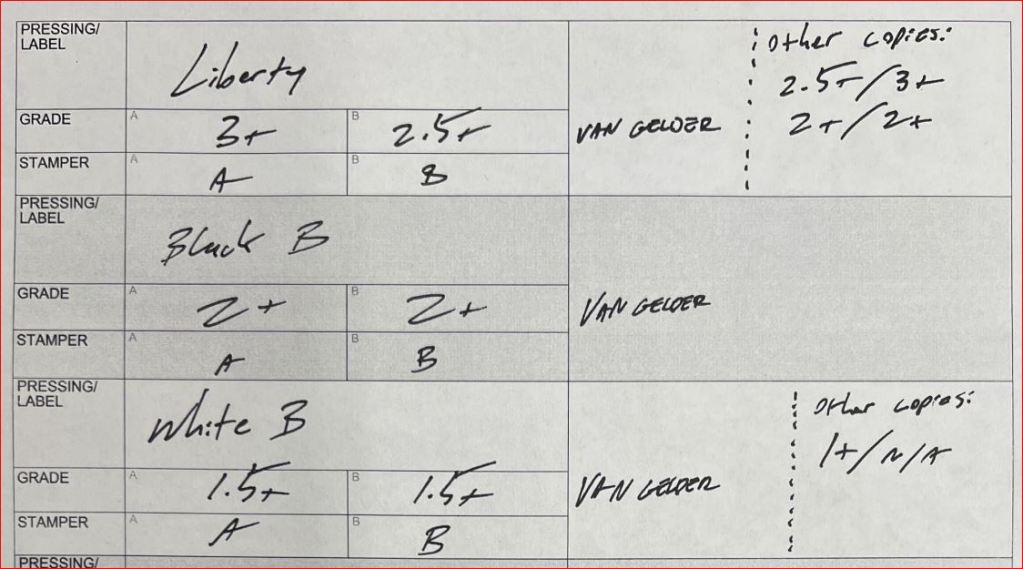

If there are record companies whose fans are extremely particular about the labels of the pressings they prefer, Blue Note has to be right at the top of that list.

The consensus among record collectors seems to be that the early label Blue Notes are practically guaranteed to have the best sound. In top condition they often sell for many thousands of dollars, far more than we have ever charged for any Hot Stamper Blue Note pressing

We are on record as not favoring early labels over later ones, absent the evidence to support such bias, but perhaps there actually are some records you should be buying based on their labels. This one, for example.

If all the stampers of a title are the same and they’re all cut by Rudy Van Gelder — early labels, middle labels and later labels alike — what do you use to guide you when trying to find the best sounding pressings?

This is precisely the conundrum that an audiophile would be faced with as he goes about trying to find the best sounding pressings of the Blue Note album whose stamper sheet you see below.

This stamper sheet reflects a fairly typical shootout for a Blue Note pressing. It’s hard to find six clean copies no matter what the title is. We probably returned or gave up on half the copies we bought, so we might have had to buy nine in order to shootout six.

(Note that there is nothing on any label after the White B from the 70s. We have never heard any title with an 80s label or later sound worth a damn so we stopped buying them a long time ago.)

Drawing Conclusions

Let’s look at some of the conclusions the typical record collector/audiophile might draw from the information above.

For example:

1.) I have a Blue Note with Van Gelder stamps and it’s decent sounding but I like [fill in the blank with some other pressing] better. Since all the pressings are cut by him, he must not have done a very good job. Thank goodness modern mastering engineer X came along to finally bring out the sound of the master tape that he was not able to do.

That’s an easy one to rebut. The later pressings cut by Rudy are consistently worse sounding than the earlier ones in the case of this title. If you don’t have a big batch to work through, however, you simply have now way of knowing that fact, and therefore whatever conclusions you choose to draw from a too-small pool of pressings are suspect at best.

(more…)

The Original Mercury Pressings Don’t Sound Good on this Title, But Why?

Hot Stamper Pressings of Mercury Classical Recordings Available Now

For Mercury classical and orchestral recordings, the original FR pressings (when there are such pressings) on the plum label are the way to go, right? 

In some cases, yes. We talk about how much better the FR pressings for The Firebird are compared to the much more common, and still quite good, M2 reissue pressings here.

And the FR pressing of the Rachmaninoff record you see pictured above may indeed have the best sound.
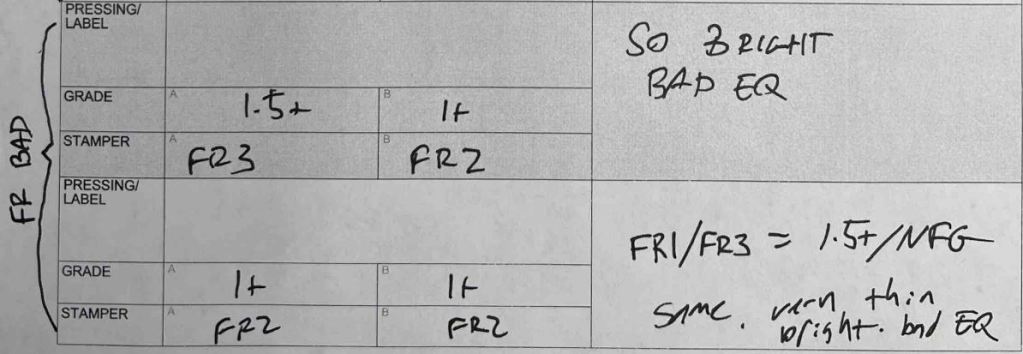

The stamper numbers you see below belong to a different album.

(We’ve lately been giving out much more stamper information than we used to, but for now we are keeping this title closer to the vest.)

Note that we had FR1, FR2 and FR3, all originals, yet none of them could be considered good enough to offer our customers.

It’s just another one of a number of rules of thumb collectors use (“A method or procedure derived entirely from practice or experience, without any basis in scientific knowledge; a roughly practical method.”), one that will sometimes lead you astray if what you are trying to find are not just good sounding pressings of albums, but the best sounding pressings of albums.

Same with reissue versus original. Nice rule of thumb, but it only works, to the extent that it works at all, if you have enough copies of the title to know that you’re not just assuming the original is better. You actually have the data — gathered from the other LPs you have played — to back it up.

Who knew the recording would sound so much better on the right reissue pressings?

(more…)

If You’re Looking for the Best Sound on Standard Coltrane, Look No Further

Hot Stamper Pressings of the Music of John Coltrane Available Now

As you may have guessed by now, remastered is a bit of a dirty word around these parts.

Most remastered records we play, from The Beatles to John Coltrane to ZZ Top, sound to us like pale imitations of the real thing, whether the real thing is an original or a vintage reissue from back in the day.

But only a fool could fail to appreciate how correct and lively the best copies of this remastered record sound, and we’re no fools here at Better Records. We judge records by one and only one criterion: the quality of their sound.

We pay no mind to labels, record thicknesses, playback speeds, mastering speeds or anything else you can read about on audiophile websites.

We’re looking for the best sound. We don’t care where it comes from.

On that basis we’re awarding side two of this recent shootout winning copy the award for the best sound on Standard Coltrane.

No other pressing of the album could do what this side two was doing. And the good news is that side one was nearly as good, making this the best copy to ever hit the site.

Side One

So dynamic, present and lively, with a rich sax and clear, solid piano. Great energy.

Side Two

Even better, with tighter, bigger bass.

Let’s give RVG a hand, the tonality on this side is HTF: Hard To Fault.

Only a small percentage of the many remastered records we’ve played over the years can make that claim in our experience.

(more…)

Revisiting the Analog Vs. Digital Debate with Donald Fagen

Hot Stamper Pressings of the Music of Steely Dan Available Now

Many years ago we did a big shootout for this album. Afterwards we asked this question:

Do all the pressings of The Nightfly sound like CDs?

The average copy of this digitally recorded, mixed and mastered LP sounds just the way you would expect it to: like a CD.

It’s anemic, two-dimensional, opaque, thin, bright, harsh, with little extreme top and the kind of bass that’s all “note” with no real weight, solidity or harmonic structure. Sounds like a CD, right? (That’s the way many of my CDs sound, which is why I rarely listen to them these days.)

But what if I told you that the best copies of The Nightfly can actually sound like a real honest-to-goodness ANALOG recording, with practically none of the nasty shortcomings listed above? You may not believe it, but it’s true.

How do I know it’s true?

The same way I came to learn practically everything I believe about the sound of equipment and records. I heard it for myself. (Keeping in mind that I am sure to be wrong about some things. Not to worry. When I find out which things those are, I will post them in this section of the blog where they can join the other 175+ entries.)

I heard a copy sound so natural and correct that I would never have guessed it was digital. On my honor, that’s the truth. The best copies of The Nightfly can actually be shockingly analog.

Simply put, the question before the house is: Can this record sound analog? We’ll be taking the affirmative.

The problem with the typical copy of this record is gritty, grainy, grungy sound — not the kind that’s on the master tape, the kind that’s added during the mastering and pressing of the record. When that crap goes away, as it so clearly does on a copy we played recently, it lets you see just how good sounding this record can be. And that means really good sounding.

On most copies, the CD-like opacity and grunge would naturally be attributed to the digital recording process. That’s the conventional wisdom, so those with a small data sample (in most cases the size of that sample will be one) could be forgiven for reaching such a conclusion. Based on our findings it turns out to be false.

The bad pressings do indeed sound more like CDs. The best pressings do not.

If you like having your biases confirmed, then by all means, keep your digital-sounding copy and pretend you know why The Nightfly sounds bad on vinyl.

(more…)

Are the Originals the Best Sounding Pressings of Moondog Matinee?

More of the Music of The Band

In the case of this album, no. The copies with the later covers always win our shootouts.

This is not the least bit surprising to us. We’re the guys who are all about sound, not originality.

We discussed it in this commentary: Are hot stampers just original pressings?

Side One

  • Ain’t Got No Home
  • Holy Cow
  • Share Your Love
  • Mystery Train
  • Third Man Theme

Side Two

  • Promised Land
  • The Great Pretender
  • I’m Ready
  • Saved
  • A Change Is Gonna Come

AMG Review

The Band essentially went back to being the Hawks of the late ’50s and early ’60s on this album of cover tunes. They demonstrated considerable expertise on their versions of rock & roll and R&B standards like Clarence “Frogman” Henry’s “Ain’t Got No Home,” Chuck Berry’s “The Promised Land,” and Fats Domino’s “I’m Ready.”

(more…)