12-2023

Bob and Ray Were Not Enough – We Needed the Tillerman Too

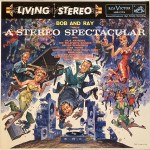
Bob and Ray Throw a Stereo Spectacular is my all time favorite test disc, the one test that every change to the system must pass: by making The Song of the Volga Boatmen sound better.

The danger in making the bulk of your sonic judgments using only one record is that you never want to optimize your system for a single record, only to find out later that it now sounds better but others you play now sound worse.

Here is the story of how I made that mistake long ago (and apparently did not learn my lesson): In 2005, I fell into a exactly this kind of audiophile trap.

The Right Way

So the right way to go about testing and tweaking is to get all your hardest test records out and start playing them, making notes as you tweak and tune your system, setup, room and whatever else you can think of.

This may take a long time, but it is time well spent when you consider that, once you are done, all — or nearly all — of your records will sound better than they did before.
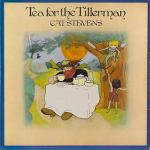
In my review of the 45 RPM Tillerman, I noted the following:

Recently I was able to borrow a copy of the new 45 cutting from a customer who had rather liked it. I would have never spent my own money to hear a record put out on the Analogue Productions label, a label that has an unmitigated string of failures to its name. But for free? Count me in!

The offer of the new 45 could not have been more fortuitous. I had just spent a number of weeks playing a White Hot pink label original UK pressing in an attempt to get our new playback studio sounding right.

We had a lot of problems.

We needed to work on electrical issues.

We needed to work on our room treatments.

We needed to work on speaker placement.

We Repeated Our Mistake
(more…)

Bennett and Basie – We Was Wrong about Strike Up The Band

More of the Music of Tony Bennett

More of the Music of Count Basie

Years ago we thought the Emus reissues were the best sounding pressings of this album, but we was wrong and we don’t mind admitting it. We live and learn just like anybody else who plays different pressings of their favorite albums in search of the best sounding versions.

We don’t know it all and we’ve never claimed to. Having done shootouts for thousands upon thousands of titles, we’re bound to make mistakes from time to time. What could be more predictable?

Our erroneous comment from years back went a little something like this:

The originals we have played are uniformly horrible sounding compared to these wonderful reissues – the tonality here is Right On The Money.

The originals tend to be harsh and shrill, and on a big band record like this one, that is simply not a sound that can be tolerated, much less enjoyed.

But the right originals do not have those problems, and those are the ones we offer our customers, along with the better pressings on Emus.

Findings Overturned

We’re so used to the conventional wisdom being wrong, and having our own previous findings overturned by new ones, that in listing after listing we take the time to point out just how wrong we were. (And of course why we think we are correct now.)

A common misperception among those visiting the site is that we think we know it all. Nothing could be further from the truth.

We learn something new about records with practically every shootout.

(more…)

It Ain’t Easy Being a One-Man Band

How to Go About Improving Your Critical Listening Skills

I should know. I was a one-man band working 60 to 80 hours a week with very little help until about 2000. I had someone cleaning records and packing and shipping, but everything else was on me. It was a lot.

In order to evaluate the qualities of the titles I was selling back then, whether on Heavy Vinyl or thin, imported or domestic, original or reissue, the process was the same.

I would play the record, and I would listen for the qualities that were important to me, qualities you might say were of a “make it or break it” nature.

What I mostly wanted to know about the record was whether it was:

  • Tonally correct.
  • Big enough.
  • Clear enough.
  • Balanced from top to bottom.
  • Energetic.
  • Present in the midrange.
  • Not bass shy.
  • Not rolled off in the high frequencies.
  • Not compressed.
  • And, finally, whether it would appeal to a wide enough audience to make carrying it worthwhile.

If I had other pressings of the same title to audition, which, to be honest, sometimes I did not, I would play those to see how they compared.

For some records this was not easy. To give just one example, for many of the Speakers Corners Decca classical pressings, I rarely had especially good pressings to judge them by.

I might have had some Londons and some Stereo Treasurys I could throw on, but good sounding, brand new Heavy Vinyl pressings on quiet German vinyl for $35 each did not warrant a big shootout back in those days. I was too busy doing other, more profitable things to keep the business alive.

If the Heavy Vinyl reissue sounded right to me, I said as much and sold it, figuring for $35 the customer who bought it was getting a good record at a fair price. (In constant dollars, those records would be more than $60 today.)

And of course the stereo I had back then (all tube and very powerful, but richer, darker and dramatically less revealing) set a low bar, one that was a great deal easier to get over than the ruthlessly revealing stereo we use now. (More on that subject here.)

I had someone cleaning records for me, sure, but to take the time to clean and play a pile of classical pressings was simply not the best use of my time. I would approve of the sound of whatever pressing I had just auditioned, something along the lines of “good” to “great,” and then write a short review to go in the next catalog.

Many of the records that passed these tests don’t sound all that good to me now. I clearly had a lot to learn.

And I had no other option but to understand records and audio at a higher level because the success of the business depended on it.

There was just too much money on the line at the prices we needed to charge. We, as a company, were forced to deliver a clearly superior product or the discipline of the market would come crashing down on our heads and put an end to our crazy experiment in “Hot Stampers.”

Lack of Resources

When you operate as a one-man band, you simply do not have the resources to clean and play enough copies of a given album to make accurate judgments about their sound.

Everybody makes mistakes, but small sample sizes increase the frequency of mistakes by orders of magnitude, especially a sample size as small as one. More on that here.

Here is another example of a sample size of one, because the three other pressings have very little chance of offering top quality sound. They’re what an audiophile who’s been asleep for the last twenty years might find on his record shelf. We find it hard to take seriously anything such an audiophile would say.

No Resources Needed

The current crop of audiophile reviewers appears to be writing for those who are generally satisfied with the Heavy Vinyl pressings being made today.

The reviews they do are easily carried out by those with an obvious aversion to the serious, disciplined, intense work it would take to do them properly.

They get one of these new records in, they give it a spin and they tell everybody how great it is. The advertisers like it, their readers like it, the labels like it, and everybody is happy as a clam.

When troublemakers like us come along, we upset that one-hand-washes-the-other arrangement, and before long everybody gets real upset real fast. Nobody wants that. They want to keep selling Heavy Vinyl because that is what can be produced, in volume, at a reasonable cost, then advertised and distributed easily and, most importantly, priced affordably.

Win win win win win. So much winning!

If you want something better sounding, from us, it will most likely cost you a pretty penny. It will be every bit as good as we say it is, but it will not be cheap and it will rarely be have any collector value.

Collecting for the Sake of Collecting

It appears as though the vast majority of record loving audiophiles really like collecting records. If I had to guess, I would venture it’s at least 95% and perhaps more. The five per cent that do not fall into that category are unlikely to want to spend their life savings on our pricey, not-especially-collectible pressings.

Our records have virtually no resale value. All their value is tied up in their sound.

That leaves our potential pool of customers at less than one per cent of all the record-loving audiophiles who want better sound and can afford it. Subtract the number of them who don’t like me personally — judging by what I read on Hoffman’s forum it seems like a lot — and you have a fairly small cohort of customers from which to draw.

Thankfully, it is big enough to keep our business going and food on the table for the ten dedicated. music-loving men and women who supply the world with Hot Stamper pressings. Nobody is getting rich, even at these prices, but we’re making a living and providing a service which people really appreciate, or at least that’s what they tell us.

(more…)

What to Listen For on Songs from the Big Chair

More of the Music of Tears For Fears

More of Our Favorite Art Rock Albums

Below you will find an excerpt from the commentary associated with a shootout winning pressing we discovered a while back:

There is one quality that the best copies always have and that the worst copies always lack: Frequency Extension, especially on the top end.

When you get a copy like this one, with superb extension up top, the grit and edge on the highs almost disappears. You can test for that quality on side one very easily with the percussive opening to Shout. If the harmonics and air are present at the opening, you are very likely hearing a top quality copy.

Side one here has smooth, sweet, analog richness and spaciousness I didn’t think was possible for this recording. The bass is full and punchy. When it really starts cooking, like in the louder, more dynamic sections of Shout or Mothers Talk, it doesn’t get harsh and abrasive like practically every other copy I’ve heard. It’s got energy and life, and it gets loud when it needs to without making your ears bleed.

There is wonderful transparency and presence in the vocals, not to mention a really deep soundstage. This copy trounced nearly all of the other pressings we played in terms of bringing the music to life while still keeping the aggressiveness of the presentation under control.

A Classic

This is a classic in the Tears for Fears canon, probably the album most people regard as their best. I myself prefer Seeds of Love, a near perfect pop masterpiece and one I have played hundreds of times from start to finish. (It helps to have it on cassette.)

All of which takes nothing away from Big Chair — it’s one of the top albums from the 80s no matter how you slice it. It went to Number One on the charts for a reason. There’s really not a bad song on either side, and quite a few absolutely brilliant ones.

(more…)

Dvorak’s Symphony No. 9 – An Overview of Decca’s Recordings

More of the music of Antonin Dvorak (1841-1904)

This commentary was written close to a decade ago, when we were first trying to figure out which pressings and performances of the work were worth pursuing.

Please to enjoy.

We got off to a rough start with this piece of music. The early pressings we played were often sonically uninspiring, and that’s being charitable.

The London pressings with Kubelik (CS 6020) that we had thought were competitive with some of the better recordings we had on hand turned out to be disappointing.

The strings were often hard and shrill, the overall sound crude and full of smear.

These Londons cost us a pretty penny owing to the high quality condition we require them to be in for our shootouts. In the end, all that time, effort and money was for naught. A big chunk of dough was headed down the drain.

The Stereo Treasury pressing of this same performance sounded better to us than any of the Bluebacks we played but far from competitive with the recordings we ended up preferring.

The Londons and Deccas from 1967 with Kertesz conducting the LSO also left much to be desired sonically. After hearing the 9th on both London and Decca, we did a quick needle drop on the other symphonies from the complete cycle that Kertesz conducted and concluded that none of them were worth our time.

The trade-in pile was growing ever taller.

Then some good news came our way when we dropped the needle on the Decca/London recording with Mehta and the LA Phil. Our best London sounded shockingly good, much better than the one Decca pressing we had on hand.

His 8th Symphony (CS 6979) is also quite good by the way.

This is surprising because we rarely like anything by Mehta and the LA Phil. from this period — the recording in question is from 1975 — but of course we are happy to be surprised when the recordings sound as good as the ones we played.

The one that seemed to us to be the best balance of sound and performance was conducted by Istvan Kertesz, but not with the LSO.

His recording with the Vienna Philharmonic in 1961, his debut for Decca as a matter of fact, is the one that ended up winning our shootout of a dozen pressings or so.

We prefer a later mastering of the recording though, not the original.

Here are more reviews of music conducted by Kertesz, a man whose work we very much admire.

(more…)

Bruch in Living Stereo – Two Vastly Different Sides

Hot Stamper Pressings of Recordings Featuring the Violin

This listing is at least ten years old, perhaps even fifteen.

WHITE HOT Stamper sound for the Bruch side of this original RCA Shaded Dog, one of the best Heifetz concerto titles of all time. (I’m trying to think of a Heifetz title that sounds better and coming up blank.)

[UPDATE: As of 2023 we know of a couple so stay tuned.]

This was our shootout winner on side two, beating all comers, earning our highest grade, the full Three Pluses (our blue ribbon, gold medal, and best in show all wrapped into one). The sound is nothing short of DEMO DISC QUALITY.

If you want to demonstrate the magic of Living Stereo recordings, jump right to the second movement of the Bruch. The sonority of the massed strings is to die for. When Heifetz enters, the immediacy of his violin further adds to the transcendental quality of the experience. Sonically and musically it doesn’t get much better than this, on Living Stereo or anywhere else.

The violin is captured beautifully on side two. More importantly there is a lovely lyricism in Heifetz’s playing which suits Bruch’s Romantic work perfectly. I know of no better performance.

The performance of the Vieuxtemps Concerto No. 5 is also wonderful, but the sound is not. Want proof that two sides of the same record can have vastly different sound? Here it is. Note how oversized the violin on side one is, how smeary the orchestra, how little texture there is to anything in the soundfield. This side one is no Hot Stamper.

And yet somehow side two won our shootout with the best sound we have ever heard for the Bruch. Go figure.

More records for which we’ve detailed the strengths and weaknesses of a specific shootout copy.

(more…)

Letter of the Week – “The copy I bought from you 100% blew my mind, with no wiggle room….completely blown!”

Hot Stamper Pressings of the Music of Led Zeppelin Available Now

One of our good customers had this to say about a Hot Stamper pressing he purchased recently:

Hi Tom,
I’ve been waiting for the right time to play the RL WHS LZII. It finally happened last night. I do have a LZ II with RL on side 1, and I was previously quite happy with it. I did prefer it over all the other copies, both regular and audiophile.

However, the copy I bought from you 100% blew my mind, with no wiggle room….completely blown!

JB’s drum kit is coming right out of the speakers like there is no tomorrow. I think I lost my mind while listening to Heartbreaker, a song I like but never really fully enjoyed……until NOW.

The room is never big enough for this one. Those punches of sound were so punchy, like George Foreman hitting Ali… massive.

Side 2 of this album is nothing short of phenomenal. I’m not sure if I own another LP that rocks like this RL one does. No wonder you made a top ten list just so you could put this one on it.

Someone will ask me or comment…why on earth would you spend $2400 on a record? To that person I will say… I am not buying a record. I am buying an experience that I can repeat as many times as I like, over and over again. To me, listening to this music in this way is priceless.

I truly don’t have the words to express what utter joy my being felt while listening to this. Can’t wait to do it again.

(more…)

For the Best Sound, Stick to the 360s on Parsley, Sage, Rosemary and Thyme

More of the Music of Simon and Garfunkel

More superb sound from the legendary CBS 30th street studios in New York!

This album checks off some big boxes for us here at Better Records.

Turn up the volume, turn down the lights, and you’ll have one of the best — if not THE best — folk duos of all time performing right there in your listening room for you. The sound is open, spacious, and transparent with breathy vocals and unusually low levels of spit. The strings are more dynamic than we’re used to hearing and the bottom end has really nice weight to it.

These old Simon & Garfunkel records weren’t often owned by audiophiles who kept their records in pristine condition. 

No, these were the popular records of their day, purchased by the record-buying public, and they were played and played hard, typically on cheap equipment. There are many quiet passages on this album that are going to reveal whatever surface issues might exist, so a copy that plays Mint Minus Minus is about as good as you can hope for.

Since only the right vintage 360 pressings have any hope of sounding good on this album, that will most often be the playing condition of the copies we sell.

(more…)

What Causes Lifeless and Pointless Sound?

More of the Music of Chuck Mangione

We did a shootout for this album in 2012 and had a hard time finding much energy in the music. That is, until we stumbled upon a few good copies, which showed us just how well recorded the album was and how enjoyable the music could be on the right pressing.

It’s shocking just how lifeless and pointless Feels So Good can sound on some copies.

After only a few minutes the band seems to be having a hard time staying awake.

But the same performance is captured on every pressing, so how can the band sound so inspired here and so uninspired elsewhere?

It’s one of the mysteries of recorded media, one which still takes us by surprise on a regular basis, every week in fact.

This idea that most pressings do a poor job of communicating the music still has not seeped into the consciousness of the audiophile public. Here at Better Records, we’ve been diligently working to change that for close to twenty years, one Hot Stamper at a time.

The copies that are present, clear, open, transparent and energetic, with a solid rhythmic line driving the music, are a hundred times more enjoyable than the typical pressing that can be found practically unplayed (gee, I wonder why?) sitting in most record collections.

By the way, if you know Feels So Good only through the radio, you may be surprised to find that it’s close to ten minutes long, not the three minutes you’re familiar with. The band stretches out quite a bit and the solos are fairly inventive, as AMG noted.

This very side two has that problem to a fair degree; it’s a bit too murky and veiled to be as much fun as side one. But so few copies were any good at all that it still earned an A+ grade. If you turn it up it helps it quite a bit. Still, it lack extension high and low compared to this side one. (more…)

The Original Mercury Pressings Don’t Sound Good on this Title, But Why?

Hot Stamper Pressings of Mercury Classical Recordings Available Now

For Mercury classical and orchestral recordings, the original FR pressings (when there are such pressings) on the plum label are the way to go, right? 

In some cases, yes. We talk about how much better the FR pressings for The Firebird are compared to the much more common, and still quite good, M2 reissue pressings here.

And the FR pressing of the Rachmaninoff record you see pictured above may indeed have the best sound.
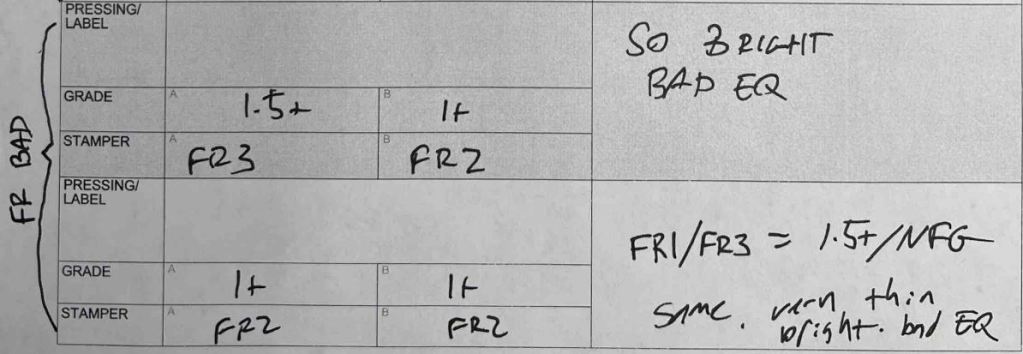

The stamper numbers you see below belong to a different album.

(We’ve lately been giving out much more stamper information than we used to, but for now we are keeping this title closer to the vest.)

Note that we had FR1, FR2 and FR3, all originals, yet none of them could be considered good enough to offer our customers.

It’s just another one of a number of rules of thumb collectors use (“A method or procedure derived entirely from practice or experience, without any basis in scientific knowledge; a roughly practical method.”), one that will sometimes lead you astray if what you are trying to find are not just good sounding pressings of albums, but the best sounding pressings of albums.

Same with reissue versus original. Nice rule of thumb, but it only works, to the extent that it works at all, if you have enough copies of the title to know that you’re not just assuming the original is better. You actually have the data — gathered from the other LPs you have played — to back it up.

Who knew the recording would sound so much better on the right reissue pressings?

(more…)