con-wis

Many audiophiles are inclined to believe the conventional wisdom they receive from other enthusiasts.

Some of it is right, some of it is wrong, but if you don’t know how to critically listen to records for yourself, you will never be able to tell which is which.

You’ll be stuck with the approaches most audiophiles use — guessing and assuming. Neither are a reliable method for getting at the truth.

It Took Us More than Twenty Years to Figure Out What Was the Problem

Hot Stamper Pressings of the Music of Neil Young Available Now

Years ago — precisely how many we can’t really say, the old listings for those records have been deleted — we thought the original pressings in the nameless cover you see pictured had the best sound.

We thought the pressings that came in this early cover were the ones that were made from the original mix, the mix that Neil later disowned. (More on that below.)

We had played a number of copies that came in the original cover, and they sounded better to us than the others we had auditioned.

Our mistake was not understanding that pressings made with the first mix and pressings made with the second mix both came in the early cover, and both were pressed on the Reprise Two Tone label.

Here is what we wrote some years ago:

It turns out the remixed pressings we’d been selling for years were not the way to hear this album at its best. Neil wanted his voice to sound clearer and more present than the first mix, but the approach the engineers took to increase the clarity and presence was simply to boost the middle and upper midrange, a boost that seriously compromises the wonderful Tubey Magic found in the rich lower midrange of the original mix.

Neil may have liked the sound of his voice better on the new mix, played back on whatever mediocre-at-best stereo he was using at the time, but we here at Better Records are of a decidedly different opinion. On a modern, highly-resolving system Neil’s voice will not sound the least bit “buried” on the original mix, not on the better pressings anyway. Of course, the better ones are the only ones we sell.

If you want to hear this album sound right, we strongly believe that the original mix is the only way to go. And if you want to hear this album sound really right, better-than-you-ever-thought-possible right, you need a copy that was mastered, pressed and cleaned properly, and that means a Hot Stamper from Better Records.

It turns out the stampers for the pressings we like are the ones made from the remixed tapes.

(more…)

Letter of the Week – “I dropped the needle on side one and started singing by the end of the first verse.”

Hot Stamper Pressings of the Music of Neil Young Available Now

One of our good customers had this to say about some Hot Stampers he purchased recently (emphasis added):

Hey Tom,  

Two fantastic finds; well done once again. The After the Gold Rush you sent is incredibly revealing. The pressing removed the veil. This LP typically sounds dull and I don’t mean the songs.

I dropped the needle on side one and started singing by the end of the first verse. I had planned to have a critical listen first as I always do, so I have a reference in which to make comparisons. If an album is great I start to sing the second time thru. That should tell you what I think of this pressing.

When I played my copy it lasted one verse and one chorus before it was removed from the platter. Exceptional pressing!!! 

Re: Rubber Soul. I have 3 copies of this LP, all Parlophone and all earlier pressings than the one I purchased from you. One doesn’t really count because it is from the very first pressings that had problems.

However, the other 2 are very good pressings. One is very transparent but extremely bass shy. The other is very much the opposite. It has lots of whomp but is grainy.

The pressing from Better Records is beautifully transparent, especially in the voice, and is nowhere near as bass shy.

I believe that being closest to the source usually reveals more accuracy.

That goes for most every discipline of study. This pressing, though not being the actual closest, was the winner. Go figure!

(more…)

1A, or Is 1B Better on Parsley, Sage, Rosemary and Thyme? Your Guess Is As Good As Mine

Hot Stamper Pressings of the Music of Simon and Garfunkel Available Now

UPDATE 2024

Speaking of 1A and 1B, the evidence is in. We have now confirmed that one of these sets of stampers (one for each side) can win shootouts. Which of the two it is we will leave to you to discover, as we make it a point never to give out the shootout winning stampers except under the rarest of circumstances. We give out plenty of stamper information, just not the stampers of the winners.


We now return to our commentary from many years ago:

Before we go any further, I have one question:

Why are we guessing?

I received an email recently from a customer who had gone to great pains to do his own shootout for a record; in the end he came up short, with not a lot to show for his time and effort. It had this bit tucked in toward the end:

Some of [Better Records’] Hot Stampers are very dear in price and most often due to the fact that there are so few copies in near mint condition. I hate to think of all the great Hot Stampers that have ended up in piles on the floor night after night with beer, Coke, and seeds being ground into them.

Can you imagine all the 1A 1B or even 2A 2B masters that ended up this way or were just played to death with a stylus that would be better used as a nail than to play a record!

To be clear, it’s extremely unlikely than any Hot Stampers have ever ended up in piles on the floor. Hot Stampers are not just originals or good sounding records.

They are pressings that have been cleaned, gone through the shootout process and found to be superior to their competition. Until they prove themselves, records like the ones whose unfortunate fate this reviewer fantasizes about are just old records that had the potential to sound good but never got the chance to demonstrate they had better sound than other pressings.

As it so happens, shortly thereafter I found myself on Michael Fremer’s old website of all places, where I saw something eerily similar in his review for the (no doubt awful) Sundazed vinyl. I quote below the relevant paragraphs.

(more…)

We Learned a Valuable Lesson About Goats Head Soup in 2016

More of the Music of The Rolling Stones

Presenting a classic case of live and learn.

We would agree with very little of what we had to say about Goat’s Head Soup as a recording when we wrote about it back in 2011 — and for the previous 35+ years since I had first played a domestic original. (Turns out the imports are no good either.)

Having done a big shootout for the album in 2016, we now know that there most certainly are great sounding pressings to be found, because we found some. We broke through.

The data are in, and now we know just how wrong we were.

In our defense, let me just ask one question: Did anybody else know this record was well recorded? I can find no evidence to support anyone having ever taken such a contrarian position.

But we’re taking that position now.

All it takes is one great sounding copy to show you the error of your ways, and we had more than one.

Here’s what we had to say back in 2011. After having played dozens of copies and never hearing the record sound more than passable, can you blame us?

(more…)

Stop Doing These Things and You Too Will Start Finding Better Sounding LPs

Our Guide to Collecting Better Sounding Records

We’ve learned through thousands and thousands of hours of experimentation that there is no reliable way to predict which pressings will have the best sound for any given album.

The impossibility of predicting the sound of individual pressings is one which we’ve learned to accept as axiomatic. As a scientifically-oriented person and a born skeptic, this was a concept I had never had any difficulty wrapping my head around.

At some point in my audio career, probably in the early-90s, about twenty years into my audio journey, I realized it was in fact beyond dispute. Like it or not — and, based on what I read on forums and such, there apparently is a sizable number of audiophiles who don’t like it — it was simply a fact.

What to Stop

Given the unpredictable nature of records, the five most important aspects of the solution we put into practice were these:

  1. We stopped pretending we could know something that can’t be known. [1]
  2. We stopped relying on theories proven to have virtually no predictive effect. [2]
  3. We stopped paying attention to the experts and so-called authorities. [3]
  4. We stopped assuming and speculating. [4]
  5. We stopped worrying about getting it wrong. [5]

It took many years, decades even, to learn what worked and what didn’t work in our pursuit of better records. We came to realize over that span of time that the five things listed above were hindering us in doing our job, so we stopped doing them.

What remained was the simplest possible approach to the problem. One that could be taught in a high school science class, if high school science classes were run by experimentally-minded record collectors.

  1. Guess what pressings might be good for a given album.
  2. Buy some of those pressings and others like them.
  3. Clean them up, play them and see if your guess about the sound of the pressing turns out to be right, wrong or somewhere in-between.
  4. Repeat steps one through three until you chance upon a pressing that sounds better than all the others.
  5. Get hold of as many of those as you can and play them against each other under rigorously controlled conditions.
  6. Continue to make other guesses and acquire other pressings to play against the pressing you believe to be the best.
  7. Keep making improvements to your playback system and never stop testing as many alternate pressings as possible.

That’s it. Nothing to it. It all comes down to experimenting at a sufficiently large scale to achieve higher rates of success.

Failing Forward

Edison is said to have failed 10,000 times before inventing a light bulb filament that had a practical use.

Most audiophiles do not have the time and money, not to say patience, needed to fail again and again this way.

For us, having a full-time staff of ten and a rather large record buying budget, we see failures as just another part of the job. Our successes pay for them, since obviously somebody has to, Milton Friedman’s famous remark about free lunches being as true as ever. This partly accounts for our prices being as high as they are.

We don’t make a dime from writing about records that don’t sound good to us. We review them as a service to the audiophile community. We play them so that you don’t have to.

(more…)

Who Knew that Dylan Could Sound This Good in 1983?

Hot Stamper Pressings of the Music of Bob Dylan Available Now

This vintage copy of Infidels could not be beat. Big and rich, with correct tonality from top to bottom, strong bass and plenty of space, this copy sounded just right to us.

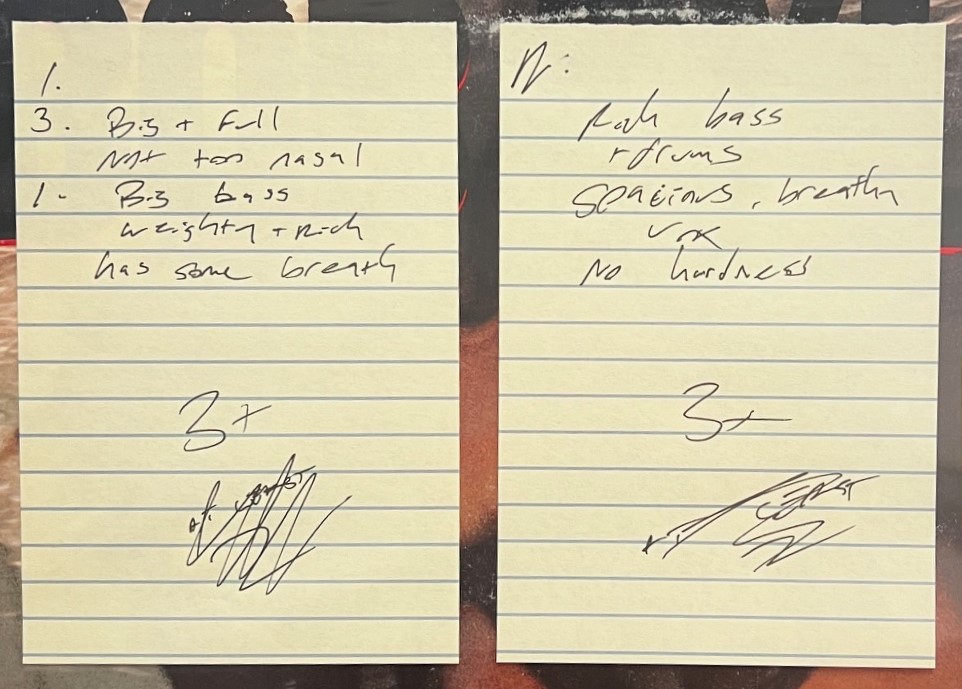
Our post-it notes tell the album’s story. (By the way, if you like reading our post-it notes, we’re putting more and more of them on the blog these days. We talk about the importance of taking notes  as part of the shootout advice we share. This post will help you with the basics.)

Side One

Track Three

    • Big and full
    • Not too nasal

Track One

    • Big bass
    • Weighty and rich
    • Has some breath

Side Two

Track One

    • Rich bass and drums
    • Spacious breathy vocals
    • No hardness

What We Learned

What do these notes have to tell us, other than this is a much better recording than it’s given credit for?

On side one, the vocals have a tendency to get nasally, sounding like Dylan is singing through his nose, not his mouth, a common problem with Dylan records from every era.

Also. when we say “has some breath, ” that basically means that most pressings on side one are not especially breathy in the mids, but this one is better in that department.

Not that the original grade was “at least 2,” and after going through all the copies, it turned out nothing could be beat this one. Some breath was probably more breath than any other side one we played.

On side two, the sound had “no hardness, ” and again, that simply means plenty of copies, maybe all the other copies, suffered from hardness in the vocals. “At least 2” turned into our Shootout Winner when no other copy could beat it.

Who Knew?

Has any other audiohile reviewer ever said a kind word about this album, other than us of course?

Not that I know of.

And we’re as guilty as any of them in assuming that 1983 was not a good year to be recording Dylan and expecting audiophile quality sound.

But we were proven wrong once again, by the only method that can possibly be relied upon to supply the truth: experimentation.

(more…)

Do All the Early Stamper Shaded Dog Pressings of this Title Sound Good?

Hot Stamper Pressings of Living Stereo Recordings Available Now
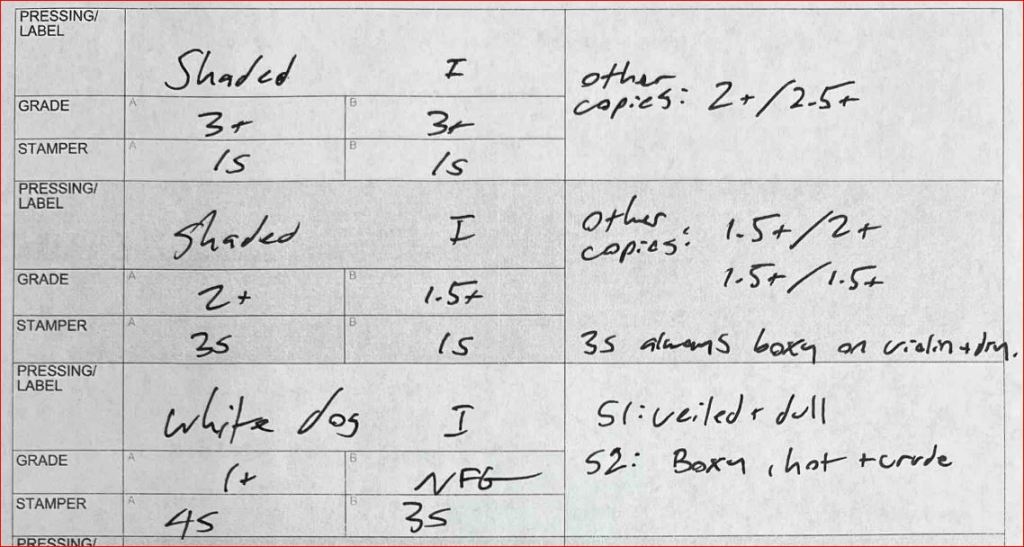
Below you will see the complete stamper sheet for a shootout we did recently.

Note that the album you see pictured — LSC 2265 — is not the record we did this particular shootout for.

We are not revealing what record had these stampers and earned these grades for the simple reason that we rarely if ever give out the specific information that identifies the best sounding pressing of any album.

As I’m sure you can understand, we want you to buy the copy with the Hottest Stampers from us, not find one on your own! We’re happy to be somwhat helpful, but naturally we find it necessary to draw the line somewhere, and giving out “the shootout winning stampers” are where we choose to draw it.

One set of stampers for the mystery Shaded Dog pressings we played in our most recent shootout sounded consistently subpar.

The sound on 3s was boxy and the violin was dry. This was surprising as the stampers are quite low: 3s/1s.

Many RCA chamber recordings can be dry, and if one owned a nice early stamper pressing of the album with boxy, dry sound, one might conclude that this RCA is just another chamber recording with those shortcomings.

But one would be wrong, because the 1s stamper shootout winner sounded amazing, not dry or boxy in the least.

How Come?

Since, as we discovered recently, 1s wins, and handily, why does 3s/1s do so much worse?

Who knows?

And why is the White Dog barely passable on side one and just awful on side two?

Your guess is as good as mine.

More of the Same

Below you will find links to other records we’ve played that had the same problems as our mystery RCA here.

(more…)

The Reissues Consistently Beat the Originals on this Mercury

Hot Stamper Pressings of Mercury Classical Records Available Now

For Mercury classical and orchestral recordings, the original FR pressings on the plum label are the way to go, right? 

In some cases, yes. We talk about how much better the FR pressings for The Firebird are compared to the much more common, and still quite good, M2 reissue pressings here.

The stamper numbers you see below belong to a different album.

The notes for the FR original pressings we played read:

  • Less spacious, more bright and flat.

They’re not bad sounding, they’re just not as good sounding as the RFR reissues, which, incidentally, won the shootout.

We’ve lately been giving out much more stamper information than we used to, but we make it a point to never give out the stamper information for our shootout winners, as finding those very special pressings has been the work of a lifetime and is certainly not something that should be given away for free.

Rules of Thumb

It’s just another one of a number of rules of thumb collectors use (“A method or procedure derived entirely from practice or experience, without any basis in scientific knowledge; a roughly practical method”), one that will sometimes lead you astray if what you are trying to find are not just good sounding pressings of albums, but the best sounding pressings of albums.

Same with reissue versus original. Nice rule of thumb, but it only works, to the extent that it works at all, if you have enough copies of the title to know that you’re not just assuming the original is better. You actually have the data — gathered from the other LPs you have played — to back it up.

Who Knew?

Who knew the recording would sound so much better on the right reissue pressings?

Certainly not us, not until we had done the shootout.

The difference between the way we do things and the way others do them boils down to this: We assumed that the original could be the best, and then we tested that assumption and found out we were wrong.

But the right reissues of this Mercury — again not the ones you see pictured — is indeed an exceptionally good sounding record.

This is why we do shootouts, and why you must do them too, assuming that owning the highest quality pressings is important to you.

(more…)

Letter of the Week – “Smokes the best of my three UK 1st press red apple covers I have collected.”

Hot Stamper Pressings of Let It Be Available Now

Our customer Michael S. wrote to tell us how much he likes his Hot Stamper pressing of Let It Be.

Hi guys,

The Let It Be 3+/3+ I bought from you few weeks ago is an absolute stunner that smokes the best of my three UK 1st press red apple covers I have collected over the last few years. Thanks again and keep’em coming!

All the best,

Michael S.

Michael,

Thanks for writing. That’s great to hear.

You could buy fifty of those original pressings and the White Hot Stamper pressing we sent you would smoke every last one of them.

We don’t bother with them because we know which pressings can beat them, so why waste the money for the so-called “original” when the reissue is — as you now know — superior sounding?

The conventional wisdom that the original is the way to go with most Beatles records is something we learned was mistaken more than 30 years ago and nothing has changed our minds about it since then, and that’s after having played literally hundreds and hundreds of Beatles records in the ensuing years.

(more…)

Domestic Pressings of Clear Spot? Forget ‘Em!

Hot Stamper Pressings of the Music of Captain Beefheart Available Now

We did this shootout many years ago, so many years ago that I cannot find a record of it.

I remember we thought the German pressings were perhaps a bit boosted on both ends and not as natural sounding as the domestic pressings.

After a multitude of improvements in our cleaning and playback, we would agree with our previous understanding that the German pressings are often wrong, but now we also know how right the right ones can be.

It turns out tha some German pressings are not particularly good, another piece of the puzzle that fell into place during our most recent shootout, as painful as that turned out to be considering the money wasted on them.

Did we have the bad German stamper pressings last time around? Who knows?

The producer, Ted Templeman, (Doobie Brothers, James Taylor) brought his mainstream talents to bear on this music, and when the Captain’s free-form tendencies smashed into Templeman’s conservatism, the result was this musical supernova — out there, but not too far out there.

(Play Trout Mask Replica sometime if you miss that feeling from your old hippie days of being on acid. With that music, drugs are entirely superfluous.)

I don’t know how many audiophiles like Captain Beefheart, probably not too many, but if you’re ever going to try one of his albums, this is the place to start: his masterpiece.

(more…)