 Hot Stamper Pressings of Blue Note Albums Available Now
If there are record companies whose fans are extremely particular about the labels of the pressings they prefer, Blue Note has to be right at the top of that list.
The consensus among record collectors seems to be that the early label Blue Notes are practically guaranteed to have the best sound. In top condition they often sell for many thousands of dollars, far more than we have ever charged for any Hot Stamper Blue Note pressing
We are on record as not favoring early labels over later ones, absent the evidence to support such bias, but perhaps there actually are some records you should be buying based on their labels. This one, for example.
If all the stampers of a title are the same and they’re all cut by Rudy Van Gelder — early labels, middle labels and later labels alike — what do you use to guide you when trying to find the best sounding pressings?
This is precisely the conundrum that an audiophile would be faced with as he goes about trying to find the best sounding pressings of the Blue Note album whose stamper sheet you see below.
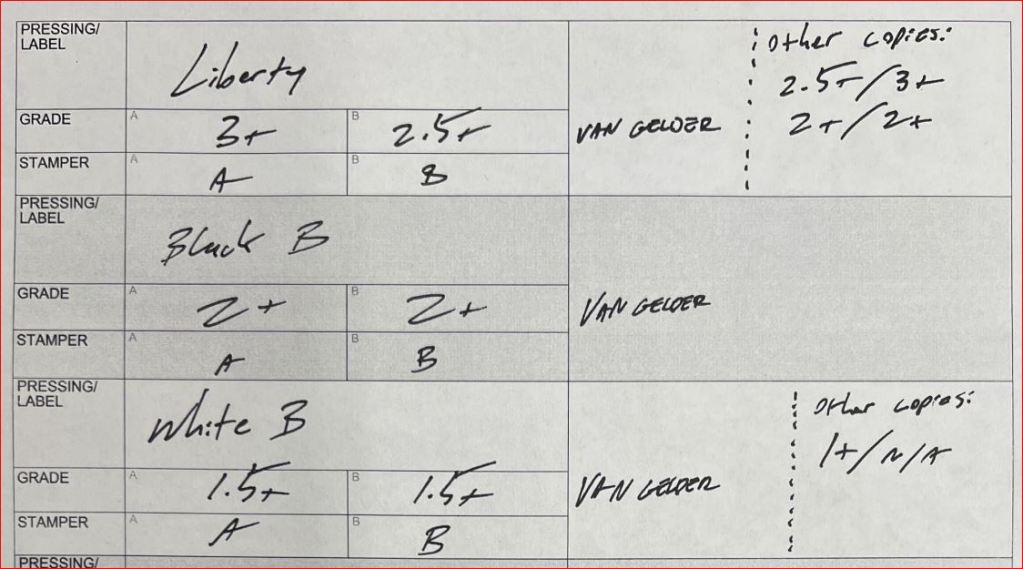
This stamper sheet reflects a fairly typical shootout for a Blue Note pressing. It’s hard to find six clean copies no matter what the title is. We probably returned or gave up on half the copies we bought, so we might have had to buy nine in order to shootout six.
(Note that there is nothing on any label after the White B from the 70s. We have never heard any title with an 80s label or later sound worth a damn so we stopped buying them a long time ago.)
Drawing Conclusions
Let’s look at some of the conclusions the typical record collector/audiophile might draw from the information above.
For example:
1.) I have a Blue Note with Van Gelder stamps and it’s decent sounding but I like [fill in the blank with some other pressing] better. Since all the pressings are cut by him, he must not have done a very good job. Thank goodness modern mastering engineer X came along to finally bring out the sound of the master tape that he was not able to do.
That’s an easy one to rebut. The later pressings cut by Rudy are consistently worse sounding than the earlier ones in the case of this title. If you don’t have a big batch to work through, however, you simply have now way of knowing that fact, and therefore whatever conclusions you choose to draw from a too-small pool of pressings are suspect at best.
2. I have a Liberty pressing and a Black B pressing — same stampers, same VAN GELDER mark — and of course they sound identical. My advice: You can save yourself a lot of money by just buying the later, less-collectible, less-expensive pressings.
You may be right and you may be wrong about that. One later pressing was Super Hot (2+) and one early pressing had that same grade. But two other early pressings had better sound, including our White Hot shootout winner, which is clearly a step up in sound from the Super.
And of course, as we never tire of saying, in the world of records everything is relative.
Do you want a good sounding record or do you want a great sounding record?
And how would you know which one you had without comparing enough copies to find out what the best copies do that the next-best copies don’t? (These notes from recent shootout winners should help to bring hom the point.)
3. The lesser of the two White B copies did earn a grade of 1+ on side one, non-Hot Stamper grade that made the record unsaleable, and playing side two pointless.
It’s possible someone could have produced a Heavy Vinyl pressing that would equal it or even best it for sound.
The owner of such a record might say something like: “Wow! My new Heavy Vinyl pressing is better than my Van Gelder-mastered Blue Note with the early stampers, and it plays quiet, and it cost me a whole lot less than the real Blue Note pressing.”
All of which could be true under a set of very specific circumstances that are not impossible, assuming some company could produce a modern reissue of the album that was decent sounding, a reality that is not at all likely and looking less likely by the day, what with so many awful reissues being produced in such large numbers by so many different companies.
This is what happens when small data sets are used as the basis for experimentally logical — but erroneous — conclusions.
When you clean and play lots of records under carefully controlled conditions, you find that the things audiophiles believe about records are mostly basic, comforting notions that succeed in allowing them to avoid spending the money and doing the work that would easily prove them wrong.
If getting at the truth is important to you — and being on this blog is a pretty sure sign that you might just be that kind of audiophile — then we hope our experience with this mystery Blue Note and thousands of other records like it encourages you to do your own shootouts.
In the process you will no doubt demonstrate to yourself that no other method has any real chance of succeeding.
When it comes to stampers, labels, mastering credits, country of origin and the like, we make a point of revealing little of such information on the site, for a number of reasons we discussed in a commentary we wrote many years ago, at the dawn of the Hot Stamper revolution. (Ahem.)
However, in 2024 we decided to reverse our previous policy. We now make available to our readers a great deal of that information, under these four headings:
Please to enjoy.
Some information has been left out, the specific stamper numbers for our Shootout Winners for example, and in the cases where we give out the stampers for the top copies, we do not identify the title of the record with those stampers. As you can imagine, our sizable investments in reseach and development over the course of decades make up a big part of the costs we must pass on to our customers.
We are more than happy to give out some tips — plenty of them in fact.
However, if you really want to find the best sounding pressing of any given title, you have to do the work we did, and that means buying, cleaning, playing and evaluating a big batch of pressings of the same album.
It’s expensive, it’s a huge amount of work, but our experience tells us there is simply no other way to do it.
Further Reading