small-sample

A too-small sample size is the most common source of a mistaken judgment about the sound of any given title.

An Overview of Beatles Oldies But Goldies

Hot Stamper Pressings of the Music of The Beatles Available Now

This is a Beatles album we think we know well.

We’ve done a number of shootouts for A Collection of Beatles Oldies over the last ten years or so, and our experimental approach using many dozens of copies provides us with strong evidence to support the following conclusions regarding the sound of the originals vis-a-vis the reissues:

  1. The best of the early pressings always win our shootouts. No reissue has ever earned our top grade of A+++ and it is unlikely any reissue ever will.
  2. The reissues can be quite good however. The best of them have earned grades of Double Plus (A++).
  3. The worst of the early pressings also earned grades of Double Plus (A++).
  4. Conclusion: if you have a bad original and a good reissue, you might be fooled into thinking the sound quality was comparable.

(more…)

How Do the The Mastering Lab Pressings of Sticky Fingers Sound?

Hot Stamper Pressing of the Music of The Rolling Stones Available Now

A listing for an early domestic Hot Stamper pressing for Sticky Fingers will typically be introduced like this:

If you have never heard one of our Hot Stamper pressings of the album, you (probably) cannot begin to appreciate just how amazing the sound is.

A landmark Glyn Johns / Andy Johns recording, our favorite by the Stones, a Top 100 Title (of course) and 5 stars on Allmusic (ditto).

After hearing so much buzz about it, we finally broke down and ordered a German TML pressing about a year ago. Having played scores of phenomenally good sounding copies of the album over the past fifteen or so years, we were very skeptical that anyone could cut the record better than the mastering engineers who inscribed Rolling Stones Records into the dead wax on the early pressings. (I could find no mastering engineers credited.)

Well, the results were not good. As we suspected would be the case, we were not impressed in the least with what The Mastering Lab — one of the greatest independent cutting houses of all time, mind you — had wrought.

Their version is not really even good enough to charge money for. It might have earned a grade of One Plus, just under the threshold for a Hot Stamper that we would put on the site these days. Decent, but not much more than that.

Wait, There’s More

We subsequently learned that it is the British TML pressings that are supposed to be the best.

So we got one of those in, an A3/B4 copy.

Better, but good enough? Barely.

Here are the notes for the copy we played. For those who have trouble reading our writing, I have transcribed the notes as follows:

Side One

Track one:

Weighty, a bit veiled or smeary. Backing vox kinda lost.

Track three:

Very full, rockin’ but not the sparkle/space.

Kinda compressed.

Not as huge.

Side Two

Track two:

Not as rich, clear.

A bit pushy/dry vox.

No real space.

Thick drums

Track one:

This works better.

A bit hard, but full and lively.

This Sound?

Is this the sound audiophiles are raving about?

(more…)

A Collection of Beatles Oldies on Video – Expert Advice?

The LOST Beatles Album | Cancelled By Apple – Should It Be Re-released?

Click on the link above to see an interesting and informative video that we think is well worth watching.

Allow me to make a few points:

As to the question posed above, my vote would of course be no. The new Beatles albums are awful sounding. Here are a few of rour eviews detailing their many shortcomings:

After playing those three, we gave up on the idea of playing the rest of the set.

The Mono Box (in analog!) was even worse. We played one record, heard truly awful sound, and that was all she wrote.

Mushy Sound Quality

Andrew Milton, the Parlogram Auctions guy, offers opinions about the sound quality of the various pressings he reviews. Naturally we are skeptical of reviewers’ opinions for reasons that should be clear to readers of this blog.

We have no idea how he cleans his records or how carefully he plays his records, or even what he listens for.

Frankly, even if we knew all those things it wouldn’t mean much to us. So many reviewers like so many bad sounding modern records that we’ve learned not to take anything they say seriously.

The comment about the 1G stampers being “mushy” that Andrew makes about 19 minutes in is one we take exception to. Part of the problem with his comment is that we can’t really be sure what he means by “mushy.” If it means smeary or thick, that has not been our experience with the best cleaned originals.

Since the later pressings tend to be thinner and less Tubey Magical, they are probably even less “mushy,” assuming I have the definition of the term right.

My guess is that he has a system with problems like those we had thirty years ago.

Our playback systems from the 80s and 90s were tubier, tonally darker and dramatically less revealing, which strongly worked to the advantage of leaner, brighter, less Tubey Magical pressings such as the reissues of A Collection of Beatles Oldies…

But to say that the 1G stampers were used for both the originals as well as the reissues with the Black and Silver labels and that therefore the sound is the same is definitely a sign that Andrew’s understanding of stampers and pressings is hopelessly incomplete.

What We Think We Know

We have done a number of shootouts for the album over the last ten years or so, and our experimental approach using many dozens of copies provides us with strong evidence to support the following conclusions regarding the originals versus the reissues:

(more…)

The Best Pressings of Love Over Gold Have Surprisingly Natural Sound

Hot Stamper Pressings of the Music of Dire Straits Available Now

This modern album (1982) can sound surprisingly good on the right pressing.

On most copies the highs are grainy and harsh, not exactly the kind of sound that inspires you to turn your system up good and loud and get really involved in the music. I’m happy to report that the best pressings have no such problem – they rock and they sound great when playing loud.

We pick up every clean copy we see of this album, domestic or import, because we know from experience just how good the best pressings can sound.

What do the best copies have?

REAL dynamics for one.

And with those dynamics you need rock solid bass. Otherwise the loud portions simply become irritating.

A lack of grain is always nice — many of the pressings we played were gritty or grainy.

Other copies that were quite good in most ways lacked immediacy, and we naturally took serious points off for that.

The best copies of Love Over Gold are far more natural than the average pressing you might come across, and that’s a recognizable quality we can listen for and give weight to in our grading.

It’s key to the sound of the better pressings, which means in our shootouts it’s worth a lot of points. Otherwise you might as well be playing the CD.

Domestics or Imports?

(more…)

How Not to Conduct a Proper Shootout for Aqualung

UPDATE 2023

This commentary was probably written in 2010 or thereabouts, since that’s the date on Fremer’s Aqualung review, which, for those with much more tolerance for audiophile BS than I am able to muster, can be found here. I’ve made a few changes to the commentary below, but most of the original text is intact.


We recently put up a Hot Stamper Aqualung that just BLEW THE DOORS OFF the CLASSIC 200g pressing. Michael Fremer may think the new reissue is the ultimate pressing, but we sure don’t. 

The Aqualung shootout on his site is priceless. He has so many silly things to say about it, let’s not waste any more time and get right to them.

His Shootout Begins

He says he “… compared Classic’s new 200g reissue with: 1) an original UK Chrysalis 2) an original American Chrysalis/Warner Brothers, 3) an original French Pink Label Island, 4) The Mobile Fidelity ½ speed mastered edition and 5) DCC’s 180g issue mastered by the team of Hoffman and Gray.”

How many of each? One, right? (All the articles in front of the nouns are singular. Assuming MF is using good grammar, how many could there be?)

Mikey, that’s your first mistake.

When it comes to the domestic release, one is a wholly inadequate sample size for pressings that were pumped out by the millions and therefore mastered multiple times. Go to Discogs if you want to see just how many different stamper numbers can be found in the original Reprise pressings. Hint: it’s a lot. Some of them are known to us to be awful, some fall into the middle of the pack, and some we like. Figuring out which are which has taken us a lifetime of work and is well beyond the ability of any single person to decode for more than a few dozen records.

Maybe you got hold of a bad sounding “original American Chrysalis/Warner Brothers,” did you ever think of that? The record bins are full of them.

If you did get hold of a bad one — and all the evidence points in that direction — the time and effort you put into your shootout just went flying out the window, defenestrated as they say.

Shootouts using only a small number of pressings have very little value. Anybody who claims to know anything about records ought to know that.

This next line just floors me.

Now rather than make value judgments, let’s just compare without prejudice.

This guy may not be good for much, but he sure is good for a laugh.

Does he really expect us to believe that the comments that follow are not biased in any way, that they are The Truth, that he is able to measure “intimacy and warmth” and tell us precisely how much of each there is on any given pressing? Who in his right mind thinks like that?  (At this rate he may end up wandering about a park with snot running down his nose, greasy fingers smearing shabby clothes, but let’s hope it doesn’t come to that. Help is available; perhaps Stereophile has a mental health plan under which he could be covered.)

Soon enough he goes on to give his opinion as to the merits of each of the pressings noted above. I’m sorry, did I say opinion? I meant comparisons without prejudice. Sorry, my bad.

The Big Truth

And of course he is more than welcome to make any and all the comparisons he deems fit, each from that lovely sample size of one. And if he wants to add another sample (size = 1) to the mix by playing the DCC gold CD, he’s welcome to do that too, which he did. I’m guessing that his CD player is every bit as accurate as his front end (comprising turntable/ arm/ cartridge/ phono stage/ cables), which, if he were to ascribe a percentage to the accuracy of all the pieces that make up this chain, would have to be in the range of 100% or thereabouts. Or as the late John McLaughlin might say, on a scale of one to ten: ten, meaning Metaphysically Accurate.

No colorations. No imperfections. Pure Truth, and nothing but.

(more…)

White Dogs or Shaded Dogs on the Brahms Piano Concerto No. 2?

Hot Stamper Pressings of Living Stereo Titles Available Now

UPDATE 2024: The review you see below is quite old. We no longer agree with the statement we made back then that the White Dog pressings are better sounding than the Shaded Dogs.

In our recent shootout, the first one I can remember since 2005 — that was 20 years ago! — the White Dogs did not do nearly as well as the Shaded Dogs we played.


This White Dog pressing is the best sounding copy I’ve ever heard, much better than the earlier pressings. The piano doesn’t break up like it does on those, especially in the second movement.

Finally the piano sounds right – solid and with the correct overtones. It goes without saying that this is an exceptionally good performance as well.

One of the best of the Cliburn recordings which, as you may know, are rarely any good, the worst of them being LSC 2252 and the best of them being, probably, LSC 2507.

Seems we got some of this one wrong. Live and learn is our motto, with mea culpa running a close second.

It’s possible that our mistaken judgment about the superiority of the White Dog pressings in 2005 was mostly the result of sample sizes that were much too small. However, I was operating as a one man band back when I was doing all the classical shootouts, so my chances of getting the wrong answer were fairly high, a reality I have documented on this blog in some detail.

I also was not able to clean the records under comparison very well, a problem that has been solved — and then some — by a great many improvements in techniques, machinery and fluids over the last twenty years.

What we could do back then and what we can do now, after twenty years of constant improvement, are as different as night and day, a subject we write about quite a bit under the heading of audio progress.

I’ve also made a habit of admitting my mistakes in the hopes that other audiophile reviewers would consider following suit. To my knowledge this has yet to happen, but hope springs eternal!

(more…)

Years Ago We Badly Misjudged the Recording Quality of Tull’s Debut

Hot Stamper Pressings of the Music of Jethro Tull Available Now

A clear case of live and learn.

We listed a White Hot copy of This Was in 2008 on the Island pink label and noted at the time:

Be forewarned: this ain’t Stand Up or Aqualung. I don’t think you’ll be using any copy of This Was to demo your stereo, because the recording has its share of problems. That said, this record sounds wonderful from start to finish and will make any fan of this music a VERY happy person. We guarantee you’ve never heard this album sound better, or your money back.

Now we know a couple of things that we didn’t back in 2008.

1). This album is a lot better sounding than we gave it credit for years ago. It’s not perfect by any means but it is much better than the above comments might lead you to believe.

We chanced upon an exceptional sounding copy of the album in 2017 or so, and that taught us something new about the record:

2). The Pink Label pressings are not the best way to go on this album.

Once we heard the exceptional copy alluded to above, we played it against our best Pink Label copies and it was simply no contest.

In 2008 we still had a lot to learn. We needed to do more research and development, which of course we are doing regularly with Classic Rock records, our bread and butter and the heart of our business.

We do them as often as is practical, considering how difficult it is to find copies with audiophile quality playing surfaces.

Nine years later, we felt we finally had a proper understanding on the various pressings of This Was. It goes like this:

The Pink Label original British pressings can be good, but they will never win a shootout up against copies with these stampers (assuming you have more than one copy — any record can have the right stampers and the wrong sound, we hear it all the time. Beware of small sample sizes).

(more…)

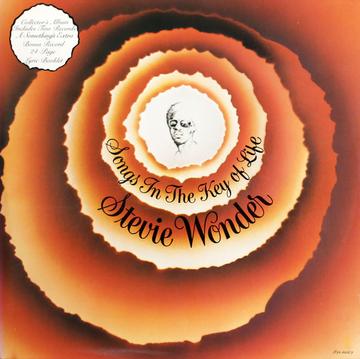
Songs in the Key of Life – Is This a Well-Engineered Album?

Hot Stamper Pressings of the Music of Stevie Wonder Available Now

Full disclosure: This commentary was written more than ten years ago and probably updated a bit here and there since then.


I’ve just gone to this reviewer’s website to make sure the quote below is accurate, and everything you need to see is still up and as misguided as ever.

Some audiophiles never learn, and a great deal of this blog is devoted to helping audiophiles avoid the errors this reviewer and others like him have been making for decades. In the mid-90s I wrote my first commentary about the awful audiophile records this person had raved about in his review in one of the audiophile rags.

In the years since it seems that nothing has changed. Bad sounding audiophile pressings make up the bulk of this person’s favorable reviews to this day. Here are 157 of them.

How it is possible to spend so much time doing something, yet learn so little in the process? It is frankly beyond me.

I put the question to you again:

Is this a well-engineered album?

The first question that comes to mind is:

How on Earth could anyone possibly know such a thing?

Some background. Years ago our first Hot Stamper shootout for Songs in the Key of Life had us enthusiastically singing its praises:

Hot Stampers discovered for one of the funkiest and most consistent double albums of all time! It’s beyond difficult to find great sounding Stevie Wonder vinyl, but here’s a copy that proves it’s possible if you try hard enough. So many copies are terrible in so many different ways — we should know, we played them. And just to be clear, this copy is far from perfect as well, but it did more things right in more places than we ever expected it would or could. And that means it showed us a great sounding Stevie Wonder record we never knew existed.

But a well known reviewer says it’s a bad recording. Does he know something we don’t?

(more…)

It Ain’t Easy Being a One-Man Band

How to Go About Improving Your Critical Listening Skills

I should know. I was a one-man band working 60 to 80 hours a week with very little help until about 2000. I had someone cleaning records and packing and shipping, but everything else was on me. It was a lot.

In order to evaluate the qualities of the titles I was selling back then, whether on Heavy Vinyl or thin, imported or domestic, original or reissue, the process was the same.

I would play the record, and I would listen for the qualities that were important to me, qualities you might say were of a “make it or break it” nature.

What I mostly wanted to know about the record was whether it was:

  • Tonally correct.
  • Big enough.
  • Clear enough.
  • Balanced from top to bottom.
  • Energetic.
  • Present in the midrange.
  • Not bass shy.
  • Not rolled off in the high frequencies.
  • Not compressed.
  • And, finally, whether it would appeal to a wide enough audience to make carrying it worthwhile.

If I had other pressings of the same title to audition, which, to be honest, sometimes I did not, I would play those to see how they compared.

For some records this was not easy. To give just one example, for many of the Speakers Corners Decca classical pressings, I rarely had especially good pressings to judge them by.

I might have had some Londons and some Stereo Treasurys I could throw on, but good sounding, brand new Heavy Vinyl pressings on quiet German vinyl for $35 each did not warrant a big shootout back in those days. I was too busy doing other, more profitable things to keep the business alive.

If the Heavy Vinyl reissue sounded right to me, I said as much and sold it, figuring for $35 the customer who bought it was getting a good record at a fair price. (In constant dollars, those records would be more than $60 today.)

And of course the stereo I had back then (all tube and very powerful, but richer, darker and dramatically less revealing) set a low bar, one that was a great deal easier to get over than the ruthlessly revealing stereo we use now. (More on that subject here.)

I had someone cleaning records for me, sure, but to take the time to clean and play a pile of classical pressings was simply not the best use of my time. I would approve of the sound of whatever pressing I had just auditioned, something along the lines of “good” to “great,” and then write a short review to go in the next catalog.

Many of the records that passed these tests don’t sound all that good to me now. I clearly had a lot to learn.

And I had no other option but to understand records and audio at a higher level because the success of the business depended on it.

There was just too much money on the line at the prices we needed to charge. We, as a company, were forced to deliver a clearly superior product or the discipline of the market would come crashing down on our heads and put an end to our crazy experiment in “Hot Stampers.”

Lack of Resources

When you operate as a one-man band, you simply do not have the resources to clean and play enough copies of a given album to make accurate judgments about their sound.

Everybody makes mistakes, but small sample sizes increase the frequency of mistakes by orders of magnitude, especially a sample size as small as one. More on that here.

Here is another example of a sample size of one, because the three other pressings have very little chance of offering top quality sound. They’re what an audiophile who’s been asleep for the last twenty years might find on his record shelf. We find it hard to take seriously anything such an audiophile would say.

No Resources Needed

The current crop of audiophile reviewers appears to be writing for those who are generally satisfied with the Heavy Vinyl pressings being made today.

The reviews they do are easily carried out by those with an obvious aversion to the serious, disciplined, intense work it would take to do them properly.

They get one of these new records in, they give it a spin and they tell everybody how great it is. The advertisers like it, their readers like it, the labels like it, and everybody is happy as a clam.

When troublemakers like us come along, we upset that one-hand-washes-the-other arrangement, and before long everybody gets real upset real fast. Nobody wants that. They want to keep selling Heavy Vinyl because that is what can be produced, in volume, at a reasonable cost, then advertised and distributed easily and, most importantly, priced affordably.

Win win win win win. So much winning!

If you want something better sounding, from us, it will most likely cost you a pretty penny. It will be every bit as good as we say it is, but it will not be cheap and it will rarely be have any collector value.

Collecting for the Sake of Collecting

It appears as though the vast majority of record loving audiophiles really like collecting records. If I had to guess, I would venture it’s at least 95% and perhaps more. The five per cent that do not fall into that category are unlikely to want to spend their life savings on our pricey, not-especially-collectible pressings.

Our records have virtually no resale value. All their value is tied up in their sound.

That leaves our potential pool of customers at less than one per cent of all the record-loving audiophiles who want better sound and can afford it. Subtract the number of them who don’t like me personally — judging by what I read on Hoffman’s forum it seems like a lot — and you have a fairly small cohort of customers from which to draw.

Thankfully, it is big enough to keep our business going and food on the table for the ten dedicated. music-loving men and women who supply the world with Hot Stamper pressings. Nobody is getting rich, even at these prices, but we’re making a living and providing a service which people really appreciate, or at least that’s what they tell us.

(more…)

We Were Way Off the Mark with Stand Up in 2006

Hot Stamper Pressings of Jethro Tull Albums Available Now

Years ago we wrote:

This Island Pink Label Original British pressing has ABSOLUTELY AMAZING SOUND! We mention that there was a Sunray pressing that may have been even better, but I didn’t have this copy in hand to compare the Sunray to, so I can’t be sure that pressing was any better.

This one sounds as good as any I’ve ever heard. 

It’s amazingly dynamic and powerful, yet full of tubey magic. I played almost ten different pressings of this record today (11/08/06): every domestic label variation and a handful of imports. This copy is clearly the best of the batch.

A textbook case of live and learn.

My stereo was dramatically less revealing back then and also I did not know how to clean records properly. Those two facts, combined with the underdeveloped or yet-to-be-developed listening skills that go with them, allowed me to arrive at the wrong conclusion.

In 2006 we simply had not done our homework well enough. I had been an audiophile for at least 31 years by then, and a legitimate audiophile record dealer for 19.

Sure, by 2006 my staff and I had auditioned plenty of the pressings that we thought were the most likely to sound good: the original and later domestic pressings, the early and later British LPs: in other words, the usual suspects.

The result? We were roughly in the same position as the vast majority of audiophiles. We had auditioned a sizable number pressings of the album and thought we knew enough about the sound of the album to pick a clear winner. We thought the best pink label Island pressings had the goods that no other copies could or would have.

But of course, like most audiophiles who judge records with an insufficiently large sample size, we turned out to be completely wrong.

Logic hadn’t worked. None of the originals would end up winning another shootout once we’d discovered the right reissues.

But in 2006, we hadn’t stumbled upon the best pressings because we hadn’t put enough effort into the only approach that actually works.

What approach is that? It’s trial and error. Trial and error would eventually put us on the path to success. We had simply not conducted enough trials and made enough errors by 2006 to find out what we know now.

We needed a breakthrough, and we hadn’t gotten it yet.

(more…)