con-wis-right

Many audiophiles are inclined to believe the conventional wisdom they receive from like-minded enthusiasts.

Some of it is right, some of it is wrong, but if you don’t know how to critically listen to records for yourself, you will never be able to tell which is which.

You’ll be stuck with the approaches most audiophiles use — guessing and assuming. Neither are a reliable method for getting to the truth.

An Overview of Beatles Oldies But Goldies

Hot Stamper Pressings of the Music of The Beatles Available Now

This is a Beatles album we think we know well.

We’ve done a number of shootouts for A Collection of Beatles Oldies over the last ten years or so, and our experimental approach using many dozens of copies provides us with strong evidence to support the following conclusions regarding the sound of the originals vis-a-vis the reissues:

  1. The best of the early pressings always win our shootouts. No reissue has ever earned our top grade of A+++ and it is unlikely any reissue ever will.
  2. The reissues can be quite good however. The best of them have earned grades of Double Plus (A++).
  3. The worst of the early pressings also earned grades of Double Plus (A++).
  4. Conclusion: if you have a bad original and a good reissue, you might be fooled into thinking the sound quality was comparable.

(more…)

What Can You Learn from a Mercury Shootout Like This One?

Hot Stamper Pressings of Mercury Classical Recordings Available Now

The short answer is that you can’t learn much from this shootout, because we’re not telling you which title the stampers you see below belong to.

Be that as it may, in the case of this mystery title the conventional wisdom turns out to be correct — the earlier numbered pressings did better than the later numbered pressings, and the early labels did better than the later labels.

That happens a lot, and we are happy to admit that it does. Why? Because the experimental evidence — the datasay that is what happened.

As usual for posts in which the stamper sheet from a shootout is reproduced in its entirety, the stamper numbers shown below will belong to a different album than the one you see pictured.

These can be found under the heading of Mystery Stampers. Most of these posts will illustrate something to be learned from a Hot Stamper shootout, but because the information reveals the shootout winning stampers, the actual title of the record is rarely revealed.

Much more useful stamper information can be found using this link, which includes plenty of stamper numbers for specific titles that are best avoided by audiophiles looking for top quality sound. In addition, we post the winning and losing stampers for some titles that are an unreliable guide to good sound. Unreliable stampers are also quite common.

The right stampers are only one of the many reasons some copies win our shootouts and others don’t, but in the case of this rare Mercury, a record that we only had four copies of, the RFR-2/2 stampers were clearly the best, with no other set of stampers coming close. The best of the others earned grades no better than 2+/2+.

One lesson that was clear was that the best stampers were, to quote our reviewer, “a step up!”

(more…)

The Earliest Stampers Often Just Cannot Be Beat

Hot Stamper Pressings on Decca & London Available Now

We recently posted a lengthy commentary about conventional wisdom, attempting to make the case that, although the most common record collecting approaches are more often right than wrong, there is simply no way to know what approach will produce the best results for any given title.

Rather than post one exception after another — easily done, since we know literally hundreds of them — we are happy to admit that the generally accepted record collecting rules of thumb* work well for most records, with the definition of “most” being “more than half the time.”

In the case of this Mystery London, the received wisdom turns out to be right on the money. (As per our policy, please note that the Mahler album you see pictured is not the record we are discussing in this post.)
What conclusions can we draw from this information?

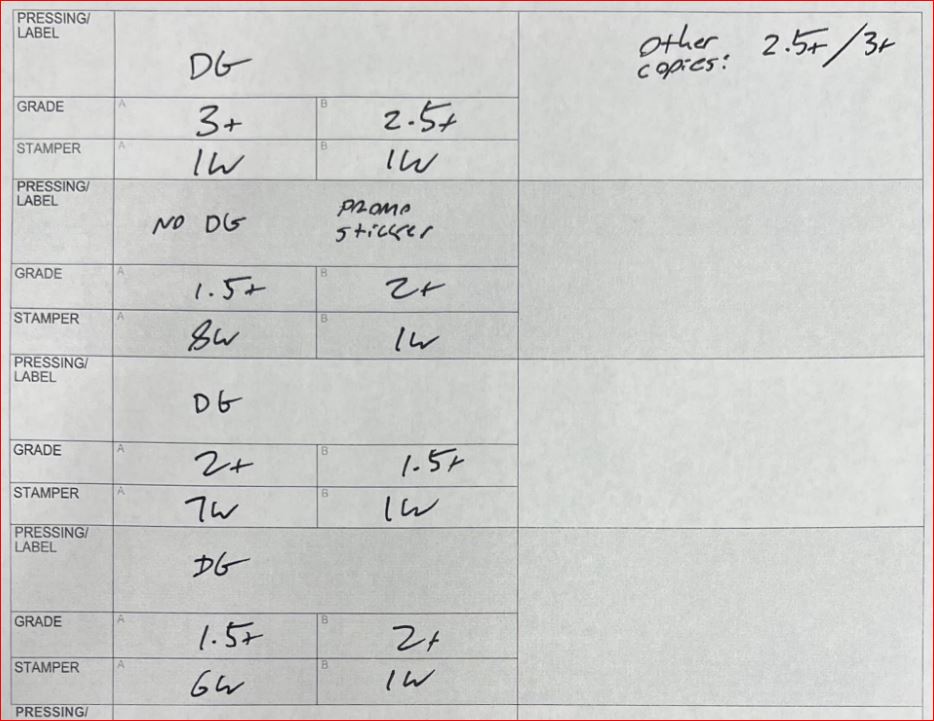
We would be very surprised if the earlierst pressings cut by Harry Fisher (1W/1W) can be beaten for sound. It’s possible, of course, and we will naturally continue to buy pressings with other stampers, if for no other reason than the fact that they are far more plentiful than the first pressings.

But if a 1W/1W gets offered to us at a high price, you can be sure we will jump at the opportunity to buy it and put it into a shootout.

The second one that comes to mind is that some vintage originals are not particularly well-mastered or pressed. (The 1W side twos should have sounded better than the 2+ grades they earned, but my guess is that the metal work by then was older and morn worn and just could not compete with the fresher, earlier copies, the ones with 1W side ones.)

All three of the early Deep Groove pressings with stampers other than 1W/1W did not earn Super Hot stamper grades (2+) on both sides. The only way to get top quality sound for this title is with the first pressing. And both of our 1W/1W pressings had Shootout Winning sides. (Here are some of the other albums we’ve discovered in which one set of stampers consistently win our shootouts.)

Now imagine that some company has come along and remastered the album on Heavy Vinyl for the benefit of audiophiles and music lovers alike.

If the vintage pressing you own just happens to have anything but 1W/1W stampers — you picked it up years ago because it’s an original on the Deep Groove early label and appears to be as vintage as vintage can be — you would be jumping for joy that finally the sound of the master tape has been transferred to vinyl properly after all these years.

Thank god for Kevin Gray / Bernie Grundman / Krieg Wunderlich / Chris Bellman or somebody else — pick any name you like — for the wonderful mastering work they do, bringing old records back to life.

What a service they do for the audiophile community!

Their critics must be idiots.

Sample Sizes and One Man Bands

Those of us who play a variety of pressings of the same album know where judgments of this kind come from.

They are mostly the result of sample sizes that are too small.

If you’re an audiophile reviewer operating as a one man band, which, as far as we know, is the only way any of them currently operate, your chances of getting it wrong are fairly high indeed. Here is one obvious example from a long time ago, but there are plenty more to be found under the heading of shootout malpractice here on the blog.

Just as an aside, please note that many of our customers do their own shootouts and seem to come to much more accurate assessments of the various pressings they play than any reviewers we’ve encountered. Perhaps we can take some small credit for showing them the way? I would like to think so.

How Did We Figure All of This Out?

(more…)

Most of the Time the Conventional Wisdom Turns Out to Be Right

Hot Stamper Pressings of Contemporary Jazz Albums Available Now

Recently we conducted a shootout for yet another superb Contemporary title. We’d played quite a collection of copies of this particular album over the years, on every label, starting back in the 90s when we first discovered how amazing sounding Contemporary records could be when you get hold of a good one.

We felt we had a solid understanding of both the music and the key aspects of the sound we might expect to hear — Tubey Magic, space, dead-on tonality, top end extension, all the stuff we’ve come to love in these live-in-the-studio, all-tube-chain Contemporary jazz recordings from their heydey throughout the 50s and 60s.

However, it’s not the record you see pictured. For now, the title of this album will have to remain a mystery, along with a great many others for which we’ve been reprinting our shootout stamper sheets so as to discuss their meaning on the blog.

As you can see, the original first pressings earned White Hot Stamper grades and were declared the winner of our shootout. With Nearly White Hot Stamper grades, the early Green second label did very well, followed by an OJC with respectable sound overall.

We recently posted a lengthy post discussing the pros and cons of conventional wisdom. In it we attempted to make the case that, although the most common record collecting tenets are more often right than wrong, there is simply no way to know which standard approach will work for the specific title at hand.

Rather than post one exception after another — easily done, since we have documented literally hundreds of them — we are happy to admit that the standard record collecting rules of thumb work well for most records, with the definition of “most” being “more than half the time.”

That leaves a lot of room for misses, and if those misses happen to be favorite albums of yours, tough luck. Unless…

Unless you know how to test records properly.

(more…)

Another Knockout for Indianapolis, and It Was Rarely Even Close

Hot Stamper Pressings of Living Stereo Recordings Available Now
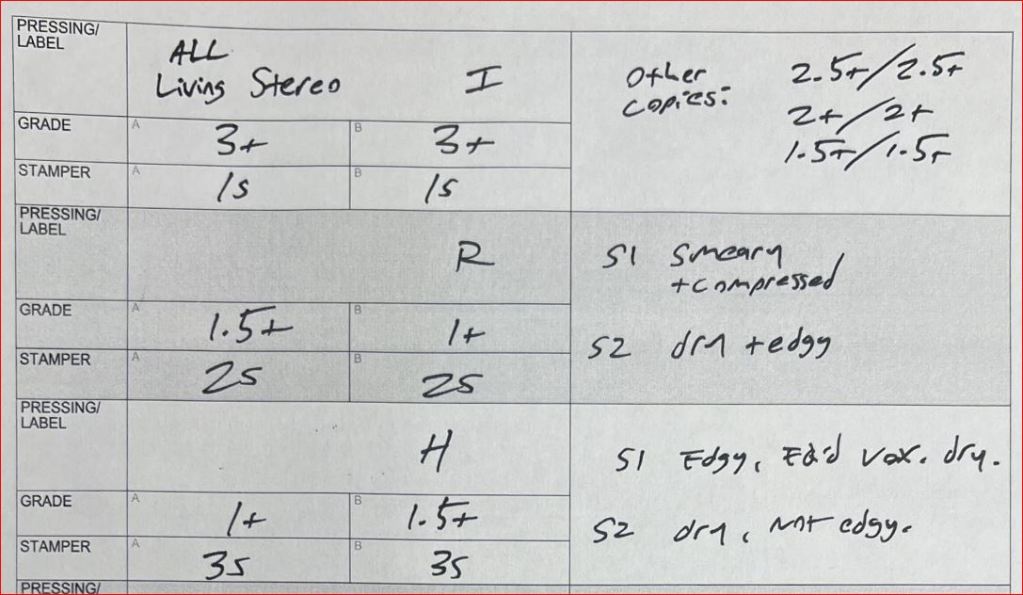

Below you will see the complete stamper sheet for a shootout we did in 2024.

Note that the album you see pictured is not the record we did the shootout for.

For RCA classical and orchestral recordings, many collectors think that the earliest pressings on the Shaded Dog label, in stereo, pressed in Indianapolis, tend to be the best sounding. 

More often than not, a rule of thumb like that one turns out to be right, which is how it got to be a rule of thumb in the first place. In this shootout, it turned out to be as right as rain.

The best pressingss with 1s stampers beat the 2s which beat the3s. Indianapolis was once again the pressing plant that produced the best sounding copies.

In fact, in this case the differences were even starker than we would have imagined going in. No copy not pressed in Indianapolis was even saleable, since a record that does not earn a grade of at least 1.5+ on both sides can qualify as a Hot Stamper pressing.

Fortunately, even though we were buying them randomly, we managed to luck out to some degree by finding many more 1s pressings than later-numbered ones.

Key Takeaways

  • 1s/1s is by far the best stamper for this mystery title, as collector wisdom would have predicted.
  • Indianapolis produced the best sounding pressings in this shootout, again, as predicted.
  • At some point collector wisdom fails us, as the Shootout Winning stampers (3+) and the good, not great stampers (1.5+) turned out to be the same stampers. This means that:
  • 1s is no guarantee of top quality sound. It follows that:
  • 1s might be the hot ticket, the 3/3 winner, but the odds, four to one, are against it. Again, it follows that:
  • As is almost always the case, the 1s pressing is most likely to be one of a bunch of potentially hot tickets.

(more…)

Seems as Though the Shaded Dogs Pressed in Indianapolis Actually Do Sound Better

Hot Stamper Pressings of Living Stereo Recordings Available Now
As painful as it may be for us to admit it, sometimes the conventional wisdom turns out to be right!

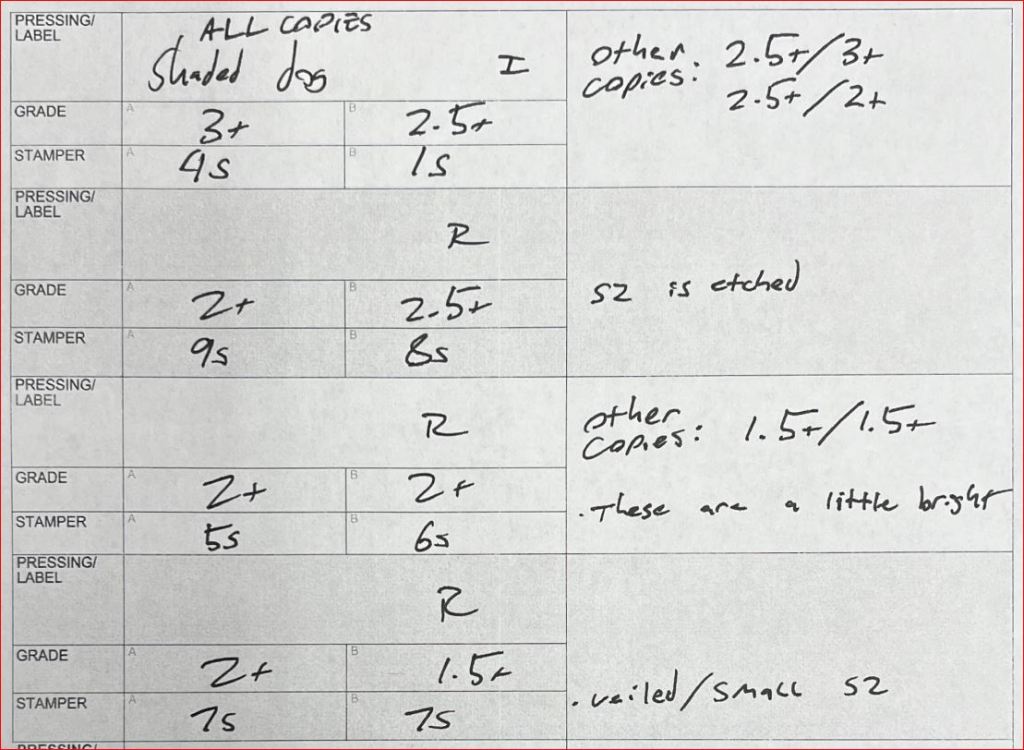
For RCA classical and orchestral recordings, collectors have long held that the earliest pressings on the Shaded Dog label, in stereo, pressed in Indianapolis, tend to be the best sounding. That qualifier “tend” may not be necessary — plenty of audiophiles think they simply are better sounding, no question about it.

Maybe. If we tallied all the copies we’ve played and created a very large spreadsheet using the data, perhaps we could give you a better answer than “maybe,” but we’ve definitely never tallied them up and have no plans to do so. It sounds like a lot of work.

We are not revealing what record had these stampers and earned these grades for the simple reason that we rarely if ever give out the specific information that identifies the best sounding pressing of any album.

As I’m sure you can understand, we want you to buy the copy with the Hottest Stampers from us, not find one on your own! We’re happy to be somwhat helpful, but naturally we find it necessary to draw the line somewhere, and giving out “the shootout winning stampers” are where we choose to draw it.

You can be sure, based on our most recent shootout for this mystery RCA title, that in future we will focus our efforts on the Indianapolis pressings and avoid the Richmond pressings unless they are cheap and minty.

When the conventional wisdom turns out to be correct, in other words, when it comports with reality, at least for the seven copies of this album that we played, we are happy to temporarily put aside our skepticism and learn from what this title is trying to tell us.

Why? Because the experimental evidence supports it.

The reality is that most of the time we are not able to predict which stampers will win a shootout before we actually sit down to play all our copies.

(more…)

Emerson, Lake & Palmer – Islands Vs Cotillions

Hot Stamper Pressings of the Music of Emerson, Lake and Palmer Available Now

UPDATE 2020

This commentary was written many years ago, around 2010 I would guess.

It was updated in 2020 when we realized we were wrong about the domestic pressings being superior on side two. At one time we thought they were, and now, with many more shootouts under our belts, we are pretty sure they are not. But you never know!

The findings from the latest shootouts have shown us the error of our ways, yet another example of live and learn.


This is what we used to think:

The Brit copies may take top honors for side one (“sweetness, openness, tubey magic, correct tonality, presence without aggressiveness, well-defined note-like bass, extended airy highs”) but the Hot Stamper Cotillion copies KILL on side two. They really ROCK, with greater dynamic contrasts and seriously prodigious bass, some of the best ever committed to vinyl.

The Brits tend to be a bit too “pretty” sounding. They’re too polite for this bombastic music. This music needs the whomp down below and lots of jump factor to work its magic.

The Brits are super-low distortion, with a more open, sweeter sound, especially up top, but the power of the music is just not as powerful as it can be on these very special Cotillions.

We prefer the British pressings on both sides now. After years of improvement to our playback, they have shown themselves to be a step up over even the best domestic pressings. The Cotillions don’t win shootouts now and would be very unlikely to win one in the future. At best they tend to earn Super Hot Stamper grades.

A top copy might be described this way:

  • This UK Island Pink Rim pressing makes the case that ELP’s debut is clearly one of the most powerful rock records ever made, here with incredible Nearly Triple Plus (A++ to A+++) grades from top to bottom – just shy of our Shootout Winner
  • Spacious, rich and dynamic, with big bass and tremendous energy – these are just some of the things we love about Eddie Offord‘s engineering work on this band’s albums
  • Analog at its Tubey Magical finest – you’ll never play a CD (or any other digitally sourced material) that sounds as good as this record as long as you live
  • “Lucky Man” and “Take A Pebble” on this copy have Demo Disc quality sound like you won’t believe
  • Our White Hot pressing had a one half plus better grade on one side and sold for $849, making this copy a “relative bargain,” if there could ever be such a thing on this site – but what an amazing sounding record!

Without a doubt this record belongs in our Top 100 Rock and Pop section.

I’d even say it belongs in the Top Ten (which of course is where you can find it, where it belongs).

The organ on this album is wall to wall and floor to ceiling. The quiet interlude during “Take A Pebble” is about as quiet as any popular recording can ever be — the guitar is right at the noise floor. It’s amazing! (Which explains why so many domestic copies have groove damage. The record is just too hard to play for the average turntable. Hell, it’s hard to play with an audiophile turntable.)

Credit engineer Eddie Offord, who would later go on to enormous and entirely justifiable fame with Yes.

(more…)

This Original British Tarkus Had the Sound Most Audiophiles Can Only Dream Of

Hot Stamper Pressings of the Music of Emerson, Lake and Palmer Available Now

To be clear, audiophiles who buy a shootout winning White Hot Stamper pressing from us don’t have to dream, but practically everyone else does, because copies that sound as good as this one are few and far between.

It’s an amazing find, the kind of record we live for here at Better Records.

We described the sound of our most recent shootout winning copy this way:

This original UK Island pressing was doing everything right, earning killer Triple Plus (A+++) grades from top to bottom.

Our recent monster shootout produced this incredible sounding British pressing on Island (the only way we offer the title) and it is stone guaranteed to rock your world.

Eddie Offord‘s trademark Tubey Magic, energy, resolution, whomp factor and dynamics are all over this phenomenal recording, and this pressing captured it all.

Here are the notes that back up everything we said, and more. We can’t put all the qualities we rave about into every listing. Who would believe us?

No other copy offered this kind of sound. It’s what we used to call AGAIG — As Good As It Gets.

3+/3+ records like this one go in our Top Shelf section, which currently holds 32 titles.

Records with at least one 3+ side go in this section, and there are 143 of those as of today, almost five times as many.

Eddie Is The Man

Tarkus is clearly a Demo Disc for big speakers that can play at loud levels.

The organ captured here by Eddie Offord (of Yes engineering fame, we’re his biggest fans) and then transferred so well onto our Hot Stamper pressings will rattle the foundation of your house if you’re not careful. This music really needs that kind of megawatt reproduction to make sense. It’s Big Bombastic Prog that wants desperately to rock your world. At moderate levels it just sounds overblown and silly. At loud levels it actually will rock your world.

All but the best Brit pressings have a tendency to be a bit turgid and many of them lack the bottom end weight that music like this absolutely must have to work its magic. There are some good domestic copies — not in a league with the best Brits at all — but most of them have sub-generation sound that robs the instruments of their immediacy and texture (much the same way that Heavy Vinyl does, truth be told).

(more…)

Do All the Early Stamper Shaded Dog Pressings of this Title Sound Good?

Hot Stamper Pressings of Living Stereo Recordings Available Now

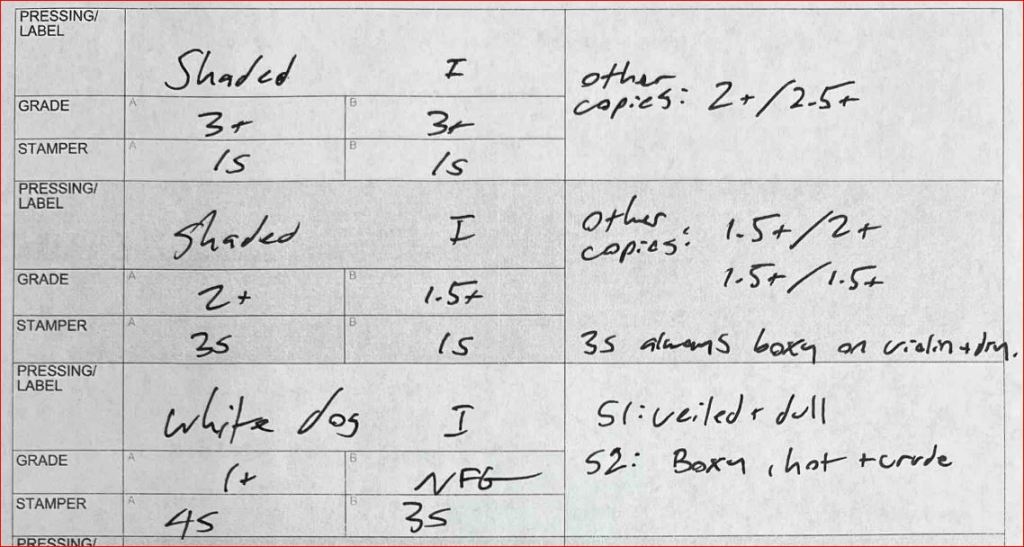
Below you will see the complete stamper sheet for a shootout we did recently.

Note that the album you see pictured — LSC 2265 — is not the record we did this particular shootout for.

We are not revealing what record had these stampers and earned these grades for the simple reason that we rarely if ever give out the specific information that identifies the best sounding pressing of any album.

As I’m sure you can understand, we want you to buy the copy with the Hottest Stampers from us, not find one on your own! We’re happy to be somwhat helpful, but naturally we find it necessary to draw the line somewhere, and giving out “the shootout winning stampers” are where we choose to draw it.

One set of stampers for the mystery Shaded Dog pressings we played in our most recent shootout sounded consistently subpar.

The sound on 3s was boxy and the violin was dry. This was surprising as the stampers are quite low: 3s/1s.

Many RCA chamber recordings can be dry, and if one owned a nice early stamper pressing of the album with boxy, dry sound, one might conclude that this RCA is just another chamber recording with those shortcomings.

But one would be wrong, because the 1s stamper shootout winner sounded amazing, not dry or boxy in the least.

How Come?

Since, as we discovered recently, 1s wins, and handily, why does 3s/1s do so much worse?

Who knows?

And why is the White Dog barely passable on side one and just awful on side two?

Your guess is as good as mine.

More of the Same

Below you will find links to other records we’ve played that had the same problems as our mystery RCA here.

(more…)

Maybe We SHOULD Start Buying Blue Notes on the Early Labels

Hot Stamper Pressings of Blue Note Albums Available Now
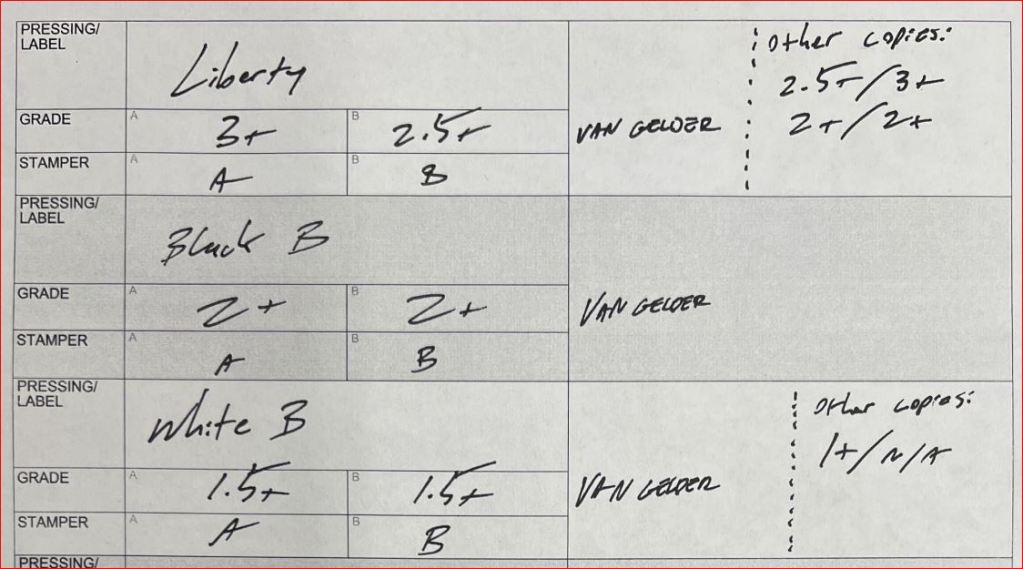
If there are record companies whose fans are extremely particular about the labels of the pressings they prefer, Blue Note has to be right at the top of that list.

The consensus among record collectors seems to be that the early label Blue Notes are practically guaranteed to have the best sound. In top condition they often sell for many thousands of dollars, far more than we have ever charged for any Hot Stamper Blue Note pressing

We are on record as not favoring early labels over later ones absent evidence to support such bias, but perhaps there actually are some records you should be buying based on their labels. This one, for example.

If all the stampers of a title are the same and they’re all cut by Rudy Van Gelder — early labels, middle labels and later labels alike — what do you use to guide you when trying to find the best sounding pressings?

This is precisely the conundrum that an audiophile would be faced with as he goes about trying to find the best sounding pressings of the Blue Note album whose stamper sheet you see below.

This stamper sheet reflects a fairly typical shootout for a Blue Note pressing. It’s hard to find six clean copies no matter what the title is. We probably returned or gave up on half the copies we bought, so we might have had to buy nine in order to shootout six.

(Note that there is nothing on any label after the White B from the 70s. We have never heard any title with an 80s label or later sound worth a damn so we stopped buying them a long time ago.)

Drawing Conclusions

Let’s look at some of the conclusions the typical record collector/audiophile might draw from the information above.

For example:

1.) I have a Blue Note with Van Gelder stamps and it’s decent sounding but I like [fill in the blank with some other pressing] better. Since all the pressings are cut by him, he must not have done a very good job. Thank goodness modern mastering engineer X came along to finally bring out the sound of the master tape that he was not able to do.

That’s an easy one to rebut. The later pressings cut by Rudy are consistently worse sounding than the earlier ones in the case of this title. If you don’t have a big batch to work through, however, you simply have now way of knowing that fact, and therefore whatever conclusions you choose to draw from a too-small pool of pressings are suspect at best.

(more…)