mystery-contemporary

So You Actually Think an OJC Can Beat an Original Black Label Contemporary?

Hot Stamper Pressings of Contemporary Jazz Albums Available Now

Yes, we think that, because that’s what the evidence from our most recent shootout in 2025 showed us.

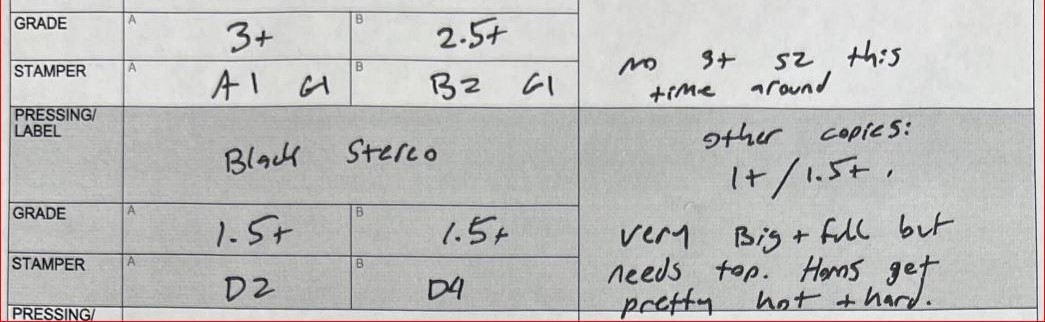
As you can see from the stamper sheet below, the A1/B2 stampers of our OJC, in a blinded test, came out on top.

Better mastering equipment? Better mastering skills? Better vinyl? Better pressing methods?

Who the hell knows?

Better yet, what audiophile or record collector with a lick of sense would even pretend to know?

Not us, that’s for sure. At this point we are very comfortable not having answers for the unanswerable questions we posed above.

But don’t rush off to buy the OJC of the Sonny Rollins record you see pictured. This commentary has nothing to do with that record. For now we’re keeping the title a mystery, consistent with the idea that we give out lots of the bad stampers on this blog, but rarely do we give out the good ones. (That said, here are some of the stampers that win shootouts, and we expect to be posting more soon, mostly for records we can no longer do shootouts for due to: 1.) a lack of interest, or 2.) unacceptably high costs for the best pressings, or 3.) or the fact that we are simply unable to find pressings that play quietly enough for audiophiles.)

So why is it that you can’t tell us the title of this record?

The cost of discovering the right stampers (aka R&D) is usually high, can sometimes take decades, and is fundamentally at the heart of how we make our money: by taking pressings we hope to be good, cleaning them up, playing them, and offering only those that actually do sound good, regardless of when they were made, who made them or why.

Once the shootout is done, the time for hoping and guessing is over. We have the evidence, and in our world that is the only thing that counts. That evidence may be provisional — we could prove ourselves wrong with the next shootout, and there have been times when that has happened — but for now this is the best information we have to work with.

Key Takeaways for this Mystery Record

  • We did not have enough copies with the right stampers to find a 3+ side two. (The other copies earned grades of no better than 2+/2+.)
  • Which simply means that if we’re not hearing faultless or nearly-faultless sound on one side or another, the sound is not White Hot and does not deserve a 3+ grade. Fair’s fair after all.
  • The original pressing you see with D2/D4 stampers had some of that “old record” sound we find on far too many vintage pressings.
  • True, it was very big and full, but lacked top end, causing, among other things, the horns to get hot and hard.
  • Who wants to listen to a Sonny Rollins famous classic jazz record with horns that don’t sound right?

(more…)

Most of the Time the Conventional Wisdom Turns Out to Be Right

Hot Stamper Pressings of Contemporary Jazz Albums Available Now

Recently we conducted a shootout for yet another superb Contemporary title. We’d played quite a collection of copies of this particular album over the years, on every label, starting back in the 90s when we first discovered how amazing sounding Contemporary records could be when you get hold of a good one.

We felt we had a solid understanding of both the music and the key aspects of the sound we might expect to hear — Tubey Magic, space, dead-on tonality, top end extension, all the stuff we’ve come to love in these live-in-the-studio, all-tube-chain Contemporary jazz recordings from their heydey throughout the 50s and 60s.

However, it’s not the record you see pictured. For now, the title of this album will have to remain a mystery, along with a great many others for which we’ve been reprinting our shootout stamper sheets so as to discuss their meaning on the blog.

As you can see, the original first pressings earned White Hot Stamper grades and were declared the winner of our shootout. With Nearly White Hot Stamper grades, the early Green second label did very well, followed by an OJC with respectable sound overall.

We recently posted a lengthy post discussing the pros and cons of conventional wisdom. In it we attempted to make the case that, although the most common record collecting tenets are more often right than wrong, there is simply no way to know which standard approach will work for the specific title at hand.

Rather than post one exception after another — easily done, since we have documented literally hundreds of them — we are happy to admit that the standard record collecting rules of thumb work well for most records, with the definition of “most” being “more than half the time.”

That leaves a lot of room for misses, and if those misses happen to be favorite albums of yours, tough luck. Unless…

Unless you know how to test records properly.

(more…)

Now That You Know the D2 Stampers Have the Best Sound, What’s Your Next Move?

Hot Stamper Pressings of Contemporary Jazz Albums Available Now

Recently we conducted a shootout for yet another superb Contemporary recording, one that we had auditioned a couple of times before, and one for which we had a good understanding of both the music and the quality of the sound. We’ve played vintage Contemporary pressings by the hundreds at this point. Rarely are we surprised by how good the right stampers and labels can sound.

It’s not the record you see pictured, however. For now, the title of this album will have to remain a mystery, along with a great many others we’ve been discussing on the blog recently.

The cost of discovering the right stampers for famous and often expensive records is often high, can take decades, and is fundamentally at the heart of how we make our money. We are in the business of finding potentially amazing sounding pressings. Often they have stampers we know to be good, and sometimes they have stampers we discover are even better.

We clean them up, play them, and offer to our customers those that, for whatever reasons no one has yet figured out — including us — are far better sounding than any others.
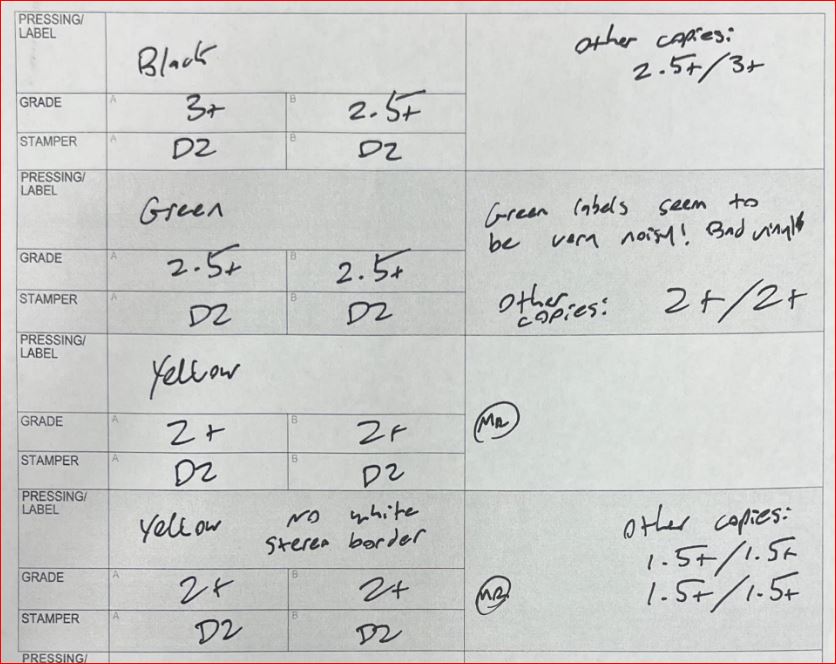
You’ll notice that the early Black Label pressings did the best in our shootout, followed by the later Green Label pressings, followed by the Yellow Label pressings with the earlier cover at 2+, which are in turn followed by the Yellow Label pressings in the later cover.

Depending on which D2 you’re playing, the sound could be absolutely amazing, or perhaps excellent, or, as in the case of the 1.5+ copies, merely good, not great.

Lessons Learned

Knowing the right stampers are D2 for this title does not allow us to predict which pressings will win a shootout. We actually have to sit down and play all the copies to come up with the hierarchy we laid out above.

However, knowing that the Black Label originals with D2 stampers are the copies most likely to win shootouts is very helpful information.

(more…)

How Can the Best Stampers Also Be the Worst Stampers?

Hot Stamper Pressings of Contemporary Jazz Available Now

Recently we conducted a shootout for a superb Contemporary recording, one that we had auditioned a couple of times before and one which we felt we knew the music and the quality of the sound well.

It’s not the record you see pictured. For now we’re keeping the title a mystery, consistent with the idea that we give out lots of bad stampers on this blog, but almost never do we give out the good ones.

Why, you ask?

The cost of discovering the right stampers is usually high, can take decades, and is fundamentally at the heart of how we make our money: by finding amazing sounding pressings with stampers we know to be good, cleaning them up, playing them, and offering those that, for whatever mysterious reasons that no one has figured out, including us, tend to have the best sounding grooves.

This time around we kept track of the stamper numbers for all the pressings we played, something we are making a habit of doing these days and using to highlight discoveries in the sound of the records we play.

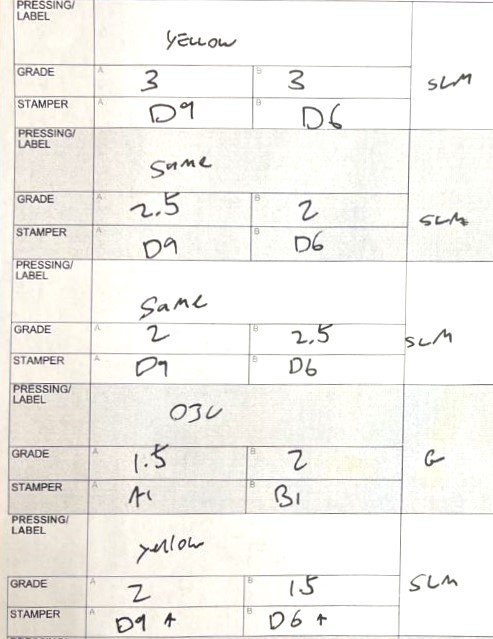
In this case, we discovered an anomaly we thought we would bring to the audiophile world’s attention: the fact that the stampers for the best souding pressing were also the stampers for the worst sounding pressing, because they were the stampers for all the pressings.

One copy earned our White Hot Stamper grade, our highest, for its clearly superior sound, and another one earned our lowest Hot Stamper grade of 1.5+. The rest were quite good, in between those two, which is a very common outcome for most of our shootouts: lots of records in the middle of the distribution, some winners at the top and some losers at the bottom.

Note that the OJC of this title is one we have liked in the past. It didn’t do so well this time around, and that is mostly because we found out about some stampers we like even better. We will probably not being buying the OJC anymore; it’s probably more trouble than it’s worth.

However, the key takeaway from this stamper sheet is the fact that it beat one of the real Contemporary label pressings in the shootout.

So the question an audiophile record collector might ask himself is this one: is the OJC better or worse than the real Contemporary pressing with D9/D6 stampers?

(more…)