best-worst

It’s Already So Good, How Could It Get Any Better?

Hot Stamper Pressings of the Music of Berlioz Available Now

You may have noticed that most of the time when we give out the stampers for the top copies of an album, we do not identify the title of the record that has those Shootout Winning stampers.

As you can imagine, our huge investments in research and development make up a big part of our costs, costs that accrue over the course of years, decades even, and that must eventually be passed on to our customers.

But this title is an exception, because we are telling you straight out that the 1K pressings of CS 6101, Music of Berlioz, are the way to go.

It turns out that both the early Decca pressings (SXL 2134) and the London Bluebacks were cut by Tony Hawkins.

It’s unfortunate that this record did not sell well when it came out in 1959, which explains why we could find no evidence of copies with any stampers other than 1K.

Not that the work of any other mastering engineers was in any way needed. Mr. Hawkins did a wonderful job on the copies we played than managed to reproduce the glorious, Golden Age All Tube analog sound of the master tape, which may sound  tautological as all get out but I assure you is not.

No, sadly for us, that glorious sound could be found on one and only one pressing, the one we graded 3+/3+.

No other pressing earned a top grade on either side. Whatever caused the amazing pressings to come out differently from the very good ones happened in the plating and pressing stages of manufacturing, an area that did not involve the work of any of the Decca mastering engineers.

(more…)

RE-2 Wins Our Shootouts for this Jimmy Smith Recording

Hot Stamper Pressings of Large Group Jazz Recordings Available Now

What happens when all the stampers are RE-2?

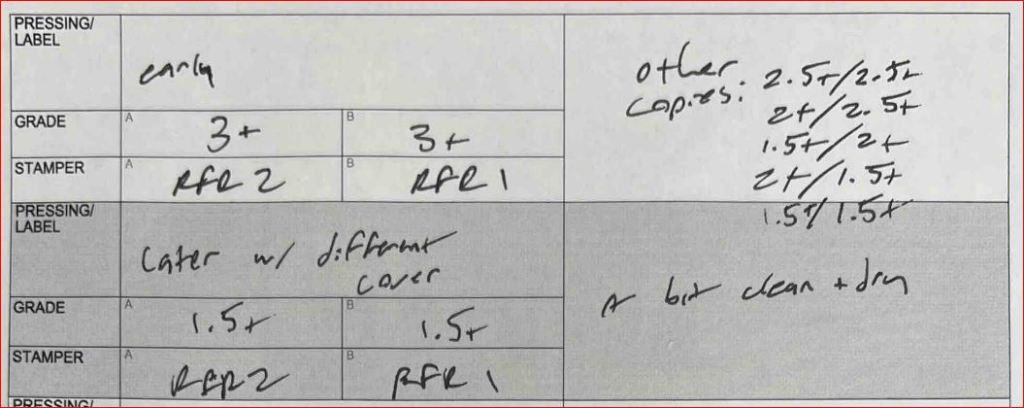
This is precisely the problem we were faced with on the Jimmy Smith Verve album you see pictured to the left and whose stamper sheet is shown below.

What information can you rely on when trying to find the best sounding pressings? The stamper numbers are no help.  There were some markings in the dead wax for the 3+ copies that were different from the copies that earned lower grades, but they are hard to read and most sellers we buy from would struggle to identify them.

No, on this record there was really nothing to go by other than the sound.

From our shootout panel’s point of view, this is the only way it can possibly work.

(more…)

Here Are the Shootout Winning Stampers for SR 90435

Hot Stamper Pressings of Mercury Living Presence Records Available Now

You may have noticed that when we give out the stampers for the top copies, we rarely identify the title of the record with those Shootout Winning stampers.

As you can well imagine, our sizable investments in research and development over the course of decades make up a big part of the costs we must pass on to our customers.

However, in the case of Mercury SR 90435, knowing the Shootout Winning stamper numbers is not going to get you very far (which is of course the only reason we can afford to give out this information).

You will actually need a pile of copies with those stampers in order to find one worthy of a 3+ White Hot stamper grade.

Obviously, knowing the “right” stamper information in this case gets you in the ballpark, but it won’t help you hit the grand slam home run you were hoping for. To do that you have to clean and play at least five copies the way we did.

Hot Stamper shootouts may be expensive, they may be a lot of work, but our experience tells us there is simply no other way to find the highest quality pressings. They’re the ones that earn the 3+ grades, not the 1.5+ grades, regardless of their stamper numbers, labels, mastering engineer credits or country of origin.

As we have been saying for more than twenty years, for title after title, when you clean them right and play them right, they might all look the same, but rarely if ever will they sound the same.


Changes for 2024

Beginning in 2024 we decided to make available to our readers a great deal of the pressing information we’ve compiled over the last twenty years, under these headings:

(more…)

Does 1s Sound Great or Does It Sound Good (but Hot, Dry and Crude)?

Hot Stamper Pressings of Living Stereo Recordings Available Now

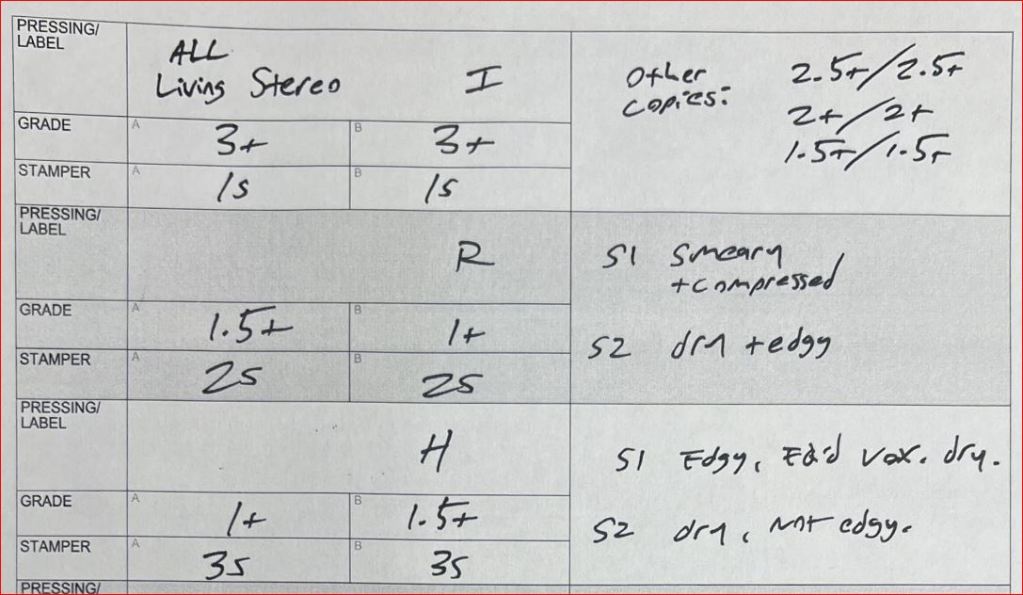
Below you will see the complete stamper sheet for a shootout we did recently.

Note that the album you see pictured is not the record we did the shootout for.

We are not revealing what record had these stampers and earned these grades for the simple reason that we rarely if ever give out the specific information that identifies the best sounding pressing of any album.

As I’m sure you can understand, we want you to buy the copy with the Hottest Stampers from us, not find one on your own! We’re happy to be moderately helpful, but naturally we find it necessary to draw the line somewhere, and giving out “the shootout winning stampers” is where we choose to draw it.

How Come?

Since, as we discovered recently, 1s wins, and handily, why would any 1s pressing sound as bad as the one at the bottom does?

(Which by the way is not actually bad — just far from the best.)

If the 1s wins the shootout as it did here, that means that the received knowledge about RCA Living Stereo pressings being better on the first pressing is correct.

But if you are the unlucky buyer of the 1s that did not do nearly as well, you might say to yourself “Hey, I thought the 1s pressing was supposed to be the hot ticket. Wha’ happen?” (Assuming you don’t conclude that the recording is at fault, which is what most audiophiles and record collectors would be likely to do. I did it and I bet you did too.)

We noted in a commentary from many years ago that the record collecting theories we see commonly promoted by those who consider themselves “in the know” seem to have a great deal of trouble accounting for these anomalies.

We had two copies of Court and Spark, each with one good side opposite a bad side on the same pressing. An excerpt:

(more…)

How Do the Early Pressings of The Poll Winners Sound?

Hot Stamper Pressings of Contemporary Jazz Albums Available Now

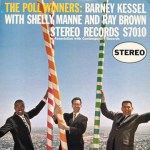
A recent Shootout Winning copy with the early stereo badge cover was described this way:

Stunning sound throughout this vintage Black Label Stereo Records pressing, with both sides earning Shootout Winning Triple Plus (A+++) grades or close to them

Roy DuNann always seems to get the real sound out of the sessions he recorded – amazingly realistic drums in a big room; Tubey Magical guitar tone; deep, note-like bass, and on and on

4 1/2 stars: “The choice of material, the interplay between the three players, and the lead work all meld together beautifully on The Poll Winners, making it a classic guitar album in a small-group setting.”

Musically, all true. Sonically, not so much. The early D1/D2 stampers on the early Black Label might be passable on side one (1+), but side two was just a mess (NFG).

Side One

Track Two

  • A bit bright and flat

Track One

  • Very clear but lacking richness, weight and depth
  • Thin, and bright up top
  • 1+

Side Two

Track One

  • Narrow stereo field
  • Weird tape hiss
  • Metallic top end
  • Very recessed and weird
  • Nope

A different Stereo Badge Cover copy sporting a Black Label won the shootout by the way. Go figure.

(more…)

When All the Stampers Are the Same, What’s a Mother to Do?

Hot Stamper Pressings of Blue Note Albums Available Now

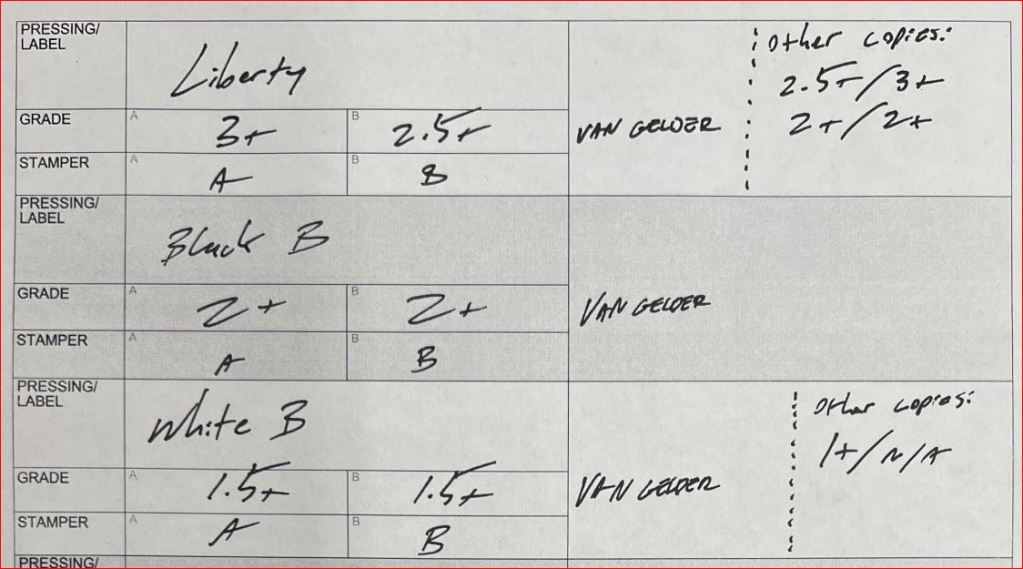
What happens when all the stampers are A and B and every one of them is cut by Rudy Van Gelder?

This is precisely the problem we were faced with on the mystery Blue Note album whose stampers can be seen below.

It’s not Cornbread — those are really hard to find! We did a shootout last year and hope to have another one coming before long, but most of what we buy ends up going back to the seller for noise issues, so it may be a while before we can get it going.

In the meantime, whatever you do, don’t waste your money on the Tone Poets reissue — it’s ridiculously bad.

What information can you rely on when trying to find the best sounding pressings?

The stamper numbers are no help.

And you can’t look for the VAN GELDER stamp in the deadwax since they all have it.

Of course, now that we’ve done the shootout, we know to buy the Liberty label pressings, but that could hardly have been predicted beforehand. Plenty of later labels beat the early label pressings on Blue Note’s albums.
But readers of this blog surely know that we are being facetious when we say we faced a lack of stamper information with the title above.

We have no way of knowing what the label is for any copy that is playing on our turntable, so how could the stamper information possibly matter, ever, under any circumstances?

We judge records by their sound quality, then grade them on that single metric, ignoring all others.

Only later do we learn which labels and stamper numbers correspond with which sonic grades, assuming they actually correspond at all. (Some don’t.)

If you are buying certain pressings because they have earlier labels, rather than pressings with later labels, predicated on the theory that the earlier labels should have better sound, this blog will be a godsend — because it will prove to you that the approach you are taking is not a particularly good one.

You are only fooling yourself if you think it is. It might work more often than not, but do you really want to be wrong about four records out of ten? Forty out of a hundred. Four hundred out of a thousand? With no way of knowing which group — good or bad — any given title happens to fall into?

A record collection of a thousand records is a decent sized collection. But with four hundred titles having second-rate or worse sound? Nobody wants that.

Buying originals is just not a good way to insure your collection will have top quality sound. Fortunately we know of a way that does.

(more…)
Now That You Know the D2 Stampers Have the Best Sound, What’s Your Next Move?

Hot Stamper Pressings of Contemporary Jazz Albums Available Now

Recently we conducted a shootout for yet another superb Contemporary recording, one that we had auditioned a couple of times before, and one for which we had a good understanding of both the music and the quality of the sound. We’ve played vintage Contemporary pressings by the hundreds at this point. Rarely are we surprised by how good the right stampers and labels can sound.

It’s not the record you see pictured, however. For now, the title of this album will have to remain a mystery, along with a great many others we’ve been discussing on the blog recently.

The cost of discovering the right stampers for famous and often expensive records is often high, can take decades, and is fundamentally at the heart of how we make our money. We are in the business of finding potentially amazing sounding pressings. Often they have stampers we know to be good, and sometimes they have stampers we discover are even better.

We clean them up, play them, and offer to our customers those that, for whatever reasons no one has yet figured out — including us — are far better sounding than any others.

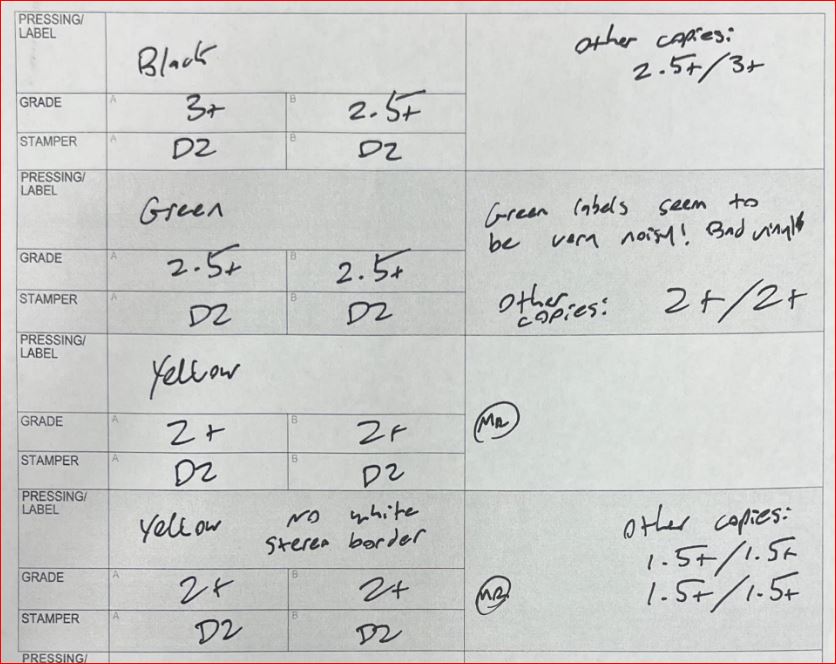
You’ll notice that the early Black Label pressings did the best in our shootout, followed by the later Green Label pressings, followed by the Yellow Label pressings with the earlier cover at 2+, which are in turn followed by the Yellow Label pressings in the later cover.

Depending on which D2 you’re playing, the sound could be absolutely amazing, or perhaps excellent, or, as in the case of the 1.5+ copies, merely good, not great.

Lessons Learned

Knowing the right stampers are D2 for this title does not allow us to predict which pressings will win a shootout. We actually have to sit down and play all the copies to come up with the hierarchy we laid out above.

However, knowing that the Black Label originals with D2 stampers are the copies most likely to win shootouts is very helpful information.

(more…)

Another Knockout for Indianapolis, and It Was Rarely Even Close

Hot Stamper Pressings of Living Stereo Recordings Available Now
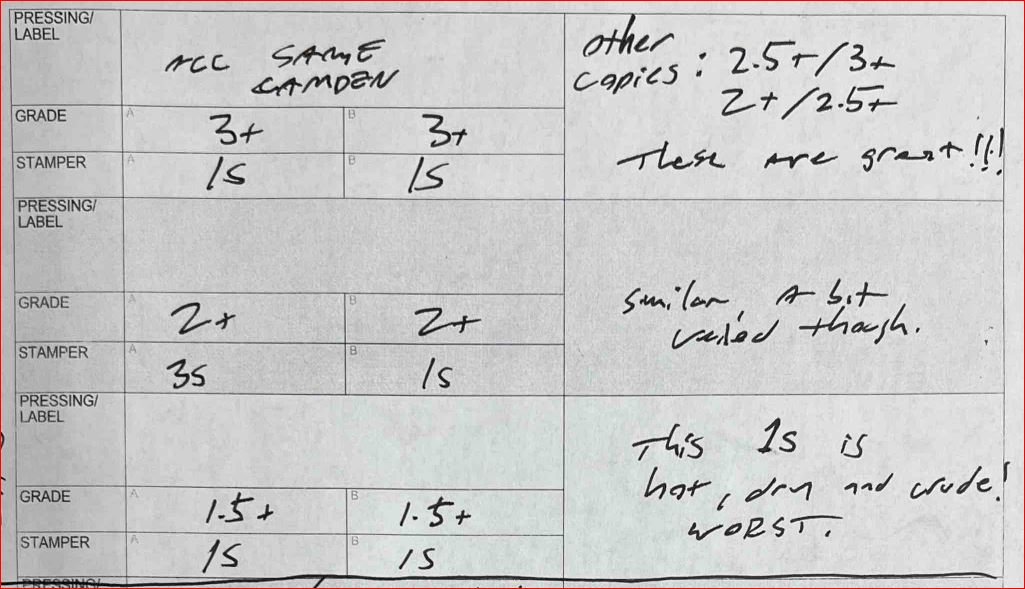
Below you will see the complete stamper sheet for a shootout we did in 2024.

Note that the album you see pictured is not the record we did the shootout for.

For RCA classical and orchestral recordings, many collectors think that the earliest pressings on the Shaded Dog label, in stereo, pressed in Indianapolis, tend to be the best sounding. 

More often than not, a rule of thumb like that one turns out to be right, which is how it got to be a rule of thumb in the first place. In this shootout, it turned out to be as right as rain.

The best pressingss with 1s stampers beat the 2s which beat the3s. Indianapolis was once again the pressing plant that produced the best sounding copies.

In fact, in this case the differences were even starker than we would have imagined going in. No copy not pressed in Indianapolis was even saleable, since a record that does not earn a grade of at least 1.5+ on both sides can qualify as a Hot Stamper pressing.

Fortunately, even though we were buying them randomly, we managed to luck out to some degree by finding many more 1s pressings than later-numbered ones.

Key Takeaways

  • 1s/1s is by far the best stamper for this mystery title, as collector wisdom would have predicted.
  • Indianapolis produced the best sounding pressings in this shootout, again, as predicted.
  • At some point collector wisdom fails us, as the Shootout Winning stampers (3+) and the good, not great stampers (1.5+) turned out to be the same stampers. This means that:
  • 1s is no guarantee of top quality sound. It follows that:
  • 1s might be the hot ticket, the 3/3 winner, but the odds, four to one, are against it. Again, it follows that:
  • As is almost always the case, the 1s pressing is most likely to be one of a bunch of potentially hot tickets.

(more…)

Our Advice Has Been Followed and the Results Are In

Proper Record Cleaning Can Help You Find Your Own Hot Stamper Pressings

One of our customers wrote to us about cleaning his collection not long ago, and we advised him how he should go about it. He seems to have taken much our advice to heart and has quieter, better sounding records as a result. He did not spring for the pricey Keith Monks style machine we use, but felt that his efforts produced excellent results regardless. Best to hear it from him:

Hey Tom,

Just did three records, in all different conditions, and this one Eddie Palmieri, the Latin Salsa pioneer. And I had been meaning to get some famous albums in that genre, and I looked through Discogs.com and this guy wanted $40 for an album called Mozambique. Even though it looked great, it had so much noise from years of build up.

It played beautifully after all the steps. There was a huge jump in fidelity, just the tiniest, tiniest surface noise between songs. You wouldn’t notice if you weren’t listening for it.

From the other two records which had different issues, I don’t think it’s very hard to understand what else a Keith Monk type machine might add to other more difficult records, in combination with the Prelude stuff and a VPI. But for this one, and I think a lot of other records I own, the Prelude and VPI are all I needed.

I know there’s going to be a huge learning curve and I don’t expect things to be so simple. But it was just cool and kind of a treat, my first time out, to know that it’s possible.

Anyway, I just wanted to share that for what it’s worth. Thanks,

Andrew

Dear Andrew,

Glad to hear you were able to get your records cleaner and make them better sounding to boot. What could be better?

Well, there actually is an answer to that rhetorical question, and we supplied it right here on the blog in a listing with step by step instructions using the Prelude Record Cleaning System and two record cleaning machines. You asked me to write it all out so that’s what I did.

It does not surprise me in the least that you got great results with your VPI. That is the very machine we had been using since the early-90s to clean all our records. Sometime later in the decade we discovered the Disc Doctor fluids and switched to them. I wrote a long piece in my paper catalog (this was in our pre-internet days) discussing how much quieter and better sounding all of our vintage classical records sounded when cleaned with DD fluids, and that I was therefore going to reclean them all and reevaluate every last one for sound and surfaces. It was that big a difference.

In 2007, when I first heard a record cleaned with the Prelude System, everything changed radically, a story I tell using the record I was testing at the time, Meddle. It was one of the biggest breakthroughs we had experienced up to that time.

This is the kind of difference you have now heard with Prelude and your 16.5. You are operating at a different level now.

But there was more to come for us when an audio friend invited me to bring a record over that he would clean with Prelude on his Keith Monks machine. I brought over a killer copy of Meddle as I recall. Imagine my shock when it sounded even better than it had when first cleaned with Prelude. I immediately ordered up a industrial-strength threaded-pickup machine, the Odyssey, made in Germany, and started offering Hot Stamper pressings that were quieter and had better sound than I had ever heard before. (We are currently on our third unit. We clean a lot of records.)

This is leap you have yet to take. It might not make as much difference as your cleaning has to date, but, once you do it, you will find that there is a clearly audible “before and after” quality to the sound of your records. No doubt you will want to reclean all your personal favorites using Prelude and whatever Keith Monks type machine you end up with.

(more…)

Is This Really Robert Ludwig’s Doing? I Thought He Was One of the Good Guys

Hot Stamper Pressings of Rock and Pop Albums Available Now

Below is the complete shootout stamper sheet for a rock record whose name we do not plan to reveal at this time.

We could reveal it, since knowing the “right” stamper numbers appears to be of no help at all — the best stampers and the worst stampers are exactly  the same stampers! (Nothing new there.)

RL stands for Robert Ludwig and MD stands for Masterdisk.  As you can see, Robert Ludwig cut all seven of the pressings that made it to the shootout.

One of them actually won. “Robert Ludwig’s stuff cannot be beat!” might be the post on whatever audiophile forum you frequent. (If it’s Hoffman’s forum, it would more likely read “Robert Ludwig’s stuff cannot be beat except by Steve Hoffman!”)

Another pressings with those same markings came in next to last, with such mediocre-at-best sound that it would not qualify as a Hot Stamper at all. (1.5+ on both sides or better is the minimum grade for any record we sell.)

Robert Ludwig really screwed up the mastering of this title, another forum member might post.

Can they both be wrong? Of course they can. When has any information posted on a forum been reliable or free from error?

If you were to tell me you have the Robert Ludwig-mastered original pressing for this record and it sounds amazing, I would be inclined to agree with you that that is very possible. If, on the other hand, you were to tell me you have the Robert Ludwig-mastered original pressing for this record and it sounds terrible, I would say I happen to know firsthand that that’s possible too.

The most likely sound for any copy you might have is “good, not great,” because only two copies earned grades of 2+ or better on both sides. Two out of seven. (Which is disappointing because it hurts our bottom line when so few copies in a shootout will end up selling for much more than we invested in them in money and labor.)

(more…)