The Yellow Submarine Songtrack Did Not Float My Boat

Last year a customer wrote to tell me how much he liked the sound of his 2004 Japanese DMM pressing of the Yellow Submarine Songtrack.

After looking into the background of this album, we saw right from the start that it had three strikes against it.

First off, we rarely like Japanese pressings outside of those that were recorded in Japan, such as the direct to disc jazz and classical records we’ve done shootouts for. Other Japanese pressings we like were recorded in the states for the Japanese market: the jazz direct to discs on East Wind come to mind.

Secondly, whenever possible we avoid DMM pressings. They often add what seems to us like digital artifacts to the sound.

And lastly, we rarely like modern remixes, especially modern remixes that obviously use digital processes of various kinds. The remixed Abbey Road is a complete disaster. Nothing that comes out of Abbey Road these days should be expected to sound good. Their work is a disgrace.

So rather than buy the Japanese-pressed version of the album, we cheaped out and just bought a UK one for half the price.

We half-expected the worst and that’s pretty much what we found.

I used to sell this very version of the album back in 1999 when it came out. I thought it sounded just fine. That was about twenty years ago. My all tube system was darker and dramatically less resolving than the one I have now.

Scores of improvements have been made since then to every aspect of analog reproduction, something we discuss endlessly on this blog.

We Have No Idea

To be fair, we admit that we have no idea what the Japanese pressing of the album sounds like. We’ve never played one.

So what’s wrong with the UK pressing of the Yellow Submarine Songtrack?

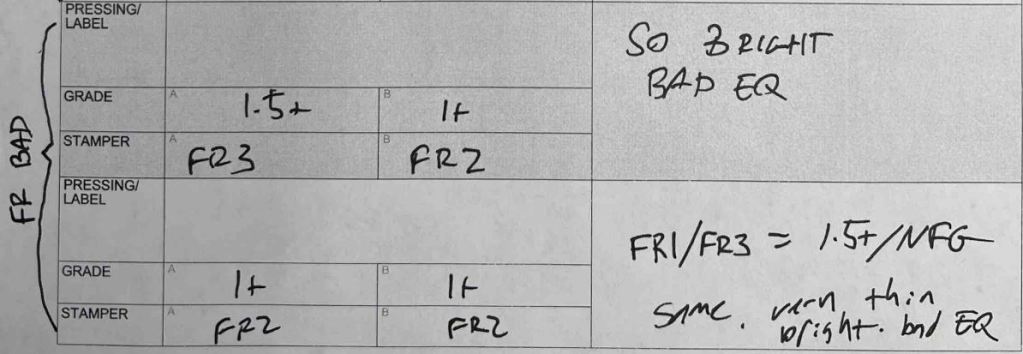
From the notes reproduced on the left — incidentally some of the last I wrote before I retired — you can see that the overall sound struck me as drythin and CD-like.

(more…)

Letter of the Week – “I now have twelve copies in total… eleven of them are useless.”

Hot Stamper Pressings of Led Zeppelin’s Albums Available Now

We love it when our customers take the time and make the effort to do their own shootouts, especially when we win, which is what happens about 99% of the time.

Hey Tom,   

I’ve really been enjoying the LPs that I’ve gotten from you. Especially the Led Zep 3 most recently. Mindboggingly good. My first copy of that record I got Christmas 1970, I now have twelve copies in total… eleven of them are useless.

Think of all the money wasted on bad pressings, which 98% of them are! If not bad, then certainly mediocre.

I want to thank you for this invaluable service. I tell my friends about your service but so far it falls on deaf ears.

All the best,
Fred

If you want to convince them of the reality of Hot Stampers, play them that Zep III you bought. Ask them to bring over their best pressings and then blow that shit right out of the water. That ought to do it.

As I wrote to a customer not long ago, explaining doesn’t work. Only hearing works.

(more…)

Tchaikovsky – Sleeping Beauty Highlights / Ansermet

More of the music of Peter Ilyich Tchaikovsky (1840 – 1893)

More Classical and Orchestral Recordings

  • With STUNNING Shootout Winning Triple Plus (A+++) Demo Disc sound from first note to last, this Decca pressing from 1974 could not be beat
  • These sides are doing everything right – they’re rich, clear, undistorted, open, spacious, and have depth and transparency to rival the best recordings you may have heard
  • Ansermet is of course a master of the ballet – the complete performance of Tchaikovsky’s Sleeping Beauty by the Suisse Romande is outstanding, perhaps even definitive
  • 1959 was a great year for classical recordings – other Must Own Orchestral releases can be found here.
  • Here are more of the orchestral “sleeper” recordings we’ve discovered with demo disc sound

Big Decca sound! Powerful deep bass. Beautiful string tone and sharply articulated brass. This is a simply wonderful record.

Ansermet is surely the man for this music, and the famously huge hall he recorded in just as surely contributes much to the wonderful sound here.

Production and Engineering

James Walker was the producer, Roy Wallace the engineer for these sessions from 1958 in Geneva’s glorious Victoria Hall. It’s yet another remarkable disc from the Golden Age of Vacuum Tube Recording.

The gorgeous hall the Suisse Romande recorded in was possibly the best recording venue of its day, perhaps of all time. More amazing sounding recordings were made there than in any other hall we know of. There is a solidity and richness to the sound that goes beyond all the other recordings we have played, yet clarity and transparency are not sacrificed in the least.

It’s as wide, deep and three-dimensional as any, which is of course all to the good, but what makes the sound of these recordings so special is the weight and power of the brass, combined with timbral accuracy of the instruments in every section.

(more…)

Inner Secrets Is One of the Best Sounding Rock Records We’ve Ever Played

Hot Stamper Pressings of the Music of Santana Available Now

In our most recent shootout (11/2023), the first we’ve done in quite a few years, my main listening guy was blown away by the sound of the Shootout Winning copy. This warmed my heart no end, as I have been raving about the sound of this album for fifteen years or more.

We created a section for phenomenally good sounding records like Inner Secrets, and this link will take you to it.

His notes from the session can be seen below.

And he’s not wrong about much of the album being “blah.” There are really only about four top quality songs out of the nine on the album, but three of those four are killer, and, even at our prices, make the album a Must Own for those of you with big speakers that can play good and loud.

Phase One and Phase Two of a Shootout

Like other Hot Stampers you may have read about, sometimes the instruments and voices just jump out of the speakers. When that happens I usually write “It’s Alive!” on the post-it, and I know exactly what to do with it. I put it right in the Contender pile, to be compared with the other top contender copies at some point.

It’s definitely a crazy-good Hot Stamper; just how hot we still need to find out.

Which is what happens in Phase Two of these affairs. We go back through all the best copies to see in what areas they really shine and in what areas they may fall a bit short of the best.

Of course there’s no way to know what accounts for any of the sound we hear. Not for sure anyway. It’s just interesting to ponder what makes one record sound one way and the next record, with stampers as little as one letter off in the alphabet — sometimes with exactly the same stampers! — sound so different from one another.

Doug Sax Is The Man

All the originals (the only ones with the potential for good sound in our experience) are cut by The Mastering Lab, one of the greatest cutting houses to ever master records.

Doug Sax may or may not have had anything to do with the making of this record, but one thing we can be sure of: he knew how to keep his lathes and amplifiers working at state-of-the-art levels. The sound quality is unsurpassed.

And he did it all with tubes.

(more…)

Letter of the Week – “The Triplanar is bringing out more of the life and energy in the music than any other change I’ve made.”

Check Out Our New Audio Advice Section

When our customers ask for audio advice, we never hesitate to give it to them. (We also give out plenty of advice that nobody asked for.)

We want to help our customers pursue the kind of equipment that we know through decades of experience is probably superior to most of what is available in audiophile salons, regardless of price.

(In 1976, at the tender age of 22, I heard something at an audio salon that rocked my world: tube equipment. Everything changed that year.)

Robert Brook has taken our advice and ended up with much of the same equipment we currently use. He seems very happy with the analog sound he is getting these days, especially from his Triplanar tonearm.

And now Aaron B. has made a great leap forward into better sound. He wrote to tell me all about the differences he is hearing now that he has a system that is designed to reveal what’s actually on his records. His previous system was better at hiding the imperfections and shortcomings of many of the albums he was playing, but he’s decided he doesn’t want to go down that road anymore, and we couldn’t be happier for him. His letter:

I’m feeling another huge dose of gratitude for you, Tom.

I installed the Tri-Planar arm on Friday, and I could tell right away that things are sounding just wonderfully better.

My whole setup is getting really close to your full recommendation. Dynavector 17dx mounted in a Tri-Planar tonearm, mounted on a VPI Aries 1 table, going into an EAR 324, out to a [redacted] amp, driving Legacy speakers.

I managed to buy everything except the cartridge used and in good shape. The total cost for my current system is a hair above $10K, and it is sounding nearly as good as I’ve ever heard vinyl sound, or any recorded music for that matter.

The Triplanar tonearm is a game-changer. This is the most dramatic improvement since I first replaced my B&W bookshelf speakers with the Legacys. I’m frankly stunned by what a difference it makes.

The difference the tonearm makes is evident in nearly every aspect of the sound.

First, the problems I was having previously have cleared up. This includes vocal sibilance, occasional graininess to the sound, and what I mistook for groove wear, even on some hot stampers that otherwise sounded great.

Some that I returned to you, I now wish I could have back.

Beyond fixing the last of my playback problems, the Triplanar is bringing out more of the life and energy in the music than any other change I’ve made since you started advising me.

The attack on instruments is arresting. I’ve come to believe that the aspect of live music that’s hardest for any recording to capture is the attack. That’s where the energy of live music is to be found.

I am hearing more details and overtones to the music that I ordinarily needed to turn up the volume to hear. Also, there’s greater depth to the soundstage, even in my small room.

I’ve said this to you before, but it bears repeating. I love the records you sell. I’ve got 15 hot stampers now, and they are the crown jewels of my collection. But, it’s the education you’ve given me that’s truly transformed my music listening experience.

Today, for that, you have my deep gratitude.

Aaron

Aaron,

Thanks for taking the time to write and say all those nice things about our records and the equipment we have recommended you play them with. As you can clearly see now, it takes the right stereo to really bring our records to life. Glad to hear yours is working so well.

I have long held that the best way to do audio is to find a system in someone’s home that sounds amazing and just buy all the same stuff that person has and set it up the same way he did. If a stereo is sounding good, much of it has to be working right. Start there, then make your own improvements based on a proven model of success.

I did this to the extent it was possible back in the 80s, copying my friend George Louis’s system, comprising four 140 watt per channel transistor amps (four times the power I have now), an electronic crossover, two sets of adjustable electrostatic tweeter arrays (RTR for one and Janzen for the other), a large number of woofers in the main cabinet and a couple of dual 10″ subs thrown in for good measure.

(more…)

Borodin / Symphonies 2 & 3 – Side Two Had Some Common Sonic Problems

More of the music of Alexander Borodin (1833-1887)

This shootout, conducted back in 2012, was our first for the album.

This White Hot Stamper pressing has DEMO QUALITY sound of the HIGHEST ORDER on fairly quiet vinyl no less. We’ve long considered the album one of the greatest of all the Decca / London recordings, but this pressing takes the sound beyond even our high expectations.

There is simply nothing in the sound to fault. Where is the slightly dry and midrangy quality in the upper strings that so many Londons from this era suffer from? It’s nowhere to be found on this side one. (If you have a rich sounding cartridge, perhaps with that little dip in the upper midrange that so many moving coils have these days, you will not notice this tonality issue nearly as much as we do.)

And it’s not as though our stereo was hiding that quality, because some of it creeps into the sound on this very side two (which is why it earned a slightly lower grade of A++).

Big, rich and dynamic, this is the sound of LIVE MUSIC, and it can be yours, to enjoy for years to come — if you’ve got the stereo to play it and the time to listen to it.

The powerful lower strings and brass are gorgeous. Ansermet and the Suisse Romande get that sound better than any performers I know. You will see my raves on record after record of theirs produced during this era. No doubt the world renowned Victoria Hall they recorded in is key. One can assume Decca engineers use similar techniques for their recordings regardless of the artists involved. The only real variable should be the hall.

Ansermet’s recordings with the Suisse Romande exhibit a richness in the lower registers that is unique in my experience. His Pictures At Exhibition has phenomenally powerful brass, the best I’ve ever heard. The same is true for his Night On Bald Mountain. Neither performance does much for me — they’re both too slow — but the sound is out of this world. Like it is here.

Side One

A+++, big, rich and lively, yet clear, transparent and spacious. The brass is shockingly dynamic and powerful. I defy you to find better brass on a record than can be found on this side one. I can’t recall hearing it, and we play the best sounding Golden Age classical recordings by the score week after week.

Side Two

A++, a bit wider, with lovely sheen to the strings, but tonally a bit thinner and drier than it should be. Still, awfully good in comparison to the better classical records we put up every week, just not competitive with this amazing side one.

If you’re looking for Demonstration Quality Sound, look no further. This side one has it in spades.

Heavy Vinyl

Speakers Corner did a heavy vinyl reissue of this title, which we auditioned and used to sell. It’s reasonably good, but like all reissues it lacks the weight found on this original. I remember it being a little flat and bright. I haven’t played it in years so I could easily be wrong.

(more…)

Santana – Inner Secrets

More Santana

More of Our Hardest Rockin’ Records

  • A big, bold, exciting and hard-rocking pressing with INCREDIBLE Shootout Winning Triple Plus (A+++) sound from start to finish -exceptionally quiet vinyl too
  • Power and energy are what make this album a true Demo Disc in the world of rock, and this copy has both
  • A sleeper in the Santana canon that boasts some of the best sound the band ever put to vinyl
  • As a matter of fact, the notes for this copy mentioned that it was one of the best sounding rock records we have ever played – and who plays more amazing sounding rock records than we do?
  • Top tracks here include three of their biggest barnburners: “Dealer” (Traffic), “Stormy” and “Well…All Right” (Blind Faith)

I know exactly the kind of sound I like on this album. When the background vocals come in, on the Tubey Magical copies they are wall to wall and sweet as honey, with no trace of grain or edge. Big as life too. The guitars have plenty of bite, but no matter how loud they get, they never seem to strain. The louder they get the more I like it. That’s the ticket as far as I’m concerned.

Turn It Up

Like Abraxas, when you play a Hot Stamper copy good and loud, you find yourself marvelling at the musicianship of the group — because the Hot Stamper pressings, communicating all the energy and clarity the recording has to offer, let you hear what a great band they were.

If you’ve got the the big room, big speakers, and the kind of power it takes to drive them, you can have a live rock and roll concert in your very own house.

When Santana lets loose with some of those legendary monster power chords — which incidentally do get good and loud in the mix, unlike most rock records which suffer from compression and “safe” mixes — I like to say that there is no stereo system on the planet that can play loud enough for me. (Horns maybe, but I don’t like the sound of horns, so there you go.) Here are some other records that have especially dynamic guitar solos.

What makes it possible to play this record so loud and still enjoy it? Simple. When the sound is smooth and sweet, completely free of aggressive mids and highs, records get better as they get louder. (This, of course, assumes low distortion and all the rest, but the main factor is correct tonality from top to bottom, and this record has it.)

(more…)

Listen to Winwood’s Left Hand on “Glad”

More of the Music of Steve Winwood

Many years ago, perhaps in 2015, while playing an especially transparent copy of John Barleycorn, we learned something new about the album. Although it was a title I had been playing since it came out all the way back in 1970, apparently things had changed.

This pressing made it clear — really, for the first time — exactly what Winwood was doing with his left hand on the piano during the song Glad.

There are two musical figures that one can focus on: one involving the lower notes, which tend to be blurry, obscured and murky on most pressings, and two, the right-handed higher notes, which are typically much more clear and audible in the mix.

Only the very best copies let us “see” the bass notes of the piano so clearly and correctly. Next time you’re in the mood to compare different pressings of Barleycorn, pay special attention to the lower notes of the piano on Glad. It is our contention, backed by mountains of evidence, that no two copies of the album will get that piano to sound the same. (It will also help if you have large dynamic speakers with which to do the test.)

Lately we have been writing quite a bit about how pianos are good for testing your system, room, tweaks, electricity and all the rest, not to mention turntable setup and adjustment.

  • We like our pianos to sound natural (however one chooses to define the term).
  • We like them to be solidly weighted.
  • We like them to be free of smear, a quality that is rarely mentioned in the audiophile record reviews we read.

(more…)

Letter of the Week – “I love Blood On The Tracks, I have 6 copies of it and none of them come near yours”

Hot Stamper Pressings of the Music of Bob Dylan Available Now

One of our good customers had this to say about some Hot Stampers he purchased recently:

Hey Tom, 

Received the LP a few days ago, and thank you. I love Blood On The Tracks. I have 6 copies of it and none of them come near yours. I can stop looking now. Thank you.

Arun,

We love it when our customers take the time and make the effort to do their own shootouts, especially when we win, which is what happens about 98-99% of the time.

It is not the least bit unusual for our customers to take another listen and thereby become convinced of the superior sound of the Hot Stamper pressing we sent them.

Seems our copy of Blood on the Tracks was clearly so much better there was no need to listen further.

When a customer says we lost the shootout he conducted, we promptly refund the buyer’s money and wish him or her a nice day.

What do we do with the record, assuming the customer had no problem with its playing condition?

We put it right back up on the site to sell to the next person who wants it. In only two or three cases that I can recall did it ever come back to us again. Two or three out of thousands and thousands of Hot Stampers sold. Not bad.


Further Reading

Emerson, Lake and Palmer – Brain Salad Surgery

More Emerson, Lake and Palmer 

 More Prog Rock

  • Boasting two solid Double Plus (A++) or BETTER sides, we guarantee you’ve never ELP’s 1973 release sound remotely as good as it does on this superb import copy
  • This early British pressing is huge, spacious and rich, with prodigious amounts of bass, guaranteed to sound better than any other copy you’ve heard
  • Remarkable transparency – you hear into the huge, deep soundfield with almost nothing between you and the musicians
  • 4 1/2 stars: “The songs are… among their best work — the group’s arrangement of Sir Charles Hubert Parry’s setting of William Blake’s ‘Jerusalem’ manages to be reverent yet rocking, while Emerson’s adaptation of Alberto Ginastera’s music in ‘Tocatta’ outstrips even ‘The Barbarian’ and ‘Knife Edge’ from the first album as a distinctive and rewarding reinterpretation of a piece of serious music.”

(more…)