zero-tube

Some records are so completely lacking in analog warmth, richness and sweetness that they sound more like bad CDs than records. They have so little Tubey Magic that you might as well peg the figure at ZERO.

This is definitely not our sound. No Hot Stamper pressing could possibly lack Tubey Magic — it’s one of the analog qualities that sets our records apart from even the best of those pressed on Heavy Vinyl – but plenty of other records do, and this link will take you to about 50 of them.

What Willie and Nat Can Teach Us about Heavy Vinyl

Hot Stamper Pressings of the Music of Willie Nelson Available Now

This letter came to us many years ago. Updates have been added as of 2024.

One of our good customers had this to say about some Hot Stampers he had purchased:

Hello team,

I’ve been a little distracted here, I got married over the weekend! So, haven’t done as much listening over the past couple of weeks. However, I did have a chance to listen to Stardust and Love Is The Thing. They were both different than their Classic Records and Analogue Productions counterparts. Willie sounded a little smoother, more organic, and more integrated.
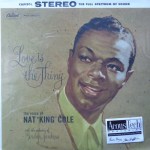
The strings on Love Is The Thing were very different, more pronounced and emotional, but Nat’s voice, and the sound overall, sounded a little strident, maybe “too” hot.

I’d like to send them both back to you, and if you have a chance to send back the discs I sent to you I’d very much appreciate it. All told, the two big sets of Better Records are really incredible, and only serve to make my want list grow. Here’s to you and the next set!

Doug,

We now have the update for those two titles.

I, along with the two other guys in our listening panels, sat down to play the Heavy Vinyl you sent us, and the long and short of it is that we were astonished that records that sound as bad as those two actually were approved for release.

Nat is wrong six ways from Sunday, and Willie is not so much wrong as just not very good.

Nat: “F,” one of the worst heavy vinyl disasters of all time, and Willie: “D” sound, more like a CD than a record. There are many pressings of this album that are not good, but this version is probably worse than most of them, hence the D grade.

The old Classic pressing is probably better, and it would earn about a C grade. [I honestly do not remember exactly what pressing Douglas sent us. All I remember is that it was on Heavy Vinyl.]

I suspect the CDs of both these pressings are much better sounding than this vinyl.

The DCC gold is definitely better by a long shot, and the plain old Willie CD is probably a step up as well. 


A Further Update

(more…)

Jimmy Page’s Houses of the Holy Needed Tubes and Didn’t Get Them

Hot Stamper Pressings of the Music of Led Zeppelin Available Now

We did not care for the newly remastered version of Houses of the Holy. It badly lacks the kind of mastering that Robert Ludwig brought to the sound, and by that we mean lots of lovely tubes in the mastering chain.

What tube equipment he used and how he used it is something we have been researching for years now, but rather than go down that rabbit hole for the moment, let’s just say the Tubey Magic that is all over the original cuttings of the album is hard to find on the new one, and that means it’s missing a quality that makes Houses of the Holy one of the most luscious audiophile listening experiences one can have, even for those of us who long ago gave up on tube equipment.

The notes for side one, track one (The Song Remains the Same) and track three (Over the Hills and Far Away), read:

  • Blary, but not as awful as I expected
  • Dry, top end is bright, big though

The notes for side two, tracks one (Dancing Days) and three (No Quarter), read:

  • A bit thick, tonally OK
  • Less space around the low end

Tubes are what the doctor ordered, precisely the medicine that was needed to cure many of this pressing’s problems, but tubes are not what Jimmy Page and his engineer, John Davis, brought to the project, and more’s the pity. Any good domestic original will show you exactly what is wrong with the sound of this version in under two minutes.

(more…)

Another “Problematical” Classic Records Reissue

Hot Stamper Pressings of Living Stereo Titles Available Now

It’s been quite a while since I played the Classic pressing of these works by Shostakovich, but I remember it as nothing special.

Like a lot of the records put out by this label, it’s tonally fine but low-rez and lacking spacewarmth and above all, Tubey Magic.

I don’t think I’ve ever played an original or a Victrola reissue that didn’t sound better, and that means that the best grade to give Classic’s pressing is probably a D for below average.

The Classic Records pressing can currently be found on the TAS list, but we don’t think it has any business being there, along with a great many others, far more than we could ever find the time to play and review.

(more…)

The Yellow Submarine Songtrack Did Not Float My Boat

Last year a customer wrote to tell me how much he liked the sound of his 2004 Japanese DMM pressing of the Yellow Submarine Songtrack.

After looking into the background of this album, we saw right from the start that it had three strikes against it.

First off, we rarely like Japanese pressings outside of those that were recorded in Japan, such as the direct to disc jazz and classical records we’ve done shootouts for. Other Japanese pressings we like were recorded in the states for the Japanese market: the jazz direct to discs on East Wind come to mind.

Secondly, whenever possible we avoid DMM pressings. They often add what seems to us like digital artifacts to the sound.

And lastly, we rarely like modern remixes, especially modern remixes that obviously use digital processes of various kinds. The remixed Abbey Road is a complete disaster. Nothing that comes out of Abbey Road these days should be expected to sound good. Their work is a disgrace.

So rather than buy the Japanese-pressed version of the album, we cheaped out and just bought a UK one for half the price.

We half-expected the worst and that’s pretty much what we found.

I used to sell this very version of the album back in 1999 when it came out. I thought it sounded just fine. That was about twenty years ago. My all tube system was darker and dramatically less resolving than the one I have now.

Scores of improvements have been made since then to every aspect of analog reproduction, something we discuss endlessly on this blog.

We Have No Idea

To be fair, we admit that we have no idea what the Japanese pressing of the album sounds like. We’ve never played one.

So what’s wrong with the UK pressing of the Yellow Submarine Songtrack?

From the notes reproduced on the left — incidentally some of the last I wrote before I retired — you can see that the overall sound struck me as drythin and CD-like.

(more…)

The Planets on Pro-Use Japanese Vinyl at 45 RPM Is Just Awful

More of the music of Gustav Holst (1874-1934)

This EMI 45 RPM Japanese Import 2 LP set is considered one of the great Planets by many audiophiles, but it’s not, based on our playing of a copy we had years ago, which means it belongs in our audiophile hall of shame.

The best copies on British or Dutch EMI vinyl are clearly better than this “audiophile” pressing.

What could be less surprising?

This is precisely why we dislike Japanese pressings as a rule — they sound like this audiophile trash.

Our favorite performance of The Planets can be found here.

The Big Picture from a Lifelong Audiophile

You may have seen the following text in another listing, but it bears repeating.

There is nothing new under the sun, and that is especially true when it comes to bad sounding audiophile records. The world is full of them.

There has been one big change from the days when I self-identified as a freshly minted audiophile in the 70s.

Yes, the records being marketed to audiophiles these days may have second- and third-rate sound, but at least now they have good music. That’s progress, right?

The title reviewed above is a good example of the kind of crap we newbie audiophiles used to put up with back in the old days, long before we had anything resembling a clue.

This one clearly belongs on our list of bad audiophile records.

You might be asking: What kind of audio fool was I? to buy a dumbass record like this.

It’s a fair question. Yes, I admit I was foolish enough to buy records like this and expect it to have good music, or at least good sound. Of course it had neither. Practically none of these kinds of records ever did. Sheffield and a few others made some good ones, but most Direct to Disc recordings were crap.

As clueless as I was, even back in the day I could tell that I had just thrown my money away on this lipsticked-pig in a poke.

But I was an audiophile, and like a certain Mr. Mulder, I wanted to believe. These special super-hi-fidelity records were being made for me, for special people like me, because I had expensive equipment and regular records are never going to be good enough to play on my special equipment, right?

To say I was wrong to think about audio that way is obviously an understatement. Over the course of the last forty years, I (and to be fair, my friends and my staff) have been wrong about a lots of things in the worlds of records and audio.

You can read more about many of the things we got wrong under the heading: live and learn.

The good news? Audio progress is real and anyone who goes about doing audio the right way can achieve the equivalent of miracles.

(more…)

If You Can’t Make a Good Record, Why Make Any Record At All?

Hot Stamper Pressings of the Music of Steely Dan Available Now

This Speakers Corner Heavy Vinyl pressing has to be one of the worst sounding versions of the album ever pressed.

You think the average ABC or MCA pressing is opaque, flat and lifeless, not to mention compromised at both ends of the frequency spectrum?

You ain’t heard nothin’ yet!

As bad as the typical copy of this album is, the Speakers Corner Heavy Vinyl is even worse, with not a single redeeming quality to its credit.

If this is what passes for an Audiophile Record these days, and it is, it’s just one more nail in the coffin for Heavy Vinyl.

But that’s not the half of it.

Go to Acoustic Sounds’ website and read all the positive customer reviews — they love it! Is there any heavy vinyl pressing on the planet that a sizable contingent of audiophiles won’t say something nice about, no matter how bad it sounds? I can’t think of one.

To sum up, this record is nothing less than an affront to analog itself. I guarantee you the CD is better, if you get a good one. I own four or five and the best of them has far more musical energy than this thick, dull, opaque and boring piece of audiophile analog trash.

It was probably made from a digital copy of the master, or more likely a digital copy of an analog dub of the master — three generations, that’s sure what it sounds like — but that’s no excuse.

If you can’t make a good record, don’t make any record at all. Shelve the project. The audiophile vinyl world is drowning in bad sounding pressings; we don’t need any more, thank you very much.

(more…)

If This Is Your Idea of a Reference Record, You Are in Real Trouble

Hot Stamper Pressings of TAS List Super Disc Albums Available Now

An astoundingly bad Sound Show!!

An audiophile hall of shame pressing and a Half-Speed mastered disaster if there ever was one. If this Reference LP isn’t the perfect example of a pass/not-yet record, I can’t imagine what would be. It is just awful.

Mastered by none other than Stan Ricker. RR-7 also appears to still be on Harry Pearson’s TAS List.

My recent notes can be seen below. (The 1 in the upper left hand corner is my abbreviation for side one, which seems to be the worst side of the two here.)

Track two, the Red Norvo selection, is a real mess, highlighting the problems typically caused by Half Speed Mastering, especially at the hands of one of the most notorious “Audiophile” Mastering Engineers of All Time, the late Stan Ricker. Who cut as many bad sounding records as SR/2 himself? No one I can think of comes close.

His records, with few exceptions, suffer from bad bass (probably bloated and poorly defined in this case, my notes don’t say but after playing these records for thirty years I doubt I’m very off with this guess) and phony, boosted highs, which cause the striking of the mallets to be emphasized in an especially unnatural and unpleasant way.

Arthur Lyman had dramatically better sound in the 50s.

How come none of the audiophiles at Reference Records bothered to figure out how he did it?

Can anybody take sound like this seriously?

(more…)

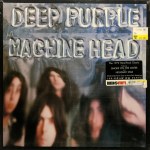
Machine Head on Rhino Vinyl Sounds Like a CD

Hot Stamper Pressings of the Music of Deep Purple Available Now
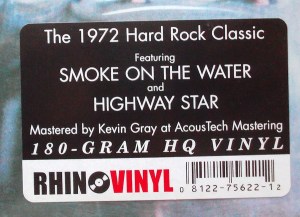
Mastered by Kevin Gray, this record has what we would call ”modern” sound, which is to say it’s clean and tonally correct, but it’s missing the Tubey Magic the British originals are swimming in.

In other words, it sounds like a CD.

I’m guessing that very few people have ever heard this record sound the way our best Hot Stamper pressings can sound.

For one thing, the domestic pressings are made from dubbed tapes, and that’s what most of us Americans would have owned. The original domestic pressings are smeary, veiled and small as a rule

Yes, the average copy may be nothing special, but this one is a boring, lifeless mess, so save your money.

Rhino Records has really made a mockery of the analog medium. Rhino touts their releases as being pressed on “180 gram High Performance Vinyl.” However, if they are using “performance” as a synonym “sound quality,” we have found the performance of their vinyl to be quite low, lower than the average copy one might stumble upon in the used record bins.

Who can be bothered to play a record that has so few of the qualities audiophiles should be looking for on vinyl?

Back in 2007 we put the question this way: why own a turntable if you’re going to play mediocrities like these?


Further Reading

Records are getting awfully expensive these days, and it’s not just our Hot Stampers that seem priced for perfection.

If you are still buying these modern remastered pressings, making the same kind of mistakes that I was making before I knew better, take the advice of some of our customers and stop throwing your money away on Heavy Vinyl and Half-Speed mastered LPs.

(more…)

Francis Albert Sinatra & Antonio Carlos Jobim on Bad Rhino Heavy Vinyl

More of the Music of Frank Sinatra

Reviews and Commentaries for the Music of Frank Sinatra

Sonic Grade: C-

The Rhino 180 gram LP mastered by Kevin Gray is passable, but the real thing is the real thing and just can’t be beat by some wannabe reissue.

There is a richness, a sweetness and a relaxed naturalness on the best early pressings that are virtually never found on modern remasterings.

Rhino Records has really made a mockery of the analog medium. Rhino touts their releases as being pressed on “180 gram High Performance Vinyl.” However, if they are using performance to refer to sound quality, we have found the performance of their vinyl to be quite low, lower than the average copy one might stumble upon in the used record bins.

Mastered by Kevin Gray, this record has what we would call ”modern” sound, which is to say it’s clean and tonally correct, but it’s missing the analog qualities the better originals have plenty of, most notably Tubey Magic. [1]

In other words, it sounds like a CD.

Who can be bothered to play a record that has so few of the qualities audiophiles are looking for on vinyl?

Back in 2007 we put the question this way: Why own a turntable if you’re going to play mediocrities like these?


[1] Some records are so completely lacking in Analog Warmth, Richness and Sweetness that they sound like CDs, and bad ones at that. They have so little Tubey Magic that you might as well peg the figure at ZERO.

This is decidedly not our sound. No Hot Stamper pressing could possibly lack Tubey Magic — it’s one of the things that sets our records apart from the modern mediocrity known as the Heavy Vinyl LP.

The Voice (Isn’t What It Should Be) on Heavy Vinyl

More of the Music of Frank Sinatra

Reviews and Commentaries for the Music of Frank Sinatra

Sonic Grade: D

An audiophile hall of shame pressing and another Classic Records popular music LP badly remastered for the benefit of audiophiles looking for easy answers and quick fixes.

There is a boatload of TUBEY MAGIC to be heard on the early pressings, no doubt due to the fact that they are mastered with tube equipment, but you would never know it by playing this barely passable Classic repressing.

The difference is night and day.

It’s been quite a while since I played the Classic pressing, but I remember it as nothing special. Like a lot of the records put out by this label, it’s tonally fine but low-rez and lacking spacewarmth and above all, Tubey Magic.

I don’t think I’ve ever played an original that didn’t sound better, and that means that the best grade to give Classic’s pressing is probably a D, for below average. It sounds far too much like a CD.

Who can be bothered to play a record that has so few of the qualities we audiophiles are looking for on vinyl?

Back in 2007 we put the question this way: Why own a turntable if you’re going to play mediocrities like these?

(more…)