zero-tube

Some records are so completely lacking in analog warmth, richness and sweetness that they sound more like bad CDs than records. They have so little Tubey Magic that you might as well peg the figure at ZERO.

This is definitely not our sound. No Hot Stamper pressing could possibly lack Tubey Magic — it’s one of the analog qualities that sets our records apart from even the best of those pressed on Heavy Vinyl – but plenty of other records do, and this link will take you to about 50 of them.

Workingman’s Dead is Dead as a Doornail on Rhino Records

Hot Stamper Pressings of the Music of The Grateful Dead Available Now

This review was written many years ago, shortly after the release of the album in the early-2000s.


An audiophile hall of shame pressing and a Heavy Vinyl disaster if there ever was one (and oh yes, there are plenty. Here are some of the more recent examples we’ve played).

The 2003 Rhino reissue on Heavy Vinyl of Workingman’s Dead is absolutely awful. It sounds like a bad cassette.

The CD of the album that I own is superb, which means that the tapes are not the problem, bad mastering and pressing are.

This pressing has what we call ”modern” sound, which is to say it’s clean and tonally correct for the most part, but it’s missing the Tubey Magic the originals and the good reissues both have plenty of.

Is it the worst version of the album ever made? The pressings on the last WB labels are pretty awful, but this awful? Who can say.


Rhino Records has really made a mockery of the analog medium. Rhino bills their releases as pressed on “180 gram High Performance Vinyl”. However, if they are using performance to refer to sound quality, we have found the performance of their vinyl to be quite low, lower than the average copy one might stumble upon in the used record bins.

The CD versions of most of the LP titles they released early on are far better sounding than the lifeless, flat, pinched, so-called audiophile pressings they did starting around 2000. The mastering engineer for this garbage actually has the nerve to feature his name in the ads for the records. He should be run out of town, not promoted as a keeper of the faith and defender of the virtues of “vinyl.” If this is what vinyl sounds like I’d switch to CD myself.

And the amazing thing is, as bad as these records are, there are people who like them! I’ve read postings on the internet from people who say the sound on these records is just fine, thank you very much. I find this very, very sad. More proof, as if we needed it, that the audiophile record collecting world has lost its mind.

Their Grateful Dead titles sound worse than the cheapest Super Saver reissue copies I have ever heard. The Yes Album sounds like a cheap cassette as well, a ghost of the real thing.

(more…)

How Do You Make a Vintage Jazz Recording Sound Wrong?

Hot Stamper Pressings of Jazz Albums Available Now
How do you make a vintage jazz recording sound wrong?

Easy. Just take out all the Tubey Magic that was captured on the master tape all those years ago by Howard Holzer and Roy DuNann.

You know the kind of Tubey Magic I’m talking about. It’s the trademark sound of every vintage Contemporary pressing ever made. It’s the defining sound of the best jazz recordings from the era. It’s the reason that jazz lovers and record collectors the world over pay big bucks for vintage pressings — because they have the sound of tubes.

When you take away that one quality — just the one, leaving everything else as it should be: the bass, the mids, the highs, the energy, the space, the size, you name it — what you are left with doesn’t sound right.

It no longer sounds the way a jazz record from 1958 would sound.

If you don’t know that sound, it’s possible that this cheap reissue pressing from 1984 might not be as bothersome for you as it was for us. But we’ve played vintage jazz records from the 50s by the hundreds. They never sound like this. The reissues might, but the best early pressings sure don’t.

Maybe This Is Your Sound?

However, if you happen to like the sound of CDs for some reason, something that is frankly hard to imagine but nevertheless seems to be true, this OJC might just be the ticket.

We’ve never liked that sound, and we sure don’t like this pressing.

Other records we’ve played that sounded like CDs to us can be found here.

We’ve only played three releases on the Music Matters label, but all three of them sounded like CDs to us — Green Street, The Magnificent Thad Jones, and Tina Brooks’ True Blue (review coming someday!).

Much of Kevin Gray‘s work has the kind of sound we associate with the compact disc. We don’t understand why everyone doesn’t hear how badly mastered his records are, but we have no trouble recognizing their many faults. They are, to one degree or another:

The OJC pressings of Harold in the Land of Jazz we played were thinner and brighter than even the worst of the 70s LPs we auditioned.

They did not make the cut for our shootout, a shootout we abandoned years ago because the early pressings we liked were just too rare, too noisy and too expensive to justify the cost and effort that would be required to make a shootout a reality.

(more…)

Our Guide to Legrand Jazz on Impex

Hot Stamper Pressings of 30th St. Recordings Available Now

Years ago I wrote about how important the Legrand Jazz album was in my growth as a critical listener.

It’s yet another example of an album that helped make me a better audiophile by showing me the error of my tweaking and tuning ways.

Now there is a new pressing of it. Well, new to us anyway. (We readily admit to being behind the times and make no apologies for it. With records like these, we often find ourselves wondering why we bother.)

Two new pressings in fact. One on a single disc at 33 RPM as of 2017, and one mastered at 45 RPM on 2 LPs as of 2019, still in print and available for $59.99.

Production details can be found at the end of this review, along with some favorable comments, some from none other than Steve Hoffman himself.

But first let’s hear from the personification of the well-meaning audiophile reviewer, Michael Fremer. He gives the Impex pressings an 11 for sound. He writes (emphasis added):

This IMPEX reissue is sourced from an “analog mix-down transfer of the original 1958 work tape by Mark Wilder at Battery Studios” and cut by Chris Bellman and Bob Donnelly at Bernie Grundman Mastering on Grundman’s all-tube mastering system. I have a clean, original 6-Eye pressing that this superbly pressed reissue betters in every way. This will make both your stereo and your heart sing. Some of the greatest jazz musicians of that or any era wailing and clearly having a Legrand time. Limited to 3000 copies. Don’t miss it!

Who are you going to believe, the Self-Appointed Vinyl Experts of the World or some guy like me who thinks he knows a thing or two about the sound of records, especially, as in this case, a record I have been playing since 1990 or thereabouts.

(Back in those early days I also had the standard CD, which is excellent and highly recommended. Since I couldn’t clean or play my original vinyl pressing properly, my guess would be that the CD had the better sound at the time.)

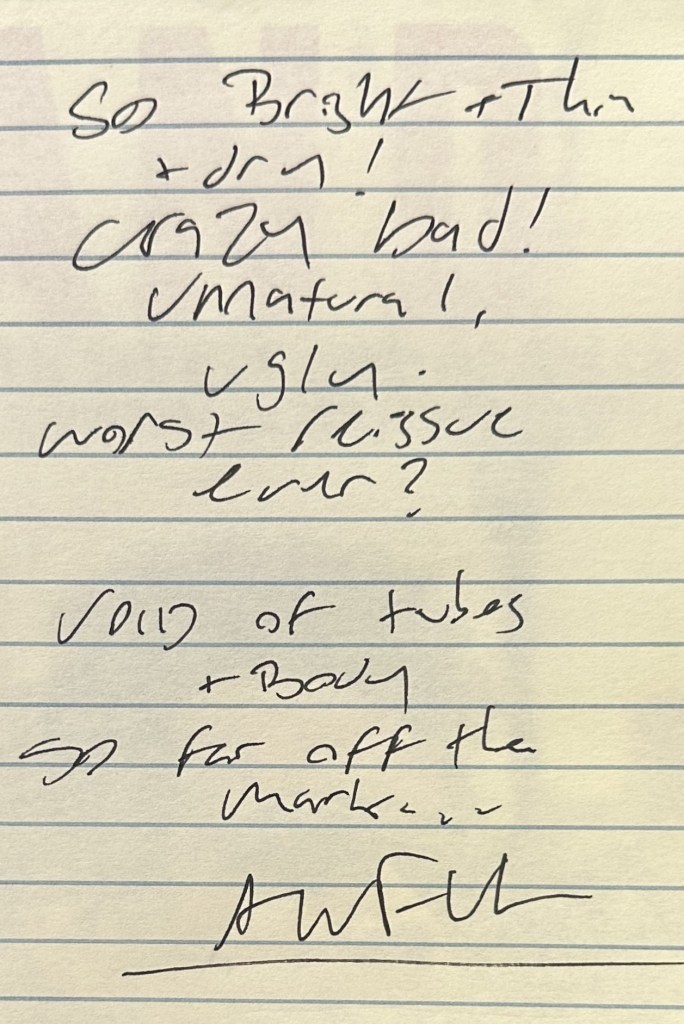
Our notes (for those who have trouble reading our scratch)

So bright and thin and dry.

Crazy bad!

Unnatural, ugly.

Worst reissue ever?

Void of tubes and body.

So far off the mark.

Awful.

A second opinion

Robert Brook reviewed this pressing a while back. He does his best to remain positive when choosing the words that he thinks will help the reader bette understand the experience of playing the Impex release of Legrand Jazz that we had loaned him. In the end he goes with the spoken word over the written one.

(more…)

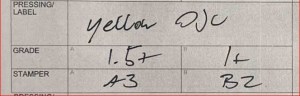
Skip the A3/B2 OJC on Some Like It Hot

Hot Stamper Pressings of the Music of Barney Kessel Available Now

Some Like It Hot badly needed to be made using tubes in the mastering chain, but that didn’t happen.

It’s another case of an OJC with zero Tubey Magic. You might as well be playing the CD. I would bet money it sounds just like this record. Maybe even better.

I suppose if you have a super-tubey phono stage, preamp or amp, you might be able to supply some of the Tubey Magic missing from this pressing, but then all your correctly mastered records wouldn’t sound right, now would they?

We had two copies of the OJC and one of them did better than this one. It earned a Super Hot grade for one side. If you see this OJC pressing in your local record store, avoid these stampers. The sound isn’t awful, but it’s not very good either, especially considering how amazing the tapes must be, based on the sound of our White Hot Stamper shootout winner.

The OJC pressing of this album is much better suited to the old school audio systems of the 60s and 70s than the modern systems of today. These kinds of reissues used to sound good on those older systems, and I should know, I had an old school stereo and some of the records I used to think sounded good back in the day don’t sound too good to me anymore (although this one never did).

The OJC pressings of Some Like It Hot are thinner and brighter than even the worst of the later pressings we’ve auditioned. That is decidedly not our sound. It’s not the sound Roy DuNann was famous for, and we don’t like it either, although we have to admit that we did find the sound of many of these OJC pressings more tolerable — even enjoyable — in the past.

Our old system from the 80s and 90s was tubier, tonally darker and dramatically less revealing, which strongly worked to the advantage of leaner, brighter, less Tubey Magical titles such as this one. Pretty much everybody I knew had a system that suffered from those same afflictions.

Like most audiophiles, I thought my stereo sounded great.

And the reality is that no matter how hard I worked or how much money I spent, I would never have been able to achieve top quality sound for one simple reason: most of the critically important revolutionary advances in audio had not yet come to pass.

It would take many technological improvements and decades of effort until I would have anything like the system I do now.

(more…)

Peter Gabriel on Classic Records

Hot Stamper Pressings of the Music of Peter Gabriel Available Now

Sonic Grade: D (or worse!)

An audiophile hall of shame pressing and another Classic Records rock album badly mastered for the benefit of audiophiles looking for easy answers and quick fixes.

We have a special section for bad sounding records that are marketed to audiophiles, and you can find that section here.

It currently has 281 entries, but if someone wanted to audition more of them — that person is definitely not me, although I cannot imagine anyone more qualified — the number could easily hit 500.

If one were to do just the Music Matters and Analogue Productions albums released to date, a thousand would be no problem.

And if one were simply to include vintage Japanese pressings, the kind many audiophiles regularly bought in the 80s and 90s for their quieter vinyl and supposedly higher quality mastering, our bad audiophile record section would contain multitudes. Multitudes I tell you!

(more…)

An Insult to Aaron Copland on Reference Records

Hot Stamper Pressings of Orchestral Music Available Now

Yet another Reference Record we’ve reviewed and found wanting.

In all the years I was selling audiophile records, one of the labels whose appeal made no sense to me whatsoever (along with their long-forgotten TAS list brethren, American Gramaphone and Telarc) was Reference Records.

Back then, when I would hear one of their orchestral or classical recordings, I was always left thinking, “Why do audiophiles like these records?”

I was confused, because at that time, back in the 80s, I had simply not developed the listening skills that today make it so easy to recognize the faults of their recordings.

I made the mistake of thinking that other audiophiles with more advanced equipment and more refined listening skills must be hearing something I was not.

I had trouble putting my finger on what I didn’t like about them, but now, having worked full time (and then some!) for more than twenty years to develop better critical listening skills, the shortcomings of their records, or, to be more accurate, the shortcomings of this particular copy of this particular title, took no time at all to work out.

My transcribed notes for RR-22:

  • Lean tonality
  • No real weight
  • No Tubey Magic
  • Blurry imaging when loud
  • No real depth
  • Bright tonal balance

Is this the sound you are looking for in an audiophile record?

Shouldn’t you be looking for audiophile quality sound?

Well, you sure won’t find it here.

On our current playback system, this Reference Record is nothing but a joke, a joke played on a much-too-credulous audiophile public by the ridiculously inept and misguided engineers and producers who worked for Reference Records.

This is a reference for something? For what?

As I wrote about another one of their awful releases, if this is your idea of a reference record, you are in real trouble.

It would be hard to imagine that anyone who has ever heard a good vintage classical recording — here are some of our favorites — could ever confuse this piece of audiophile trash with actual hi-fidelity orchestral sound.

(more…)

Moondance on Heavy Vinyl Is a Disgrace to Audiophiles and Record Lovers All Over the World

Hot Stamper Pressings of the Music of Van Morrison Available Now

The original grade I gave out in 2015 when I last played this remastered version as part of a shootout was “D.” I explained at the time:

Just listen to how strange Van’s voice sounds, so lean, hard and sour. That alone qualifies it for an “F,” but considering how bad most pressings of this album are, let’s be fair, if not downright generous, and call it a “D.”

I just revisited the record in a current shootout, and after giving it some thought I have decided that the right grade is in fact “F.” It cannot be any other, for reasons I discuss below.

In 2014 I had written:

Where is the Tubey Magic of the originals? The sweetness? The richness? And why is there so little ambience or transparency? You just can’t “see” into the studio on this pressing the way you can on the good originals, but that’s fairly consistently been the knock on these remastered Heavy Vinyl records. We noted as much when we debunked Blue all the way back in early 2007, so no surprise there.

Having just played a marvelous shootout-winning early pressing, this time around I found the reproduction of Van’s voice on the reissue to be so leaned-out, artificial and unpleasant that I could hardly stand to listen to it.

We had reset the VTA correctly; the overall tonal balance of the recording from top to bottom was correct. It was only the voice that sounded so off. All the other shortcomings I had mentioned before were still true of course, but none of that mattered. The singer on this record just sounded awful.

As you know, we are constantly making improvements to our playback system. The real Moondance we had just played sounded better than ever. The fake Moondance, however, was sounding worse than ever. That’s what higher quality playback can do for you. It makes your good records sound better than they’ve ever sounded, and shows you just how bad your bad records really are.

Do I have a bad copy of the Heavy Vinyl pressing? Maybe, can’t say I don’t. If any of you out there in the real world have a copy of this pressing that you like, and would be willing to send it to me to hear for myself, I would be more than happy to give it a listen and report my findings on this blog.

Short of that I’m not sure what more I can do. I certainly do not feel the least bit inclined to waste a nickel of my hard-earned money on another copy of this ridiculously badly-mastered crap vinyl.

If you want to read about other records that have these same shortcomings, there are links below to the ones we’ve auditioned and identified to date. Our advice would be to avoid them, and if you own some of these pressings, perhaps now is the time to give them another listen and see if you don’t hear the same faults we did.

And, of course, the Hot Stamper pressings we offer, when played side by side with any of these Heavy Vinyl remasters, can help you to see more clearly just where these new records are going wrong, or, in the case of Moondance, completely off the rails.

(more…)

Fifth Dimension – More Dead as a Doornail Sundazed Sound

Hot Stamper Pressings of Sixties Pop Recordings Available Now

This review was written probably more than twenty years ago, back in the day when we actually would order up the latest Sundazed title in the hopes of finding something worth offering to our customers. Looking back, it’s hard to imagine a bigger waste of our time. So few were any good and so many were terrible, why were we bothering to fish where there weren’t any good fish?

Through it all, through the worst of those dark days, somehow we managed to learn some important lessons.

The main lesson we learned was that there was no record with sound so bad that it could not be released.

Even worse, there was no record with sound so bad that it would prevent the better known reviewers from raving about it. (If you think anything has changed, just pull up the latest TAS Super Disc list. The bad souding Heavy Vinyl pressings to be found there far exceed the good sounding vintage pressings they’ve nominated for inclusion over the last 50 years. A small sample.)

Our days playing and selling even the best of these kinds of modern reissues are long gone. By 2007 everything had changed.

Our Old Review

The best stereo copies are rich, sweet and Tubey Magical — three areas in which the Sundazed reissues are seriously lacking.

If anyone still cares, anyone besides Michael Fremer, that is. He seems to like some of their remastered records. We can’t be bothered with mediocrities such as this and the rest of their sorry output, but apparently people are still buying these records. The label is still in business and cranking out more dreck with each passing year. 

And none of the Columbia monos we’ve played did much for us either. Congested and compressed, with no real top, who in his right mind could possibly prefer that sound?

Audiophiles? Record collectors? What in god’s name are they listening with, or for?

(more…)

The Four Seasons Direct to Disc at 45 RPM

Hot Stamper Pressings of the Music of Antonio Vivaldi Available Now

This RCA Direct-to-Disc 45 RPM Double LP has awful sound, with exceptionally hard and shrill string tone.

This is precisely why we dislike Japanese pressings as a rule — they sound like this audiophile trash.

If you own this album, it should make a good one for testing string tone and texture. The strings on this record are awful, and they should sound awful on your stereo too.

The Big Picture from a Lifelong Audiophile

You may have seen this text in another listing, but it bears repeating.

There is nothing new under the sun, and that is especially true when it comes to bad sounding audiophile records. The world is full of them.

There has been one big change from the days when I self-identified as a freshly minted audiophile in the ’70s.

Yes, the records being marketed to audiophiles these days may have second- and third-rate sound, but at least now they have good music. That’s progress, right?

The title reviewed above is a good example of the kind of crap we newbie audiophiles used to put up with back in the old days, long before we had anything resembling a clue.

This one clearly belongs on our list of bad audiophile records.

You might be asking: What kind of audio fool was I? to buy a dumbass record like this.

It’s a fair question. Yes, I admit I was foolish enough to buy records like this and expect it to have good music, or at least good sound. Of course it had neither. Practically none of these kinds of records ever did. Sheffield and a few others made some good ones, but most Direct to Disc recordings were crap.

As clueless as I was, even back in the day I could tell that I had just thrown my money away on this lipsticked-pig in a poke.

But I was an audiophile, and like a certain Mr. Mulder, I wanted to believe. These special super-hi-fidelity records were being made for me, for special people like me, because I had expensive equipment and regular records are never going to be good enough to play on my special equipment, right?

To say I was wrong to think about audio that way is obviously an understatement. Over the course of the last forty years, I (and to be fair, my friends and my staff) have been wrong about a lots of things in the worlds of records and audio.

You can read more about many of the things we got wrong under the heading: live and learn.

The good news? Audio progress is real and anyone who goes about doing audio the right way can achieve a great deal.

(more…)

Axis: Bold As Love Is More of the Same Heavy Vinyl Trash from Classic Records

Hot Stamper Pressings of the Music of Jimi Hendrix Available Now

One of the worst things those dummies at Classic ever did. The mono mix sounds just plain awful.

Their reissue of the mono mix is flat and dry with practically no Tubey Magic whatsoever.

It positively screams “CHEAP REISSUE.” That two word description reminds me of this record, although to be fair the sound is quite a bit worse on the Hendrix.

Is it the worst version of the album ever pressed? It almost has to be, doesn’t it?


Further Reading

Even as recently as the early 2000s we were still impressed somewhat with the better Heavy Vinyl pressings. If we had never made the progress we’ve worked so hard to make over the course of the last twenty or more years, perhaps we would find more merit in the Heavy Vinyl reissues so many audiophiles are enamored with these days.

We’ll never know of course; that’s a bell that can be unrung. We did the work, we can’t undo it, and the system that resulted from it is merciless in revealing the truth — that these newer pressings are second-rate at best and much more often than not third-rate and even worse.

Some audiophile records have such bad sound that I was pissed off to the point of creating a special sh*t list for them. As of 2025, it contains close to 300 titles. That is a lot of bad sounding audiophile records! I should know, I played an awful lot of them.

Having now retired, I’m pleased to be able to leave that job in the more than capable hands of the listening crew at Better Records. They have been playing many of the newer releases and finding the sound is every bit as bad or worse these days.

Setting higher standards — no, being able to set higher standards — in our minds is a clear mark of progress. Judging by the hundreds of letters we’ve received, especially the ones comparing our records to their Heavy Vinyl and Half-Speed mastered counterparts, we know that our customers see things the same way.

(more…)