test-vocal

Some of our favorite vocal test discs.

Black, Green, Yellow, Orange – Which Contemporary Label Has the Best Sound?

Hot Stamper Pressings of Contemporary Jazz Albums Available Now

UPDATE 2026

We’ve learned a lot about this amazing sounding record over the last twenty years. Check out the latest updates.


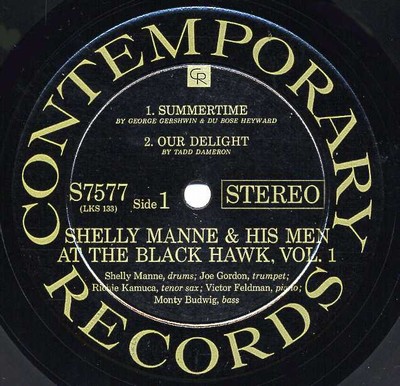
Our Hot Stamper commentary from a long-ago shootout we’d done for the wonderful Helen Humes album Songs I Like to Sing discusses the sonic characteristics we find most commonly associated with the various Contemporary labels.

This Contemporary Black Label Original LP has that classic tube-mastered sound — warmer, smoother, and sweeter than the later pressings, with more breath of life. Overall the sound is well-balanced and tonally correct from top to bottom, which is rare for a black label Contemporary, as they are usually dull and bass-heavy.

We won’t buy them locally anymore unless they can be returned. I’ve got a box full of Contemporarys with bloated bass and no top end that I don’t know what to do with.


UPDATE 2020

This commentary was written a long time ago. There are no boxes full of Contemporary records laying around in the back room. The ones that don’t sound good were sold off years ago.


Like most mediocre-to-bad sounding records we’ve auditioned, they just sit in a box taking up space. All of our time and effort goes into putting good pressings on the site and in the mailings. It’s hard to get motivated to do anything with the leftovers. We paid plenty for them, so we don’t want to give them away, but they don’t sound good, so most of our customers won’t buy them.

(more…)

Julie Is Her Name – A Boxstar Bomb from Bernie

Hot Stamper Pressings of Pop and Jazz Vocals Available Now

One question: Where’s the Tubey Magic?

We would never have pointed you in the direction of this awful Boxstar 45 of Julie Is Her Name, cut by Bernie Grundman in 2009, supposedly on tube equipment. I regret to say that we actually sold some copies, but in my defense I can honestly and truthfully claim that we never wrote a single nice thing about the sound of the record. That has to count for something, right?

We found the Tubey Magic on his pressing to be non-existent, as non-existent as it is on practically every Classic Record release he cut. If you have his version you are in for quite a treat when you finally get this one home and on your table. There is a world of difference between the sound of the two versions and we would be very surprised if it takes you more than ten seconds to hear it.

(more…)

Getting the Balance Right on Mean to Me

Hot Stamper Pressings of Pop and Jazz Vocals Available Now

Mean to Me is a favorite test track for side one, with real Demo Disc quality sound. We credit it with helping us dramatically improve our playback.

Roy DuNann at Contemporary was able to get all his brass players together in one room, sounding right as a group as well as individual voices.

The piano, bass, and drums that accompany them are perfectly woven into the fabric of the arrangement.

What makes this song so good is that when the brass really starts to let loose later in the song, with the right equipment and the right room, you can get the kind of sound that’s so powerful you could practically swear it’s live.

Helen was recorded in a booth for this album, and her voice is slightly veiled relative to the other musicians playing in the much larger room that of course would be required for so many players.

When you get the brass correct, the trick is to get her voice to become as transparent and palpable as possible without screwing up the tonality of the brass instruments.

The natural inclination is to brighten up the sound to make her voice more clear.

But you will quickly be made painfully aware that brighter is not better when the brass gets too “hot” and starts to tear your head off.

The balance between voice and brass is key to the proper reproduction of this album.

Once you have achieved that balance, tweak for transparency while guarding against too much upper midrange or top end. Which also means watch out for audiophile wires that may have fooled you into thinking they were more resolving when actually they were just peakier in some portion of the frequency range.

(more…)

Belafonte at Carnegie Hall – I Have a Theory

Hot Stamper Pressings of the Music of Harry Belafonte Available Now

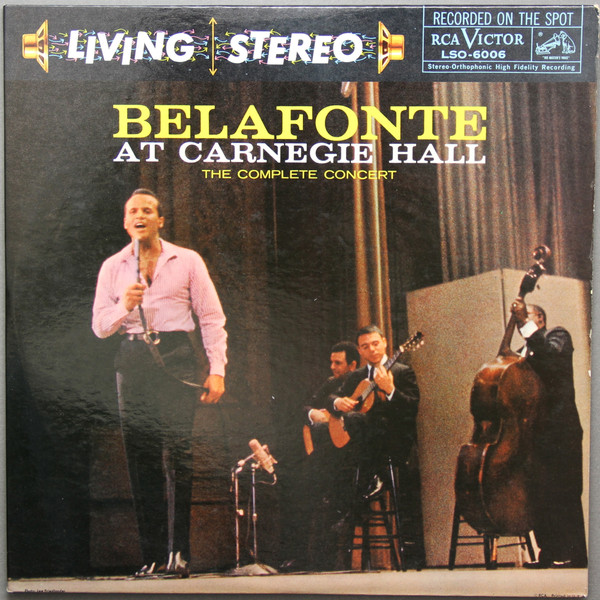
We’ve long known that some copies of the album are mastered with the polarity reversed. This is one of those copies.

But the crazy news we have today is that this copy of the album sound just fine without reversing the polarity of the system, better than any other copy we played.

True, it sounds a bit better with the polarity reversed, but it is still our Shootout Winner even with the wrong polarity.

I would never have believed that to be the case in the past, but my theory is that the new studio we built has reduced distortions and problems to such a degree that polarity issues are less of a problem now than they might have been in the past.

As I say, it’s just a theory, and as time goes on we will revisit this idea with other recordings that we know to have polarity issues, and we’ll be sure to let you know what we find.

The best sounding versions we played are cut super clean. The brass and strings have dead-on correct textures and timbres.

As good as some pressings are, the best pressings are clearly a step up in class. The differences are easy to hear:

  • The brass has more weight and body and richness.
  • Same with the strings.
  • The voice gets fuller and sweeter and less sibilant, while still maintaining every nuance of detail.
  • The presence is startling; Belafonte is absolutely in the room with you.

(more…)

1962 Tubes and The Sound That’s Been Lost for Fifty Years

Hot Stamper Pressings of Pop and Jazz Vocal Albums Available Now

UPDATE 2025

This review was written many years ago, circa 2010 I would guess, right about the time we first started doing shootouts for the album. (Here is what we have to say about I Left My Heart in San Francisco these days, suspiciously similar to what we had to say in 2010. As the song says, ‘”The fundamental things apply…”)


Everything that’s good about All Tube vocal recordings from the 50s and 60s is precisely what’s good about the sound of this record.

The huge studio the music was recorded in is captured faithfully on this pressing. The height, width and depth of the staging are extraordinary, a true Demo Disc in that regard.

We are not big soundstage guys here at Better Records, but we can’t deny the appeal of the space to be found on a record that sounds as good as this one does.

Transparency and Tubey Magic are key to the sound of the orchestra and you will find both in abundance on these two sides.

(Other records that are good for testing those two qualities can be found here and here.)

Albums such as this live and die by the quality of their vocal reproduction. On this record Mr. Tony Bennett himself will appear to be standing right in your listening room, along with the 38 other musicians from the session. (Actually, come to think of it, they’re probably sitting.)

On the best pressings, the space of your stereo room will seem to expand in all directions to accommodate them — an illusion of course, but nevertheless a remarkably convincing one.

(more…)

We Forgot How Mediocre the Originals of A Winter Romance Are

Hot Stamper Pressings of the Music of Dean Martin Available Now

We gave a couple of early pressings another chance and they blew it!

The copies we sell as Hot Stampers are the reissues from the 60s. Here is what we had to say about a copy we posted for sale recently:

With a voice that is relaxed, smooth and warm, Dino is the perfect guy to sing these songs.

The sound of this reissue is far better than any of the originals we played, which mostly weren’t very good. Which just goes to prove (once again) that in the world of vinyl, the idea that the original will have the best sound is a pernicious falsehood.

Rich, sweet, full of ambience, dead on correct tonality, and wonderfully breathy vocals – everything that we listen for in a great record is here.

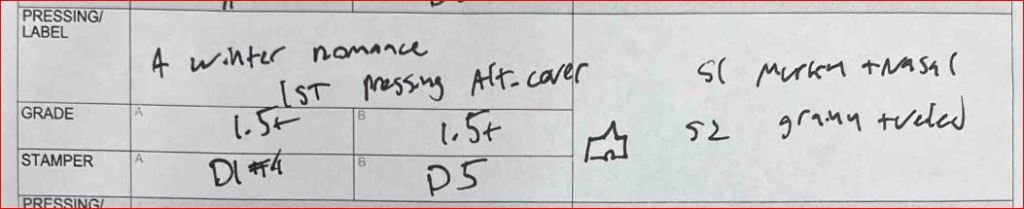
To back that up with actual stamper sheet evidence, here are the grades for the two early pressings we put in our shootout. We’d heard the originals before and never liked them, but sometimes if a particular presssing is cheap and easy to find, we give it another chance.

I think we’re done with the originals now though. They’ve let us down too many times.

Who wants to hear Dean Martin’s gorgeous baritone sounding lean, dry and recessed, or, alternately, murky, nasal, grainy and veiled?

If I didn’t know better I would suspect these originals were modern reissues. This kind of crap sound is all over the Heavy Vinyl records we play, although nobody but us ever seems to notice.

The Point Is

This serves to make a very important point that is near and dear to our hearts:

(more…)

Belafonte at Carnegie Hall – Key Tracks for Side One

Hot Stamper Pressings of Pop and Jazz Vocal Albums Available Now

Harry Pearson brought this record to the attention of audiophiles with his TAS list a long time ago, and rightfully so: it’s an amazing recording.

We happen to love the music too, which makes it one of the most recommendable records we have ever offered. If you can find a better combination of demo disc sound, with music worth the hassle and expense of reproducing it properly, more power to you. We sure can’t.

Because this is a live recording, because it has lots of natural instruments as well as a vocal, because it was recorded in the Golden Age by one of the greatest labels of all time, RCA, by Bob Simpson no less — for this and many other reasons, it has to be considered one of the most amazing recordings in the history of the world.

That said, it is our contention (and the basis of our business model) that the brilliant quality of the recording can only be appreciated if you have the pressing that captured the sound that the engineers recorded. In other words, a Hot Stamper.

From an audiophile point of view, you get to hear live musicians and all the energy they bring to this music, all on the stage at the same time: strings, brass, percussionists, and Harry Belafonte front and center. Tube mics (and not too many of them), a tube tape recorder, RCA’s superb engineering and all-tube mastering chain ensure that the “breath of life” is captured intact.

I know of no better live popular vocal recording on the planet.

Side One

Introduction
Darlin’ Cora
Sylvie 

This is a wonderful song, sung by Belafonte with virtually no accompaniment. His voice should be rich and full-bodied with plenty of presence. In other words, he should sound like a living, breathing person.

Cotton Fields 

The liner notes say this song was introduced in the previous year in Las Vegas. Before I read that I noted that the uptempo arrangement had a jazzy feel to it. The walking bass is well up in the mix and the piano and a few of the other instruments in the song are well behind — it’s pretty much Belafonte and bass. The bass is deep and very note-like.

This is of course a big system record. Do not expect good results from small speakers.

But what makes this one of the best Demo Quality tracks on the album is Belafonte’s amazingly energetic performance. He really sells this song.

As I was listening to the dynamics on the best pressings, it made me think about all the compressed-to-death vocals that are so much a part of the recording style of the modern era. Nobody gets loud anymore.

Belafonte did back in 1959, and not too many followed him.

(more…)

So Long So Wrong – Still So Wrong in the Vocal Department

Hot Stamper Pressings of Jazz and Pop Vocals Available Now

Most audiophiles have a soft spot for female vocals. It’s a sound that a high end stereo — practically any high end stereo — reproduces well.

But why do some audiophiles listen to the artificial-sounding junk that Patricia Barber and Diana Krall put out on album after album?

Their recordings are drenched in digital reverb. Who is his right mind likes the sound of digital reverb?

Rickie Lee Jones may not be my favorite female vocal of all time, but at least you can make the case for it as a Well Recorded Album. It’s worlds better than anything either of the above-mentioned artists have ever done.

The MoFi pressing of Alison Krauss (5276) is a disaster in the vocal department too.

Audiophiles for some reason never seem to notice how bad she sounds on that record. Can’t make sense of it. Any of the good Sergio Mendes records will show you female vocals that are hard to beat. Our best Hot Stampers bring the exquisite vocal harmonies of Lani Hall (aka Mrs. Herb Alpert) and Janis Hansen (and others) right into your living room.

Why bother with trash like this Mobile Fidelity?

(more…)

Close to You on Mobile Fidelity Vinyl – Is This the Sound Audiophiles Were Clamoring For in ’83?

Hot Stamper Pressings of the Music of Frank Sinatra Available Now

In 2024 we did a shootout for the first of Frank’s many releases from 1957, Close to You. We were fortunate to have the Mobile Fidelity pressing from the ’80s box set to play against the mostly original pressings we had accumulated since our last shootout in 2020.

It takes a long time to find enough clean copies to get a shootout going. Four years is fairly typical these days I would imagine.

As you can see from our notes, side one of this MoFi was just awful. Can you blame us if we didn’t bother to play side two?

P.S. I Love You

  • Over-textured violin
  • Spitty, gritty vocals
  • Hollow and dry

Close To You

  • Very clean
  • Bass and vocals really lacking body and warmth

Our grade, had we given it one, would have had to have been a big fat F.

Is it the worst version of the album ever made?

(more…)

Sinatra At The Sands through Dahlquist DQ-10’s – My Neophyte Audiophile Mind Is Blown

Hot Stamper Pressings of the Music of Frank Sinatra Available Now

Back in the early 70s this was actually the album that first introduced me to honest-to-goodness “audiophile” sound.  

I was at my local stereo store listening to speakers one day, and the salesman made a comment that the speakers we were listening to (the old Infinity Monitors with the Walsh tweeter) sounded “boxy.”

I confessed to him that I didn’t actually know what that meant or what it would sound like if it weren’t boxy. 

So he hooked up a pair of Dahlquist DQ-10s and put Sinatra at the Sands on. I was amazed at how the sound just floated in the room, free from the speakers, presenting an image that was as wide and deep as the showroom we were in. That speaker may have many flaws, but boxiness is definitely not one of them.

This description is pretty close to what I thought I heard all those years ago:

The presence and immediacy here are staggering. Turn it up and Frank is right between your speakers, putting on the performance of a lifetime. Very few records out there offer the kind of realistic, lifelike sound you get from this pressing.

This vintage stereo LP also has the MIDRANGE MAGIC that’s missing from the later reissues. As good as some of them can be, this one is dramatically more real sounding. It gives you the sense that Frank Sinatra is right in front of you.

He’s no longer a recording — he’s a living, breathing person. We call that “the breath of life,” and this record has it in spades. His voice is so rich, sweet, and free of any artificiality, you immediately find yourself lost in the music, because there’s no “sound” to distract you.

Or so I thought at the time.

(more…)