holstplane-previn

“A very rewarding day spent visiting a remarkable piece of music.”

Hot Stamper Pressings of the Music of Gustav Holst Available Now

One of our good customers had this to say about a Hot Stamper pressing of The Planets he purchased many years ago:

Hey Tom, 

I spent the day today shooting out various interpretations and sonics of the above, and, I must admit, the Previn leads the field. More decay, transparency, sweetness, magic and imagination than the Mehta, Stokowski and numerous others. If you have an amazing copy, especially re side two, please put my name on it and let me know. [We do this shootout regularly and will be glad to hold the next killer copy for you.]

A very rewarding day spent visiting a remarkable piece of music. The Previn should be used for proper setup of a big system because it does everything right and demands the same of your system.

Best,
Phil
And thank you.

You are preaching to the choir on that one, loved it for at least the last ten years and can find nothing to compare with it.

I was very fortunate to see the work performed at Disney Hall.

No record can come close, but some can come closer than others. (more…)

Select Commentaries and Letters for The Planets

Hot Stamper Pressings of Orchestral Spectaculars Available Now

Below you will find a number of the more popular commentaries we’ve written about the various recordings of this wonderful piece of music.

Included here is also a letter from a customer who spent some time with a Hot Stamper pressing of our favorite recording of The Planets.

We’ve been actively auditioning recordings of Holst’s Masterpiece since the 70s. We finally landed on the one we think offers the audiophile connoisseur the best combination of sound and performance, Andre Previn’s with The London Symphony in 1974.

(There are about 150 other orchestral recordings we think offer the best performances with the highest quality sound.  Check them out when you have time.)

This Recording of The Planets Has “Blockbuster Sound,” for Better or Worse

The Planets – MoFi and UHQR Reviewed


(more…)

Holst and Previn – A Planets for the Ages

Hot Stamper Pressings of the Music of Holst Available Now

Fortunately for audiophiles who love The Planets but are disappointed by most performances, a group that includes us to be sure, the amazing sound found on this copy is coupled with a superb performance.

As you might imagine, on a big system this would make for a powerful listening experience, which is exactly the experience we ourselves had during our recent shootout. This copy actually deserves its place on the TAS List.

The brass is so BIG and POWERFUL on EMI’s recording that other orchestras and recordings frankly pale in comparison. Until I heard one of our top EMI pressings show me brass with this kind of weight and energy, I simply had no idea it was even possible to play the work this powerfully. The lower brass comes in, builds, gaining volume and weight, then calms down, but soon returns and builds relentlessly, ever and ever louder. Eventually the trumpets break out, blasting their way forward and above the melee the heavier brass has created below.

Quite honestly I have never heard anything like it, and I heard this work in concert in late 2012! In live performance, the members of the brass section, being at the back of the stage, were at least 100 feet away from me, perhaps more. When playing the best EMI pressings, the brass were right there in front of me, eight to ten feet away. In a way this is of course unnatural, but that fact takes nothing away from the subjective power of the experience.

Only the conductor can stand at the podium, but the EMI producers and engineers (the two Christophers in this case) have managed to put the listener, at least in this movement, right there with him.

(more…)

Holst – The Planets / Previn

More of the Music of Gustav Holst

  • An early British EMI pressing of Holst’s magnum opus, here with very good Hot Stamper sonic grades on both sides
  • Previn’s and the LSO’s performances are without peer in our estimation
  • We guarantee there is more space, richness, presence, and performance energy on this copy than others you’ve heard or you get your money back – it’s as simple as that
  • A TAS list Super Disc, with a performance that’s as spectacular as the recording (thanks to the work of the two Christophers)
  • Marks and problems in the vinyl are sometimes the nature of the beast with these vintage LPs, but once you hear the sound of this copy, you might be inclined, as we were, to stop counting ticks and pops and just be swept away by the music
  • This link will take you to more of our favorite orchestral performances with top quality sound

(more…)

The Planets – Testing with Mars and Saturn

More of the music of Gustav Holst (1874-1934)

Mars on the first side and Saturn on the second present serious challenges to any recordings of the work you may own, especially if you own the overrated Mehta recording on the TAS List.

Generally speaking, the White Hot copies stand apart from the pack with more top end extension, and/or more lower end weight. Our notes will typically say “extended highs and lows,” and those are hard to come by, on any record.

Let’s get to the specifics of the two movements we feel are the best test for The Planets as a whole.

The War Test — Side One

War, the first movement, has the string players “bouncing” their bows upside down to create the effect you hear. It’s not fingers plucking the strings; it’s the wood of the bows bouncing on the strings. The quality of that technique is so obvious and correct sounding on the good copies and so blurry and indistinct on the bad ones that you could almost judge the whole first side by that sound alone. When it’s right it’s really right. 

And of course the players are spread out wider and the soundfield is so much more transparent when these types of sonic qualities are brought out. This bouncing bow test makes it easy to separate the better copies from the also-rans when it comes to smear, resolution, transparency and the like.

The Saturn Test — Side Two

(more…)

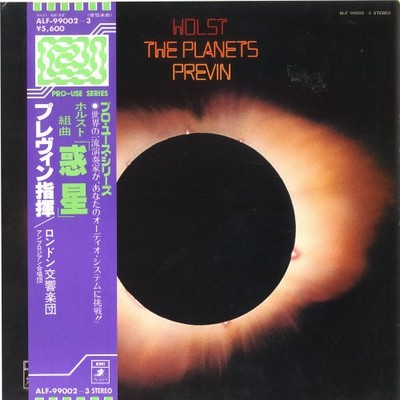
The Planets on Pro-Use Japanese Vinyl at 45 RPM Is Just Awful

More of the music of Gustav Holst (1874-1934)

This EMI 45 RPM Japanese Import 2 LP set is considered one of the great Planets by many audiophiles, but it’s not, based on our playing of a copy we had years ago, which means it belongs in our audiophile hall of shame.

The best copies on British or Dutch EMI vinyl are clearly better than this “audiophile” pressing.

What could be less surprising?

This is precisely why we dislike Japanese pressings as a rule — they sound like this audiophile trash.

Our favorite performance of The Planets can be found here.

The Big Picture from a Lifelong Audiophile

You may have seen the following text in another listing, but it bears repeating.

There is nothing new under the sun, and that is especially true when it comes to bad sounding audiophile records. The world is full of them.

There has been one big change from the days when I self-identified as a freshly minted audiophile in the 70s.

Yes, the records being marketed to audiophiles these days may have second- and third-rate sound, but at least now they have good music. That’s progress, right?

The title reviewed above is a good example of the kind of crap we newbie audiophiles used to put up with back in the old days, long before we had anything resembling a clue.

This one clearly belongs on our list of bad audiophile records.

You might be asking: What kind of audio fool was I? to buy a dumbass record like this.

It’s a fair question. Yes, I admit I was foolish enough to buy records like this and expect it to have good music, or at least good sound. Of course it had neither. Practically none of these kinds of records ever did. Sheffield and a few others made some good ones, but most Direct to Disc recordings were crap.

As clueless as I was, even back in the day I could tell that I had just thrown my money away on this lipsticked-pig in a poke.

But I was an audiophile, and like a certain Mr. Mulder, I wanted to believe. These special super-hi-fidelity records were being made for me, for special people like me, because I had expensive equipment and regular records are never going to be good enough to play on my special equipment, right?

To say I was wrong to think about audio that way is obviously an understatement. Over the course of the last forty years, I (and to be fair, my friends and my staff) have been wrong about a lots of things in the worlds of records and audio.

You can read more about many of the things we got wrong under the heading: live and learn.

The good news? Audio progress is real and anyone who goes about doing audio the right way can achieve the equivalent of miracles.

(more…)

Holst – The Planets / Previn – Our 2022 Shootout Winner

Hot Stamper Classical and Orchestral Pressings Available Now

This early British EMI pressing of Previn’s reading from 1974 is guaranteed to be the best copy of Holst’s Magnum Opus you have ever heard. Previn’s and the LSO’s performances are without peer in our estimation. These sides are rich, clear and dynamic, with weighty brass, and the kind of dynamic power that lifts the energy level right into space.

A TAS List Super Disc, with a performance that’s as spectacular as the recording (thanks to the work of the two Christophers).

As you might imagine, on a big system this would make for a powerful listening experience, which is exactly the experience we ourselves had during our recent shootout. This copy actually deserves its place on the TAS List.

The EMI Sound

EMI’s are usually recorded with a mid-hall perspective, which is somewhat distant for our taste. That’s not our sound. We prefer the Front Row Center seats (especially at these prices). That said, when an EMI from the ’70s is recorded, mastered and pressed properly, it actually sounds more like the real thing, more like the live performance of orchestral music in a concert hall.

It’s uncanny how real the best copies of this record sound. For a recording of The Planets it has no equal in our experience.

A Must Own Record

This orchestral spectacular should be part of any serious Classical Collection. Others that belong in that category can be found here.

Side One

Mars, the Bringer of War
Venus, the Bringer of Peace
Mercury, the Winged Messenger
Jupiter, the Bringer of Jollity

Side Two

Saturn, the Bringer of Old Age 
Uranus, the Magician 
Neptune, the Mystic

Structure

The suite has seven movements, each of them named after a planet and its corresponding Roman deity (see also Planets in astrology):

  • Mars, the Bringer of War
  • Venus, the Bringer of Peace
  • Mercury, the Winged Messenger
  • Jupiter, the Bringer of Jollity
  • Saturn, the Bringer of Old Age
  • Uranus, the Magician
  • Neptune, the Mystic

With the exception of the first two movements, the order of the movements corresponds to increasing distance of their eponymous planets from the Earth. Some commentators have suggested that this is intentional, with the anomaly of Mars preceding Venus being a device to make the first four movements match the form of a symphony.

One alternative explanation may be the ruling of astrological signs of the zodiac by the planets. If the zodiac signs are listed along with their ruling planets in the traditional order starting with Aries, ignoring duplication, Pluto (then undiscovered and now de-planetised), and the luminaries (the Sun and the Moon), then the order of the movements matches.

Another possibility, this time from an astronomical perspective, is that the first three movements, representing the inner terrestrial planets, are ordered according to their decreasing distance from the Sun. The remaining movements, representing the gas giants that lie beyond the asteroid belt, are ordered by increasing distance from the Sun. Critic David Hurwitz offers an alternative explanation for the piece’s structure: that “Jupiter” is the centerpoint of the suite and that the movements on either side are in mirror images. Thus “Mars” involves motion and “Neptune” is static; “Venus” is sublime while “Uranus” is vulgar, and “Mercury” is light and scherzando while “Saturn” is heavy and plodding. (This hypothesis is lent credence by the fact that the two outer movements, “Mars” and “Neptune,” are both written in rather unusual quintuple meter.)

“Neptune” was the first piece of music to have a fade-out ending. Holst stipulates that the women’s choruses are “to be placed in an adjoining room, the door of which is to be left open until the last bar of the piece, when it is to be slowly and silently closed”, and that the final bar (scored for choruses alone) is “to be repeated until the sound is lost in the distance”. Although commonplace today, the effect bewitched audiences in the era before widespread recorded sound – after the initial 1918 run-through, Holst’s daughter Imogen (in addition to watching the charwomen dancing in the aisles during “Jupiter”) remarked that the ending was “unforgettable, with its hidden chorus of women’s voices growing fainter and fainter… until the imagination knew no difference between sound and silence”.


Further Reading