cole_lovei

What Willie and Nat Can Teach Us about Heavy Vinyl

Hot Stamper Pressings of the Music of Willie Nelson Available Now

This letter came to us many years ago. Updates have been added as of 2024.

One of our good customers had this to say about some Hot Stampers he had purchased:

Hello team,

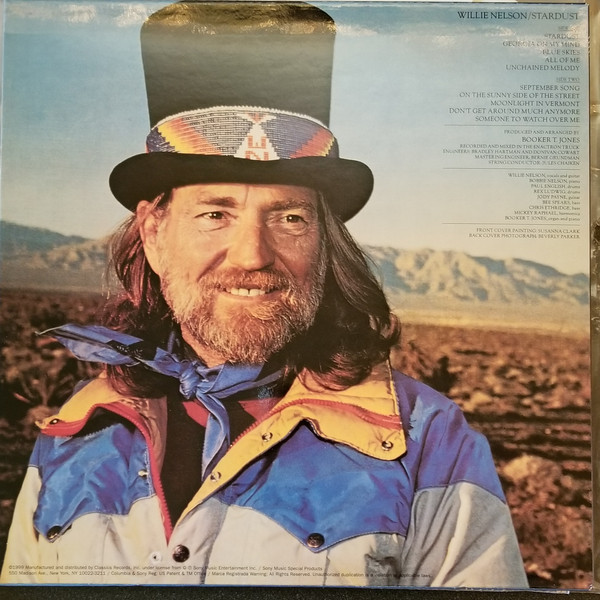
I’ve been a little distracted here, I got married over the weekend! So, haven’t done as much listening over the past couple of weeks. However, I did have a chance to listen to Stardust and Love Is The Thing. They were both different than their Classic Records and Analogue Productions counterparts. Willie sounded a little smoother, more organic, and more integrated.
The strings on Love Is The Thing were very different, more pronounced and emotional, but Nat’s voice, and the sound overall, sounded a little strident, maybe “too” hot.

I’d like to send them both back to you, and if you have a chance to send back the discs I sent to you I’d very much appreciate it. All told, the two big sets of Better Records are really incredible, and only serve to make my want list grow. Here’s to you and the next set!

Doug,

We now have the update for those two titles.

I, along with the two other guys in our listening panels, sat down to play the Heavy Vinyl you sent us, and the long and short of it is that we were astonished that records that sound as bad as those two actually were approved for release.

Nat is wrong six ways from Sunday, and Willie is not so much wrong as just not very good.

Nat: “F,” one of the worst heavy vinyl disasters of all time, and Willie: “D” sound, more like a CD than a record. There are many pressings of this album that are not good, but this version is probably worse than most of them, hence the D grade.

The old Classic pressing is probably better, and it would earn about a C grade. [I honestly do not remember exactly what pressing Douglas sent us. All I remember is that it was on Heavy Vinyl.]

I suspect the CDs of both these pressings are much better sounding than this vinyl.

The DCC gold is definitely better by a long shot, and the plain old Willie CD is probably a step up as well. 


A Further Update

(more…)

Love Is the Thing – Remixed, Remastered and Ruined

More Hot Stamper Pressings of Pop and Jazz Vocal Albums

Love Is the Thing on DCC was given a “new sound” and I don’t like it

I really liked the Nat King Cole albums on DCC when they came out back in the ’90s. Thought they were a revelation as a matter of fact.

Now I find them insufferable. Here are some of my reasons for not liking Hoffman’s remix.

Nat’s voice is much too forward and loud in the mix; consequently the orchestra is too soft. The balance is off. At least on my stereo, at the levels I play the record at, the balance seems off. You surely have a different system, in a different room, and may not feel the way I do.

But without a top pressing to compare, how do you know the mix is right or wrong? Like everything in audio, it’s relative.

The balance problem is bad enough, but what really sets my teeth on edge is the fact that the Nat King Cole record on DCC doesn’t sound remotely like any Nat King Cole record I have ever heard, outside of the ones Hoffman worked on of course.

Where is all the Capitol reverb? Nat’s records all have it, and although the reverb may be a bit excessive or unnatural in some ways, at least to some people, when you take it away you end up with a sound that never existed before, and, to my ears, it’s a sound that’s just wrong for the music.

The more I listened to the DCC the less I liked it.

The first full-length commentary I ever wrote in my record catalog in 1994 took Analogue Productions to task for remastering Way Out West and giving it a “new sound,” a sound I had never heard coming from any Contemporary pressing, from any era.

I didn’t like what Doug Sax did with Way Out West, Jazz Giant, Waltz for Debby and many, many others, and I don’t like what Steve Hoffman and Kevin Gray did to Love Is the Thing, The Very Thought of You and Just One Of Those Things.

I have tried to listen to the Gold CD in my car, but even in the car I found the sound boring and insufferable.

Is this the kind of sound you hear on your DCC Nat King Cole records? If it is, we recommend you try a Hot Stamper. If it doesn’t kill your DCC you get your money back.

At the very least it will show you some of the things your DCC is doing differently, and, we think, wrong.

(more…)

Nat “King” Cole’s – Love Is The Thing

  • A lovely pressing of this audiophile favorite, with Double Plus (A++) sound and fairly quiet vinyl on both sides to rival the best pop vocal recordings we know of
  • Nat himself sounds especially immediate and real, and the strings are much less of a problem here than they are on most pressings
  • If all you know of this album is the weirdly unnatural remix DCC did (on Analogue Productions vinyl too) this pressing will be nothing less than a revelation
  • 4 1/2 stars: “Nat King Cole’s collaborations with Gordon Jenkins rank among the finest from either artist or arranger. 1957’s Love Is the Thing remains the epitome of the pair’s undeniable compatibility, and it topped the album charts for eight weeks.”

Love Is The Thing has always been one of the better Nat “King” Cole recordings we play. The music is sublime, and on the right copy the sound can be superb. Armed with a much larger variety of pressings to play, including some interesting “finds” among them, our recent shootout convinced us that it actually is The Best. We have never heard the man sound better than he does on the best copies of this very recording.

One of the key elements we noticed on the best of the best was the quality of relaxation in Nat’s performance. He sings so effortlessly on the good sounding pressings. On some pressings that casual quality is not nearly as noticeable. (more…)

Love Is The Thing – The Breakthrough We Were Waiting For

Hot Stamper Pressings of Our Favorite Vocal Albums Available Now

Reviews and Commentaries for the Music of Nat “King” Cole

Love Is The Thing has long been one of the best sounding Nat “King” Cole recordings we had auditioned over the years. With a large variety of copies to play, including some interesting “finds” among them, we now know it actually is The Best. We have never heard the man sound better than he does on the hottest copies of this very album.

Of course we’re always on the lookout for Nat King Cole albums with good sound. In our experience that is not nearly as easy as one might expect. Far too many of his recordings are drenched in bad reverb and can’t be taken seriously. At least one we know of has his voice out of phase with the orchestra on most of the copies we played, putting a quick end to that shootout. 

If anything the sound on his albums gets even worse in the ’60s. Many of Nat’s albums from that decade are over-produced, bright, thin and shrill.

We assume most audiophiles got turned on to his music from the records that Steve Hoffman remixed and remastered for DCC back in the mid-’90s, For those of you who were customers of ours back then, you know that I count myself among that group. I even went so far as to nominate the DCC of Nat’s Greatest Hits as the best album DCC ever made. (I know now, as I expect you do, that that’s really not saying much, but at the time I thought it was a pretty bold statement.)

Devoting the Resources

Naturally, having long ago given up on Heavy Vinyl LPs by DCC and others of their persuasion, these days we are in a much better position to devote our resources to playing every Nat King Cole album on every pressing we can get our hands on, trying to figure out what are the copies — from what era, on what label, with what stampers, cut by whom, stereo or mono, import or domestic — that potentially have the Hot Stamper sound, the very Raison d’être of our business.

What we discovered with the more than dozen copies we’d pulled together for our shootout was that different pressings from different eras on different labels can all have the right sound. In fact, while listening to one copy after another, all without the benefit of knowing anything about the specific record on the table, it was simply impossible to predict from the sound alone which label the record was printed on.

Some of the earliest pressings were rich and tubey, but so were some of the later ones. Same with copies that were lean, hard or transistory — they could be on a label from any era with that sound.

(more…)