fri-2026

Forget the STS Labels with Black Print on Images Pour Orchestra

More of the music of Claude Debussy (1862-1918)

None of the pressings on this later Stereo Treasury label that we played in our most recent shootouts were very good, unlike the Silver Print labels, which can sound quite respectable.

At this stage of the game, we’ve learned our lesson and will not be giving any more of the Black Label pressings a chance. This goes for practically all the records we’ve played on the later Stereo Treasury label. They rarely sound any good and just aren’t worth the trouble now that we know what the best pressings are.

Both the Ansermet on London and the Munch on RCA are better recordings, but both sell for quite a bit more money than the Stereo Treasury pressings we offer, so if you can’t see spending the kind of bread they command, there is a much more affordable alternative that is guaranteed to satisfy.

(more…)

Is Digital Really the Problem on this Cowboy Junkies Album?

Hot Stamper Pressings of Digital Recordings with Audiophile Sound 

The RCA domestic pressings cut at Sterling are not worth the vinyl they’re pressed on.

Don’t be one of those die-hard analog types who point fingers at the fact that there was digital in the recording chain when their pressing doesn’t sound good.

It’s got nothing to do with digital. It has everything to do with Sterling doing a bad job mastering the domestic vinyl.

(Keep in mind that a very large group of audiophiles, including some well-known reviewers, had no idea there was a digital step used in the process of making some of the records they had raved about. Apparently the only way to hear it is when you already know it’s there.)

Our notes for the domestic pressing below read:

  • Flat and dry vox.
  • Shifted up [tonally]
  • A bit scooped [or “sucked out” in the midrange, meaning the middle of the midrange is missing to some degree]

The midrange suckout effect is easily reproducible in your very own listening room. Pull your speakers farther out into the room and farther apart from each other and you can get that sound on every record you own. I’ve been hearing it in the various audiophile systems I’ve been exposed to for more than 40 years.

Why Defend the Indefensible?

When good mastering houses like Kendun and Sterling and Artisan make bad sounding records, we offer no excuses for their shoddy work. The same would be true for the better-known cutting engineers who’ve done work for them, as well as other cutting operations.

Individuals working for generally good companies sometimes produce substandard work product.

How is this news to anyone outside of the sycophantic thread posters, youtubers, and self-identified record experts who write for the audiophile community?

(more…)

How Can the Best Stampers Also Be the Worst Stampers?

Hot Stamper Pressings of Contemporary Jazz Available Now

Recently we conducted a shootout for a superb Contemporary recording, one that we had auditioned a couple of times before and one which we felt we knew the music and the quality of the sound well.

It’s not the record you see pictured. For now we’re keeping the title a mystery, consistent with the idea that we give out lots of bad stampers on this blog, but almost never do we give out the good ones.

Why, you ask?

The cost of discovering the right stampers is usually high, can take decades, and is fundamentally at the heart of how we make our money: by finding amazing sounding pressings with stampers we know to be good, cleaning them up, playing them, and offering those that, for whatever mysterious reasons that no one has figured out, including us, tend to have the best sounding grooves.

This time around we kept track of the stamper numbers for all the pressings we played, something we are making a habit of doing these days and using to highlight discoveries in the sound of the records we play.

In this case, we discovered an anomaly we thought we would bring to the audiophile world’s attention: the fact that the stampers for the best souding pressing were also the stampers for the worst sounding pressing, because they were the stampers for all the pressings.

One copy earned our White Hot Stamper grade, our highest, for its clearly superior sound, and another one earned our lowest Hot Stamper grade of 1.5+. The rest were quite good, in between those two, which is a very common outcome for most of our shootouts: lots of records in the middle of the distribution, some winners at the top and some losers at the bottom.

Note that the OJC of this title is one we have liked in the past. It didn’t do so well this time around, and that is mostly because we found out about some stampers we like even better. We will probably not being buying the OJC anymore; it’s probably more trouble than it’s worth.

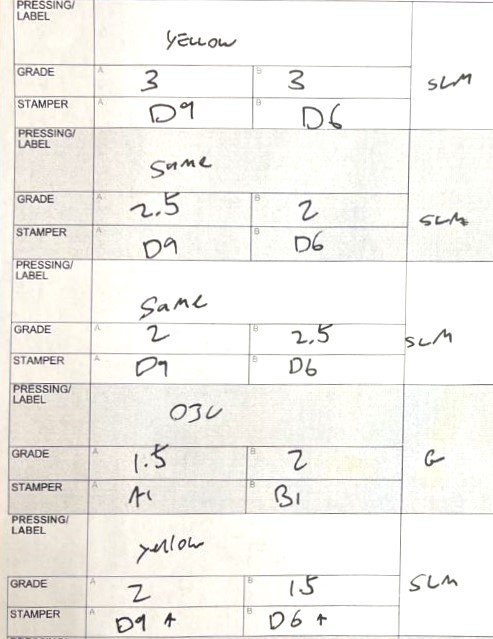
However, the key takeaway from this stamper sheet is the fact that it beat one of the real Contemporary label pressings in the shootout.

So the question an audiophile record collector might ask himself is this one: is the OJC better or worse than the real Contemporary pressing with D9/D6 stampers?

(more…)

Even in the Quietest Moments – P & M Stampers Let Us Down This Time

Hot Stamper Pressings of the Music of Supertramp Available Now

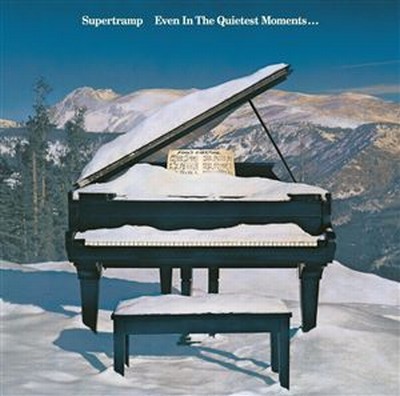
After discovering killer Hot Stampers for this forgotten classic, we feel the album can hold its own with any of Supertramp’s 70s releases, from Crime of the Century all the way through to Breakfast in America.

The UK-pressed White Hot Stamper pressings from our recent shootouts showed us some of the best Supertramp sound we have ever heard on any of their albums, which is saying a lot. Supertramp is one of the most well-recorded bands in the history of pop music. Geoff Emerick took over most of the recording duties after the band decided to work with a different engineer for this, their 1977 album.

KEN SCOTT recorded the two albums that came before this one, Crime and Crisis, and as has been well documented on this very site, he knocked both of them out of the park.

(more…)

Domestic Pressings of Clear Spot? Forget ‘Em!

Hot Stamper Pressings of the Music of Captain Beefheart Available Now

We did this shootout many years ago, so many years ago that I cannot find a record of it.

I remember we thought the German pressings were perhaps a bit boosted on both ends and not as natural sounding as the domestic pressings.

After a multitude of improvements in our cleaning and playback, we would agree with our previous understanding that the German pressings are often wrong, but now we also know how right the right ones can be.

It turns out tha some German pressings are not particularly good, another piece of the puzzle that fell into place during our most recent shootout, as painful as that turned out to be considering the money wasted on them.

Did we have the bad German stamper pressings last time around? Who knows?

The producer, Ted Templeman, (Doobie Brothers, James Taylor) brought his mainstream talents to bear on this music, and when the Captain’s free-form tendencies smashed into Templeman’s conservatism, the result was this musical supernova — out there, but not too far out there.

(Play Trout Mask Replica sometime if you miss that feeling from your old hippie days of being on acid. With that music, drugs are entirely superfluous.)

I don’t know how many audiophiles like Captain Beefheart, probably not too many, but if you’re ever going to try one of his albums, this is the place to start: his masterpiece.

(more…)

Audiophiles Should Avoid These Stampers on LSC 2435

Hot Stamper Pressings Featuring the Violin Available Now

We had two copies with 10s/10s stampers and both of them ended up at the bottom of the rankings with a decnt side one but a terrible side two, earning a grade of NO, meaning just awful.

1.5/NO, 10S, 10S, Shaded Dog
1.5/NO, 10S/10S, Shaded Dog

Note also that our 1s side one did not win the shootout, although the sound was still quite good and better than most of what we played.

There are quite a number of other records that we’ve run into over the years with obvious shortcomings.

Here are some of them, a very small fraction of what we’ve played, broken down into the three major labels that account for most of the best classical and orchestral titles we’ve had the pleasure to play.

  • London/Decca records with weak sound or performances
  • Mercury records with weak sound or performances
  • RCA records with weak sound or performances

We’ve auditioned countless pressings in the 36 years we’ve been in business — buying, cleaning and playing them by the thousands.

This is how we find the best sounding vinyl pressings ever made, through trial and error. It may be expensive and time consuming, but there is simply no other method for finding better records that works. If you know of one, please write me!

We are not the least bit interested in records that are “known” to sound the best.

Known by whom? Which audiophiles — hobbyists or professionals, take your pick — can be trusted to know what they are talking about when it comes to the sound of records?

(more…)

Watch Out for 5c on Side One of The White Album

Hot Stamper Pressings of The White Album Available Now

Starting as early as 1984, some pressings of The White Album came with a decidely inferior side one, 5c.

Often it was mated to an equally problematic-sounding side two, -6. Although the -6 stamper can be good, when it has 5c on side one, it’s never as good as it should be.

Even though this copy had less-than-impressive sound on sides three and four — these sides qualify as minimally Hot Stamper pressings — there is nothing inherently wrong with the -2/-3 stamper numbers for those sides.

These later pressings just don’t sound as good as the earlier ones we like.

Not that we like the originals.

The few we’ve played were terrible. They tend to have -1 or -2 stampers for the first two sides, and their mastering tends to add a lot of problems to a recording that already has more than its share.

Want to find your own top quality copy?

Consider taking our moderately helpful advice regarding the pressings that tend to win our shootouts. The White Album sounds its best:

(more…)

Avoid M Stampers and Imports If You Want the Best Sound on Tapestry

Hot Stamper Pressings of the Music of Carole King Available Now

The domestic pressings with the stampers shown below, and others similar to them, have not done well in our shootouts for years now. If you own a copy with these stampers, or ones like them, the good news is that we can get you a much better sounding copy of Tapestry than you have ever heard. It won’t be cheap, but we can guarantee that it will be very, very good.

Stamper numbers are not the be-all and end-all in the world of records, a subject we discuss below, but after hearing too many copies with these stampers and decidedly mediocre sound, from now on we are going to focus our attention on the stampers that do well and leave copies with these markings sitting in the bins.

Note that the last listing is for an early UK import. I have no idea how that record got into the shootout. The chances of an import doing well up against Bernie Grundman’s brilliant mastering — from back in the good old days of the 60s, 70s and 80s when he was actually doing brilliant mastering work — is so close to zero it can’t be calculated.

Sometimes we take long shots, hoping to learn something new. In this case, we learned what we already know. Yes, there are still some audiophiles who buy imports of a record like this hoping to find better sound. I can’t imagine what kind of system it would take to hide the bright, dubby sound of the UK pressing we played, but judging from some of the foolishness I read on the Hoffman forum and others of its ilk, I know there must be plenty of them out there.
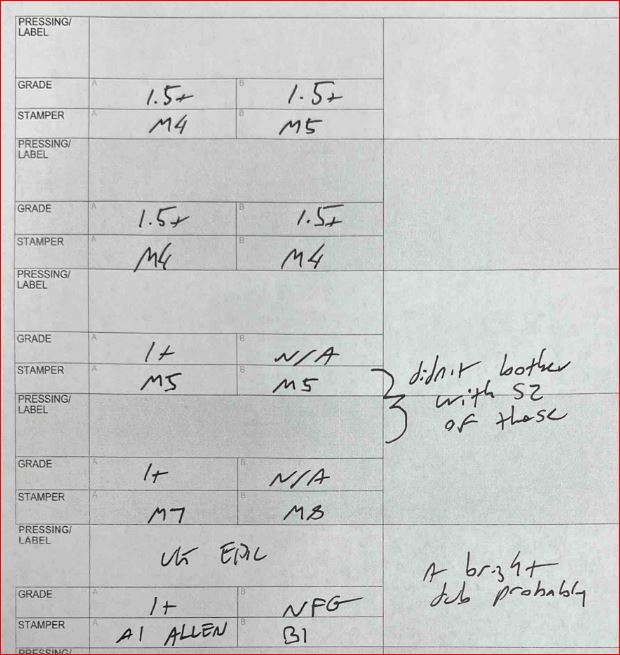
Monarch is responsible for the mediocre-at-best sound of the pressings with the stampers you see above. We tend to like Monarch pressings as a rule, but sometimes they mess up, and they messed up Tapestry compared to others who pressed the record.

We liked all the other copies with other stampers better than than these, which just goes to show you can never know how good it can get until it gets that good. That is what shootouts allow us to do.

Playing close to twenty copies of Tapestry in a shootout allows us to grade Tapestry on a scale, with the M stampers filling out most of the bottom and the other stampers — wouldn’t you like to know which ones! — occupying the middle and the top of the distribution. 

This is what the forum posters fail to understand. They think they have a Hot Stamper when what they actually have (maybe!) is a good sounding record. They don’t know how amazing the record can sound — so much more amazing than the one they own, probably — so they assume they have something good, maybe even the best.

They probably do not, but who really knows? The shootout would supply the data they need to support their conclusions, and since they could not be bothered to conduct one, they have no data to back up their opinions.

The “probably” you see in the above two sentences is there for a good reason. We make a point of being clear about what we can know and we cannot know, and we cannot know what a record sounds like until we play it.

This is obviously true for those of us who try to listen as critically as possible, but we also know that it is just as important to think about records the right way.

(more…)

Our Old Prediction for LSC 2563 Came True

Hot Stamper Pressings that Feature the Violin

Many years ago we wrote:

This is a very old review and it’s doubtful we would not prefer the right Shaded Dog pressing these days.

That turned out to be the case, as we had two late-label 70s Red Seal pressings in the shootout we just did and only one of them was even passable.

A few things about the new pressings and the old commentary caught my eye.

First off, 3s is a fairly low number. The Shaded Dogs that win the shootout must be lower, which means they are either 1s or 2s. Not much to choose from there!

Secondly, the commentary you see below goes into great detail regarding what each piece found on the pressing was doing right and wrong.

It makes us sound like we knew what we were talking about when it came to this specific Red Seal pressing of the album we had played.

I assure you that we did not.

On the web I come across lots of reviews for audiophile pressings in which the writers go on for page after page about how much better the new Heavy Vinyl pressing is compared to the old record the reviewer owns.

This is no longer hard for me to understand. They are simply as lost as I used to be.

(more…)

Maybe We SHOULD Start Buying Blue Notes on the Early Labels

Hot Stamper Pressings of Blue Note Albums Available Now
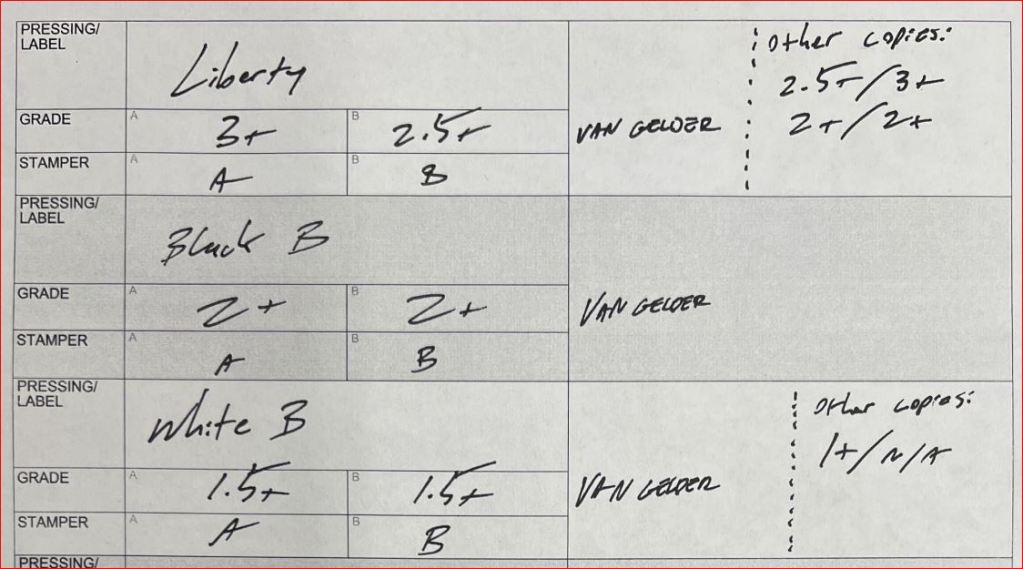
If there are record companies whose fans are extremely particular about the labels of the pressings they prefer, Blue Note has to be right at the top of that list.

The consensus among record collectors seems to be that the early label Blue Notes are practically guaranteed to have the best sound. In top condition they often sell for many thousands of dollars, far more than we have ever charged for any Hot Stamper Blue Note pressing

We are on record as not favoring early labels over later ones, absent the evidence to support such bias, but perhaps there actually are some records you should be buying based on their labels. This one, for example.

If all the stampers of a title are the same and they’re all cut by Rudy Van Gelder — early labels, middle labels and later labels alike — what do you use to guide you when trying to find the best sounding pressings?

This is precisely the conundrum that an audiophile would be faced with as he goes about trying to find the best sounding pressings of the Blue Note album whose stamper sheet you see below.

This stamper sheet reflects a fairly typical shootout for a Blue Note pressing. It’s hard to find six clean copies no matter what the title is. We probably returned or gave up on half the copies we bought, so we might have had to buy nine in order to shootout six.

(Note that there is nothing on any label after the White B from the 70s. We have never heard any title with an 80s label or later sound worth a damn so we stopped buying them a long time ago.)

Drawing Conclusions

Let’s look at some of the conclusions the typical record collector/audiophile might draw from the information above.

For example:

1.) I have a Blue Note with Van Gelder stamps and it’s decent sounding but I like [fill in the blank with some other pressing] better. Since all the pressings are cut by him, he must not have done a very good job. Thank goodness modern mastering engineer X came along to finally bring out the sound of the master tape that he was not able to do.

That’s an easy one to rebut. The later pressings cut by Rudy are consistently worse sounding than the earlier ones in the case of this title. If you don’t have a big batch to work through, however, you simply have now way of knowing that fact, and therefore whatever conclusions you choose to draw from a too-small pool of pressings are suspect at best.

(more…)