fri-2026

The RCA Later Label Pressings from the 70s Fall Short Yet Again

Hot Stamper Pressings Featuring the Violin Available Now

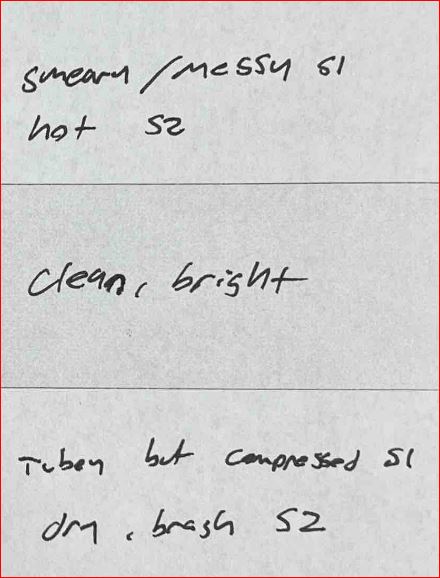
Many of the later RCA pressings we’ve played recently have left a lot to be desired.

We’re on record as telling audiophiles that it’s never a good idea to judge records by their labels, so when it came time to do a shootout for this famous Heifetz recording from 1963, LSC 2652, it was only fitting that we force ourselves to clean and play every pressing we had on the shelf, including the White Dogs and Red Seal reissues.

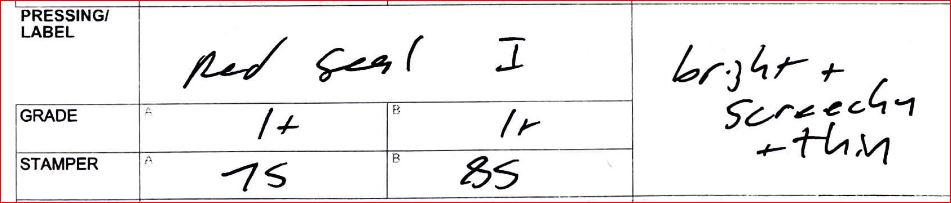
The White Dog did fine (2+ for the Bruch on side one, 1.5+ for the Mozart on side two).

The Red Seal had all the hallmarks of the transistory sound RCA apparently preferred in the 70s.

There are Red Seal pressings with excellent sound — some of them have won shootouts — but this one had too many similarities to the awful Classic Record classical titles produced in the 90s. You know the ones I’m talking about. They have bright, screechy string tone that no self-respecting audiophile with even passable equipment should find tolerable.

(The fact that many of them remain on the TAS list speaks volumes about the self-identified experts’ ability to distinguish a good record from a bad one. More on that subject below.)
More of the Same

Below you will find links to other records we’ve played that had the same problems as this RCA and are best avoided by audiophiles looking for high quality pressings to play.

There is no shortage of other records that we’ve run into over the years with these kinds of obvious shortcomings.

(more…)

Audiophiles Should Give Monteux’s Surprise and Clock Symphonies a Miss

Hot Stamper Pressings of the Music of Joseph Haydn Available Now

None of the pressings we played of this RCA (LSC 2394) were remotely competitive with Fjelstad’s recording for RCA from 1959.

The sound of the RCA Shaded Dog we played was consistently compressed and veiled, a case of the “old record” sound we find on far too many vintage pressings.

The world is full of old records that just sound like old records. We’ve suffered through them by the tens of thousands.

Our website, as well as this blog, are devoted to helping audiophiles find pressings that don’t sound anything like the millions of run-of-the-mill LPs that have been stamped out for the last seven decades.

Even a million dollar stereo can’t make the average record sound good, and the more accurate and revealing the system, the more limited and lifeless the average record will show itself to be.

The White Dog pressing was even worse. It was hot, dry and flat. Who wants to play a record that sounds like that?

Only an old school audio system can hide the faults of pressings such as these. The world is full of those too, even though they might comprise all the latest and most expensive components.

(more…)

The Wrong Stampers on Some Albums Are Shockingly Bad

Hot Stamper Pressings of the Music of Carly Simon Available Now

Below you will see the bottom part of the stamper sheet for a shootout we did recently.

Please note that the album you see pictured is not the record we are discussing here. It very well could have been been a Carly Simon album, or something from some other artist, but all we can say for sure is that it was definitely an album from the 70s on Elektra.

We are not revealing what record had these stampers and earned these grades for the simple reason that avoiding these bad labels for the record in question would make it fairly easy to figure out what the better pressings of the album might be.

As I’m sure you can understand, we want you to buy the copy with the Hottest Stampers from us, not find one on your own.

We’re happy to be moderately helpful, but naturally we find it necessary to draw the line somewhere, and giving out the kind of information that makes it is easy to find the best pressings is where we have chosen to draw it. The top copies are the ones that pay the bills around here, and with a staff of ten, in California no less, the bills are sizable.

We appreciate your understanding.

(more…)

Do All the Early Stamper Shaded Dog Pressings of this Title Sound Good?

Hot Stamper Pressings of Living Stereo Recordings Available Now
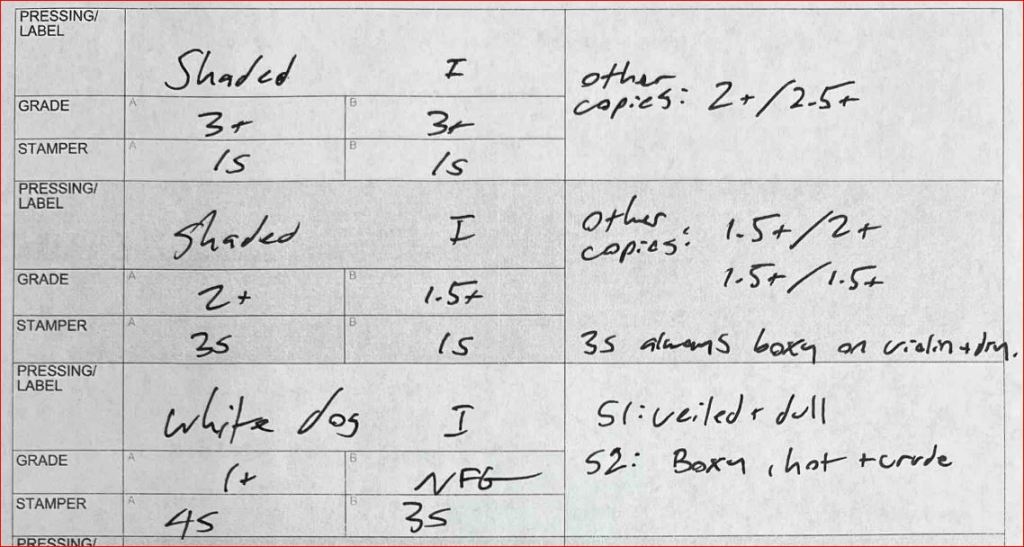
Below you will see the complete stamper sheet for a shootout we did recently.

Note that the album you see pictured — LSC 2265 — is not the record we did this particular shootout for.

We are not revealing what record had these stampers and earned these grades for the simple reason that we rarely if ever give out the specific information that identifies the best sounding pressing of any album.

As I’m sure you can understand, we want you to buy the copy with the Hottest Stampers from us, not find one on your own! We’re happy to be somwhat helpful, but naturally we find it necessary to draw the line somewhere, and giving out “the shootout winning stampers” are where we choose to draw it.

One set of stampers for the mystery Shaded Dog pressings we played in our most recent shootout sounded consistently subpar.

The sound on 3s was boxy and the violin was dry. This was surprising as the stampers are quite low: 3s/1s.

Many RCA chamber recordings can be dry, and if one owned a nice early stamper pressing of the album with boxy, dry sound, one might conclude that this RCA is just another chamber recording with those shortcomings.

But one would be wrong, because the 1s stamper shootout winner sounded amazing, not dry or boxy in the least.

How Come?

Since, as we discovered recently, 1s wins, and handily, why does 3s/1s do so much worse?

Who knows?

And why is the White Dog barely passable on side one and just awful on side two?

Your guess is as good as mine.

More of the Same

Below you will find links to other records we’ve played that had the same problems as our mystery RCA here.

(more…)

Avoid the Tan Labels and Non-TML Pressings for Nilsson Schmilsson

Hot Stamper Pressings of the Music of Harry Nilsson Available Now

Not that we would ever claim that TML in the dead wax guarantees good sound.

Side two of our tan label copy below was passable, but that’s sonically a very long way from the top copies we played, which of course were all TML, with lots of different stampers, none of which we are likely to reveal, now or in the future, for reasons we are sure you understand.

Anyone who buys one of our White Hot Stamper copies will definitely know, but we only find a couple of those every few years, as this is not a shootout that’s been easy to do for a very long time.

Make sure your equipment is tuned up and the electricity is good before you get anywhere near a pressing of this album.

Big production pop like this is hard to pull off. Harry did an amazing job, but the recording is not perfect judging by the dozen or so copies I played this week and the scores I’ve suffered through before.


Nilsson Schmilsson is an album we think we know well, one that checks off a number of important boxes for us here at Better Records:

(more…)

The Reissues Consistently Beat the Originals on this Mercury

Hot Stamper Pressings of Mercury Classical Records Available Now

For Mercury classical and orchestral recordings, the original FR pressings on the plum label are the way to go, right? 

In some cases, yes. We talk about how much better the FR pressings for The Firebird are compared to the much more common, and still quite good, M2 reissue pressings here.

The stamper numbers you see below belong to a different album.

The notes for the FR original pressings we played read:

  • Less spacious, more bright and flat.

They’re not bad sounding, they’re just not as good sounding as the RFR reissues, which, incidentally, won the shootout.

We’ve lately been giving out much more stamper information than we used to, but we make it a point to never give out the stamper information for our shootout winners, as finding those very special pressings has been the work of a lifetime and is certainly not something that should be given away for free.

Rules of Thumb

It’s just another one of a number of rules of thumb collectors use (“A method or procedure derived entirely from practice or experience, without any basis in scientific knowledge; a roughly practical method”), one that will sometimes lead you astray if what you are trying to find are not just good sounding pressings of albums, but the best sounding pressings of albums.

Same with reissue versus original. Nice rule of thumb, but it only works, to the extent that it works at all, if you have enough copies of the title to know that you’re not just assuming the original is better. You actually have the data — gathered from the other LPs you have played — to back it up.

Who Knew?

Who knew the recording would sound so much better on the right reissue pressings?

Certainly not us, not until we had done the shootout.

The difference between the way we do things and the way others do them boils down to this: We assumed that the original could be the best, and then we tested that assumption and found out we were wrong.

But the right reissues of this Mercury — again not the ones you see pictured — is indeed an exceptionally good sounding record.

This is why we do shootouts, and why you must do them too, assuming that owning the highest quality pressings is important to you.

(more…)

Does Your Pressing of Death and Transfiguration Have These Shortcomings?

More of the Music of Richard Strauss

Many of the later pressings of CS 6211 were not competitive with the earlier pressings, something we had no idea was true until we actually did the shootout.

This is why we do our shootouts with every kind of pressing we can find that has any hope of sounding good to us.

(This is of course something that cannot be predicted with much certainty. What we are saying is simply that we do not expect the German, Dutch, Japanese and such like pressings from other countries outside the UK to do well because they have almost never done well in the past, not for Decca recordings anyway.)

The notes on the left in the box are for the copies that did not do as well as our best copies.

If your copy of the album has any of the shortcomings we mention, and you would like a better pressing to play, rest assured we will have something for you down the road, as this is our favorite for both performance and sound.

Stamper Information

The stampers of the pressings that consistently came in last in our shootout had the mastering marking of L, which signifies the work of George Bettyes. He has done good work in the past, but odds are that any pressing of this title mastered by L is going to be inferior to those that are not.

Our advice: stick with E and G.

As is sometimes the case, there is one and only one set of stamper numbers that consistently wins our shootouts for CS 6211.  Here are some of the others we’ve discovered through the shootout process.

Our notes for an exceptionally good sounding copy from the last shootout can be seen below.

(more…)

For Top Quality Sound on Maiden Voyage, Skip the Black B

Blue Note Pressings with Hot Stampers Available Now

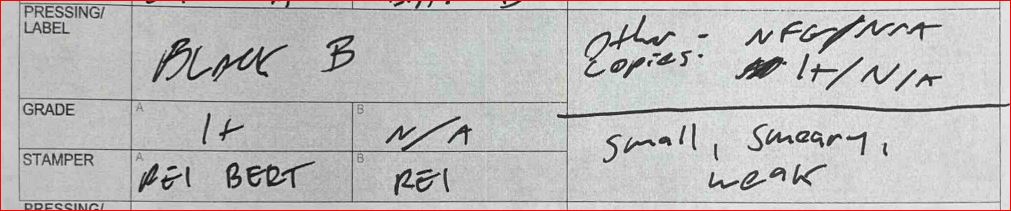
The three copies we had in our recent shootout for Maiden Voyage on the 70s Black B label did poorly.

Like a lot of the records we play when they weren’t mastered properly, they were small, smeary and weak. Considering how bad they sounded, it’s possible — accent on the word possible — that someone remastering the album for a modern audience could do a better job than Blue Note was doing in the late-70s.

This, of course, is not our standard, nor should it be anyone else’s.

Below you will find links to other records with the same problems as this Blue Note reissue.

(more…)

Skip the Later Labels of this Rodrigo Title on the TAS List

More of the music of Joaquín Rodrigo (1901-1999)

This is a TAS list title that deserves its place on a list of Super Discs, as long as you are talking about one that sounds the way the best copies do.

The best sides are exceptionally transparent and full of energy, with the lush strings of the guitars sounding much more textured and real. The orchestra is rich and sweet, especially for a Mercury, yet the guitars are clear, present and appropriately placed relative to the surrounding ensemble.

But all the later label pressings we’ve bought over the years, mostly because we could afford to buy them, hoping for a miracle, have fallen well short of the mark. The notes below tell the story of their typical and obvious shortcomings.

Side One of the most recent late label pressing we played was crude, smeary and hot (bright).

Side Two was even worse, it was very hot (bright).

If you want to avoid records with these problems, click on any of the links below to see the titles we’ve found over the years with the same issues.

(more…)

These Stampers Consistently Come in Last in Our Shootouts

Hot Stamper Pressings of the Music of The Eagles Available Now

All the original domestic pressings are cut by Ted Jensen at Sterling as far as we know.

You can find TJ and STERLING on every last one of them (with the notable exception of the SRC pressings, best avoided). What you can’t find is good sound on every last one of them.

The most common stampers can be found from pressing plants using the following label designations: MON, PRC, PRCW, AR and SP.

In our experience, two of the five labels listed above have the potential to win shootouts. Two of the others tend to end up somewhere in the middle of the grading curve. One consistently ends up at the bottom.

It’s important to keep in mind that in our shootouts, the person hearing the copy being played, the one who is carefully noting its strengths and weaknesses, has no idea what pressing plant actually produced the record, or what its specific stampers numbers might be.

That kind of  information is compiled after the grading has been done. That’s when these patterns emerge.

The domestic pressings with the stampers shown above have not done well in our shootouts for years now. If you own a copy with these stampers, or ones like them, the good news is that we can get you a much better sounding copy of The Long Run than you have ever heard. It won’t be cheap, but we guarantee that it will be very, very good.

Stamper numbers are not the be-all and end-all in the world of records, but after hearing too many copies with these stampers and less than stellar sound, from now on we are going to focus our attention on the stampers that do well and leave copies with these markings sitting in the bins.

Stampers

That the stampers are entirely responsible for the quality of any given record’s sound is a mistaken idea, and a rather convenient one when you stop to think about it. Audiophiles, like most everybody else on this planet, want answers, the simpler the better. Easier to memorize that way.

(more…)