blockbuster

The best pressings of these albums, played on the right system, set up properly in a good room, are truly sonic blockbusters of the highest order.

Stevie Ray Vaughan – Beyond White Hot Stamper Sound

More of the Music of Stevie Ray Vaughan

Years ago we heard a copy sound so much better than any copy we had ever played that we gave it a grade of Four Pluses on side two.

  • Our lengthy commentary entitled outliers and out-of-this-world sound talks about how rare these kinds of pressings are and how to go about finding them.
  • We no longer give Four Pluses out as a matter of policy, but that doesn’t mean we don’t come across records that deserve them from time to time.
  • Nowadays we often place them under the general heading of breakthrough pressings. These are records that, out of the blue, reveal to us sound that fundamentally changes what we thought we knew about these often familiar recordings.
  • When this pressing (or pressings) landed on our turntable, we found ourselves asking “Who knew?
  • Perhaps an even better question would have been “how high is up?”

The Sky Is Crying is one of the best sounding rock records ever made, especially if you are fortunate to have access to the kind of big speaker system that can play it at very loud levels like we do.

The song Little Wing rocks as hard on this pressing as any song we’ve ever heard, with demo disc sound to rival the greatest rock recordings of all time.

The guitar solos on Little Wing are as huge and lively as any we have ever heard (assuming you have a copy that sounds like this one).

(more…)

Diamond Head – Astonishingly Good Sound on the Right Island Pressing

More of the Music of Phil Manzanera

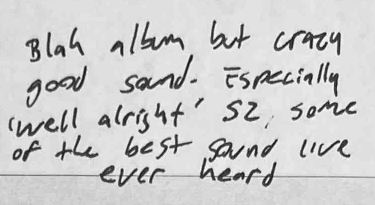
When it comes to blockbuster audiophile sound that jumps out of the speakers, the wind is at your back with Diamond Head because this is one seriously well-recorded album. If this record doesn’t wake up your stereo, nothing will.

Like its brother, 801 Live, this album is an amazing sonic blockbuster, with sound that positively leaps out of the speakers. Why shouldn’t it? It was engineered by the superbly talented Rhett Davies at Island, the genius behind Taking Tiger Mountain, the aforementioned 801 Live, Avalon, Dire Straits’ first album and many many more.

If we could regularly find copies of this audiophile blockbuster (and frankly if more people appreciated the album) it would definitely go on our rock and pop Top 100 list. In fact, it would easily make the Top Twenty from that list, it’s that good.

Looking for Tubey Magic? Rhett Davies is your man. Just think about the sound of the first Dire Straits album or Taking Tiger Mountain. The best pressings of those albums — those with truly Hot Stampers — are swimming in it.

Big Speakers Wanted Needed

This isn’t known as an audiophile album but it should be — the sound is GLORIOUS — wall to wall, floor to ceiling, and as rich and dynamic as it gets.

The best pressings of this album, played on big speakers at loud levels, are Demo Discs of the highest order.

Play this one as loud as you can. (801 Live is exactly the same way and needs high volumes to work its magic.)

A Personal Favorite

This album basically became the set list for 801 Live, the concert collaboration between Eno, Manzanera and their fellow travelers. That album is one of my all time favorites too, and a Must Own for anyone who likes British Art Rock from the ’70s.

What both of these albums share is amazing guitar work. Manzanera was the guitarist for Roxy Music, and this album can be enjoyed simply as an exercise in hearing every possible kind of sound the guitar can make. It also helps to have Eno doing electronic treatments for the instrument and coming up with a whole new sound.

One listen to a song like Diamond Head is all it should take to make you a fan. If that song doesn’t do it for you, the rest of the album won’t either, but I can’t imagine how that could be.

The best copies of this album excel in every area we prize.

It’s energetic, dynamic, the sound just jumps out of the speakers, there’s tons of bass, it’s smooth — in short, it’s doing it all.

What’s Good?

Domestic pressings suck.

German pressings too.

Don’t waste your money. We’ve never heard a good one. (And most of the British pressings you can find won’t hold a candle to this one.)

To see more reviews and commentaries for titles that we think sound their best on imported vinyl, please click here.

Want to avoid having to pay our admittedly high prices and find a top quality copy for yourself?

Consider taking our moderately helpful advice concerning the pressings that most often win our shootouts.

In the case of Diamond Head, we like it best this way:

(more…)

We Get It, This Band Is Not For Everyone

Hot Stamper Pressings of Art Rock Records Available Now

To my mind, speaking as both a fan and an audiophile, both the first two Crack the Sky albums succeed brilliantly on every level: production, originality, songwriting, technical virtuosity, musical consistency and, perhaps most importantly for those of you who have managed to make it this far, top quality audiophile sound.

This is simply a great album of adventurous, highly melodic Proggy Arty rock. If you like the well known bands that made the classic albums cited below there’s a very good chance you will like this much less well known band’s second album also. Especially if you have the taste for something different — I know of no other album quite like it. It may have been strongly influenced by many of the 70s Classics of both Prog and Art Rock, but it is stylistically unique.

This is high-production-value rock that pulls out all the stops and then some, with a massive Beatlesque string section, horns, synths, backward guitars and studio effects that rival those of 10cc.

Much like Ambrosia’s debut (another poorly understood band on a small label), such an ambitious project was clearly an effort to make a grand musical statement along the lines of Tumbleweed Connection, Sgt. Pepper, Crime of the Century, Close to the Edge, The Original Soundtrack or Dark Side of the Moon — all albums I suspect this band played countless times in hopes of recreating some of that magic themselves in the studio. I am of the opinion that they succeeded marvelously.

In the 70s I was a huge fan of those albums too. (Still am of course; check out our Top 100 if you don’t believe me. They’re all in there.) I played them more times than I can remember, with Crack The Sky’s albums spending plenty of time — in heavy rotation you could say — on the turntable in those early days.

Fun tip: Listen for the Elton-John-like piano chords on the first track. Can you name that song? (Hint: it’s on Tumbleweed Connection.)

(more…)

Taking Tiger Mountain – A Big Speaker Tour De Force

Hot Stamper Pressings of the Music of Brian Eno Available Now

If you have a big speaker and the kind of high quality playback capable of unraveling the most complex musical creations, with all the weight and power of live music, this is the record that will make all your audio effort and expense worthwhile.

Repeat As Necessary

Like Roxy Music’s first album, Taking Tiger Mountain is a powerhouse that not only rewards repeated listenings but requires them. Music like this simply cannot be digested at one sitting. Like the Beatles said, It’s All Too Much. But the more you hear it the more you will be able to understand it and appreciate it and, if you’re like me, really start to love it (I hope).

I’ve been listening to this album since the mid-70s and in all that time I have never tired of it. To me it’s the very definition of a Desert Island Disc: a record that knocks me out every time I play it and never wears out its welcome. It’s still fresh and “cutting edge” (if I can use that term) forty odd years after its release. (801 Live from 1976 is the same way.)

The Sound

This album is all about sound, pure sound itself if you will: the sound of the instruments, their textures, and the textures of the soundscape Eno has created for them. Much of that information is lost or perverted on the LP reissues and of course the CD. Only these British originals sound like they are made from fresh master tapes on rich, sweet tubey-magical, super high resolution cutting equipment.

With the subtle harmonics of Eno’s treated sounds captured onto vinyl intact, the magic of the experience far exceeds just another batch of catchy songs with clever arrangements. It truly becomes an immersive experience; sounds you’ve never heard in quite that way draw you into their world, each more interesting than the next.

Brian Eno and other Art Rockers of the period were clearly dedicated to making higher quality recordings, recordings that could only come to life in the homes of those with the most advanced audio equipment. Credit the work of the amazing Rhett Davies for some of the best albums of the 70s: this one, 801 Live, Diamond Head, Dire Straits’ first album, and more.

My system was forced to evolve in order to reproduce the scores of challenging recordings issued by Eno in the 70s. The love you have for your favorite music has to be the driving force of your progress in audio if you want to achieve world class sound.

(more…)

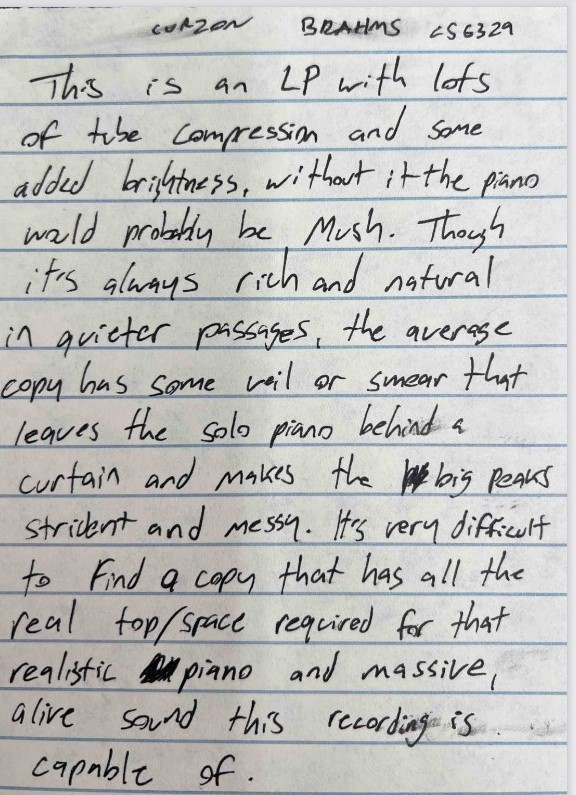
Brahms / Piano Concerto No. 1 – What to Listen For

Hot Stamper Pressings of of the Music of Brahms Available Now

Our general notes for the recording seen below explain why the typical copy in our shootout fell short.

This is an LP with lots of tube compression, and some added brightness.

Without the added brightness, the piano would probably be mud.

The added brightness and compression results in a piano that always sounds rich and natural in the quieter passages.

The average copy also has some veiling or smearing that make the solo piano parts sound like they are coming fom behind a curtain. On these copies, the big peaks can often get strident and very messy.

It’s difficult to find a copy that has all the top end extension and space required to reproduce both a realistic piano and the massive live sound the orchestra is capable of.


All of which adds up to a difficult shootout in which relatively few copies had the sound we were looking for.

Production and Enginneering

(more…)

Led Zeppelin IV – The First Two Tracks on Side One Are Key

Hot Stamper Pressings of the Music of Led Zeppelin Available Now

We always have a great time doing Zep IV shootouts. It’s one of those all-too-rare cases where amazing music and amazing sonics potentially coexist on the same slab of vinyl. You just need to find the right slab and be able to clean it right, a proposition that turns out to be much harder than it might sound.

You probably know by now just how tough it is to find audiophile quality sonics on this album. Far too many copies just leave us cold. However, the best pressings, whether British or domestic, are so good, and so much fun at the loud volumes we play them at, that in the end it turns out to be worth all the time, trouble and expense it has taken to find them.

On these two tracks, the best pressings of Led Zeppelin IV were capable of producing some of the biggest, boldest sound we have ever heard.

It’s clearly a Demo Disc for big speakers that play at loud levels. The louder you play it, the better it sounds.

Warning: do not attempt to play this album on any system that looks like this one.

The two tracks we discuss below are the ones that can truly test the energy and musical drive of whatever pressing you are playing. If you are fortunate to be able to have one of our better Hot Stamper copies on your table, the energy and musical drive of Black Dog and Rock and Roll might just take your breath away.

Side One

Black Dog

The key to both of the first two tracks is to find a copy with a solid bottom end. Next look for an extended top end, easily heard on all the splashing cymbals.

Now listen for a tonally correct Robert Plant.

The copies with lots of top will typically have him sounding too bright. The copies with little in the way of high frequency extension will have him sounding veiled and dull.

One out of ten copies (with potentially good stampers) will get all three right: the top, the bottom and his voice. When you hear it you know it immediately, but you sure do have to go through a lot of copies before you have much of a chance of hearing it.

Rock and Roll

“[Rock and Roll] was a little tough to record because with the hi-hat being so open and [Bonham] hitting it that hard it was difficult to control. But I managed somehow or another.”

Andy Johns

“The best copies prove once and for all that these are some of most up-front, lively and above all real sounding rock cymbals ever put on tape.”

Tom Port


Further Reading

Deceptive Bends – An Overview

Hot Stamper Pressings of the Music of 10cc Available Now

We’ve long been huge fans of this album both musically and sonically. It’s the kind of recording where the sound JUMPS out of the speakers. In that way it most reminds me of Crime Of The Century, one of the most amazing recordings in the history of popular music. Both are real blockbusters, and we wouldn’t have it any other way.

Deceptive Bends is also one of the most DYNAMIC popular recordings I know of.

If this album doesn’t wake up your system, it’s time to scrap it and start over.

Played on big speakers at loud levels, this is Demo Disc quality sound of the highest order.

Musically it’s one of my all time favorite albums as well, a real Desert Island Disc for yours truly.

Incredible Stereo Separation

One of the many elements that combine to push this album well beyond the bounds of most popular recordings is the thought and care that went into the soundstaging. Listen to the stereo separation on any track — the sound of each instrument has been carefully considered within the context of the arrangement and placed in a specific location within the soundfield for a reason — usually that reason is for MAXIMUM EFFECT.

That’s why we LOVE 10cc. Their recordings from this era are an audiophile dream come true. Compare that to some of the stereo mixes for the Beatles albums, where an instrument or vocal seems to panned to one channel or another not because it SHOULD be, but because it COULD be. With 10cc those hard-left, hard-right effects make the songs JUMP. They call attention to themselves precisely because the band is having a blast in the studio, showing off all the tricks they have up their sleeves. They want you to get as big a kick out of hearing them as they did conjuring them up.


Here are some other records with Demo Disc sound in these same areas:

(more…)

What the Best Copies of Boston Really Get Right

Hot Stamper Pressings of Albums with Huge Choruses Available Now

The multi-tracked layers of guitars really come to life on the better copies. The not-so-great pressings tend to be congested and compressed, thickening the sound and diffusing the layers of multi-tracked harmonies. Tom Scholz’s uniquely overdriven, distorted leads have near-perfect timbre. On the top copies you can really hear how much power that sound adds to the music.

As is the case for the better pressings of Aqualung,just to take one example, when the guitar sounds this good, it really makes you sit up and take notice of the guy’s playing. When the sound works the music works, our seven word definition of a Hot Stamper.

Our killer copies have sweetness and tubey warmth we didn’t expect to hear. Better yet, the best copies have jump-out-of-the-speakers presence without being aggressive, no mean feat.

The good ones make you want to turn up the volume; the louder they get the better they sound. Try that with the average copy. When playing mass-market pop-rock music like this, more level usually means only one thing: bloody eardrums.

The typical Boston EQ is radio-friendly, not audiophile-friendly. But some were cut right, with the kind of richness, sweetness and smoothness that we fondly refer to here at Better Records as the sound of analog.

(more…)

Big Speakers and Loud Levels Bring Out the Power of the Orchestra

Hot Stamper LPs that Sound Their Best on Big Speakers at Loud Levels

The darker brass instruments like tubas, trombones and french horns are superb here. Other Golden Age recordings of the work, as enjoyable as they may be in other respects, do not fully reproduce the weighty quality of the brass, probably due to limiting, poor eq, poor miking, or some combination of the three.

The brass on this record has the powerful weight and energy of live music like practically no other orchestral pressing we have ever played.

It’s also tonally correct. It’s not aggressive. It’s not irritating. It’s just immediate and powerful the way the real thing is when you hear it live. That’s what really caught my ear when I first played the recording.

There is a blast of brass at the end of Catacombs that is so big and real, it makes you forget you’re listening to a recording. You hear every brass instrument, full size, full weight. I still remember the night I was playing the album, good and loud of course, when that part of the work played through. The power of it was truly startling.

Back then I had the Legacy Whisper speaker system, the one with eight 15″ woofers. They moved air like nobody’s business. If you want to reproduce the power of the trombone, the loudest instrument in the orchestra, they’re the speaker that can do it.

Some of Ansermet’s recordings with the Suisse Romande are absolutely the best I’ve ever heard. It was a magical combination of the right hall, the right engineers, the right orchestra and the right technology — the pure tube ANALOG technology of the 50s and 60s!

Dynamics

Another thing this recording has going for it is dynamic power. This is a dynamic piece of music. Few recordings I have ever heard have the dynamic contrasts that this one does. It really gets loud when it needs to. The best pressings sound completely uncompressed. Although I’m sure there has to be compression of one kind or another, the listener is rarely made aware of it.

Dynamics such as these are thrilling. They let the music come alive.

(more…)

Crisis? What Crisis? – It Took Us Until 2012 to Finally Beat the Audiophile Pressing We Swore By

Hot Stamper Pressings of the Music of Supertramp Available Now

This listing is from 2012. Since that time we have been able to find and play a great many British pressings of the album, and they tend to win our shootouts.

But the domestic pressings can also do very well, just not well enough to win shootouts these days, a clear case of live and learn.

Our Understanding from 2012

TWO AMAZING SIDES, including an A+++ SIDE ONE! It’s not the A&M Half Speed, and it’s not a British pressing either. It’s domestic folks, your standard plain-as-day A&M pressing, and we’re as shocked as you are. Hearing this copy (as well as an amazing Brit; they can be every bit as good, in their own way of course) was a THRILL, a thrill that’s a step up in “thrillingness” over our previous favorite pressing, the A&M Half Speed.

The best of the best domestics and Brits are bigger, livelier, punchier, more clear and just more REAL than the audiophile pressing something we knew had to be the case if ever a properly mastered non-Half Speed could be found. And now it has. Let the rejoicing begin!

This is only the second White Hot Stamper copy of Crisis to come to the site, and it’s not the A&M Half Speed. It’s an AMAZING sounding British copy. The only other copy that we have ever heard sound this good was the domestic copy we put up a few weeks back.

The best of the best domestics and Brits are bigger, livelier, punchier, more clear and just more REAL than the audiophile pressing — something we knew had to be the case if ever a properly mastered non-Half Speed could be found.

Our previous commentary for our domestic pressings noted:

We’d love to get you some great sounding quiet British copies, but we can’t find any. They either sound bad (most of them) or they’re noisy (the rest). It is our belief that the best Hot Stamper pressings of this Half-Speed give you the kind of sound on Crisis? What Crisis? you can’t find any other way, not without investing hundreds of dollars and scores of hours of your time in the effort. Wouldn’t you just rather listen to the record?

Why did we think Jack Hunt‘s mastering approach for the A&M Half Speed was the right one?

(more…)