
Hot Stamper Living Stereo Orchestral Titles Available Now
Well below the reproduction of the front page of our old catalog you will find the review I wrote in 2007 for the Classic Records’ Heavy Vinyl pressing of Witches’ Brew.
Clearly I did not care for it in the least. In fact, I thought it was one of the worst reissues I’d ever heard, so aggressive, boosted and unnatural it defied understanding that anyone could ever play such a record and not notice how wrong it sounded.
Now when I think about the Classic Records reissue of Witches’ Brew and its awful sound, it’s obviously a modern remastering I could not possibly have liked.
However, in preparing to move to Georgia in 2022, I found myself digging through some old catalogs from the early Nineties. Something I read in one of them chilled me to the bone.
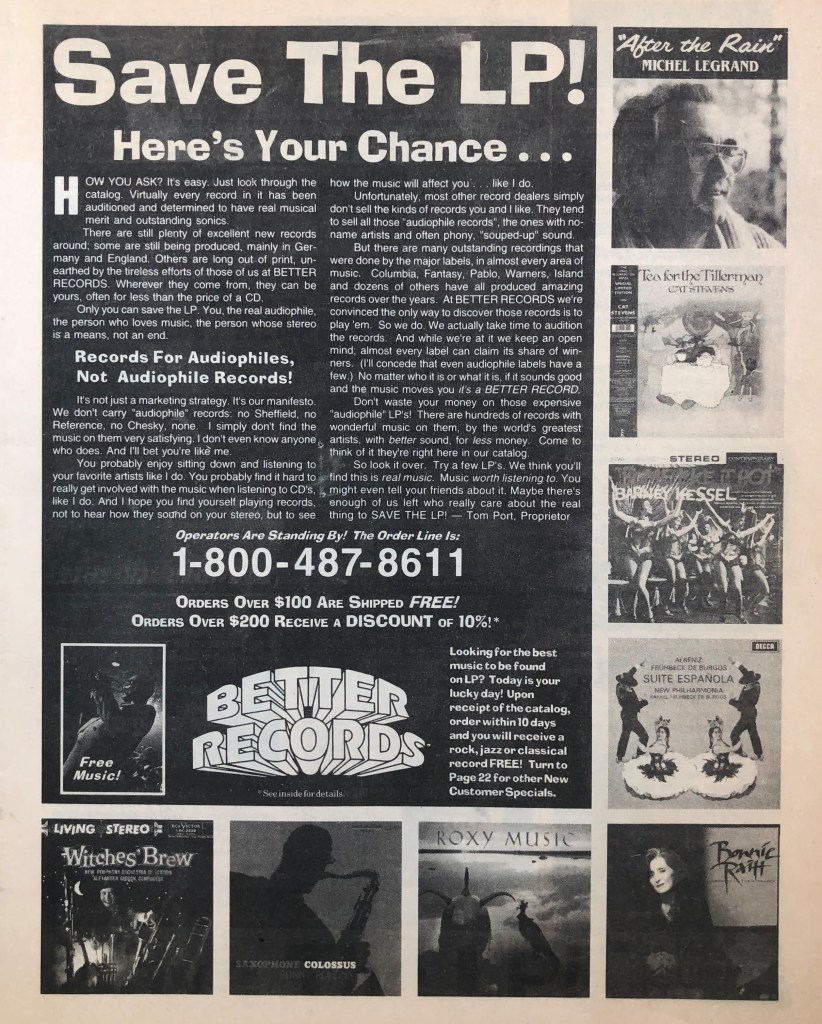 There it was in black and white: my rave review for the Classic Records pressing of Witches’ Brew.
It’s actually on the front page of the catalog, along with at least one other record that I would be mortified to sell today: the OJC pressing of Saxophone Colossus.
(As soon as I find my review in the old catalog for Saxophone Colossus, I will post it. I can hardly believe I wrote it, but I did. I wrote all my catalogs back then. My lack of competence and the guilt associated with my lack of expertise at the time is undeniable. It obviously would be foolish and wrong of me to try to deny any of it, so I don’t.)
Below you will find a commentary from 2007 detailing the shortcomings of the Classic.
I sure had a lot of nice things to say about it in 1994.
I thought my stereo was awesome back then, but it was not nearly as awesome as I thought it was. It was better than any system I had heard in a stereo salon, audio show or friend’s house, but that has to be seen as a pretty low bar, and it may even be lower now than it was back then.
I’ve written a bit about the limitations of my 90s system here.
The Dunning-Kruger effect is real, and I clearly suffered from it.
In 1994 I had been a fairly dedicated audiophile for more than twenty years, and a strongly opiniated audiophile record dealer, one who took pride in curating his vinyl offerings right from the start of the business in 1987.
I thought I knew what I was talking about. Looking back it’s clear I had a lot to learn.
We did our first shootout for the album a mere thirteen years later, owing to the fact that the originals are hard to find in audiophile playing condition, making it hard to get enough stock to do a shootout.
2007 is when our real education began. (If we have any copies left from our most recent shootout, they can be found here.)
Our Review from 2007
(With a few links added and minor changes made.)
Please to enjoy.
If this isn’t the perfect example of a pass/not-yet record, I don’t know what would be.
I’ve long held that the remastering of this album is nothing less than a crime against music lovers and audiophiles of every stripe. Boosting the bass and highs and adding transistory harshness is the last thing in the world that Witches’ Brew needed.
At the risk of insulting some of you out there, if you think the Classic Records version of this album sounds good, your system must be some combination of low-rez, dull and bass shy, or you must like really hi-fi-ish sound.
There is no way that that record should ever sound good on a full-range system that’s reasonably revealing and tonally accurate.
I’ve heard this record played by people attempting to demonstrate the brilliant sound of their system, a demonstration which nearly caused blood to run from my ears. All the while they stood there with a big grin on their face, so pleased with the sound.
I don’t understand how anyone can put up with that kind of sound, but obviously people do. People like lots of things I don’t like, and the Classic record is just one more to add to that list.
Classic Records pressings may have been mastered by one of the greats, Bernie Grundman, but he was well past his prime, as we explain here.
More Classic Bashing
Classic Records ruined this album, which should come as no surprise to anyone who has played their classical reissues.
Their version is dramatically more aggressive than the Shaded Dogs we’ve played.
The strings are exceptionally shrill and screechy even by Classic’s standards. True, the original is not the smoothest, sweetest recording Decca ever made, but what Classic did was take Decca’s sound and amplify its shortcomings.
(The other poster boy for shrill strings is Classic’s remastering of LSC 1806.)
Apparently, most audiophiles (including audiophile record reviewers) have never heard a top quality classical recording. If they had, Classic Records would have gone out of business immediately after producing their first three Living Stereo titles, all of which were dreadful and labeled as such by us way back in 1994. I’m not sure why the rest of the audiophile community was so easily fooled, but I can say that we weren’t, at least when it came to their classical releases.
We admit to having made plenty of mistaken judgments about their jazz and rock, and we have the we was wrong entries to prove it.
With every improvement we’ve made to our system over the years, their records have managed to sound progressively worse. (This is pretty much true for all Heavy Vinyl pressings, another good reason for our decision to stop buying them in 2007.) That ought to tell you something.
Better audio stops hiding the shortcomings of bad records. At the same time, and much more importantly, better audio reveals more and more of the strengths and beauty of good records.
Which of course begs the question of what actually is a good record — what it is that makes one record good and another bad — but luckily for you, dear reader, you are actually on a site that has much to say about those very issues.
There are scores of commentaries on the site about the huge improvements in audio available to the discerning (and well-healed) audiophile. It’s the reason Hot Stampers can and do sound dramatically better than their Heavy Vinyl or Audiophile counterparts: because your stereo is good enough to show you the difference.
With an old school audio system you will continue to be fooled by bad records, just as I and all my audio buds were fooled thirty and forty years ago. Audio has improved immensely in that time. If you’re still playing Heavy Vinyl and Audiophile pressings, there’s a world of sound you’re missing. We would love to help you find it.
A single amazing sounding orchestral Hot Stamper pressing might just be all it takes to get the ball rolling.
Further Reading
- New to the Blog? Start here
- What exactly are Hot Stamper pressings?
- More letters, reviews and commentaries for Witches’ Brew