 Hot Stamper Pressings of Rock and Pop Albums Available Now
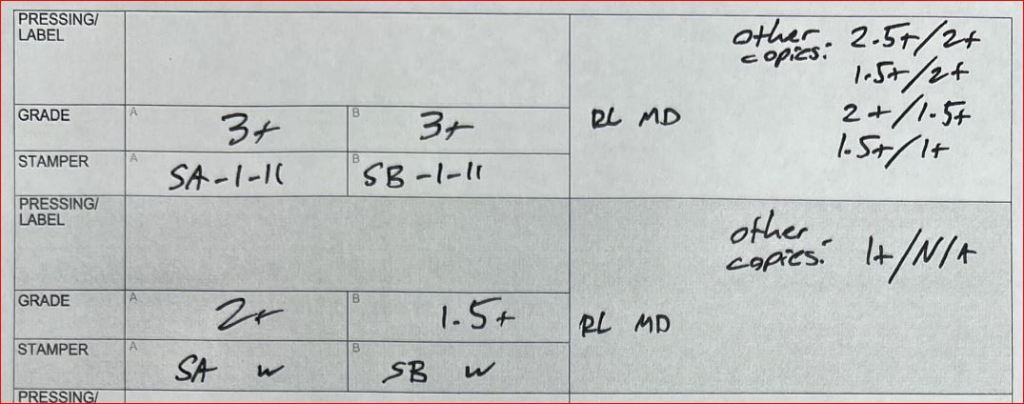
Below is the complete shootout stamper sheet for a rock record whose name we do not plan to reveal at this time.
We could reveal it, since knowing the “right” stamper numbers appears to be of no help at all — the best stampers and the worst stampers are exactly the same stampers! (Nothing new there.)
RL stands for Robert Ludwig and MD stands for Masterdisk. As you can see, Robert Ludwig cut all seven of the pressings that made it to the shootout.
One of them actually won. “Robert Ludwig’s stuff cannot be beat!” might be the post on whatever audiophile forum you frequent. (If it’s Hoffman’s forum, it would more likely read “Robert Ludwig’s stuff cannot be beat except by Steve Hoffman!”)
Another pressings with those same markings came in next to last, with such mediocre-at-best sound that it would not qualify as a Hot Stamper at all. (1.5+ on both sides or better is the minimum grade for any record we sell.)
Robert Ludwig really screwed up the mastering of this title, another forum member might post.
 Can they both be wrong? Of course they can. When has any information posted on a forum been reliable or free from error?
If you were to tell me you have the Robert Ludwig-mastered original pressing for this record and it sounds amazing, I would be inclined to agree with you that that is very possible. If, on the other hand, you were to tell me you have the Robert Ludwig-mastered original pressing for this record and it sounds terrible, I would say I happen to know firsthand that that’s possible too.
The most likely sound for any copy you might have is “good, not great,” because only two copies earned grades of 2+ or better on both sides. Two out of seven. (Which is disappointing because it hurts our bottom line when so few copies in a shootout will end up selling for much more than we invested in them in money and labor.)
Two other copies are not even saleable — their grades are below the minimum. They will most likely be traded back to one of the record stores we shop at.
Were the stampers a bit worn for those copies, or was it bad vinyl that couldn’t hold the energy of the stamper?
Maybe it’s something as simple as the pressing plates going out of alignment at some point in the cycle?
Don’t ask us. We sure don’t know.
And one thing we’ve learned over the years is not to pretend to.
These are record mysteries, and they must remain mysteries, if for no other reason than the number of production variables intertwined at the moment of a pressing’s creation can never be teased apart no matter how much you wish it were possible.
Changes for 2024
Beginning in 2024 we decided to make available to our readers a great deal of the pressing information we’ve compiled over the last twenty years, under these headings:
Advice as to which are the right countries and which are the wrong countries for specific albums we’ve auditioned.
Some of the titles listed here have better sound on labels that many record collectors would probably not expect to be the best. Other titles have inferior sound based on the labels we’ve identified in these listings.
Keep in mind that all the practical advice you see here is based solely on the experiments we’ve run and the data we’ve collected by doing them.
Helpful title-specific information on mastering houses and engineers to help you find better pressings and avoid the worst ones.
These are albums we have found to have polarity issues on some pressings.
Some audiophiles have been known to complain that our reluctance to give out stamper information is selfish. We think that’s not fair.
We admit that we rarely give out the stamper numbers for the pressings that win shootouts — we paid a high price in money, time and effort to discover them — but we regularly give out some of the stampers that did not sound expecially good to us.
The moderately helpful title-specific advice here can help you in your search for better sounding pressings. At the very least it may help you avoid some of the worst ones.
Further Reading
- Limitations? Colorations? Moi?
- There aren’t many shortcuts in audio, but we might know of a few
- For audiophiles just getting started, beware of LPs that are likely to inhibit your progress

I see that Robert Ludwig likes big speakers too. But shoving them back into the corners of the studio is unlikely to result in hi-fidelity playback. Perhaps he knows how to listen around their shortcomings.
We deserves the benefit of the doubt, based on the man’s reputation for knowing an awful lot about good sound back in the day. Led Zeppelin II may well be the most amazing mastering success in the history of popular music. The phenomenal sound of the pressings with RL inscribed in the dead wax did not come about by accident.
The guy below, with his oversized speakers placed too far apart and shoved into the corners of a room, surrounded by a scattering of room treatments of questionable value, has provided plenty of evidence that his big speakers have not helped him determine the quality of the records he’s been tasked with playing, based on the countless mistaken reviews he’s been writing over the course of decades.