*That’s Funny

The most exciting phrase to hear in science, the one that heralds new discoveries, is not “Eureka!” (I found it!) but “That’s funny …”
— Isaac Asimov

How Can the Best Stampers Also Be Some of the Worst?

Hot Stamper Pressings of Vintage Columbia Albums Available Now

Recently we conducted a shootout for a favorite Columbia recording, one that we had auditioned a couple of times before and one for which we knew the music and the general quality of the sound well.

It’s not the record you see pictured. For now we’re keeping the title a mystery, consistent with the idea that we give out lots of bad stampers on this blog, but almost never do we give out the good ones. (When we do give out the best stampers, we keep the title under wraps. We are not the least bit interested in putting ourselves out of business.)

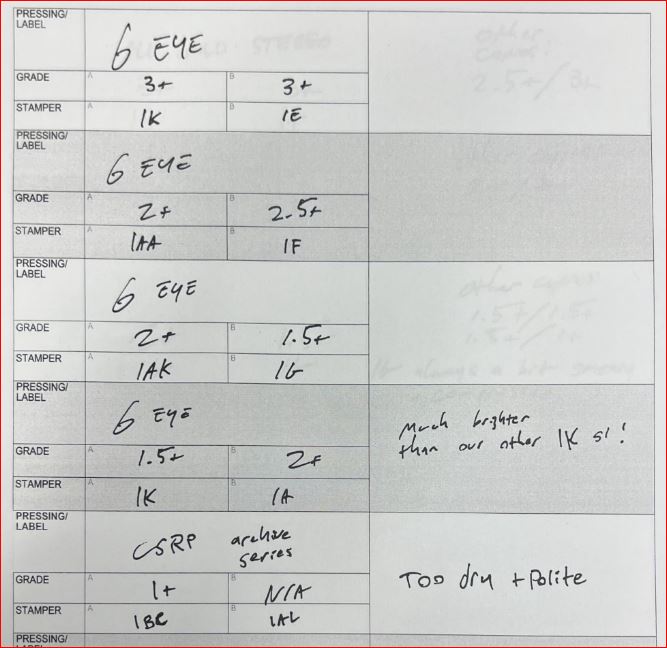
The discussion for today revolves around the idea held by a great many audiophiles that the 6-Eye pressings are going to be the best sounding of almost any album they might happen to run across.

And, to be fair, in the case of this mysterious album, they’re right.

What interests me in these findings is that the stampers for a shootout winning copy, the top one, are almost identical to the one that came in close to last in the shootout outside of the Columbia Special Products reissue, with decent, respectable but far from shootout winning grades of 1.5+ and 2+.

One of the 1K side ones was the best we played, and one was very bright.

If an audiophile collector were to go to Discogs, find the IK pressings, he could either find himself with a top quality copy, or a not-nearly-as-good copy, depending on his luck.

Why one set of stampers sounds so much better than another set, or the same or similar set on a different pressing, is a mystery, and it’s one that we confidently predict will never be solved.

Does anyone have a practical way to get around the unfortunate reality that allows one set of stampers to sound great and the same or a similar set of stampers to sound no better than very good, if that?

Well, we can’t say there is a practical way, but we do know of an impractical one. We’ve been practicing and refining that one for more than twenty years.

We just play lots and lots of copies of the albums to find out how they sound.

(more…)

This Mystery Mercury May Have the Same Stampers on Both Sides, But the Sound Is Very, Very Different

Hot Stamper Pressings of Mercury Classical Recordings Available Now
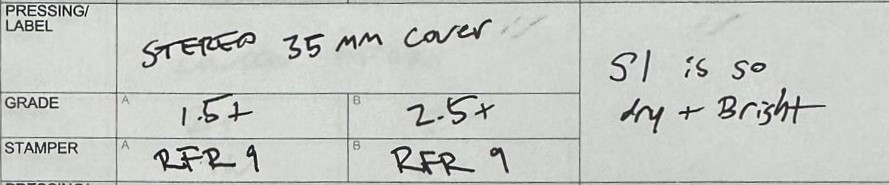

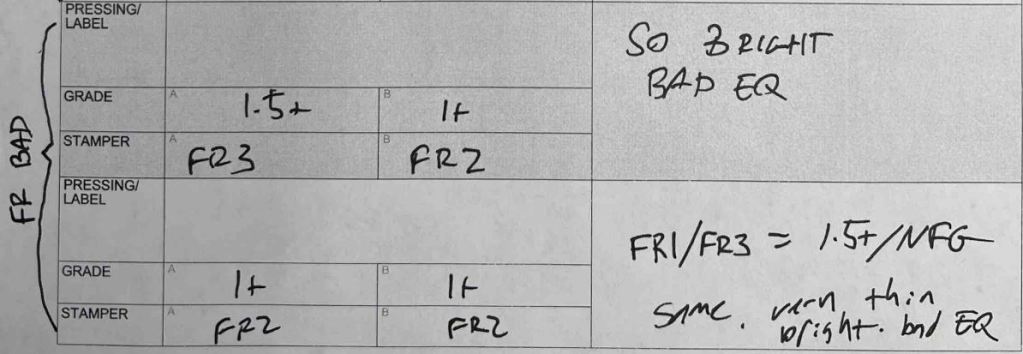
For Mercury classical and orchestral recordings, the original FR pressings (when there are such pressings), in stereo, on the original plum label are the best way to go, right? 

In many cases, yes. We talk about how much better the FR pressings for The Firebird are compared to the much more common, and still quite good, M2 reissue pressings here. (Both beat the pants off the awful Classic Records pressing.

But sometimes the RFR pressings — which, as I am sure you know, can be the earliest stampers for some titles — are nothing special on one side or the other. That is exactly the case here.

Keep in mind that the stamper numbers you see above belong to a different album.

We’ve lately been giving out much more stamper information than we used to, but for now we are keeping the identify of this title close to the vest.

We are not able to predict what stampers will win a shootout before we actually sit down to play all our copies.


It turns out that the FR pressings did not sound as good as some of other pressings. The RFR stampers came in somewhere in the middle of the pack, an average of 2+, but a hard record to sell with such very different sounding sides.

This is why we do shootouts, and why you must do them too, if owning the highest quality pressings is important to you.

Fortunately for readers of this blog, our methods are explained in detail, free of charge.

We’ve also written quite a few commentaries to help audiophiles improve the way they think about records.

I implore everyone who wants to make progress in this hobby to learn from the mistakes we’ve made. There are 146 “we were wrong” listings on the site as of this writing, and we learned something from every damn one of them, painful and costly as those experiences may have been.

(more…)

Art Pepper Today – Latest Findings

Hot Stamper Pressings of the Music of Art Pepper Available Now

UPDATE 2024

In 2010 we wrote a commentary about the album which can be found here.

It’s a long story that goes into great detail comparing the sound of the original Galaxy pressings with those of the much more common OJC’s.

Fourteen years later (!) and here we are, finally getting to the point where we have enough copies of Art Pepper Today to do a proper shootout.

Since this is a title we have not played in a very long time, we took the opportunity to give a quick listen to both kinds of pressings just to make sure that both could be expected to do well enough to be included in the shootout.


The OJCs Fall Short in a Different Way

Well, it turns out that the OJC pressings are no longer cutting it. That’s money down the drain.

It seems to be the case that they are dark and hard sounding compared to the Galaxy pressings.

This is a bit surprising because most of the OJC pressings that we don’t like are thin and bright, not dark and hard.

That’s not the way OJC’s typically sound, but in the world of records, when has that ever counted for anything?

Patterns are helpful up to a point, but on this album, the patterns we see across the label have broken down, which is why our business is built upon a foundation of playing every record we sell and judging it strictly on its own merits.

There are just too many exceptions to whatever patterns we may think we have detected.

(more…)

How Can the Best Stampers Also Be the Worst Stampers?

Hot Stamper Pressings of Contemporary Jazz Available Now

Recently we conducted a shootout for a superb Contemporary recording, one that we had auditioned a couple of times before and one which we felt we knew the music and the quality of the sound well.

It’s not the record you see pictured. For now we’re keeping the title a mystery, consistent with the idea that we give out lots of bad stampers on this blog, but almost never do we give out the good ones.

Why, you ask?

The cost of discovering the right stampers is usually high, can take decades, and is fundamentally at the heart of how we make our money: by finding amazing sounding pressings with stampers we know to be good, cleaning them up, playing them, and offering those that, for whatever mysterious reasons that no one has figured out, including us, tend to have the best sounding grooves.

This time around we kept track of the stamper numbers for all the pressings we played, something we are making a habit of doing these days and using to highlight discoveries in the sound of the records we play.

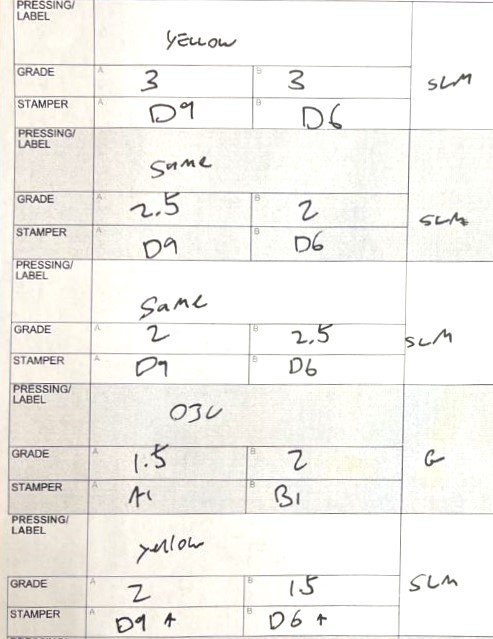
In this case, we discovered an anomaly we thought we would bring to the audiophile world’s attention: the fact that the stampers for the best souding pressing were also the stampers for the worst sounding pressing, because they were the stampers for all the pressings.

One copy earned our White Hot Stamper grade, our highest, for its clearly superior sound, and another one earned our lowest Hot Stamper grade of 1.5+. The rest were quite good, in between those two, which is a very common outcome for most of our shootouts: lots of records in the middle of the distribution, some winners at the top and some losers at the bottom.

Note that the OJC of this title is one we have liked in the past. It didn’t do so well this time around, and that is mostly because we found out about some stampers we like even better. We will probably not being buying the OJC anymore; it’s probably more trouble than it’s worth.

However, the key takeaway from this stamper sheet is the fact that it beat one of the real Contemporary label pressings in the shootout.

So the question an audiophile record collector might ask himself is this one: is the OJC better or worse than the real Contemporary pressing with D9/D6 stampers?

(more…)

Maybe We SHOULD Start Buying Blue Notes on the Early Labels

Hot Stamper Pressings of Blue Note Albums Available Now

If there are record companies whose fans are extremely particular about the labels of the pressings they prefer, Blue Note has to be right at the top of that list.

The consensus among record collectors seems to be that the early label Blue Notes are practically guaranteed to have the best sound. In top condition they often sell for many thousands of dollars, far more than we have ever charged for any Hot Stamper Blue Note pressing

We are on record as not favoring early labels over later ones absent evidence to support such bias, but perhaps there actually are some records you should be buying based on their labels. This one, for example.

If all the stampers of a title are the same and they’re all cut by Rudy Van Gelder — early labels, middle labels and later labels alike — what do you use to guide you when trying to find the best sounding pressings?

This is precisely the conundrum that an audiophile would be faced with as he goes about trying to find the best sounding pressings of the Blue Note album whose stamper sheet you see below.

This stamper sheet reflects a fairly typical shootout for a Blue Note pressing. It’s hard to find six clean copies no matter what the title is. We probably returned or gave up on half the copies we bought, so we might have had to buy nine in order to shootout six.

(Note that there is nothing on any label after the White B from the 70s. We have never heard any title with an 80s label or later sound worth a damn so we stopped buying them a long time ago.)

Drawing Conclusions

Let’s look at some of the conclusions the typical record collector/audiophile might draw from the information above.

For example:

1.) I have a Blue Note with Van Gelder stamps and it’s decent sounding but I like [fill in the blank with some other pressing] better. Since all the pressings are cut by him, he must not have done a very good job. Thank goodness modern mastering engineer X came along to finally bring out the sound of the master tape that he was not able to do.

That’s an easy one to rebut. The later pressings cut by Rudy are consistently worse sounding than the earlier ones in the case of this title. If you don’t have a big batch to work through, however, you simply have now way of knowing that fact, and therefore whatever conclusions you choose to draw from a too-small pool of pressings are suspect at best.

(more…)

The Original Mercury Pressings Don’t Sound Good on this Title, But Why?

Hot Stamper Pressings of Mercury Classical Recordings Available Now

For Mercury classical and orchestral recordings, the original FR pressings (when there are such pressings) on the plum label are the way to go, right? 

In some cases, yes. We talk about how much better the FR pressings for The Firebird are compared to the much more common, and still quite good, M2 reissue pressings here.

And the FR pressing of the Rachmaninoff record you see pictured above may indeed have the best sound.

The stamper numbers you see below belong to a different album.

(We’ve lately been giving out much more stamper information than we used to, but for now we are keeping this title closer to the vest.)

Note that we had FR1, FR2 and FR3, all originals, yet none of them could be considered good enough to offer our customers.

It’s just another one of a number of rules of thumb collectors use (“A method or procedure derived entirely from practice or experience, without any basis in scientific knowledge; a roughly practical method.”), one that will sometimes lead you astray if what you are trying to find are not just good sounding pressings of albums, but the best sounding pressings of albums.

Same with reissue versus original. Nice rule of thumb, but it only works, to the extent that it works at all, if you have enough copies of the title to know that you’re not just assuming the original is better. You actually have the data — gathered from the other LPs you have played — to back it up.

Who knew the recording would sound so much better on the right reissue pressings?

(more…)

Do the “Wrong Stampers” Sometimes Win Shootouts?

mendestill_depth_1102533608More of the Music of Sergio Mendes and Brasil ’66

Soren has some questions about shootouts and our White Hot Stamper pressing of Stillness. His questions are indented, our answers are not.

Tom,

Does it ever bug you to realize, maybe one or two years down the road and with (as Tom mentions) better playback/cleaning technology, that stampers which you dismissed in a shootout turn out to win the next one, meaning that you could have let many possible hot stampers go?

Soren,

We talk about that a bit here: which is better: Phil DeLancie digital or George Horn analog?

But being bugged by it does no good. It is a reality that must be accepted.

Because we know how easy it is to be wrong, or, more precisely, to not know everything we would like to know, we never stop doing research and development for the titles we sell.

We tell people all the time, go play your Heavy Vinyls and Half-Speeds that you haven’t played recently. If you’ve made improvements to your system, they will often start to show themselves to be not nearly as good sounding as you remember, and that means you are making progress.

I was actually reaching out to you to inquire whether the super hot Sergio Mendes Stillness that I bought from you a couple of years ago is the version with the phase reversed on side 2?

I ask because I don’t recall a phase issue on this specific title was ever mentioned on your site back when I bought it (i would have remembered, I think) so maybe you only found out recently?

Side 1 on the record sounds better to me than side 2. The matrix on this side 2 ends in “M3”.

Both M2 and M3 are in correct polarity.

M3 used to win shootouts by the way. For the longest time, at least ten years, I thought M3 was the ultimate side two.

(more…)

On Heroes, It Took Us Ages to Break the Sound Barrier

More of the Music of David Bowie

Because the conventional wisdom turned out to be so wrong.

Our intuition that the British originals would sound the best was incorrect.

The experiments we carried out falsified that prediction.

In the audiophile record collecting world, intuitions have a bad track record, but more than a few audiophiles — many of whom are addicted to sharing their “record knowledge” on audiophile forums — seem unaware of this reality.

Taking a page from one of the greatest minds of the 20th century, we’ve opted to use a more scientific approach to discovering the best sounding record pressings, and we encourage you to do likewise. 

We pioneered the evidence-based approach to finding the best sounding pressings, and, like all good scientists, we shared it with everyone. Some in the audiophile community have taken it to heart, but most have chosen to put their faith in reviewers, forum posters, common sense and logic.

None of these produce consistently good results, but those who use these methods are loathe to doubt them and only rarely if ever learn the error of their ways.

Once a decision has been made and a specific pressing acquired — you could call it door number three I suppose — cognitive dissonance and confirmation bias immediately kick in to justify the result, and soon enough the game is over. The prize has been won. It’s the best prize ever. It does everything right, everything you’d hoped for.

But the best sounding copy of the record was not behind door number three.

You don’t have the best sounding pressing (well, you might, but if you did it would be entirely the result of chance, since you have no experimental evidence), but as long as you think you do, and, like most audiophiles, you play records only for yourself, and purely for enjoyment, you have no way of  discovering where on the spectrum of best to worst your record sits.

As long as you think you have the best, you have the best. How could there ever be any evidence offered to the contrary?

(more…)

Album 1700 – Gold Versus Green

Hot Stamper Pressings of Folk Rock Records Available Now

In previous shootouts we felt strongly that the best Gold Label copies had the lock on Tubey Magic, while the best Green Label pressings could be counted on to offer superior clarity.

That was quite a few years ago, and as we never tire of saying, things have changed.

Now the Gold Label pressings have the ideal combination of Tubey Magic and clarity.

In fact, based on our recent shootout we would state categorically that the best originals are clearly better in every way, with the most vocal presence, the most harmonic resolution, the most space, the most warmth and intimacy, the most natural string tone on both the guitars and bass — in sum, the most of everything that allows a Hot Stamper vintage LP to be the most sublime musical experience available to any audiophile fortunate enough to own it.

Steve Hoffman’s famous phrase is key here: we want to hear The Breath Of Life. If these three gifted singers don’t sound like living, breathing human beings standing across from you — left, right and center — toss your copy and buy this one, because that’s exactly what they sound like here.

The TUBEY MAGIC of the midrange is practically off the scale. Until you hear it like this you really can’t even imagine it. It’s a bit shocking to hear each and every nuance of their singing reproduced so faithfully, sounding so much like live music.

This is high-rez ’60s style; not phony and forced like so much of what passes for audiophile sound these days, but relaxed and real, as if the recording were doing its best to get out of the way of the music, not call attention to itself. This, to us, is the goal, the prize we must constantly strive to keep our eyes on. Find the music, leave the rest.

(more…)

Oliver Nelson and RVG – Mastering Better than the Master?

More Music and Arrangements by Oliver Nelson

The sound of this Shootout Winning reissue is tonally correct, Tubey Magical and above all natural. The timbre of each and every instrument is right and it doesn’t take a pair of golden ears to hear it. So high-resolution too. If you love ’50s and ’60s jazz you cannot go wrong here.

For those record lovers who still cling to the idea that the originals are better, this pressing will hopefully set you straight.

Yes, we can all agree that Rudy Van Gelder recorded it, brilliantly as a matter of fact. Shouldn’t he be the most natural choice to transfer the tape to disc, knowing, as we must assume he does, exactly what to fix and what to leave alone in the mix?

Maybe he should be; it’s a point worth arguing.

But ideas such as this are only of value once they have been tested empirically and found to be true.

We tested this very proposition in our recent shootout, as well as in previous ones of course. It is our contention, based on the experience of hearing quite a number of copies over the years, that Rudy did not cut the original record as well as he should have. For those of you who would like to know who did, we proudly offer this copy to make the case.

Three words say it all: Hearing is believing.

(And if you own any modern Heavy Vinyl reissue we would love for you to be able to appreciate all the musical information that you’ve been missing when playing it. I remember the one from the ’90s on Impulse being nothing special, and the Speakers Corner pressing in the 2000s if memory serves was passable at best.)

(more…)