regular-shootouts

As explained in these commentaries, regular shootouts are the best way to improve the sound of the albums in your collection.

We Was Wrong about Our Best Black Label Copy Back in the Day

Hot Stamper Pressings of Pop and Jazz Vocals Available Now

UPDATE 2025

Turns out the Black Label early pressings actually are the best sounding. In 2025 we discovered we were wrong when we said we were wrong back in 2015.

And as far as we can tell, unlike anyone reviewing records for audiophiles writing (or speaking) these days, we have no problem admitting to it. Admitting to our mistakes is significant for many reasons, but the two that immediately come to mind are these:

  • It is a hallmark of progress in audio. Assuming your new findings are true, you are better at your job than you used to be.
  • More importantly, it is the secret of our success. How can you learn anything when you already know it all?

We write about how regular shootouts are and always will be the best way to improve the sound quality of your collection.

What we don’t say much about is how any music-loving audiophile could ever find the time to do this work. Where would the time come from to do multiple shootouts over many years, or the time to find the records, or the money it takes to buy them these days, when ever record ever pressed seems to command a collector price.

God knows we’re no angels in this regard. We do it for the simple reason that it’s our job to do shootouts year in and year out for the same records again and again. There will never be a time when everyone who wants a better sounding Abbey Road already has a good-enough sounding Abbey Road. The best copies are never short of buyers. The prices may change but the demand only goes in one direction: up.

We are not in the position of having a choice and choosing to do the right thing.

Applying the lesson of Adam Smith’s invisible hand, we are set up to do what needs to be done in order to run a business devoted to pleasing our customers. Millions of other business owners could say exactly the same. If for some reason their businesses aren’t set up properly, or run properly, or don’t offer goods at a price their customers are willing to pay, as day folllows night they will surely not be in business for long.


(more…)

Does It Seem to You That This Guy Knows Much About Dark Side of the Moon?

Hot Stamper Pressings of the Music of Pink Floyd Available Now

It doesn’t to me, but I admit to some bias when it comes to Dark Side of the Moon. I must have played more than a hundred different pressings over the last forty-odd years.

Year after year I was sure I understood exactly which copies had the best sound, and again and again I was proved wrong. (To be clear, I proved myself wrong. Shootouts have a way of doing that.)

We only found out what the best sounding versions were about five or six years ago [make that ten]. We did that by doing shootout after shootout with every version we could lay our hands on, starting around 2005. We even did a shootout for two different Mobile Fidelity pressings many years ago, which we think makes for some good reading to this day.

It’s especially good reading for those who don’t appreciate how dramatic pressing variations can be for even quality controlled limited editions. The comparison of the two MoFi’s centers around the idea that midrange tonality is by far the most important quality to listen for on Dark Side, and that, surprisingly to some audiophiles, but obviously not to us, there are MoFi pressings with a correct midrange and there are some without.

Is this fellow listening for midrange tonality? If you watch the video and he says he is, then you can let me know!  And if not, you can ask him in the comments why he wasn’t. Maybe he just likes the chiming clocks and the deep bass of the heartbeat.

(more…)

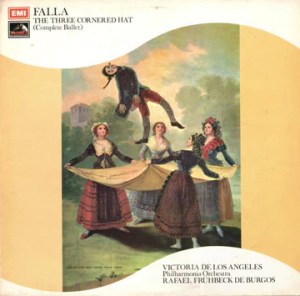
Falla / Three-Cornered Hat – We Changed Our Minds

Hot Stamper Pressings of the Music of Falla Available Now

In our review from 2010, we wrote:

Falla’s Three Cornered Hat is positively WONDERFUL on this copy (A++), and the Sinfonia Sevillana by Turina on side two is every bit as good. The second suite on side one is particularly lovely — check out how rich and full the sound is.

Side two has a HUGE soundstage, as wide as they come. The sound is very rich and full of audiophile colors — this is the kind of record that you’re going to love playing for your audio pals!  

Argenta brings the authentic Spanish flavor out in these works. Like so many audiophile reviewers have over the years, you may find these performances definitive.

The strings on the first side are a bit dry to start, like the sound many of you will recognize from Mercury’s classical records. Still, there’s much to like about the sound and you’ll have a very hard time finding a copy that’s any better. Most pressings do not have such an extended top end, and that quality here really brings this music to life.


UPDATE 2025

We played a copy of CS 6050 not long ago and were not at all pleased with the sound. You can read more about it here.

An orchestral record with dry strings? Not our idea of good sound.

But who else reviewing records these days even notices these kinds of things?

The De Burgos performance for EMI in 1964 and the Ansermet for Decca from 1961 (CS 6224) are both better recordings and our two current favorites, with the Ansermet getting the nod due to its wonderful energy and exciting performance.

There are about 150 orchestral recordings we think offer the best performances with the highest quality sound. Both are  deserving of a place on that list.

(more…)

In Search Of Amazing Mona Bones

Hot Stamper Pressings of the Music of Cat Stevens Available Now

UPDATED 2026

Below you will see the notes we made during our first shootout for Mona Bone Jakon back in 2007.

Until fairly recently the handful of UK imports we had played sounded subpar to us.

The UK pressings may have been the versions on the TAS Super Disc List, but none of the ones we’d played sounded all that super to us.

Out of the blue, in 2023 we found some imports that set a new standard for the recording quality of the album.

We thought we knew “How high is up?”, but the mports we played that year proved to us we didn’t.

Egg on our faces? Not really. It’s just us going about doing the work.Since no one else in the world of records seems to want to figure any of this stuff out, you don’t have a lot of other sources for reliable information. Seriously, wWho else are you going to turn to, other than Robert Brook?

Most of the reviewers we stumble upon act like it’s still 1982.

True, the imports don’t win by much — the best domestic pressings can still earn Nearly Triple Plus grades — but that extra half a plus the Shootout Winning imports merit is quite noticeable when you play the best pressings against the close-to-the-best copies.

(more…)

Our Previous Two Shootouts for Straight Up

Hot Stamper Pressings of the Music of Badfinger Available Now

UPDATE 2025

This title, like all the best Badfinger records, is almost always noisy, which is why you will rarely find it on our site. Most of what we buy is just not quiet enough to sell.

We were finally able to do a shootout for Straight Up again in 2025, our first in fifteen years! There is one Hot Stamper pressing active on the site at the time of this writing, but it will most likely be gone soon.


Our Thinking Circa 2010

This relatively quiet WHITE HOT STAMPER Straight Up is KILLER, with a A++ side one and an A+++ side two — you can’t do much better than that! Side two has Master Tape Sound, the kind that we like to call AGAIG — As Good As It Gets. Both sides have the kind of PRESENCE in the midrange that most copies can’t begin to compete with. The sound here just JUMPS out of the speakers, which is exactly what the best copies of the album are supposed to (but rarely) do. For fans of the band — and Power Pop in general — this is the Straight Up you have been waiting for!

Our last shootout was in 2007, not because we don’t like the record or have customers for it; rather it’s the fact that clean copies of the album just aren’t out there in the bins the way they used to be. Two or three a year is all we can find, and that’s with hitting the stores every week.

2007 vs 2010

In 2007 we wrote: “Having played more than half a dozen copies of this record during the shootout I can tell you that the most common problem with Straight Up is grainy, gritty sound. Most copies of this record are painfully aggressive and transistory.”

With improvements to cleaning and playback i would say that’s not actually true in 2010. There is some grit to the sound to be sure, but like most records from the era, veiling and smearing are what really hold most copies back

Good copies of this record, ones that are mastered properly and pressed on “good” vinyl, sound a lot like a stipped down version of Abbey Road, which is what they’re supposed to sound like. That’s clearly the sound Badfinger and their producers George Harrison and Todd Rundgren (with some help from the Beatles’ engineer Geoff Emerick* ) were aiming at.

You will also hear some influences from All Things Must Pass and McCartney’s first . The music owes a lot to both The Beatles as well as Harrison and McCartney as individuals. What’s not to like? Catchy pop songs with grungy guitars — it’s ear candy when the sound is good, and the sound is very good here!

(more…)

Charlie Mingus Asks the Question of the Day for Audiophiles – Compared to What?

Hot Stamper Pressings of the Music of Charles Mingus Available Now

We used to think the early Limelight pressing shown here was so amazing sounding that finding better sound for this recording would simply be impossible, but the original Mercury showed us just how wrong we were – the right Mercury pressing takes the recording to another level, one we never imagined it could reach. (In our experience records do that from time to time. We’ve written about some of the ones we’ve played here.)

Here is a small excerpt from our most recent commentary for the album:

The best copies recreate a live studio space the size of which you will not believe (assuming your room can do a good job of recreating their room). (Here are some of the other recordings we’ve auditioned with exceptional amounts of size and space.

The sound is tonally correct, Tubey Magical and above all natural. The timbre of each and every instrument is right and it doesn’t take a pair of golden ears to hear it — so high-resolution too.

If you love ’50s and ’60s large group jazz you cannot go wrong here. Mingus was a genius and the original music on this record is just one more album supporting the undeniability of that fact.

More evidence, if any were needed, that the three most important words in the world of audio are compared to what?

(more…)

So You Actually Think an OJC Can Beat an Original Black Label Contemporary?

Hot Stamper Pressings of Contemporary Jazz Albums Available Now
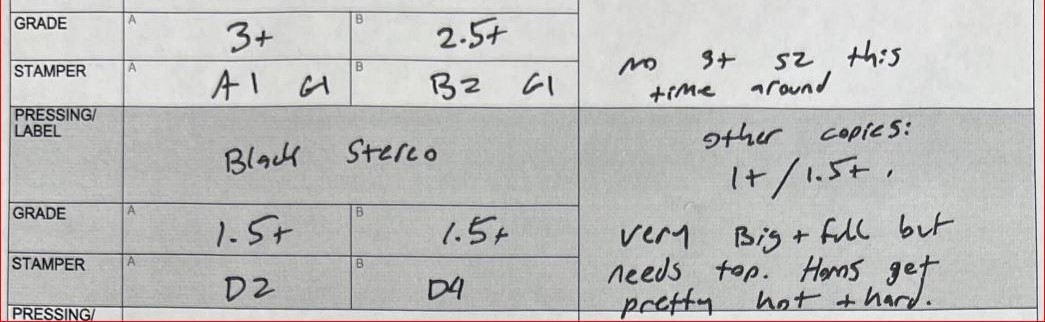
Yes, we think that, because that’s what the evidence from our most recent shootout in 2025 showed us.

As you can see from the stamper sheet below, the A1/B2 stampers of our OJC, in a blinded test, came out on top.

Better mastering equipment? Better mastering skills? Better vinyl? Better pressing methods?

Who the hell knows?

Better yet, what audiophile or record collector with a lick of sense would even pretend to know?

Not us, that’s for sure. At this point we are very comfortable not having answers for the unanswerable questions we posed above.

But don’t rush off to buy the OJC of the Sonny Rollins record you see pictured. This commentary has nothing to do with that record. (more…)

Letter of the Week – “Here is where the life and groove of the music is!”

Hot Stamper Pressings of the Music of Crosby, Stills, Nash and (Sometimes) Young

One of our good customers had this to say about some Hot Stampers he purchased recently:

What a batch of records! I just finished playback last night.

It only occurred to me afterwards that some of these titles I had only heard on compact disc or streaming, I thought I knew this music but the Hot Stampers – particularly Aja and CSNY So Far – defied me.

Here is where the life and groove of the music is! The digital formats have been calling my attention to all the wrong details.

I could go on and on. All eight titles are a knockout. Close To The Edge is a monster – the presentation is massive, and I’m sure my system isn’t doing it full justice, but I love this record and it’s by far the best I have ever heard it.

Thanks again to the Better Records team for everything you do – for this music lover it’s manna from heaven.

Cheers,

Austin

Austin,

Yes, you are so right about the digital formats. They get the sound of classic albums wrong by drawing your attention to recording details at the expense of the flow and drive and energy of the music.

As for So Far, I am a huge Crosby, Stills and Nash fan — the first album being life-changing to a 15 year old music lover such as myself, on 8-track tape in the car no less — and my ardor never flagged in all the years that have gone by since then.

It seems that there are some albums that will last you a lifetime — the first two albums, produced in 1969 and 1970, are still right at the top of my All Time Favorites.

Close to the Edge is a monster and always has been. I listen to it regularly, along with The Yes Album and Fragile. What a run of albums they released before hitting a wall with Tales of Topographic Oceans in 1973.

Aja is record I have been writing about for decades. It’s often an overblown mess, on vintage and modern pressings alike.

The copies that do well in our shootouts are the ones that are coherent, where the over-production suits the songs and does not draw too much attention to itself.

(more…)

Living and Learning Is How the Game Is Played

Hot Stamper Pressings of the Music of Elton John Available Now

A classic case of live and learn.

Scroll down to read more about what we learned from a big shootout we did many years ago for the Self-Titled album.

To illustrate how the game is played, we’ve copied some of the previous commentary into this listing to clarify how our understanding had changed from 2004 to roughly 2010, which is when all the comments you see below were written.

Live and Learn, Part One

These domestic original pressings have the very same stamper numbers as the British pressings. It appears that the metalwork was produced in England and shipped to America for pressing on domestic vinyl. What’s strange is that the American pressings are consistently brighter than the British pressings. Why this should be is a mystery, but I have a theory to explain it. The British stampers are used to make British LPs on that lovely see-through purple vinyl, and I’m guessing that that compound is a little smoother sounding than the vinyl that Uni uses. Either that or there is some other way that Uni produces their records so that they end up being brighter, even using the exact same stampers as the British ones.”

Partly true.

We have five British copies in stock, and the reason they don’t sound as good probably has less to do with British vinyl and more to do with the fact that the British ones we have are not the stampers we like the best. The domestic pressings with our favorite stampers have more highs and better highs and just plain sound better to us now.

Notice how I completely contradict myself below, yet both listings were up on the site all this time and nobody, especially me, seems to have noticed.

Live and Learn, Part Two

These original British pressings, with the lovely see-through purple vinyl, are the only good sounding versions of this album that I have ever heard. As you can imagine they are extremely difficult to come by in clean condition.

What is there to say about such a bald-faced turnabout?

Simple. We make our judgments based on the records we have on hand to play. When better pressings come along, or our equipment has improved to the point where we can appreciate other pressings, we will happily and unhesitatingly report what we hear.

The Best Version?

(more…)

One of The Most Tubey Magical Rock Recordings of All Time

Hot Stamper Pressings of Psychedelic Rock Recordings Available Now

This is some of the best High-Production-Value rock music of the 70s. The amount of effort that went into the recording of this album is comparable to that expended by the engineers and producers of bands like Supertramp, Yes, Jethro Tull, Ambrosia, Pink Floyd and too many others to list.

It seems that no effort or cost was spared in making the home listening experience as compelling as the recording technology of the day permitted. (Of course, as it turns out, recording technology only got worse as the decade wore on, and during the 80s the sound of most recordings went off the proverbial cliff.)

Big Production British Rock just doesn’t get much better than A Space in Time.

Just listen to the guitar solo on Let The Sky Fall. It comes complete with layer upon layer of guitars, acoustic and electric, with some backwards guitar thrown in for good measure. And that’s just the guitar parts. This kind of dense aural soundscape, presented with so many carefully placed elements from side to side and front to back, makes repeated listenings especially rewarding.

No matter how many times you play the album, you are likely to hear (and hopefully appreciate) something new in the mix. I’ve been playing ASIT for forty fifty years (bought my copy when I was still in high school) and I heard lots of things this time around I never knew were there. This is why we keep improving our systems, right? There is never going to be a time when these nearly forty more than fifty year old recordings have nothing new to offer.

Their Only Essential Album

By the way, this was the first Ten Years After record I bought, and I liked it so much I went out and bought many of their other albums, only to find that none of those albums are anything like this one. None of them sound particularly good; none of them are particularly well produced; and, worst of all, most of the music is fairly forgettable British Blues Rock.

(more…)