Performers

What Can You Learn from a Mercury Shootout Like This One?

Hot Stamper Pressings of Mercury Classical Recordings Available Now

The short answer is that you can’t learn much from this shootout, because we’re not telling you which title the stampers you see below belong to.

Be that as it may, in the case of this mystery title the conventional wisdom turns out to be correct — the earlier numbered pressings did better than the later numbered pressings, and the early labels did better than the later labels.

That happens a lot, and we are happy to admit that it does. Why? Because the experimental evidence — the datasay that is what happened.

As usual for posts in which the stamper sheet from a shootout is reproduced in its entirety, the stamper numbers shown below will belong to a different album than the one you see pictured.

These can be found under the heading of Mystery Stampers. Most of these posts will illustrate something to be learned from a Hot Stamper shootout, but because the information reveals the shootout winning stampers, the actual title of the record is rarely revealed.

Much more useful stamper information can be found using this link, which includes plenty of stamper numbers for specific titles that are best avoided by audiophiles looking for top quality sound. In addition, we post the winning and losing stampers for some titles that are an unreliable guide to good sound. Unreliable stampers are also quite common.

The right stampers are only one of the many reasons some copies win our shootouts and others don’t, but in the case of this rare Mercury, a record that we only had four copies of, the RFR-2/2 stampers were clearly the best, with no other set of stampers coming close. The best of the others earned grades no better than 2+/2+.

One lesson that was clear was that the best stampers were, to quote our reviewer, “a step up!”

(more…)

Grieg / Piano Concerto – Speakers Corner

Hot Stamper Pressings of the Music of Edvard Grieg Available Now

We used to think this was one of the better Speakers Corner Deccas.

We haven’t played a copy of this record in years, but back in the day we liked it, so let’s call it a “B” with the caveat that the older the review, the more likely we are to have changed our minds. Not sure if we would still agree with what we wrote back in the ’90s when this record came out, but here it is anyway.


One of the best Deccas — superb sound and music that belongs in your life!

This performance also includes Franck’s “Variations Symphoniques” and Litolff”s “Scherzo from Concerto Symphonique, Op. 102”.


Our two favorite recordings of the Grieg Piano Concerto are the Decca with Lupu and Previn from 1973 and Rubinstein’s for RCA in 1962.

This Speakers Corner title may be good, but our Hot Stamper classical and orchestral pressings will be dramatically more transparent, open, clear and just plain REAL sounding, because these are all the areas in which Heavy Vinyl pressings tend to fall short in our experience.  For more on that subject, see here and here.

(more…)

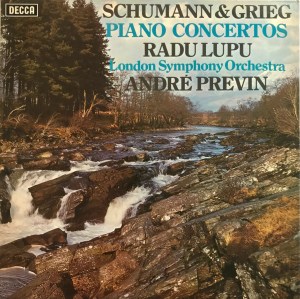
Schumann and Grieg Piano Concertos / Lupu / Previn

More of the Music of Edvard Grieg

  • A superb UK Decca pressing of this wonderful classical masterpiece with Double Plus (A++) sound from start to finish
  • Both sides boast full brass and an especially clear, solid, present piano, one with practically no trace of vintage analog tube smear
  • Dynamic, huge, lively, transparent and natural – with a record this good, your ability to suspend disbelief will require practically no effort at all
  • Back in the days when the TAS Super Disc List meant something, this record was on it and deservedly so
  • The London pressings of the same album can be very good in their own right, but they don’t win shootouts – only the best of these Decca pressings do, a subject we discuss in some of these listings
  • Our two favorite recordings of the Grieg Piano Concerto are this one and Rubinstein’s for RCA in 1962
  • There are about 150 orchestral recordings we think offer the best performances with the highest quality sound. This record is certainly deserving of a place on that list.

(more…)

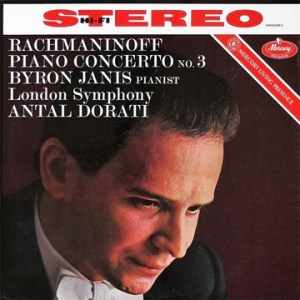
Rachmaninoff – Piano Concerto No. 3 / Janis / Dorati

More of the Music of Sergei Rachmaninoff

  • Outstanding sound for this classic Byron Janis Mercury album, with both TAS-approved sides earning solid Double Plus (A++) grades or BETTER
  • The piano is huge and weighty, the strings rich and highly resolving, and the overall presentation is powerful, balanced, dynamic and exciting like few other piano concerto recordings we have ever had the pleasure to audition
  • Not only is this the consistently best sounding copy we have had to offer in years, but we are happy to report that the vinyl is reasonably quiet for a Mercury stereo pressing of this vintage
  • If you have the system to play a record as big and powerful as this Mercury from 1961, we cannot recommend it any more highly
  • There are about 175 orchestral recordings we’ve awarded the honor of offering the best performances with the highest quality sound, and this record certainly deserve a place on that list.
  • This is one of the two Must Own Mercury piano concerto recordings, the other being SR 90300, which often suffers from inner groove distortion — not to worry, as a matter of grading policy, we check the inner grooves of every record we offer on the site

Not only is the sound amazing — yes, it’s on the TAS Super Disc list, and for good reason: a copy as good as this one really is a Super Disc — but this copy has another vitally important characteristic that most copies of the record do not: no Inner Groove Distortion.

We can’t begin to count the times we have had to return (or toss) a copy of one of these famous Byron Janis records because the piano breakup for the last inch or so of the record was just unbearable. That’s a sound no serious listener could possibly tolerate, yet I would venture to guess that a great many Mercury piano concerto recordings suffer from this kind of groove damage.

Enough about those typically bad copies, let’s talk about how good this one is.

This is an early Mercury Plum label stereo pressing of one of Byron Janis’s most famous performances (along with the Rachmaninoff 1st; it’s also a longtime member of the TAS super disc list).

The sound is rich and natural, with lovely transparency and virtually no smear to the strings, horns or piano. What an amazing recording! What an amazing piece of music.

The recording is explosively dynamic and on this copy, the sound was positively jumping out of the speakers. In addition, the brass and strings are full-bodied, with practically no stridency, an unusual feat the Mercury engineers seem to have accomplished while in Russia.

Big, rich sound can sometimes present problems for piano recordings. You want to hear the percussive qualities of the instrument, but few copies pull off that trick without sounding thin. This one showed us a piano that was both clear and full-bodied.

With huge amounts of hall space, weight and energy, this is Demo Disco quality sound by any standard. Once the needle has dropped you will quickly forget about the sound (and all the money you paid to get it) and simply find yourself in the presence of some of the greatest musicians of their generation, captured on the greatest analog recordings of all time.

(more…)

Better Front Ends Actually Reduce Surface Noise

Hot Stamper Pressings of the Music of Tchaikovsky Available Now

This record has no marks that play appreciably, but that RCA vinyl is up to its old tricks again.

Mint Minus Minus with constant light surface noise underneath the music in the quieter sections is the rule. The first half inch of side two is where you will notice it the most.

We are of the opinion that good sound and good music allow you to pretty much ignore surfaces such as these (scratches being another thing entirely of course). 

Better Front Ends

I would make the further point that the better your front end is, the less likely you are to have a problem with vinyl like this, which is the opposite of what many audiophiles perceive to be the case. In other words, some of the cheaper tables and carts seem to make the surface noise more objectionable, not less. (They also tend to collapse completely under the weight of a mighty recordings.)

On the other hand, some pricey cartridges — the Benz line comes to mind — are consistently noisier than those by Dynavector, Lyra and others, in our experience anyway.

Vintage Vinyl

As long as vintage vinyl is the only vinyl with sound worth pursuing, as is surely the case these days and will be the case for the forseeable future — we have ample evidence to support this statement for this who are interested in that lamentable reality — a quiet cartridge and a very high quality arm are essential to your being able to recognize good records and reproduce them properly.

Our Dynavector 17Dx gets down deep into the groove, where vintage used records have the least number of problems created by their previous owners.

And we run it nude for even better sound. I discovered this possibility more than a decade ago — so long ago that I cannot remember where I came by the information — but the sound was immediately so much better that all questions were answered moments after dropping the needle.

Not a lot of things are obvious, but that sure was.

(more…)

Don’t Waste Your Money on this Living Stereo from 1962

Hot Stamper Pressings of Living Stereo Recordings Available Now

The sound of the copies we’ve played of LSC 2605, Highlights from Rubinstein at Carnegie Hall, released by RCA in 1962, have never impressed us sonically.

We didn’t listen to the music critically because our primary purpose here at Better Records is to evaluate recordings for their sound quality first (hence the name of our business), and if the sound isn’t good enough, we have to move on to titles with better sound that our customers might find more to their liking.

1962 was surely one of the truly glorious years for analog recordings, but the sound of the most recent copy of the album we played may have been rich, but unfortunately is was also opaque.

We would consider the sound no better than passable, and therefore it’s not a title we would consider offering to our customers.

Unless…

Unless you somehow managed to come across a copy noticeably better than the ones we’ve played over the last twenty or more years — a possibility that, although unlikely, cannot be ruled out — we would advise those interested in a top quality piano recital recording to look elsewhere.

Leave this RCA to the people who love collecting records. It’s perfect for record collectors — it’s from the right company, made in the right era, and it has the right original label — but it’s really not suitable for those of us who love playing good sounding records. It will of course sit happily on a shelf, to be pulled out and shown to other like-minded souls, but it is unlikely to spend much time spinning on a turntable platter with a needle tracing its grooves.

Some audiophiles are of the opinion that vintage Living Stereo recordings on the original Shaded Dog label can do no wrong, but we have never subscribed to that view. We’ve played too many that did plenty wrong. Maybe one out of three are good enough for the audiophile who wants to experience music reproduced at a highest levels of sound quality.

There are quite a number of records that we’ve run into over the years with more shortcomings than this one. Here are some of them, a very small fraction of the titles we’ve played, broken down by label.

  • London/Decca records with weak sound or performances
  • Mercury records with weak sound or performances
  • RCA records with weak sound or performances

(more…)

Music of Old Russia – We Give Up (on Noisy Angel Vinyl)

Hot Stamper Pressings Featuring the Violin Available Now

White Hot Stamper sound on side one – the Tubey Magic is off the scale. Milstein is brilliant on these shorter violin works, 7 in all.

This rare, hard to find original Blue Angel stereo pressing has exquisite sound. As we noted in our listing for Milstein’s Saint-Saens Third, it is the rare Heifetz album on Shaded Dog (or any other label) that could hope to compete with it.

We would rank this Angel pressing with the best of Rabin and Milstein on Capitol, as well as the wonderful Ricci and Campoli discs on London/Decca.

The transparency of both sides lets you “see” the orchestra clearly, without sacrificing richness or weight.

What a record! What a performance from the incomparable Nathan Milstein. 


UPDATE 2024

This is an album we can no longer find enough clean, early stereo pressings with which to do a proper shootout.

Consequently it has been tagged as a never again record. It’s possible we could do it again, but unlikely.

We love both the music and sound and encourage you to find a nice copy for yourself.

For best results, stick to the Blue Label stereo pressings. There are two, but only one of them sounds good.

See how hard all this record stuff is!

(more…)

Piano Concerto Testing and Inner Groove Distortion

Hot Stamper Pressings of the Music of Rachmaninoff Available Now

The piano is huge and weighty, the strings rich and highly resolving, and the overall presentation is powerful, balanced, dynamic and exciting like few other piano concerto recordings we have ever had the pleasure to audition.

Not only is the sound amazing — yes, it’s on the TAS Super Disc list, and for good reason: a copy as good as this one really is a Super Disc — but this copy has another vitally important characteristic that most copies of the record do not: no inner groove distortion.

We can’t begin to count the times we have had to return (or toss) a copy of one of these expensive Byron Janis records because the piano breakup for the last inch or so of the record was just unbearable. That’s a sound no serious listener could possibly tolerate, yet I would venture to guess that many Mercury piano concerto recordings suffer from this kind of groove damage.

As a matter of grading policy, we check the inner grooves of every record we offer on the site,

The Sound

The sound is rich and natural, with lovely transparency and virtually no smear to the strings, horns or piano. What an amazing recording! What an amazing piece of music.

The recording is explosively dynamic — on the best copies the sound comes jumping out of the speakers. In addition, the brass and strings are full-bodied, with practically no stridency, an unusual feat the Mercury engineers seem to have accomplished while in Russia (and not as often in the states).

Big, rich sound can sometimes present problems for piano recordings. You want to hear the percussive qualities of the instrument, but few copies pull off that trick without sounding thin. This one showed us a piano that was both clear and full-bodied.

With huge amounts of hall space, orchestral weight and performance energy, this is Demo Disc quality sound by any standard. Once the needle has dropped you will quickly forget about the sound (and all the money you paid to get it!) and simply find yourself in the presence of some of the greatest musicians of their generation, captured on one of the greatest analog recordings of all time.

Fine and Cozart

The piano is huge and powerful, yet the percussive and lighter qualities on the instrument are clearly heard in proper relation to the orchestra as a whole.

I simply cannot criticize the work that Fine and Cozart have achieved with this recording, and believe me, there are very few records in this world about which I could not find something to criiticize. After all, it is our job, and we like to set very high standards for the work we do.

Lately we have been writing quite a bit about how good pianos are for testing all aspects of your system, room, tweaks, electricity and the rest, not to mention turntable setup and adjustment.

  • We like our pianos to sound natural (however one chooses to define the term).
  • We like them to be solidly weighted.
  • We like them to be free of smear, a quality that for some reason is rarely mentioned in most audiophile reviews.

Our twenty or so of our favorite piano concerto recordings with top quality sound can be found here.

To read the 50 reviews and commentaries we’ve written for some of the greatest piano concerto recordings ever pressed on vintage vinyl, please click here

(more…)

VICS-1030 Can Have Passable Sound for Chopin’s Piano Concerto No. 1

Hot Stamper Pressings of Living Stereo Recordings Available Now
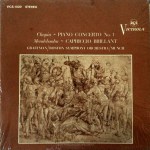
Our favorite recording for performance and sound is the Living Stereo from 1961, LSC 2575, with Rubinstein at the piano and Skrowaczewski conducting the New Symphony Orchestra of London.

This Victrola pressing, VICS-1030, with Graffman performing, had good, not great sound. We’ve played them before and none of them was ever better than middling.

Some specifics we noted in the sound:

  • The piano was loud and clear, close-miked.
  • Boxy sound, could be richer
  • Orchestration not too compressed but veiled and small.
  • Not a standout performance.

A decent-enough record I suppose, but lacking in too many of the qualities our customers are looking for, especially at the prices we charge.


This is what we had to say about the sound of our Shootout Winner for LSC 2575:

We love the huge, solid and powerful sound of the piano on this recording. This piano has weight and heft. As a result, it sounds like a real piano.

For some reason, a great many Rubinstein recordings are not capable of reproducing those seemingly all-important qualities in the sound of the piano.

Those are, as I hope everyone understands by now, the ones we don’t sell. If the piano in a piano concerto recording doesn’t sound solid and powerful, what is the point of playing such a record?

Or, to be more accurate, what is the point of an audiophile playing such a record? (Those of you who would like to avoid bad sounding vintage classical and orchestral records have come to the right place. We’ve compiled a very long list of them for precisely that purpose, and we add to it regularly, a public service from your friends here at Better Records.)

(more…)

Prokofiev – Violin Concerti Nos. 1 and 2 / Ricci / Ansermet

More of the Music of Sergei Prokofiev

  • With two outstanding Double Plus (A++) sides, this early London Stereo pressing of Ricci and Ansermet’s performance of Prokofiev’s Violin Concerti Nos. 1 and 2 will be very hard to beat
  • It’s also remarkably quiet at the high end of Mint Minus Minus, a grade that even our most well-cared-for vintage classical titles have trouble playing at
  • Ricci is a fiery player – this pressing will allow you to appreciate his playing in a coherent, natural and realistic way
  • The sound of the orchestra is dramatically richer and sweeter than you will hear on nearly all other pressings – what else would you expect from Decca‘s engineers and the Suisse Romande?

(more…)