Albums in Focus

Reproducing the Phenomenal Size and Space of Time Out

More Columbia 30th Street Studio Recordings

Time Out is a jazz album that’s been a personal favorite of mine for a very long time, as well as a record I’ve been obsessed with for decades. I spent a lot of time working on my system in order to get this album to sound its best.

It taught me a lot, and for that reason it is a recording that deserves a fair amount of credit for helping me become a better listener.

Here is how we described a copy that won one of our shootouts a while back:

Spacious and transparent, this copy has the big three-dimensional soundstage that makes this record such a joy to listen to. The piano has weight and heft, the drums are big and dynamic, and everything is relaxed and sweet — in short, this copy is doing pretty much everything we want a top quality Time Out to do. 

Listen to the drums on Everybody’s Jumpin’. This album was recorded on a big sound stage and there is a HUGE room which can clearly be heard surrounding the drum kit. Add to that that some of the drums are in the left channel and some of the drums are in the right channel and you have one big drum kit — exactly the way it was intended to sound.

Size and Space

One of the qualities that we don’t talk about on the site nearly enough is the SIZE of the record’s presentation. Some copies of the album just sound small — they don’t extend all the way to the outside edges of the speakers, and they don’t seem to take up all the space from the floor to the ceiling. In addition, the sound can often be recessed, with a lack of presence and immediacy in the center.

Other copies — my notes for these copies often read “BIG and BOLD” — create a huge soundfield, with the music positively jumping out of the speakers. They’re not brighter, they’re not more aggressive, they’re not hyped-up in any way, they’re just bigger and clearer.

And most of the time those very special pressings just plain rock harder. When you hear a copy that does all that, it’s an entirely different listening experience.

More letters, reviews and commentaries for recordings made at Columbia’s 30th Street studio.

(more…)

You Simply Cannot Record a Piano Better than Roy DuNann

The piano sounds uncannily lifelike right from the start, a beautiful instrument in a natural space, tonally correct from top to bottom. I can’t think of any record off the top of my head that gets a better piano sound than this one.

Listen to the tambourine on the third track on side one. Shelly Manne messes about with lots of percussion instruments on this album and all of them are recorded to perfection.

Not to leave Red Mitchell out, check out the bass; it’s deep and note-like throughout the album.

Better Than a Dream, the second track on side two, has one of the best sounding jazz pianos I have ever heard. My notes say “you cannot record a piano any better” and I stand behind that statement one hundred percent.

There is not a modern reissue on the face of the earth that can hold a candle to the sound of this record.

For any of you out there who doubt my words please take this record home and play it against the best piano jazz recordings you own. If it doesn’t beat them all we are happy to pay the domestic shipping back.

Even our amazing sounding 45 RPM pressing of The Three does not present the listener with a piano that sounds as real as the one on this record.


(more…)

Advances in Playback Technology Are More Than Blind Faith

More of the Music of Eric Clapton

In a 2007 commentary for a Hot Stamper pressing of Blind Faith we noted that:

When it finally all comes together for such a famously compromised recording, it’s nothing less than a THRILL. More than anything else, the sound is RIGHT. Like Layla or Surrealistic Pillow, this is no Demo Disc by any stretch of the imagination, but that should hardly keep us from enjoying the music. And now we have the record that lets us do it.

The Playback Technology Umbrella

Why did it take so long? Why does it sound good now, after decades of problems? For the same reason that so many great records are only now revealing their true potential: advances in playback technology.

Audio has finally reached the point where the magic in Blind Faith’s grooves is ready to be set free.

What exactly are we referring to? Why, all the stuff we talk about endlessly around here. These are the things that really do make a difference. They change the fundamentals. They break down the barriers.

You know the drill. Things like better cleaning techniques, top quality front end equipment, Aurios, better electricity, Hallographs and other room treatments, amazing phono stages like the EAR 324p, power cables; the list goes on and on.

If you want records like Blind Faith to sound good, we don’t think it can be done without bringing to bear all of these advanced technologies to the problem at hand, the problem at hand being a recording with its full share of problems and then some.

Without these improvements, why wouldn’t Blind Faith sound as dull and distorted as it always has? The best pressings were made more than thirty years ago [thirty? make that fifty] — they’re no different.

(more…)

Rockin’ the Mandolin with Loggins and Messina

Hot Stamper Pressings of the Music of Loggins and Messina Available Now

A recent White Hot Stamper pressing of L&M’s fourth release demonstrated pretty convincingly just what an amazing Demo Disc this album can be.

When Jim Messina rips into his mandolin solo halfway through Be Free, your jaw is likely to hit the ground. On the best copies it positively leaps out of the left speaker.

I can’t recall another pop or rock recording that captures either the plucked energy or the harmonic nuances of the instrument better. To hear such a well-recorded mandolin on a copy of this quality is nothing less than a thrill.

This copy showed us:

  • A full-bodied piano
  • Rich, lively vocals, present between the speakers and brimming with enthusiasm
  • Harmonically-rich guitars, mandolins, dobros and the like, as well as a
  • Three-dimensional soundstage that revealed the space around them all

What to Listen For

What typically separates the killer copies from the merely good ones are three qualities that we often look for in the records we play: transparency, speed, and lack of smear.

Transparency allows you to hear into the recording, reproducing the ambience and subtle musical cues and details that high-resolution analog is known for.

Note that most Heavy Vinyl pressings being produced these days seem to be transparency challenged. Lots of important musical information — the kind we hear on even second-rate regular pressings — is simply nowhere to be found.

Lack of smear is also important, especially on a recording with so many plucked instruments. The speed and clarity of the transients, the sense that fingers are pulling on strings, strings that are ringing with tonally correct harmonics, is what makes these L&M records so much fun to play.

The best copies really get that sound right, in the same way that the best copies of Cat Stevens’ records get the sound of stringed instruments right.

No two pieces of electronics will get this record to sound the same, and some will fail miserably. If vintage tube gear is your idea of good sound, this record may help you to better understand where its shortcomings lie.

(more…)

Listening to Aja (with Free Cisco Debunking Tool)

Hot Stamper Pressings of the Music of Steely Dan Available Now

This commentary references a shootout we did in 2007 or thereabouts, shortly after the release of Cisco’s misbegotten remaster.

Another in our series of Home Audio Exercises with specific advice on What to Listen For (WTLF) as you critically evaluate your copy of Aja.

Our track commentary for the song Home at Last makes it easy to spot an obvious problem with Cisco’s remastered Aja: This is the toughest song to get right on side two.

Nine out of ten copies have grainy, irritating vocals; the deep bass is often missing too. Home at Last can sometimes be just plain unpleasant, which is why it’s such a great test track.

Get this one right and it’s pretty much smooth sailing from there on out.

If you own the Cisco pressing, focus on Victor Feldman’s piano at the beginning of the song. It lacks body, weight and ambience on the new pressing, but any of our better Hot Stamper copies will show you a piano with those qualities in spades on every track. It’s some of my favorite work by the Steely Dan vibesman.

The thin piano on the Cisco release must be recognized for what it is: a major error on the part of the mastering engineers.

Bonus Listening Test for Side Two

The truly amazing side twos — and they are pretty darn rare — have an extended top end and breathy vocals on the first track, Peg, a track that is dull on nine out of ten copies. (The ridiculously bright MoFi actually kind of works on Peg because of the fact that the mix is somewhat lacking in top end. This is faint praise though: MoFi managed to fix that problem and ruin practically everything else on the album.)

If you play Peg against the tracks that follow it on side two, most of the time the highs come back. On the best of the best the highs are there all the way through.

Listening Tests for Side One

Generally what you try to get on side one is a copy with ambience. Most copies are flat, lifeless and dry as a bone. You also want a copy with good punchy bass — many are lean, and the first two tracks simply don’t work at all without good bass. And then you want a copy that has a natural top end, where the cymbals ring sweetly and Wayne Shorter’s saxophone isn’t hard or honky or dull, which it often is on the bad domestic copies.

Also listen for GRAIN and HONK in the vocals on Black Cow. The better your copy is, the less grainy and honky the vocals will be.

(more…)

801 Live – None Rocks Harder

Hot Stamper Pressings of the Music of Brian Eno Available Now

I listened to this album from start to finish just yesterday (5/31/2024), so I thought it only fitting that I share my enthusiasm for this absolutely amazing record with those who read this blog.

The best Island copies of this album rock harder than practically any record we’ve ever played. If you have the system for it, this amazing Rhett Davies recording will bring a live art rock concert right into your living room.

This is a big speaker record. It requires a pair of speakers that can move air with authority below 250 cycles and play at fairly loud levels. If you don’t own speakers that can do that, this record will never really sound the way it should.

It’s right at the top of the list of my favorite rock albums — a desert island disc if ever there was one. I stumbled across it more forty years ago and I’ve loved it ever since. It all started when a college buddy played me the wildly original Tomorrow Never Knows from the album and asked me to name the tune before the vocals kicked in. Eno’s take is so different from The Beatles version that I confess it took me an embarrassingly long while to catch on.

Demo Disc Quality Sound

This is a true Demo Disc in the areas of sound reproduction listed below. Other records with these important qualities can be seen by clicking on any of these links.

Adventures in Music and Sound

Phil Manzanera and Brian Eno were founding members of Roxy Music. AMG calls Roxy Music the “most adventurous rock band of the early ’70s” and I’m inclined to agree with them.

Those who played in Roxy Music are certainly some of the most influential and important artists in my growth as a music lover and audiophile, joining the ranks of 10cc, Steely Dan, Yes, James Taylor, Peter Gabriel, David Bowie, America, Fleetwood Mac, Supertramp, Eno, Talking Heads, The Doors, Jethro Tull, Elton John, The Beatles, Santana, Crosby, Stills and Nash, Little Feat, Traffic, Nilsson, Elvis Costello, Sergio Mendes, Neil Young, The Eagles, Frank Zappa, Pink Floyd, Joni Mitchell, The Cars, Peter Frampton, Led Zeppelin, Cat Stevens and countless others.

These musicians and bands were clearly dedicated to making high quality recordings, recordings that could only come to life in the homes of those with the most advanced audio equipment.

My system was forced to evolve in order to reproduce the scores of challenging recordings issued by these groups in the 60s and 70s.

The love you have for your favorite music has to be the strongest driving force if you actually want to be successful in this hobby.

Some of the records that did the most to help me advance in audio can be found here.


Want to find your own top quality copy?

Consider taking our moderately helpful advice concerning the pressings that tend to win our shootouts.

(more…)

Crosby, Stills and Nash’s Debut – An Overview

Hot Stamper Pressings of the Music of Crosby, Stills and Nash Available Now

Below you will find some of the more popular commentaries we’ve written about Crosby, Stills and Nash’s debut. It’s an album I have been obsessed with since the age of 15, which I enjoyed mostly on 8-track tape back then.

For those of you too young to know about these things, that speaks volumes about the quality of turntable at the time, which was mounted to an all-in-one auto-changing record player, attached to an AM/FM receiver complete with 8-track tape playback. The thing probably retailed for less than a hundred bucks and sounded like it.

This is also one of the records that we’ve often used to test with in order to improve the quality of our playback over the years, along with scores of others you can read about here on the blog.

Don’t expect to find any Hot Stamper pressings on the site though. They are very hard to find, due to the fact that the right reissues are the only ones that sound good to us and they apparently just did not make very many of them.

Listening in Depth to Crosby Stills and Nash

Although millions of copies of this album were sold, so few were mastered and pressed well, and so many mastered and pressed poorly, that few copies actually make it to the site as Hot Stampers.

We wish that were not the case — we love the album — but the copies we know to have the potential for Hot Stamper sound are just not sitting around in the record bins these days.

Whatever you do, don’t waste your money on the Joe Gastwirt-mastered CD. It couldn’t be any more awful. (His Deja Vu is just as bad.)

(more…)

Swing Sessions – Recorded in a Real Concert Hall (Thank Goodness)

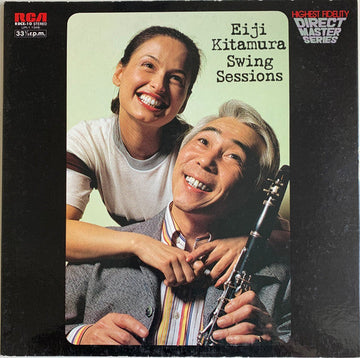
If you’re a fan of clarinet-led swing jazz, you’ll have a hard time finding a better record than this. The music is absolutely wonderful. Not only that, but it has DEMO DISC sound as well.

The Liner Notes

Direct-to-Disc Recording recorded live at Iruma City Auditorium, Saitama, Japan on April 21, 1978. Eiji Kitamura and His Allstars include Eiji on clarinet, Ichiro Masuda on vibraphone, Yoshitaka Akimitsu on piano, Yukio Ikezawa on bass, Hiroshi Sunaga on drums and Judy Anton provides vocals on “What a Little Moonlight Can Do.”

This album was recorded by the Direct-to-Disc recording method, to capture the natural reverberation of the 1,200 seat concert hall. Various kinds of recording equipment were brought in parts to the backstage of the hall for the recording then reassembled and adjusted. Two whole days were spent adjusting all the equipment. (more…)

Exile on Main Street – A Good Test for Grit and Grain

More reviews and commentaries for the music of The Rolling Stones

The best copies will tend to have the qualities we discuss below, and the more abundant these qualities are on any given pressing, the higher its grade will be.

Yes, it is a science, an empirical one, which can only be carried out by the use of strict protocols and controls, but it sure ain’t rocket science.

All you need is the system, the room, the records, the time and the will to do the painstaking critical listening required to carry out the task.

It can be done, but you could spend a lifetime meeting audiophiles of the vinyl persuasion and never run into a single one who has made the effort more than a handful of times.

To be honest, shootouts are a bitch. If you aren’t getting paid to do them the way we are, finding the motivation to devote the time and energy required to do them right — not to mention the piles of copies of each record you will need — is daunting to say the least.

So, back to the question: what to listen for? (more…)

Relax, Stare into the Middle Distance and Listen to the Players as a Group

Hot Stamper Direct-to-Discs Available Now

Reviews and Commentaries for More Direct to Disc Recordings

Many years ago we had discussed the polarity issues associated with this record:

According to the liner notes, this album has its polarity reversed. They tell you straight out to reverse the positive and negative at the speaker terminals for the best “transient response and spatial clarity.”

That out of phase quality is as plain as the nose on your face when you know what to listen for. There’s an unpleasant hardness and hollowness to the midrange, a lack of depth, and an off-putting opaque quality to the sound. The top gets dull and the bass gets weird and wonky.

With our EAR 324p phono stage, the click of a button reverses the polarity. I can’t tell you how handy it is to have such a tool at your disposal. Checking the polarity for Discovered Again couldn’t have been easier.

But get this: most side ones are NOT out of polarity. How about them apples! We could not have been more shocked. Here is the most famous reversed polarity audiophile recording in the history of the world — or maybe just the history of our world — and it turns out most copies are not reversed on side one at all.

Findings from a Few Years Back

I did not do the shootout for the album, but I wanted to check on the polarity just to hear it for myself. I must admit I had to go back and forth a number of times, using my favorite song on the album and an old Demo track from back in my earliest days in audio, the mid- to late-70s: Keep Your Eye On The Sparrow.

Harvey Mason’s super-punchy drum playing catches your attention right off the back. A tambourine comes along in the left channel at some point. Lots of bass. Rit’s guitar in the right channel and Grusin’s keyboards in the center fill out the soundstage. The ensemble is on fire.

Evaluating the sonic differences of the individual instruments in and out of polarity had me confused. A typical conundrum: Should the tambourine be smoother with more body, or brighter with more harmonic overtones? Which is right? Who can say definitively?

Experiments Provide Answers

It was only after about fifteen minutes of switching the polarity back and forth that the penny dropped.

Focussed on an individual instrument, I could hear it just fine both ways. But then I noticed that with the polarity reversed the group got vague.

The images seemed blurrier, less defined. If I relaxed and just stared into the middle distance and let the music flow, the band seemed to be more jumbled up and messy.

That was the key. The obvious change when the polarity was wrong was a loss of image specificity. Flipping the record over to side two and using my new “lens” to hear the difference with the polarity changed, it was obvious when the polarity was right or wrong.

I have experimented with polarity on scores of records.

Certain effects on certain records are unmistakable. But these effects seem to vary a great deal from title to title.

Grusin’s brilliant direct to disc recording initially had me at a loss. With a little experimentation, the improvement in the sound with the correct polarity became evident over time, as it always seems to do. Thank god I didn’t have to change speaker leads the way I used to in the old days. (more…)