6-2024

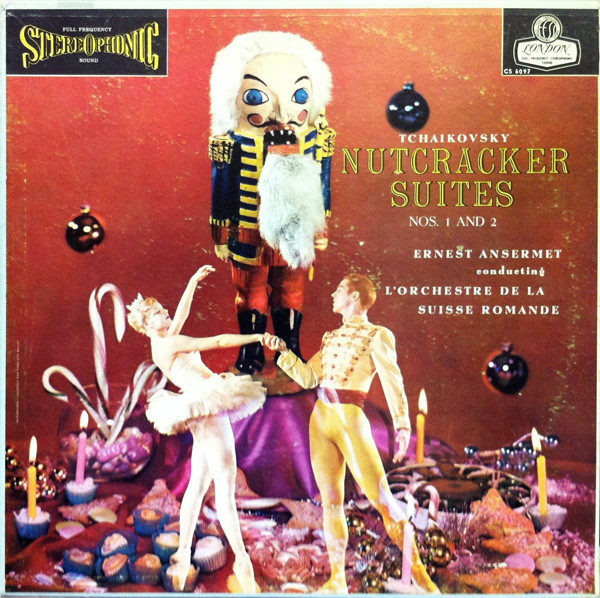
Does Anybody Ever Talk About the Dry String Tone on London LPs?

Hot Stamper Pressings of the Music of Tchaikovsky Available Now

Not that we know of.

If audiophiles and the reviewers who write for them are listening carefully to these famous recordings on the supposedly high quality (and often very high-dollar) equipment they use, why do they never talk about this problem?

Here is what we noticed when we played a big batch of Nutcracker recordings on London and Decca:

On some copies of this album the strings are dry, lacking in that wonderful quality we like to call Tubey Magic. Dry is decidedly not our sound, although it can often be heard on the hundreds of London pressings we’ve played over the years.

And we imagined that this might be the culprit:

If you have a rich sounding cartridge, perhaps with that little dip in the upper midrange, the one that so many moving coils have these days, you may not notice this tonality issue nearly as often as we do.

Our Dynavector 17Dx Karat is ruler flat and quite tonally unforgiving in this regard. It makes our shootouts much easier, but brings out the flaws in all but the best pressings, exactly the job we require it to do.

We discussed the issue in a commentary entitled Hi-fi beats my-fi if you are at all serious about audio.

(more…)

Listening to Aja (with Free Cisco Debunking Tool)

Hot Stamper Pressings of the Music of Steely Dan Available Now

This commentary references a shootout we did in 2007 or thereabouts, shortly after the release of Cisco’s misbegotten remaster.

Another in our series of Home Audio Exercises with specific advice on What to Listen For (WTLF) as you critically evaluate your copy of Aja.

Our track commentary for the song Home at Last makes it easy to spot an obvious problem with Cisco’s remastered Aja: This is the toughest song to get right on side two.

Nine out of ten copies have grainy, irritating vocals; the deep bass is often missing too. Home at Last can sometimes be just plain unpleasant, which is why it’s such a great test track.

Get this one right and it’s pretty much smooth sailing from there on out.

If you own the Cisco pressing, focus on Victor Feldman’s piano at the beginning of the song. It lacks body, weight and ambience on the new pressing, but any of our better Hot Stamper copies will show you a piano with those qualities in spades on every track. It’s some of my favorite work by the Steely Dan vibesman.

The thin piano on the Cisco release must be recognized for what it is: a major error on the part of the mastering engineers.

Bonus Listening Test for Side Two

The truly amazing side twos — and they are pretty darn rare — have an extended top end and breathy vocals on the first track, Peg, a track that is dull on nine out of ten copies. (The ridiculously bright MoFi actually kind of works on Peg because of the fact that the mix is somewhat lacking in top end. This is faint praise though: MoFi managed to fix that problem and ruin practically everything else on the album.)

If you play Peg against the tracks that follow it on side two, most of the time the highs come back. On the best of the best the highs are there all the way through.

Listening Tests for Side One

Generally what you try to get on side one is a copy with ambience. Most copies are flat, lifeless and dry as a bone. You also want a copy with good punchy bass — many are lean, and the first two tracks simply don’t work at all without good bass. And then you want a copy that has a natural top end, where the cymbals ring sweetly and Wayne Shorter’s saxophone isn’t hard or honky or dull, which it often is on the bad domestic copies.

Also listen for GRAIN and HONK in the vocals on Black Cow. The better your copy is, the less grainy and honky the vocals will be.

(more…)

Why Is It So Hard for Mobile Fidelity to Get the Midrange Right?

Hot Stamper Pressings of the Music of Joni Mitchell Available Now

We recently auditioned the Mobile Fidelity One-Step pressing of Blue and made the notes regarding the sound you see below.

We focussed on the quality of their pressing’s vocal reproduction, for the simple reason that a Joni Mitchell album that gets the vocals wrong is a Joni Mitchell album that no music lover and certainly no audiophile  would ever want to play.

The fact that some audiophiles do want to play this record speaks poorly of their ability to reproduce it properly. Accurate playback will reveal the problems with Joni’s voice described in detail below. The post-it for side one is on the left, for side two on the right.

We try to be very specific about the shortcomings of these records, which is why we reproduce our notes whenever they are available.

Side One

  • Tonally not far off, a bit too stringy and flat. Not awful. Congested vocals at peaks, harsh. 1+

Side Two

  • Vocal peaks like “traveling, traveling, traveling…” or “California” get squashed and harsh, lacking the real dynamics, presence and space of the vocals. No grade. (Awful in other words.)

(more…)