test-orchestral

Some of our favorite orchestral test discs.

The Bloated Cello Sound Some Audiophiles Find Appealing

Hot Stamper Pressings of the Music of Claude Debussy Available Now

On this pressing we were a bit surprised at how natural the cello sounded — more like the real instrument and less like the typical recording of it. 

Normally when recording the cello, the microphones are placed fairly close to the instrument. This often results in what’s known as the “proximity effect,” which simply describes a boost in the lower frequencies relative to the more linear response of the microphone when placed at a distance.

The famous Starker cello recordings on Mercury — you know the ones, the originals and even the reissues sell for hundreds and hundreds of dollars — suffer from this effect, which audiophiles seem to prefer. (The Mercury heavy vinyl reissues, at least the ones I’ve played, were ridiculously fat and bloated in the bottom.)

Audiophiles did not seem to mind much, judging by the apparently strong sales and the rave reviews I read. Bass shy systems, and that means most of the systems owned by audiophiles, probably benefited from the bass boost.

Systems with lots of large woofers — at least in our case — would of course make the sound of these pressings positively unbearable. That indeed was our experience.

Getting back to the record at hand, it presents a more natural cello if only because the instrument has been miked from a greater distance.

Side two is a bit fuller sounding than side one, and one of them is going to sound more correct on your system than the other. I would not even want to say for sure which one actually is more correct, as the slight difference between them might be subtle enough to play into room and system non-linearities that plague all stereos and rooms.

Both sides here will sound the way these real instruments sound when played in the kinds of rooms that one might hear them in, practice rooms perhaps. That makes this recording unusual in the world of “audiophile recordings,” if I can call this one, and no less refreshing and enjoyable for it.

(more…)

Carmen – Dry Strings on One Side, Rich on the Other

More of the music of Georges Bizet (1838-1875)

My notes for side two on a copy we recently auditioned read:

Could use more tubes.

Strings could be a bit smoother.

Needs a bit more weight down low.

My notes for side one:

Side one had all of this and more!

Some Common Issues with Londons and Deccas

Many London and Decca pressings lack weight down low, which thins out the overall sound and washes out the lower strings.

On some sides of some copies the strings are dry, lacking Tubey Magic. This is decidedly not our sound, although it can easily be heard on many London pressings, the kind we’ve played by the hundreds over the years.

If you have a rich sounding cartridge, perhaps with that little dip in the upper midrange that so many moving coils have these days, you will not notice this tonality issue nearly as much as we do.

Our 17Dx is ruler flat and quite unforgiving in this regard. It makes our shootouts much easier, but brings out the flaws in all but the best pressings, exactly the job we require it to do.

Here are some other records that are good for testing string tone and texture.

(more…)

A Simple Test for Polarity – Listen to the Solo Violin

More of the music of Frederic Chopin (1810-1849)

More of the Music of Jacques Offenbach (1819-1880)

This is one of the pressings we’ve discovered with Reversed Polarity.

Both sides are reversed.

On side two, the Chopin side, notice how vague the solo violin is with the polarity wrong.

As soon as it is switched, a solid, real, natural, palpable violin pops into view.

That’s how you know when your polarity is correct, folks!

This Heavy Vinyl pressing is also quite vague, but you can reverse your polarity until the cows come home, it ain’t gettin’ any better.

Here are some other Records that Are Good for Testing Vague Imaging


The top end of this record is clear, clean and correct. No other copy sounded like this one on the first side. When you hear all the percussion instruments — the tambourines, triangles, wood blocks and what-have-you — you know instantly that they sound RIGHT.

The overall sound is very different from many of the other recordings of the work that we have offered in the past. Rather than smooth, rich and sweet, the sound here is big and bold and clear like nothing we have ever played.

This is Front Row Center sound for those whose systems can reproduce it.

And this is truly a top performance by Fistoulari and the Royal Philharmonic. I know of none better. For music and sound this is the one!

What Do You Mean by “Boxy” Sound?

More of the Music of Tchaikovsky

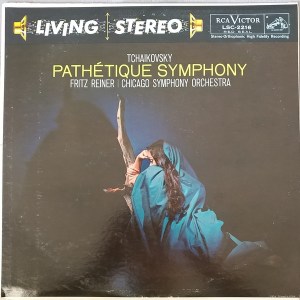
Many Golden Age classical records simply do not have very good sound, and this is one of them.

We’ve never heard a good sounding copy of LSC 2216, and we’ve played quite a number of them over the decades that we’ve been in the business of selling them. (LSC 1901, with Monteux conducting, is no better.)

A copy came in a while back so I figured it was time to give it a spin and see if there was any reason to change my opinion. Hey, maybe this one had Hot Stampers!

Can’t say it wouldn’t be possible. Unlikely, yes, impossible, no.

So here’s what I heard. No real top above 6k, hardly any bottom, but with a very wide stage – the textbook definition of “boxy sound.” (Dry and thin too, on a vintage RCA pressing no less!)

If you are a fan of Living Stereo pressings, have you noticed that many of them – this one for example – don’t sound good?

If you’re an audiophile with good equipment, you should have. But did you? Or did you buy into the hype surrounding these rare LSC pressings and just ignore the problems with the sound?

(more…)

The Brahms Violin Concerto – Unplug or Suffer the Consequences!

Hot Stamper Pressings Featuring the Violin Available Now

The massed strings here, such as those found at the opening, are close-miked and immediate as befits the Mercury recording style.

Your electricity had better be good when you play this record, because it presents a test many of you will have trouble passing at even moderate levels. 

We’ve often encouraged our readers and customers to go about unplugging things in their homes in order to test the effect of clean electricity on their playback systems.

The opening of this record is a perfect example of the kind of material everyone should be testing with in order to hear these changes.

I’d be very surprised if the strings on this record don’t sound noticeably better after you’ve unplugged a few things in your house, and the more the better.

The effect should not be the least bit subtle. It’s certainly not subtle in our listening room.

The same would be true for any of the tweaks we recommend. The Townshend Seismic Platform or Hallographs would be a godsend for proper playback of this record. Hard to imagine what it would sound like without them. (To tell you the truth, we don’t really want to know.)

(more…)

Bach / Organ Music Volume 2 – Size and Space Are Key

Hot Stamper Pressings of the Music of J.S. Bach Available Now

Some audiophiles buy organ records to show off their subwoofers. Exceptional pressings of exceptional recordings such as this one will allow you to do that, but the best of them have musical qualities far beyond simple demonstrations of bass fundamentals. Carl Weinrich understands this music perfectly and makes it come alive in a way I’ve rarely heard by other performers.

For those of you who think technology marches on — which of course it does in some ways — this 1963 recording shows that the RCA engineers were capable of capturing the authentic sound of the instrument with the vintage tube equipment available to them. In my opinion they could do it better back in those days.

Musically speaking there aren’t many organists in Carl Weinrich’s class. The only other Bach organ records of this caliber that we know of are the two volumes that Karl Richter recorded for Decca in the mid-’50s. You can’t go wrong with any of them. At least one belongs in any serious audiophile’s collection.

Size and Space

One of the qualities that we don’t talk about on the site nearly enough is the SIZE of the record’s presentation. Some copies of the album just sound small — they don’t extend all the way to the outside edges of the speakers, and they don’t seem to take up all the space from the floor to the ceiling. In addition, the sound can often be recessed, with a lack of presence and immediacy in the center.

Other copies — my notes for these copies often read “BIG and BOLD” — create a huge soundfield. They’re not brighter, they’re not more aggressive, they’re not hyped-up in any way, they’re just bigger and clearer.

We often have to go back and downgrade the copies that we were initially impressed with in light of such a standout pressing. Who knew the recording could be that huge, spacious and three dimensional? We sure didn’t, not until we played the copy that had those qualities, and that copy might have been number 8 or 9 in the rotation.

Think about it: if you had only seven copies, you might not have stumbled upon the copy that sounded so exceptionally open and clear. And how many of even the most dedicated audiophiles would have more than one of two clean vintage pressings with which to do a shootout? These kinds of records are expensive and hard to come by in good shape. Believe us, we know whereof we speak when it comes to getting hold of vintage Living Stereo albums.

When you hear a copy do what this copy can, it’s an entirely different – and dare I say unforgettable — listening experience.

(more…)

Vivid and Accurate Timbre for Reeds and Percussion – A Demo Disc Like No Other

Hot Stamper Pressings of Percussion Recordings Available Now

This is one of the most phenomenal sounding records I have ever heard in my life.

Take the best sound you’ve ever heard from the best authentic Mercury classical record you own (not that Heavy Vinyl BS) and translate it into pop arrangements for clarinets, flutes, saxes, oboes, bassoons, percussion and who-knows-what-else and what do you have?

Sound that leaps out of the speakers with absolutely dead on tonality.

But what is most shocking of all is how vivid and accurate the timbre of every instrument is.

Yes, it’s multi-miked, and sometimes the engineers play with the channels a bit much (especially at the start of the first track).

That said, if you have the system for it, it’s very possible you have never heard most of these instruments sound this real on any other recording. It’s as if you were standing right in the studio with them. Yes, it’s that crazy good.

For our last shootout, it took two copies to provide you with top sound on both sides. Clean stereo pressings are very hard to find. Most copies are mono, and most copies are beat, and that combination makes for some slim pickings indeed. This side two is not especially quiet but it’s the best we can find, and we hope that when you hear the glorious sound the surfaces will be easy to ignore. If not, send it back.

(more…)

A True Audiophile Pressing at 45 RPM to Shame Them All

More of the music of Sergei Prokofiev (1891-1953)

Reviews and Commentaries for the Music of Sergei Prokofiev

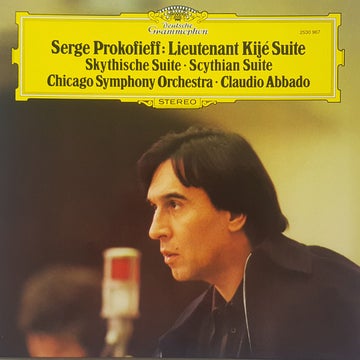
This Japanese 45 RPM remastering of our favorite recording of Prokofiev’s wonderful Lt. Kije Suite has DEMONSTRATION QUALITY SOUND. For starters, there are very few records with dynamics comparable to these. Since this is my favorite performance of all time, I can’t recommend the record any more highly. 

Most of what’s “bad” about a DG recording from 1978 is ameliorated with this pressing. The bass drum (drums?) here must be heard to be believed. We know of no Golden Age recording with as believable a presentation of the instrument as this.

The drum is clearly and precisely located at the back of the stage; even better, it’s as huge and powerful and room-filling as it would have been had you attended the session yourself. That’s our idea of hi-fidelity here at Better Records.

Real Dynamics

Over the course of this and many other shootouts, we’ve discovered that it’s practically impossible to find the right volume setting for this album. It’s so dynamic that no matter what volume you set it at the loud portions get too loud. There is a huge amount of deep bass on this recording and that, coupled with the practically unparalleled dynamics, means that you must have a great deal of amplifier power to reproduce this one properly. Either that or a very efficient speaker such as a horn. I confess I would need a great deal more power than I have at my disposal to get the climaxes of this recording to play cleanly.

The Best DG Recording

(more…)