edgy-sound

Letter of the Week – “To think I spent all those years playing a record that was bright and edgy, none the wiser to matrix numbers and pressing variations.”

Hot Stamper Pressings of the Music of Michael Jackson Available Now

Our good customer who goes by the handle ab_ba on the web wrote to us about his experience with the White Hot Stamper pressing of Michael Jackson’s Thriller he recently acquired.

Part one of his letter can be found here.

Here he tells us about the shootout he conducted, which included a “pricey Japanese pressing” and a pressing that the forums recommended as the “holy grail.”

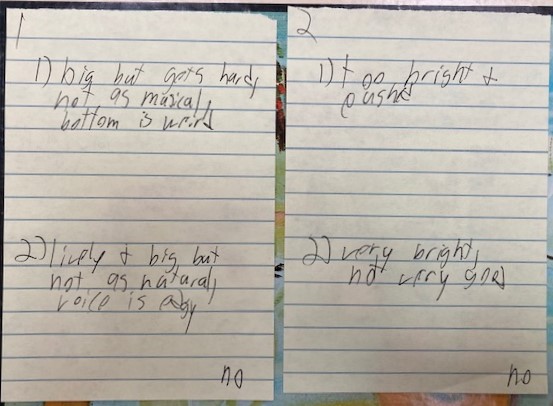
A few weeks later, on the eve of the closing of the return window, I shot it out against the best of my other copies. They range from the copy I grew up with, one of the few records from childhood that I held onto, to a pricey Japanese pressing in great shape (purchased long ago, when I thought Japanese pressing were where it’s at), to some copies I’ve picked up over the years because they looked to be in good shape and they were just five bucks, and a pressing that the forums told me was the “holy grail.”

None stacked up to the white hot stamper. In fact, they really weren’t even close. Here’s what I found:

The copy I grew up with is bright and edgy. To think, I spent all those years playing and re-playing a record that was bright and edgy, none the wiser to matrix numbers and pressing variations.

Some other lucky kid back then was surely listening to the copy I now own. I wonder if he ever said to himself, “wow, there’s something about this record. It sounds really special.”

The pressing with a sought-after matrix code had phenomenal bass, but the vocals were recessed. I’d so easy to be impressed with those huge drums on Billie Jean, but that alone is not enough to tell you it’s a great pressing. A lot of pressings seem to get that right.

My Japanese pressing was clear and full. But too smooth. The guitars don’t bite. Also, it fatigued me by about halfway through the side. This is energetic music. It might exhaust you, but it doesn’t have to fatigue you. This is an example of where if you don’t have a white hot stamper to compare it to, you’ll just assume your version sounds as good as it can get.

Dear ab_ba,

Most Japanese pressings cater to the sound a mid-fi system would need to sound good and a hi-fi system would find disastrous. They are almost always made from dubbed tapes, which are then brightened up in the mastering phase since that is the sound that appeals to the Japanese market for some reason unknown to me. (Old school audio equipment — horn speakers and vintage tube electronics — would be my guess.)

(more…)

The ’83 & ’89 Reissues of Music From Big Pink Are Just Awful

Hot Stamper Pressings of the Music of The Band Available Now

Both the pressings of Music from Big Pink mastered by Capitol with the help of the Specialty Record Corporation (SRC) are just awful sounding. They released one in 1983 and another 1989. The notes you see below are for the 1989 pressing.

The overall sound was bright and forced, with edgy vocals. Who wants a Band record that sounds like that? The MoFi CD (from 1989) is better than the MoFi record, but that’s not saying much. I wouldn’t have either one in my collection.

Earlier this year we raved about our amazing sounding Shootout Winner:

  • Here are just a few of the things we had to say about an incredible copy in our notes: “huge and breathy and weighty”…”very rich vox and toms”…”huge and rich and jumping out of the speakers”…”big and rich and spacious”
  • Forget all those vague, veiled, lifeless, ambience-free Heavy Vinyl pressings – this is the Big Pink that The Band recorded!
  • Remember when you used to play the same record over and over, never taking it off the turntable for days at a time?
  • Well here it is – this pressing captures the music in a way that will make repeated plays the joy they are meant to be

(more…)

Capriccio Italien on Classic Records and How Badly I Missed the Boat

More of the Music of Peter Ilyich Tchaikovsky

More of the Music of Nikolai Rimsky-Korsakov

Years ago, around 2005 if memory serves, I played a copy of the Classic Records pressing of LSC 2323 and thought it was pretty good.

I thought it was better than the Shaded Dog copies I had compared it to, which, based on hundreds of other Classic Records titles I had auditioned, was unexpected to say the least.

Little did I know that the Shaded Dog pressings on this title are not remotely competitive with the early reissues.

The best of the Shaded Dog pressings we could find, which just happened to have a 1s side one, came in tied for last with the one 70s Red Seal pressing we thought sounded good enough to make the shootout.

(Some inside baseball: most of the Shaded Dogs and Red Seals were needle-dropped, and all but two were eliminated before the shootout. It takes time and wastes money to clean and play pressings that sound hopeless, so a quick elimination round often precedes the cleaning process.)

Back then it was tough to wrap my head around the idea that a Classic Record classical title could actually be better sounding than a Shaded Dog — it had never happened, so I knew there had to be more to the story.

Finding the time to do the serious investigation of LSC 2323 that would be necessary to get to the bottom of it was not in the cards, so I shelved the project for close to the next twenty years.

The title would have to wait until 2024 to go through a proper shooout, and when it did, naturally the Classic was part of the mix, which is the way we do things here at Better Records. Every record gets the chance to show us what it can do, to be evaluated fairly without the listener having any way to know which pressing is playing.

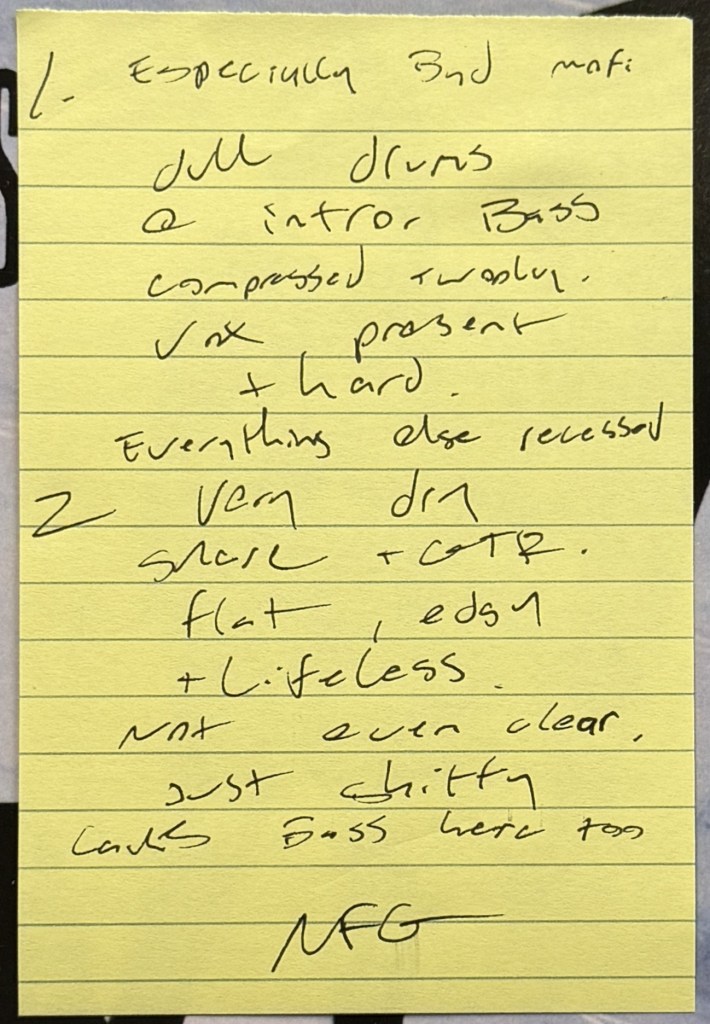
It turns out that side one of the Classic was passable, but side two — the side I had probably never played — was every bit as bad as most of their other classical offerings.

Side One, Second Movement (Tchaikovsky)

  • Big, but bright and compressed
  • Gets loud but opaque and hot
  • Good weight

Side One, First Movement

  • Bright and blurry bells
  • Sort of tubey but a mess
  • Grade: 1+ (passable, but no Hot Stamper)

Side Two (Rimsky-Korsakov)

  • Big but boomy and smeary
  • Brass is edgy and opaque
  • No top end or space
  • Peaks are hot and congested
  • Grade: NFG

To recap: In 2005 I was impressed with Classic’s pressing of LSC 2323. That was only twenty years ago, yet I could not have been more wrong. I thought my stereo was great — I’d owned top quality equipment since 1975 by then — thirty sodding years — so my audiophile credentials would surely dwarf those of the vast majority of forum posters who write about audiophile pressings today. How reliable should we expect their reviews to be?

(more…)

I’m Starting to Get a Bad Feeling About Record Store Day

Hot Stamper Pressings of the Music of Neil Young Available Now

For some reason, don’t ask me why, they keep hiring Chris Bellman to make Heavy Vinyl reissues of Neil Young’s albums, even though he has shown again and again that he has no idea what these recordings are supposed to sould like.

So far he’s ruined After the Gold Rush and Neil Young’s Greatest Hits, and there may be others he’s remastered to death, but no copies of those have come our way so we really don’t know, or care to know, to be honest.

If this is your idea of analog, you are most likely in the wrong hobby and should consider finding a different one. At the very least you are wasting your time and money on worthless crap vinyl pressings put out by the legion of Heavy Vinyl Grifters who emerge from the bowels of the earth on Record Store Day, targeting their rip-off LPs at the low- to mid-fi vinyl collector types who have yet to figure out what a giant scam the whole thing is.

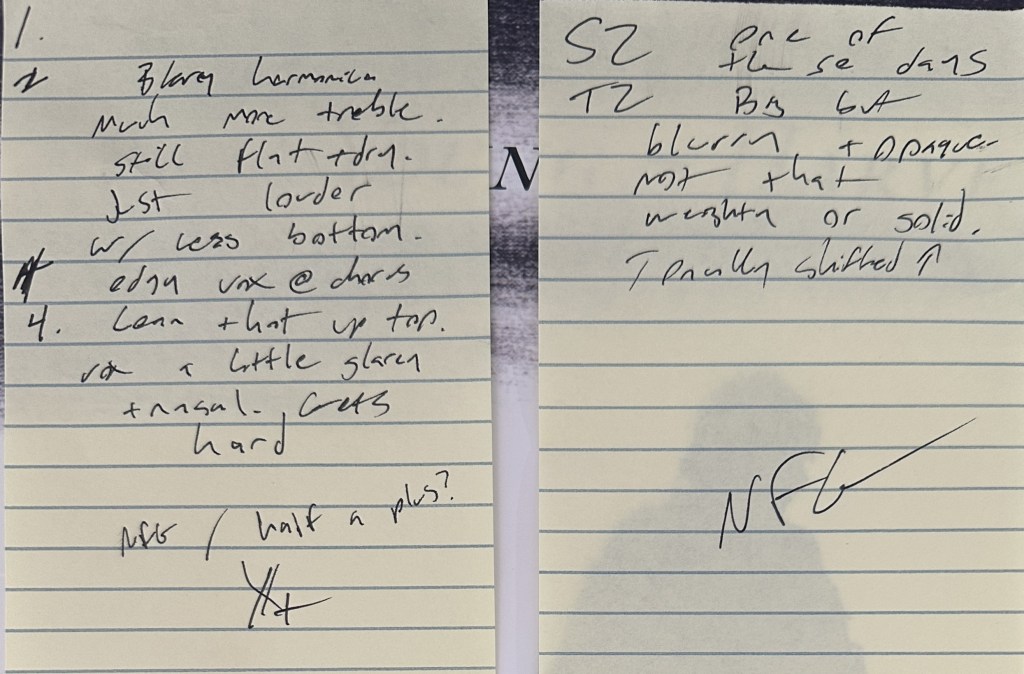
These records have virtually no redeeming features, none that we could find anyway. Allow us to catalog the shortcomings of the three sides that comprise the 2017 Record Store Day release of Harvest Moon.

For the first time in five years we had finally been able to do a shootout for the imports we like, so we knew exactly how good the best pressings could sound. Long story short, they sure don’t sound like this!

Side One

Track Two (From Hank to Hendrix)

  • Blary harmonica
  • Much more treble
  • Still flat and dry
  • Just louder with less bottom
  • Edgy vocals in the chorus

(more…)

This Joan Baez Album Is Bad News in Mono

Hot Stamper Pressings of the Music of Joan Baez Available Now

Here is how we described the sound of one of the better stereo pressings we played recently:

Both sides of this early Stereo Vanguard pressing (one of only a handful of copies to hit the site in years) were doing just about everything right, earning superb grades on both sides.

You get pure, rich, sweet, Tubey Magical analog sound from first note to last, with Baez’s remarkably present and breathy vocals front and center where they should be.

The monos we played, however, just sounded like old records, and not very good ones at that.

Thin and edgy vocals? On a Joan Baez record? What could be worse?

When the voice is wrong on a Joan Baez record, you have yourself a completely worthless piece of vinyl.  (Other titles that get the voice wrong and therefore should be avoided by audiophiles of all stripes can be found here.)

We also noted that the sound may be weighty, but it’s not rich. That lack of richness is what is causing Joan’s voice to sound thin and edgy.

Full of Them

Most record collections are full of these kinds of records. They just sit on shelves, never getting played because the sound is not good enough to make the music interesting.

Only an old school audio system can hide the faults of a pressing such as this one. The world is full of those too, even though they might comprise all the latest and most expensive components.

The mono pressings of this title are hopeless. For other albums that don’t sound good in mono, click here.

If you see this album in mono at a garage sale, don’t even waste a buck on it. Not even a quarter. It’s just not worth the vinyl it’s pressed on.

More on the subject of mono versus stereo.

(more…)

These Are the Stampers to Avoid on A Hard Day’s Night

Hot Stamper Pressings of the Music of The Beatles Available Now

In our experience, the stereo pressings with -2/-2 stampers are terrible sounding.

We do not have any on hand, but we doubt that -1/-1 — the original, the first, the one approved by George Martin himself! — is any better.

With -2 stampers this is a hall of shame pressing, as well as another early Beatles LP reviewed and found seriously wanting.

You may know that the pressings with -2 stampers are the ones that come in the original BC-13 Beatles Box from 1978.

Some of the titles in that set can sound very good, but this is not one of them. To recognize a mid-70s pressing, note that the back of the jacket will have a laminate strip on the side. At the bottom of this post you can find a picture of it.

Avoid that cover and the record inside it if you want a good sounding pressing of A Hard Day’s Night.

That Old Canard

The early pressings are consistently grittier, edgier and more crude than the later pressings we’ve played. So much for that old canard that “the original is better.” When it comes to A Hard Day’s Night it just ain’t so, and it doesn’t take a state-of-the-art system or a pair of golden ears to hear it.

The audiophile community seems not to have caught on to the faults of the early Beatles pressings, but we here at Better Records are doing our best to correct these and other misconceptions, one Hot Stamper pressing at a time.

It may be a lot of work, but we don’t mind — we love The Beatles! We want to find the best sounding copies of ALL their records, and there is simply no other way to do it than to play them, preferably by the dozens.

(more…)

Chad Has Served Poor Jethro Tull Most Barbarously

Hot Stamper Pressings of the Music of Jethro Tull Available Now

With a nod to our old friend, John Barleycorn.

We were finally able to get our hands on Analogue Productions’ newly remastered Stand Up, an album we know well, having played the British copies from every era by the score. Our notes for the sound can be seen below.

If ever a record deserved a “no” grade, as in “not acceptable,” this new 45 RPM pressing mastered by Kevin Gray deserves such a grade, because it’s just awful. (This link will take you to a great many more records best avoided by audiophiles in search of better sound. Although we’ve only linked to about 75 pressings here on the blog, it should be noted that the world is full of bad sounding records.)

But let’s put that grade in context. The last time a good sounding version of Stand Up was released, as far as we can tell, was 1989, and that version was the Mobile Fidelity Gold CD. I bought mine soon after it came out. I wasn’t even planning on buying a CD player when the Compact Disc was first invented, but then Mobile Fidelity played a dirty trick on me. Instead of releasing Loggins and Messina’s first album on vinyl, they put it out exclusively on CD as part of their Silver MFCD series.

As a die-hard MoFi fan, that sealed the deal: now I had to buy a CD player. I picked up a cheap Magnavox player, the 1040. I think it ran me less than $100, and played my new Sittin’ In CD, which, as I recall, sounded pretty good. (One of my other early CD purchases was Tumbleweed Connection, the regular label release, and it was dreadful.)

I still own Stand Up on Gold CD, and I still find it superb in every way. (Many of the MFSL Gold CDs from this era are excellent and worth seeking out.)

It sounds nothing like this new vinyl release, and that’s a good thing.

On vinyl, Stand Up has rarely been given the care it deserved. The last version of Stand Up to have sound we would want to listen to was pressed in the UK in the early ’70s. That was close to fifty years ago.

We sold some domestic pressings of the album back in the early 2000s, describing them at the time as made from dub tapes with all the shortcomings that entails, but mastered very well from dub tapes. The best domestic pressings are rich, smooth, tonally correct and natural sounding. They’re too dubby to sell as Hot Stampers, but they are not bad records. Some later Chrysalis pressings are big and open, but often they are too thin and bass-shy for the music to work. We’ve never taken them seriously.

It wasn’t long before we’d eliminated everything but the early UK pressings for our shootouts, and we quickly discovered that the earliest of the UK pressings on the older Island label were not good at all. We wrote about the problem with some originals more than ten years ago.

What was surprising about the shootouts we had done in past years was how disappointing most of the early British pressings we played were. They were flat, lacked energy and just didn’t rock the way they should have.

We learned the hard way that most British Pink label pressings aren’t especially rich, that some are small and recessed, and some are just so smeary, thick and opaque that they frustrate the hell out of you as you’re trying to hear what any of the musicians other than Ian Anderson is doing.

So when a reviewer comes along and says something positive about the new pressing compared to some unidentified original, we appreciate the problem that is at the root of his mistaken judgments:

Here’s the deal: if the goal was to duplicate the original pink label Island sound, this reissue misses that, which is good because this new double 45 reissue is far superior to the original in every possible way.

The tape was in great shape, that’s for sure. Clarity, transparency, high frequency extension and especially transient precision are all far superior to the original. Bass is honest, not hyped up and the mastering delivers full dynamics that are somewhat (but only slightly), compressed on the original. Ian Anderson’s vocals are naturally present as if you are on the other side of the microphone. Most importantly, the overall timbral balance sounds honest and correct. But especially great is the transient clarity on top and bottom.

If you’re fortunate to have an original pink label Island, at first you might think the sound is somewhat “laid back”, but that’s only because the mids and upper mids are not hyped up as they are on the original. That adds some excitement, but it clouds the picture and greatly obscures detail.

If you scroll down to our notes, you will see what we thought of the “laid back” sound this reviewer talks about. (Keep in mind that we first read the above review mere moments ago.)

We think “smaller, thick and stuck in the speakers” may be someone’s idea of “laid back,” but, just so there is no misunderstanding, it’s our idea of “awful.”

None of these are good things. Our Hot Stamper pressings are never small, thick or stuck in the speakers. They’re the records with the opposite of that sound. Our records are big, transparent and open. That’s why we can charge so much money for them and have people scooping them up from our Wednesday mailer the moment they become available.

They deliver the big, bold sound that the brilliant engineer for the album, Andy Johns, was known for. Laid back was not in his vocabulary.

Here is more of what we heard on side one.

Jeffrey Goes to Leicester Square

“Transients are sharp but body is dull. Kinda phony.”

Phony sound is the key here. Messing with the EQ in the mastering benefits some aspects of the sound at the expense of others.

Nothing new there. Audiophile pressings with wacky EQ are the norm. I would be surprised if any common Reprise pressing from back in the day wouldn’t sound more “right,” more tonally correct, more seamless. I’ve played quite a few and I don’t recall ever hearing one sound “phony.”

On side two we played the first two tracks.

(more…)