Hot Stamper Pressings of Prog Rock Albums Available Now
Here is how we described a Hot Stamper pressing of I Robot that went up recently, our first in five years:
An early UK pressing (and the first copy to hit the site in years) with seriously good sound throughout.
Many copies tend to be overly smooth, but this one has the kind of clarity that allows the natural textures of the instruments to come through.
Transparency is key to the sound of the better copies, and that is precisely where the dubby domestic pressings fall apart.
Even many of the early British pressings fell short. Good luck finding top quality sound on this one. At the very least you are going to need a big budget — these early UK pressings are not cheap to find in audiophile playing condition.
As you can see, we weren’t kidding about those UK pressings falling short. Here’s two that did, with their stamper numbers posted for all to see.

Side two of the first copy is being held back by sound that is smeary, dry and hard.
Side one of the second copy is murky and hot (bright).
Note that these are early UK stampers, which some in-the-know audiophile collectors will tell you are clearly the best.
Unfortunately, some of those “in the know” don’t seem to understand that dramatic pressing variations are common in albums that were produced in very large numbers. I Robot was a hit here and across the pond, which means they had to stamp them out as fast as they could to keep up with the surge in demand.
Is the Blair’s cut for side one of the first record the right one, potentially at least?
Maybe it is, maybe it’s not. If you know anything about records, you know that it all depends on the pressing. But plenty of folks who describe themselves as audiophiles don’t seem to want to admit to the possibility that they should have to take that into account.
Which is why we make a point of providing evidence for the things we believe to be true about records.
Could there be an early British pressing cut by a famous mastering engineer with no better than decent sound? Is such a thing possible? Why yes, it is as a matter of fact. We just found two of them.
Ask yourself: Who are you going to believe? What someone on some internet board tells you, or your own two ears?
The recommendation from some guy you’ve never met and have no idea what his stereo sounds like, assuming he even has one?
Just Answer One Question
The question we always ask, and have yet to hear a good answer for, is this one:
If you say you’re an expert, how did you come by your expertise?
I know how we did. We played a big stack of cleaned copies on a killer system you can see right here. [1]
In the old days we used to take pictures of the piles of copies we played. They can be found all over this blog. Please send us a picture of the pile of copies you played, and one of your room if you don’t mind. [2]
Grading These Copies
Both of these copies earned grades that would prevent them from being sold as Hot Stamper pressings. You need 1.5+ on both sides or better to make the cut.
The best side of each of the copies above was “good, not great.” It earned a minimal Hot Stamper grade of 1.5+.
1.5+ is four grades down from one of our Shootout Winning copies, the kind that we would put in this section. (To read more about some of the phenomenally good sounding Shootout Winning pressings of other albums we’ve played recently, click here.)
That’s a steep dropoff as far as we’re concerned. 1.5+ only hints at how good a recording I Robot can be on the best vintage pressings.
The 1+ grade found on one side of each of these copies means it has passable sound. Not bad, not good, but somewhere in between.
For context, we might say that it is probably comparable to the best domestic pressing, and probably comparable to the best Heavy Vinyl pressing of the album if it was mastered well, and would trounce the typical Heavy Vinyl pressing that’s wasn’t mastered well, which, if you spend much time on this blog, you know is far too many of them.
Either way, it certainly has no claim to audiophile quality sound.
MoFi
We put both the standard MoFi pressing and the UHQR version in our hall of shame back in the day, two more phony sounding “audiophile” records to add to the very long list of bad Half-Speeds that impressed most audiophiles back in the day (not us, I hasten to add).
The MoFi is a textbook example of their ridiculous affinity for boosted top end, not to mention the extra kick they put in the kick drum, great for mid-fi but a serious distraction on a high-end system with proper low-end reproduction.
Even the UHQR sucks. Don’t kid yourself. They’re still mastered by Stan Ricker, and he likes plenty of top end. As the old saying goes, if it’s worth doing it’s worth overdoing.
[1] Wouldn’t you like to have a beautiful system like this? Complete with postal carrier bins by the table and pillows under the phono stage.

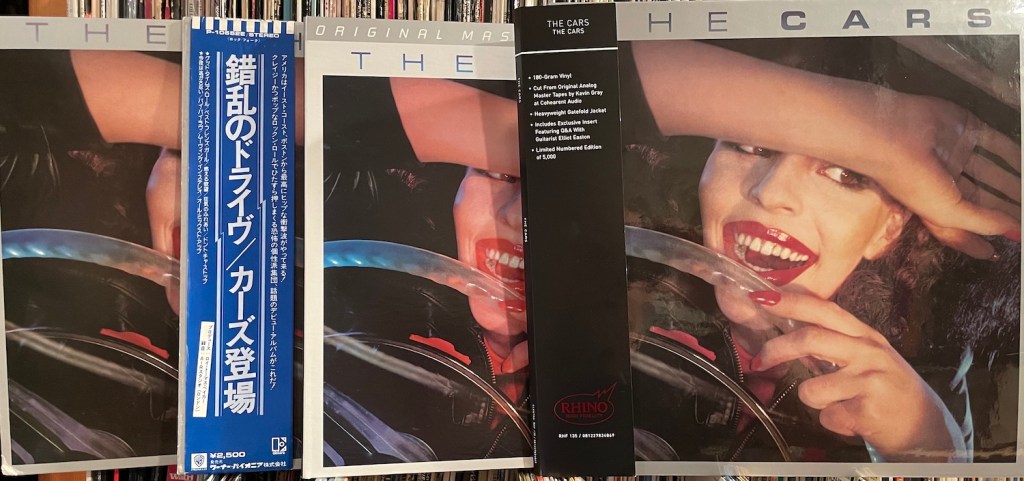
[2] The audiophile reviewer who posted the picture you see below of The Cars’ first albums he owns was undoubtedly proud of his collection. What he didn’t understand is that this one picture has revealed to us — well, some of us — everything we needed to know about the seriousness of the “shootouts” he carries out.