smeary-sound

Smear, a blurring or loss of sharpness of individual notes, refers to missing transient information, the kind most often associated with tube gear.

However, smear occurs with every kind of gear, especially high-powered amps, the kind typically required to power the inefficient speakers audiophiles seem to favor these days.

When we got rid of our tube equipment and high-powered amps, some of the smear in our records disappeared with them.

Once that happened, the smear that is commonly heard on modern Heavy Vinyl repressings became much more noticeable and, as might be expected, even more annoying.

Every Last One of These Bartok Records with Ansermet Was No Good

Hot Stamper Pressings of the Music of Bela Bartok Available Now

Every last one of our London pressings of Concerto for Orchestra was a disaster: smeary strings, blary brass and painfully shrill throughout, with no top or bottom to speak of, the very definition of boxy sound.

The entire group of CS 6086 we had on hand — whether on Blueback or Whiteback, we had a good selection of both — were much too unpleasant to be played on high quality modern equipment.

Why had I been buying them for years?

I made the mistake of assuming that the phenomenally talented Decca engineering and producing team who worked on this project could be relied upon to produce a top quality recording of the Concerto for Orchestra.

As it turns out, my guess turned out to be wrong.

I had made the mistake of believing in the infallability of experts.

I talk about the team of producers and engineers seen below in listing after listing, raving about the amazing sound of the recordings produced by them in the 50s and 60s, many of which are right at the top of the best sounding recordings I have ever had the privilege to play.

(more…)

Good Digital Beats Bad Analog Any Day

Hot Stamper Pressings of the Music of Sonny Rollins Available Now

And this is some very bad analog indeed!

We here present our 2010 review of the Sonny Rollins Plus 4 album, the one remastered on two slabs of 45 RPM Analogue Productions Heavy Vinyl.

It has everything going for it, right?

Steve Hoffman, Kevin Gray, 45 RPMs, Heavy Virgin Vinyl, fancy packaging — clearly no expense was spared!

The ingredients may have been there, but the cake they baked was not only not delicious, it was positively unlistenable — I mean, inedible.

I cannot recall hearing a more ridiculously thick, opaque and unnatural sounding “audiophile” pressing than this Rollins record, and believe me, I’ve heard plenty. (And it seems the bad news will never stop.)

As I noted in another commentary “Today’s audiophile seems to be making the same mistakes I was making as a budding enthusiast more than thirty forty years ago. Heavy Vinyl, the 45 RPM 2 LP pressing, the Half-Speed limited edition — aren’t these all just the latest audiophile fads, each with a track record more dismal than the last one?”

It reminds me of the turgid muck that Doug Sax was cutting for Analogue Productions back in the 90s. The CD has to sound better than this. There’s no way could it sound worse.


CD Update:

I managed to track down a copy of the CD and it DOES sound better than this awful record, and by a long shot. It’s not a great sounding CD, but it sure isn’t the disaster this record is.

Buy the CD, and whatever you do, don’t waste money on this kind of crap vinyl.


This is a very bad sounding record, so bad that one minute’s play will have you up and out of your chair trying to figure out what the hell is wrong with your system. But don’t bother. It’s not your stereo, it’s this record.

It has the power to make your perfectly enjoyable speakers sound like someone wrapped them in four inches of cotton bunting while you weren’t looking.

(more…)

Venice on Classic Records

Hot Stamper Pressings of Classical and Orchestral Music

Classic Records remastered the tapes for LSC 2313 and even the people who like the sound of Classic’s Heavy Vinyl pressings used to complain about it, so you can imagine what we think of it.

What a piece of garbage. With smeary, shrill, screechy strings, it gives no indication of the beauty that is on the tape. 

The Victrola reissue, VICS 1119, is dramatically better sounding than any other reissue of the album we have played, including of course the Classic, and may even be better sounding that the Shaded Dog original itself.


This Heavy Vinyl reissue is noticeably lacking in a number of areas that are important to the proper presentation of orchestral music. If you own a copy of this title, listen for the qualities we identified above in the sound that came up short.

Below you will find links to other records that have the same shortcomings we heard when playing the Classic Records pressing of LSC 2313.


(more…)

What Can You Learn from a Mercury Shootout Like This One?

Hot Stamper Pressings of Mercury Classical Recordings Available Now

The short answer is that you can’t learn much from this shootout, because we’re not telling you which title the stampers you see below belong to.

Be that as it may, in the case of this mystery title the conventional wisdom turns out to be correct — the earlier numbered pressings did better than the later numbered pressings, and the early labels did better than the later labels.

That happens a lot, and we are happy to admit that it does. Why? Because the experimental evidence — the datasay that is what happened.

As usual for posts in which the stamper sheet from a shootout is reproduced in its entirety, the stamper numbers shown below will belong to a different album than the one you see pictured.

These can be found under the heading of Mystery Stampers. Most of these posts will illustrate something to be learned from a Hot Stamper shootout, but because the information reveals the shootout winning stampers, the actual title of the record is rarely revealed.

Much more useful stamper information can be found using this link, which includes plenty of stamper numbers for specific titles that are best avoided by audiophiles looking for top quality sound. In addition, we post the winning and losing stampers for some titles that are an unreliable guide to good sound. Unreliable stampers are also quite common.

The right stampers are only one of the many reasons some copies win our shootouts and others don’t, but in the case of this rare Mercury, a record that we only had four copies of, the RFR-2/2 stampers were clearly the best, with no other set of stampers coming close. The best of the others earned grades no better than 2+/2+.

One lesson that was clear was that the best stampers were, to quote our reviewer, “a step up!”

(more…)

Nursery Cryme on Classic Records – What System Can Make It Sound Good?

Hot Stamper Pressings of Genesis Albums Available Now

Sonic Grade: F

The Classic Heavy Vinyl pressing from 2000 is a smeary, lifeless mess next to the best early tan label British pressings. No Classic pressing of any of the Genesis albums that we’ve played sounded right to us.

The Peter Gabriel albums they remastered were just as bad. All of them earned a grade of F. We made no effort to do listings for most of them because they all were bad sounding, and bad sounding in the same way.

If I were to try to “reverse engineer” the sound of a system that could play this record and compensate for its many faults, I would look for a system that was thick, dark and fat, with added richness and a heaping portion of euphonic tube colorations.

I know that sound. I had a stereo in the 90s with many of those same shortcomings, but of course I hadn’t a clue about any of that. Back then, I didn’t know what I didn’t know. I needed to put together a system with a lot more “Hi-fi” and a lot less “My-fi,” a process that took many years and a great deal of effort.

I’m glad to say things are different now.

What to Listen For

As a general rule, this Heavy Vinyl pressing will fall short in some or all of the following areas when played head to head against the vintage pressings we offer:


Further Reading

The sonic signature of the modern Heavy Vinyl Classical reissue in five words: diffuse, washed out, veiled, and vague.

(more…)

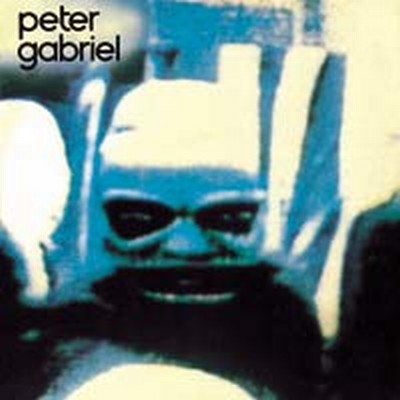
On Security, Robert Ludwig Let Us Down, Big Time

Hot Stamper Pressings of the Music of Peter Gabriel Available Now

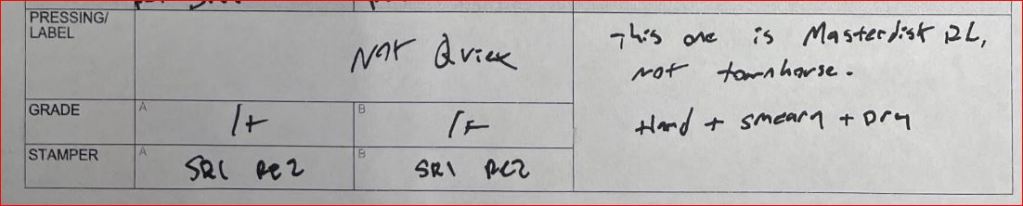
All the copies we had in our shootout were pressed domestically, and none of them were mastered by the legendary Robert Ludwig except for the one whose stampers you see below.

We awarded both sides of RL’s cutting a sub-Hot Stamper grade of 1+, which means the sound is passable at best, even after a good cleaning. (Without a good cleaning it would probably not even earn that single plus.)

We do not sell records with 1+ grades. We figure you can find those on your own. The world is full of them, as are most audiophile record collections.

1+ is actually a fairly good grade for many of the Heavy Vinyl pressings being made today. Some of the ones we’ve reviewed can be found in our Heavy Vinyl mediocrities section.

Any version of the album we sell will be noticeably — and probably dramatically — better sounding.

If you own any of those titles and didn’t pay much for them, you didn’t get ripped off too badly. You got something for your money. Not much, but something, and it would surprise us no end if any of them have been played much. Mediocre records tend to spend most of their lives sitting on record shelves. They’re not good enough sounding to bother with.

If you have any of these specific Heavy Vinyl pressings, something is wrong somewhere and it would be a good idea for you to figure out what before you flush any more money down the drain.

General Advice

On this title, forget the Brits. Every British pressing we played was badly smeared and veiled.

This took us somewhat by surprise because we happen to like the British PG pressings. However, So on British vinyl is awful too, so it’s clear (to us anyway) that the later PG records are bad on British vinyl and the early ones are better.

We are limiting our comments here to albums up through So. Anything after that is more or less terra incognita for us simply because we don’t care for any of the music he was making after 1986.

(more…)

On Ballet Music From The Opera, How Much Tubey Magic Is Too Much?

Hot Stamper Pressings of Living Stereo Recordings Available Now

UPDATE 2023

We have stopped buying the original LSC 2400 for the simple reason that it is not competitive with the budget VICS 1206 reissue from 1960 that replaced it in the RCA catalog.

The review we wrote for the Shaded Dog is probably close to twenty years old. There was a time when the shortcomings of the original RCA were not nearly as easy for us to recognize, but that time has long since past.

If any copy of the original, or any remastered version from the modern era sounds good to you, we can almost guarantee that you are mistaken about the quality of the sound, and, even better, we can offer you the pressing that makes our case better than any review can.


Our Old Review

The hall is HUGE — so transparent, spacious and three-dimensional it’s almost shocking, especially if you’ve been playing the kind of dry, multi-miked modern recordings that the 70s ushered in for London and RCA. (Many of Solti’s recordings from the decade are not to our liking, for reasons we lay out here.)

EMI recordings may be super spacious but much of that space is weird, coming from out-of-phase back channels folded in to the stereo mix. And often so mid-hall and distant. Not our sound, sorry.

We strongly believe that there will never be a modern reissue of this record that even remotely captures the richness of the sound found on the best of these Living Stereo original pressings.

Here are some of the strengths and weaknesses we noted on a copy we played way back when.

Side One

Big and lively. The Tubey Magical colorations are a bit much for us, with too much tube smear on the strings and brass to earn more than a single plus. 

Side Two

Even bigger and more spacious, with some smear caused by the serious amounts of tube compression being used, of course, but the quiet passages are magical. [Which is precisely what heavy tube compression is designed to accomplish.]

The Victrola Reissue

We much prefer the sound of the Victrola reissue, VICS 1206, which came out in 1966.

As for the Victrola pressing, we’re guessing — how could we possibly know for sure? — that less tube compression was used in the mastering.

It’s still plenty tubey, but more to our taste for not being overly tubey.

(more…)

This London from 1961 Didn’t Make the Grade

Hot Stamper Classical and Orchestral Imports on Decca & London

1961 just happens to be one of the greatest years for high quality analog recordings. Just check out this amazing group of albums, all recorded or released that year.

This London LP was released in 1961, right in the heart of the Golden Age, so we figured it had a good chance of displaying the kind of relaxed, immersive, smooth, rich, Tubey Magical Decca sound we absolutely cannot get enough of here at Better Records.

As we were preparing to do the shootout with the six copies of CS 6202 we had amassed over the years, we suddenly ran into a big problem.

(Cue sound effect of record being scratched here.)

(more…)

Capriccio Italien on Classic Records and How Badly I Missed the Boat

More of the Music of Peter Ilyich Tchaikovsky

More of the Music of Nikolai Rimsky-Korsakov

Years ago, around 2005 if memory serves, I played a copy of the Classic Records pressing of LSC 2323 and thought it was pretty good.

I thought it was better than the Shaded Dog copies I had compared it to, which, based on hundreds of other Classic Records titles I had auditioned, was unexpected to say the least.

Little did I know that the Shaded Dog pressings on this title are not remotely competitive with the early reissues.

The best of the Shaded Dog pressings we could find, which just happened to have a 1s side one, came in tied for last with the one 70s Red Seal pressing we thought sounded good enough to make the shootout.

(Some inside baseball: most of the Shaded Dogs and Red Seals were needle-dropped, and all but two were eliminated before the shootout. It takes time and wastes money to clean and play pressings that sound hopeless, so a quick elimination round often precedes the cleaning process.)

Back then it was tough to wrap my head around the idea that a Classic Record classical title could actually be better sounding than a Shaded Dog — it had never happened, so I knew there had to be more to the story.

Finding the time to do the serious investigation of LSC 2323 that would be necessary to get to the bottom of it was not in the cards, so I shelved the project for close to the next twenty years.

The title would have to wait until 2024 to go through a proper shooout, and when it did, naturally the Classic was part of the mix, which is the way we do things here at Better Records. Every record gets the chance to show us what it can do, to be evaluated fairly without the listener having any way to know which pressing is playing.

It turns out that side one of the Classic was passable, but side two — the side I had probably never played — was every bit as bad as most of their other classical offerings.

Side One, Second Movement (Tchaikovsky)

  • Big, but bright and compressed
  • Gets loud but opaque and hot
  • Good weight

Side One, First Movement

  • Bright and blurry bells
  • Sort of tubey but a mess
  • Grade: 1+ (passable, but no Hot Stamper)

Side Two (Rimsky-Korsakov)

  • Big but boomy and smeary
  • Brass is edgy and opaque
  • No top end or space
  • Peaks are hot and congested
  • Grade: NFG

To recap: In 2005 I was impressed with Classic’s pressing of LSC 2323. That was only twenty years ago, yet I could not have been more wrong. I thought my stereo was great — I’d owned top quality equipment since 1975 by then — thirty sodding years — so my audiophile credentials would surely dwarf those of the vast majority of forum posters who write about audiophile pressings today. How reliable should we expect their reviews to be?

(more…)

Carnival of the Animals on Klavier Is Another Doug Sax-Mastered Disaster

Hot Stamper Pressings of the Music of Saint-Saens Available Now

Yet another murky, smeary audiophile piece of vinyl trash from the mastering lathe of the formerly brilliant Doug Sax. He used to cut the best sounding records in the world. (Exhibit A: this one.)

Then he started working for perhaps the worst record label of all time and to my knowledge never cut a good sounding record again.

This record may be on the TAS Super Disc list, but we don’t think it belongs there. Instead, it belongs on the bad TAS list that we created specifically for these far-from-super records.

To be fair, the real EMI is on there as well, ASD 2753. However, including the Klavier on the list brings into doubt the compentence of whoever is curating it these days.

This Klavier pressing, along with all the Classic Records titles, as well as other modern reissues, renders the advice found there all but useless. Is anyone calling attention to all the bad sounding records that have lately been recommended by The Absolute Sound? I think we might just be the only ones. If you know of any others, please email me at tom@better-records.com.

Doug Sax

For those of us who remember the consistently superb work Doug Sax was doing in the 70s, we sadly note that he passed away in 2015. I was honored to have met him a few years before then at a Chopin concert with Lincoln Mayorga performing on the piano. (Impressively performing, I might add. He played the complete Chopin Preludes from memory, all 24 of them.)

Both he and Lincoln were gentlemen and artists of the highest caliber. Needless to say, I hope this awful sounding Klavier is not the kind of record that he would want to be remembered by.

On this record, in Doug’s defense it should be noted that he had only second generation tapes to work with, which is neither here nor there as these pressings are not worth the dime’s worth of vinyl used to make them and should never have seen the light of day.

Can this dubbysmeary sound possibly be what EMI engineer Stuart Eltham was after?

Hard to believe. We’ve played plenty of his recordings and we cannot ever remember any of the non-audiophile pressings having this kind of sound.

But isn’t that just the way? The mainstream labels mass produce the good sounding pressings and the audiophile labels produce the limited edition junk.

Now there’s a rule of thumb you might want to keep in mind, especially if you’ve made the mistake of buying any of the Heavy Vinyl pressings we reviewed in 2024 and 2025, a parade of horribles that defy understanding.

Actually, if we understand that there is a need for vinyl product for the lo- to mid-fi record collector market, it makes perfect sense. That’s what Klavier was in the business of producing, and now everybody wants in on the action, hence the proliferation of crap Heavy Vinyl pressings coming to market, practically every one even worse sounding than the last.

(more…)