old-rec

The albums linked here have what we call “old record” sound. They tend to be boxy, thick, dull, opaque, smeary, closed-in, two-dimensional, lifeless and uninvolving.

Most records suffer from some of these shortcomings to one degree or another. The Hot Stamper pressings we offer are the ones without these problems.

And to Think I Used to Like this Strauss Record

Hot Stamper Mercury Pressings Available Now

I used to like this Strauss Family Album back in the old days. Picked them up whenever I saw them, usually for ten bucks or less. They’re fairly common. It’s not exactly HiFi a la Espanola.

Now when we play this Mercury, it doesn’t sound so good. We traded what we had in stock back to stores or gave them away as freebies to our good customers.

A lot of records that I used to like because they were cleaner and brighter — later Red Seal Living Stereos, some OJC jazz, some reissues of rock — sounded much better when my system was darker and less revealing.

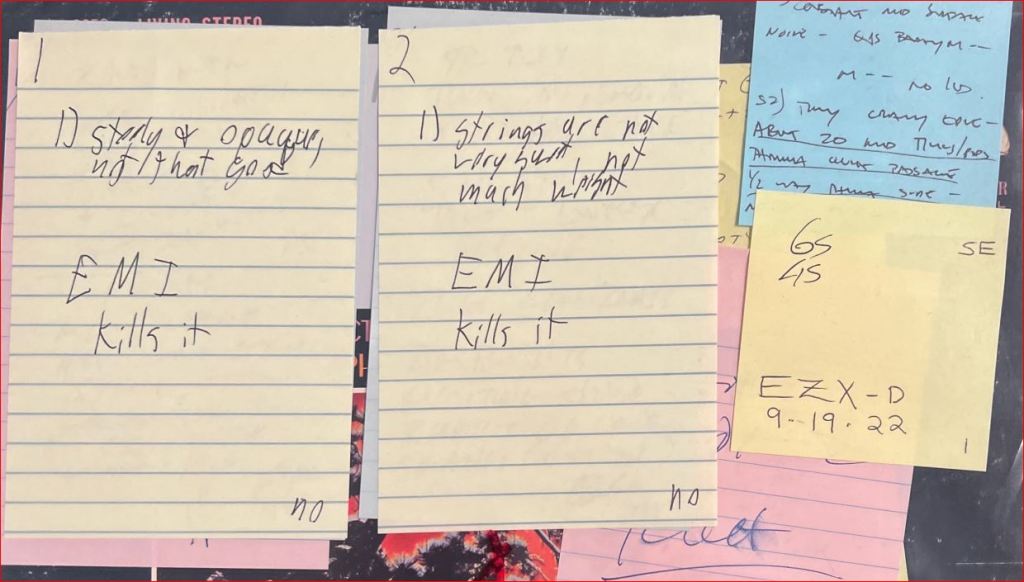
Side one of this copy has steely strings, the kiss of death on this kind of music.

Side two is passable, a low grade Hot Stamper. If you see this album for five bucks, pick it up and give it a listen. More than that and you should probably pass.

Many Mercury records simply do not sound good, and this appears to be one of them. The sound is  shrill, and that is just not acceptable on today’s highly-tweaked stereos.

Some of the early Mercs seem better suited to the old school audio systems of the 60s and 70s than the modern systems of today.

Some of these records used to sound good on those older systems, and I should know. I had an Old School stereo and some of the records I used to think sounded good back in the day don’t sound too good to me anymore.

For a more complete list of those records, click here.

How Did We Figure All of This Out?

There are more than 2000 Hot Stamper reviews on this blog. Do you know how we learned so much about so many records?

Simple. We ran thousands and thousands of record experiments under carefully controlled conditions, and we continue to run scores of them week in and week out to this very day.

(more…)

Dorati and Mercury Did Not Produce a Good Sounding Eroica

More of the Music of Ludwig van Beethoven

The sound of this 1959 Mercury recording was unacceptable. SR 90011 was crude and shrill. It seems that many early Mercury recordings suffer from these shortcomings.

Our favorite Beethoven 3rd for sound and performance is the one Solti recorded for Decca in 1959.

1959 just happens to be one of the truly great years for quality analog recordings, as can be seen from this amazing group of albums, all was recorded or released that year.

This Mercury might be passable on an old school system, but it was too unpleasant to be played on the high quality modern equipment we use.

There are quite a number of others that we’ve run into over the years with similar shortcomings. Here they are, broken down by label.

  • London/Decca records with weak sound or performances
  • Mercury records with weak sound or performances
  • RCA records with weak sound or performances

Have You Noticed…

If you’re a fan of Mercury Living Presence records — and what right-thinking audiophile wouldn’t be? — have you noticed that many of them, this one for example, don’t sound very good?

If you’re an audiophile with good equipment, you should have.

But did you? Or did you buy into the hype surrounding these rare pressings and just ignore the problems with the sound?

There is plenty of hype surrounding the hundreds of Heavy Vinyl pressings currently in print. I read a lot about how wonderful their sound is, but when I actually play them, I rarely find them to be any better than mediocre, and most of them are downright awful.

It seems as if the audiophile public has bought completely into the hype for these modern Heavy Vinyl pressings. Audiophiles have too often made the mistake of approaching these records without the slightest trace of skepticism. How could so many be fooled so badly? Surely some of these people have good enough equipment to allow them to hear how bad these records sound.

I would say Mercury’s track record during the ’50s and ’60s is a pretty good one, offering (potentially) excellent sound for roughly one out of every three titles or so.

But that means that odds are there would be a lot of dogs in their catalog. This is definitely one of them.

To see the 50+ Living Presence classical titles we’ve reviewed to date, click here.

(more…)

Not as Good a TAS List Title as We Thought, Sorry!

Hot Stamper Pressings of Living Stereo Titles Available Now

We had a handful of copies of this famous TAS List title in the backroom, so we decided it was high time to get a shootout going. We pulled all the pressings of the music (both Billy the Kid and Rodeo) we had on hand on every label and proceeded to needle-drop them in preparation for a big Copland shootout.

Much to our chagrin, most of the copies of LSC 2195 we played were unacceptable. The sound, for the most part, was very much not to our liking. Our notes read:

  • Smeary — (more records with smeary sound can be found here),
  • Dry — (more records with dry sound can be found here),
  • Bright — (more records with bright sound can be found here),
  • Flat — (more records with flat sound can be found here),
  • Hi-Fi-ish — (more records with hi-fi-ish sound can be found here),

Those records weren’t cheap. That was a lot of money down the drain. Not only can’t we sell records that sound as bad as this Living Stereo — our customers simply would not buy them — but we would never even try. Unlike other record dealers, we actually know what our records sound like. We don’t care about the reputations of the records we sell. We only care about their sound.

Some of the records on the TAS List seem better suited to the old school audio systems of the 60s, 70s and 80s than the modern systems of today.

(more…)

Don’t Waste Your Money on this Living Stereo with Munch from 1962

More of the Music of Franz Schubert

Some audiophiles buy albums based on their labels. For example, this Shaded Dog pressing of LSC 2522 from the Golden Age of RCA Living Stereo might appeal to a certain kind of audiophile who seeks out clean copies LSCs on the original label.

More than that, he might limit himself to the most sought-after 1S Indianapolis pressings. Hooray! What could be better?

However, many records from this era simply do not sound good, and this is one of them. We have never heard a good sounding copy of LSC 2522, and we’ve played plenty of them over the decades that we’ve been auditioning Golden Age Classical records for sale.

This Shaded Dog might be passable on an old school system, but it was too unpleasant to be played on the high quality modern equipment we use.

There are quite a number of other records that we’ve run into over the years with similar shortcomings. Here are some of them, a very small fraction of what we’ve played, broken down by label.

  • London/Decca records with weak sound or performances
  • Mercury records with weak sound or performances
  • RCA records with weak sound or performances, including many on the coveted Shaded Dog label

(more…)

How Can Anybody Not Hear What’s Wrong with Old Records Like These?

beatlrubbeoriginalRecord Collecting – A Guide to the Fundamentals

It is our strongly held belief that if your equipment (regardless of cost) or your critical listening skills do not allow you to hear the kinds of sonic differences among pressings we describe, then whether you are just getting started in audio or are a self-identified audio expert writing for the most prestigious magazines and websites, you still have a very long way to go in this hobby.

Purveyors of the old paradigms — original is better, money buys good sound — may eventually find their approach to records and equipment unsatisfactory (when it isn’t just plain wrong), but they will only do so if they start to rely more on empirical findings and less on convenient theories and received wisdom.

A reviewer we know all too well is clearly stuck in the old, mistaken paradigm, illustrated perfectly by this comment:

It’s not my pleasure to be so negative but since I have a clean UK original (signed for me by George Martin!) I’ll not be playing this one again. Yes, there are some panning mistakes and whatever else Martin “cleaned up” but really, sometimes it’s best to leave well-enough (and this album was well-enough!) alone.

We can’t imagine how anyone can have a system in this day and age that can obscure the flaws of the original Parlophone pressings of Rubber Soul (or any other Yellow and Black label Parlophone pressing for that matter, other than Yellow Submarine and Oldies but Goldies).


UPDATE 2022

Here is another exception to that “rule.”


This reviewer apparently does (as do some of our customers, truth be told), but we have something very different indeed. One might even consider it the opposite of such a system.

Our system is designed to relentlessly and ruthlessly expose the flaws of every record we play.

Only the best of the best can survive that level of scrutiny. Our system (comprising equipment, setup, tweaks, room treatments, electricity) operates at the highest level of fidelity we have been able to achieve to date. We are constantly making improvements to our playback system in search of even better sound.

Real Progress

But wait a minute, who are we to talk about being fooled? Bear in mind that as recently as 2000 or so we were still recommending DCC and other Heavy Vinyl pressings. These are records that, with few exceptions, I would have a hard time sitting through nowadays.

My system couldn’t show me how colored and lifeless they were then, but it sure can now.

It’s amazing how far you can get in 10 years [now 20] if you’re obsessive enough and driven enough, and are also willing to devote huge amounts of your time and effort to the pursuit of better audio. This will be especially true if you are perfectly happy to let your ears, not your brain, inform your understanding of the sound of the records you play.

If we thought like most audiophiles, that money buys good sound and original pressings are usually the best, there would be no such thing as Hot Stampers. Old thinking and wrong thinking can really slow down your progress.

(more…)

A Very Bad Porky/Pecko Cutting of My Aim Is True

Hot Stamper Pressings of Elvis’s Albums Available Now

My notes for the one and only UK pressing I’ve played in many years, the one with Porky is the dead wax, note its many weaknesses:

Really loud and full.

Too loud and hot vocal.

Strains a lot.

You know what the sound of this record reminds me of?

An old 45 RPM 7″ single. Remember those?

It’s not unusual for 45 RPM singles from back in the day to be very loud, very compressed, and they often have much-too-hot vocals designed to jump right into your lap.

Mono mixes sometimes have some of that same lowest-common-denominator sound.

This mix is stereo but it sounds like it’s coming right out of a jukebox.

No doubt Mr. Peckham was told to make the record sound that way, and he did his job very well.

But audiophiles looking for good sound should heed this warning and avoid the UK LPs of the album. It’s a joke next to the domestic pressings with the right stampers. (The right stampers are hard to find but you will never hear a good sounding early pressing unless you have a copy with the stampers that sound right, a tautology to be sure but one worth noting.)

(more…)

Don’t Waste Your Money on this Mozart Record from 1960

Hot Stamper Pressings of the Music of Mozart Available Now

Neither the sound nor the performance of this 1960 Living Stereo are impressive.

LSC 2287 might be passable on an old school system, but it was too unpleasant to be played on the high quality modern equipment we use.

There are quite a number of other records that we’ve run into over the years with similar shortcomings. Here are some of them, a very small fraction of what we’ve played, broken down by label.

(more…)

Offenbach & Strauss – A Waste of Money on the Mercury Original

More of the Music of Jacques Offenbach (1819-1880)

This lovely Mercury boasts one of the greatest performances of the piece ever recorded. 

Dorati is surely The Man when it comes to energy, drive and dynamic excitement with this venerable warhorse. He and his Minneapolis Symphony play the hell out of this boisterous music, and luckily for us audiophiles, the Mercury engineers give us Demonstration Quality Sound to go with it.

But not on the original pressing.

The original Mercury release of this record (90016) is a shrill piece of trash, as is the Mercury Wing pressing. So many of the early Mercurys were poorly mastered it seems.

We used to really like the Golden Import reissue, but that was years ago. Not sure how we would feel about it now.

Our current favorite performance of The Gay Parisian is this one on, gulp, Readers Digest.

(more…)

This Thelonious Monk Record Didn’t Make the Grade

More of the Music of Thelonious Monk

Every copy of this record we have ever played sounded terrible. The early pressings sounded bad and the OJC sounded bad. We gave up on the album a long time ago. Why throw good money after bad?

Some audiophile reviewers prefer to review only the records that sound good to them and ignore the rest. We think this does the audiophile community a disservice.

Like Consumer Reports, we like to test things. They test toasters, we test records. We put them through their paces and let the chips fall where they may.

They want to find out if the things they are testing offer the consumer good quality and value.

We want to find out if the records we are testing offer the audiophile good sound and music.

It takes a lot of people and a healthy budget to carry out large numbers of these kinds of tests.

No other record dealers, record reviewers or record collectors could possibly have auditioned more than a small fraction of the records that we’ve played. We’ve been looking for the best sounding records for a very long time. Now, with a staff of ten or more, we can buy, clean and play records in numbers that are unimaginable for any single person to attempt.

That puts us in a unique position to help audiophiles looking for the highest quality pressings.

Yes, we have the resources, the staff and the budget. More importantly, we came up with a different approach.

We’ve learned through thousands and thousands of hours of experimentation that there is no reliable way to predict which pressings will have the best sound for any given album.

(more…)

Billion Dollar Babies Often Suffers from a Case of 70s Warner Bros. House Sound

More of the Music of Alice Cooper

The last White Hot Stamper copy we put up had the two best sides back to back we heard in our shootout, with a killer side two that really brought this music to life.

Which is not easy to do, given that the average copy of this album is a sonic mess —

There are a lot of green label Warner Bros. records from the 70s that sound like that, one might even call it their “house sound.”

When you play most of the later pressings, it’s obvious that they’ve gone overboard in cleaning up the murk, leaving a sound that is lean, flat and modern — in other words, unmusical, inapt and more often than not disastrous.

Finding the right balance of fullness and clarity, especially on this album, may not be easy, but it can be done. This side two was far and away the best we heard and proves that the album can sound good.

(more…)