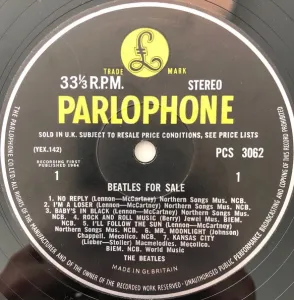
Y&B

An Overview of Beatles Oldies But Goldies

Hot Stamper Pressings of the Music of The Beatles Available Now

This is a Beatles album we think we know well.

We’ve done a number of shootouts for A Collection of Beatles Oldies over the last ten years or so, and our experimental approach using many dozens of copies provides us with strong evidence to support the following conclusions regarding the sound of the originals vis-a-vis the reissues:

  1. The best of the early pressings always win our shootouts. No reissue has ever earned our top grade of A+++ and it is unlikely any reissue ever will.
  2. The reissues can be quite good however. The best of them have earned grades of Double Plus (A++).
  3. The worst of the early pressings also earned grades of Double Plus (A++).
  4. Conclusion: if you have a bad original and a good reissue, you might be fooled into thinking the sound quality was comparable.

(more…)

Sgt. Pepper on Yellow and Black Parlophone

Hot Stamper Pressings of the Music of The Beatles Available Now

UPDATE 2026

This commentary was written in 2010, prompted by our good fortune in finding a clean, -1/-1 original pressing of Sgt. Pepper, at a local record store, in stereo no less.

Since that time I believe we have played at least one other early pressing. We are unlikely to play another.

The originals have almost nothing in common with the amazing pressings that end up winning our shootouts, none of which have ever been mastered in the 60s to the best of my knowledge, although it is possible that ten or fifteen years ago, before we really got to know the record the way we know it now, there might have been one or two from that decade.

Since then the cutoff is somewhere in the mid-70s. We leave the specific years for you to figure out.

Of course, if you bought a White Hot Stamper copy from us, you know at least one of the stampers for at least one of the sides that wins a shootout, and perhaps both if you happened to have purchased a 3/3 Top Shelf copy. (At the time of this writing there are a total of seven on the site, out of about 500 records. Needless to say, they are very hard to find.)

Certainly nothing from 1967 and nothing on the original label.

And definitely nothing in mono.


We had the opportunity not long ago to audition a very clean original early pressing of the album and were frankly quite taken aback by how just plain AWFUL it was in every respect. No top end above 8k or so, flabby bass, muddy mids — this was as far from Hot Stamper sound as you could get.

To be fair, we have played exactly one copy on our current system. (Played an early copy or two long ago but on much different equipment, so any judgments we might have made are highly suspect.) Perhaps there are good ones. We have no way of knowing whether there are, and we are certainly not motivated to find out given the price that original Sgt. Pepper’s pressings on the Yellow and Black label in audiophile playing condition are fetching these days.

(more…)

These Are the Stampers to Avoid on With The Beatles

Hot Stamper Pressings of the Music of The Beatles Available Now

In our experience, the stereo pressings with -2/-2 stampers are terrible sounding. We do not have any on hand, but we doubt that -1/-1 — the original, the first, the one approved by George Martin himself! — is any better.

With -2 stampers this is a hall of shame pressing, as well as another early LP reviewed and found wanting.

That Old Canard

The early pressings are consistently grittier, edgier and more crude than the later pressings we’ve played. So much for the idea that the “original is better.” When it comes to With The Beatles it just ain’t so, and it doesn’t take a state of the art system or a pair of golden ears to hear it.

The audiophile and record collecting community seems to have failed to reckon with the faults of the early Beatles pressings, but we here at Better Records are doing our best to correct their misperceptions, one Hot Stamper pressing at a time.

It may be a lot of work, but we don’t mind — we love The Beatles! We want to find the best sounding copies of ALL their records, and there is simply no other way to do it than to play them by the dozens, as you can see from the picture below.

(more…)

How Can Anybody Not Hear What’s Wrong with Old Records Like These?

beatlrubbeoriginalRecord Collecting – A Guide to the Fundamentals

It is our strongly held belief that if your equipment (regardless of cost) or your critical listening skills do not allow you to hear the kinds of sonic differences among pressings we describe, then whether you are just getting started in audio or are a self-identified audio expert writing for the most prestigious magazines and websites, you still have a very long way to go in this hobby.

Purveyors of the old paradigms — original is better, money buys good sound — may eventually find their approach to records and equipment unsatisfactory (when it isn’t just plain wrong), but they will only do so if they start to rely more on empirical findings and less on convenient theories and received wisdom.

A reviewer we know all too well is clearly stuck in the old, mistaken paradigm, illustrated perfectly by this comment:

It’s not my pleasure to be so negative but since I have a clean UK original (signed for me by George Martin!) I’ll not be playing this one again. Yes, there are some panning mistakes and whatever else Martin “cleaned up” but really, sometimes it’s best to leave well-enough (and this album was well-enough!) alone.

We can’t imagine how anyone can have a system in this day and age that can obscure the flaws of the original Parlophone pressings of Rubber Soul (or any other Yellow and Black label Parlophone pressing for that matter, other than Yellow Submarine and Oldies but Goldies).


UPDATE 2022

Here is another exception to that “rule.”


This reviewer apparently does (as do some of our customers, truth be told), but we have something very different indeed. One might even consider it the opposite of such a system.

Our system is designed to relentlessly and ruthlessly expose the flaws of every record we play.

Only the best of the best can survive that level of scrutiny. Our system (comprising equipment, setup, tweaks, room treatments, electricity) operates at the highest level of fidelity we have been able to achieve to date. We are constantly making improvements to our playback system in search of even better sound.

Real Progress

But wait a minute, who are we to talk about being fooled? Bear in mind that as recently as 2000 or so we were still recommending DCC and other Heavy Vinyl pressings. These are records that, with few exceptions, I would have a hard time sitting through nowadays.

My system couldn’t show me how colored and lifeless they were then, but it sure can now.

It’s amazing how far you can get in 10 years [now 20] if you’re obsessive enough and driven enough, and are also willing to devote huge amounts of your time and effort to the pursuit of better audio. This will be especially true if you are perfectly happy to let your ears, not your brain, inform your understanding of the sound of the records you play.

If we thought like most audiophiles, that money buys good sound and original pressings are usually the best, there would be no such thing as Hot Stampers. Old thinking and wrong thinking can really slow down your progress.

(more…)

After Years of Searching, We Finally Found an Old Beatles Record with Top Quality Sound

Hot Stamper Pressings of The Beatles for Sale Album

UPDATE 2026

Sometime before 2022 we played a copy of Beatles For Sale on the original label that earned Super Hot Stamper (2+) grades on both sides. This was surprising because we rarely like Beatles albums on the early label with the exception of two titles, Yellow Sub and A Collection of Oldies…


UPDATE: 2022

We just played another original pressing of For Sale and this copy had a Triple Plus (A+++) side one, mated to a Double Plus (A++) side two. For Sale is still the only studio album with top quality sound on the original pressing that we have ever played, but now we can say with some authority that if you have a bunch of originals, you might just have one with killer sound like the one we had. There was a later pressing that also earned our top grade, a subject we touch on in this commentary for Kind of Blue.


UPDATE to the UPDATE: 2023

We’ve just played another original pressing of For Sale in a shootout and amazingly it earned Triple Plus (A+++) grades for its sound on both sides. Most original Beatles pressings on the early label do not even qualify to make it into our shootouts. Their mastering is so crude, congested and distorted that the sound simply cannot be taken seriously on a modern hi-fi rig. On a jukebox, maybe. Mine’s in the shop.

Note that this label information, like most label information, is not as helpful as it might seem. The Yellow and Black Parlophone label was used in the UK all the way up until 1969, during which time a lot of copies of For Sale, first released in 1964, were sold. In other words, if you want to find a great sounding pressing of For Sale on the early label, you have your work cut out for you.


This finding about For Sale is precisely why live and learn is our motto.

We don’t know it all, and we’ve never claimed that we did. We constantly learn things about pressings in our daily shootouts. That should not be too surprising, as record shootouts are the only way to learn anything about the sound of records that’s actually worth knowing.

Start doing your own experiments and your record knowledge might just take off the way ours has. 99% of what we think we know about the sound of records we’ve learned in shootouts over the course of the last twenty years.

We are happy to share our advice with you on getting started.

Before this, the only Beatles record we would sell on the Yellow and Black Parlophone label was A Collection of Oldies… But Goldies. That title does have the best sound on the early label. In numerous shootouts, no Black and Silver label pressing from the ’70s was competitive with the best stereo copies made in the ’60s.

Until now, it was clearly the exception to our rule. From With the Beatles up through Yellow Submarine, the best sounding Beatles pressings would always be found on the best reissue pressings.

Here are the notes for the best sounding For Sale on the early label we played in our 2022 shootout.
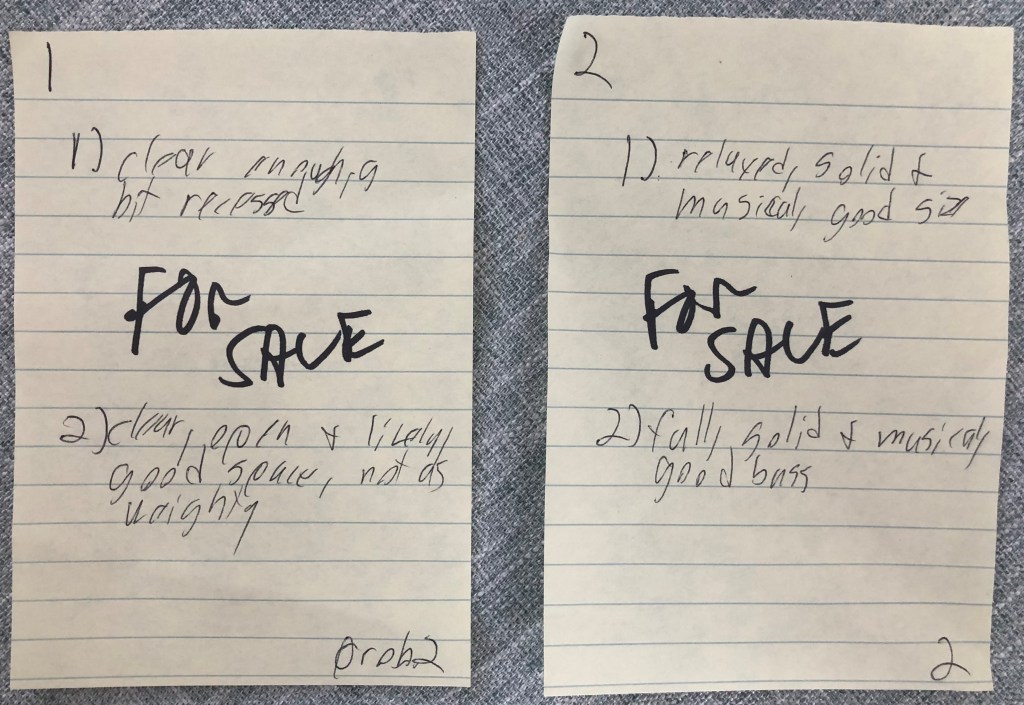
For those who have trouble reading our writing, the notes say:

Side One

  • Track one is clear enough, a bit recessed.
  • Track two is clear, open and lively, with good space, but not as weighty as the best.

Side Two

  • Track one is relaxed, solid and musical, with good size.
  • Track two is full, solid and musical, with good bass.

We Was Wrong

A very good sounding record, with few of the problems we heard on the other early label Beatles pressings we’ve played in the past. Most of them had the kind of old record sound — compressed, congested, harmonically distorted, bandwidth limited, etc. — that kept them from making the cut.

But that’s the reason to play records, not judge them by their labels, right? How else would you possibly learn anything about their sound? And you have to play them head to head against other copies, a normally crude process we’ve refined over the last twenty years into a science we like to call the Hot Stamper shootout.

(more…)

The Original Pressings of The Beatles Albums Are the Best Sounding, Right?

beatles help labelHot Stamper Pressings of the Music of The Beatles Available Now
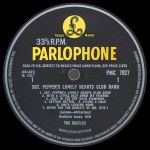
No they are not. At least the ones on the label you see pictured are not (with the exceptions noted below).

We think it’s just another example of mistaken audiophile thinking.

Back in 2005 we compared the MFSL pressing of Help to a British Parlophone LP and were — mistakenly, as you may have already surmised — impressed by the MoFi. We wrote:

Mobile Fidelity did a GREAT JOB with Help!. Help! is a famously dull sounding record. I don’t know of a single original pressing that has the top end mastered properly. Mobile Fidelity restored the highs that are missing from most copies.

The source of the error in our commentary above is in this sentence, see if you can spot it:

I don’t know of a single original pressing that has the top end mastered properly.

Did you figure it out? If you’ve spent much time on our site of course you did.

Original pressing?

Is that the standard?

Why? Who said so? Where is it written?

(more…)