mystery-title

Is It Hard for You to Imagine Stampers So Similar Sounding This Different?

Hot Stamper Pressings of Living Stereo Recordings Available Now

Subtitle: it’s also hard to imagine that space and time are two aspects of the same reality, spacetime, but that’s why we employ the scientific method to test our theories and prove ourselves wrong.

We here at Better Records like testing records. We want to know if the predictions we make about the titles we play are accurate, which is simply to say, do they match the data derived from our blinded shootouts?

In the case of the stampers for this mystery title, it turns out that our whatever intuitions we may have had going in would have been no help at all. Who could possibly predict that, for sound quality on side one, 13s would substantially beat 12s, 12s would beat 15s, and that 15s would beat 11s. Side two was even wackier: 10s badly beat 12s, 12s beat 11s, and 11s beat 20s.

I can detect practically no pattern in these numbers, on either side. They seem pretty random.

But we don’t have a problem with random numbers because the person sitting at the table playing the record and the person in the listening chair grading the sound of that record never know what the stampers are for any of the records they are playing. This should be standard practice, but it seems nobody in the audiophile world practices it but us and Robert Brook.

(more…)

3s Can Have Amazingly Good Sound, or 3s Can Have Mediocre Sound

Hot Stamper Pressings of Living Stereo Recordings Available Now

But how can you tell which 3s copies sound amazing and which 3s copies don’t?

Below you will see the stamper sheet for a shootout we did not long ago.

A lot of our stamper sheets look like this one, close to half I would guess.

As you can see, the stampers and the sound are all over the map. This is not the least bit unusual in our experience. It’s simply the nature of records — they tend to come off the press with very different sound depending on factors that no one seems to understand very well, not even us!

Note that the album you see pictured is not the record we did the shootout for.

(more…)

What Can You Learn from a Mercury Shootout Like This One?

Hot Stamper Pressings of Mercury Classical Recordings Available Now

The short answer is that you can’t learn much from this shootout, because we’re not telling you which title the stampers you see below belong to.

Be that as it may, in the case of this mystery title the conventional wisdom turns out to be correct — the earlier numbered pressings did better than the later numbered pressings, and the early labels did better than the later labels.

That happens a lot, and we are happy to admit that it does. Why? Because the experimental evidence — the datasay that is what happened.

As usual for posts in which the stamper sheet from a shootout is reproduced in its entirety, the stamper numbers shown below will belong to a different album than the one you see pictured.

These can be found under the heading of Mystery Stampers. Most of these posts will illustrate something to be learned from a Hot Stamper shootout, but because the information reveals the shootout winning stampers, the actual title of the record is rarely revealed.

Much more useful stamper information can be found using this link, which includes plenty of stamper numbers for specific titles that are best avoided by audiophiles looking for top quality sound. In addition, we post the winning and losing stampers for some titles that are an unreliable guide to good sound. Unreliable stampers are also quite common.

The right stampers are only one of the many reasons some copies win our shootouts and others don’t, but in the case of this rare Mercury, a record that we only had four copies of, the RFR-2/2 stampers were clearly the best, with no other set of stampers coming close. The best of the others earned grades no better than 2+/2+.

One lesson that was clear was that the best stampers were, to quote our reviewer, “a step up!”

(more…)

So You Actually Think an OJC Can Beat an Original Black Label Contemporary?

Hot Stamper Pressings of Contemporary Jazz Albums Available Now

Yes, we think that, because that’s what the evidence from our most recent shootout in 2025 showed us.

As you can see from the stamper sheet below, the A1/B2 stampers of our OJC, in a blinded test, came out on top.

Better mastering equipment? Better mastering skills? Better vinyl? Better pressing methods?

Who the hell knows?

Better yet, what audiophile or record collector with a lick of sense would even pretend to know?

Not us, that’s for sure. At this point we are very comfortable not having answers for the unanswerable questions we posed above.

But don’t rush off to buy the OJC of the Sonny Rollins record you see pictured. This commentary has nothing to do with that record. For now we’re keeping the title a mystery, consistent with the idea that we give out lots of the bad stampers on this blog, but rarely do we give out the good ones. (That said, here are some of the stampers that win shootouts, and we expect to be posting more soon, mostly for records we can no longer do shootouts for due to: 1.) a lack of interest, or 2.) unacceptably high costs for the best pressings, or 3.) or the fact that we are simply unable to find pressings that play quietly enough for audiophiles.)

So why is it that you can’t tell us the title of this record?

The cost of discovering the right stampers (aka R&D) is usually high, can sometimes take decades, and is fundamentally at the heart of how we make our money: by taking pressings we hope to be good, cleaning them up, playing them, and offering only those that actually do sound good, regardless of when they were made, who made them or why.

Once the shootout is done, the time for hoping and guessing is over. We have the evidence, and in our world that is the only thing that counts. That evidence may be provisional — we could prove ourselves wrong with the next shootout, and there have been times when that has happened — but for now this is the best information we have to work with.

Key Takeaways for this Mystery Record

  • We did not have enough copies with the right stampers to find a 3+ side two. (The other copies earned grades of no better than 2+/2+.)
  • Which simply means that if we’re not hearing faultless or nearly-faultless sound on one side or another, the sound is not White Hot and does not deserve a 3+ grade. Fair’s fair after all.
  • The original pressing you see with D2/D4 stampers had some of that “old record” sound we find on far too many vintage pressings.
  • True, it was very big and full, but lacked top end, causing, among other things, the horns to get hot and hard.
  • Who wants to listen to a Sonny Rollins famous classic jazz record with horns that don’t sound right?

(more…)

Does 1s Sound Great or Does It Sound Good (but Hot, Dry and Crude)?

Hot Stamper Pressings of Living Stereo Recordings Available Now

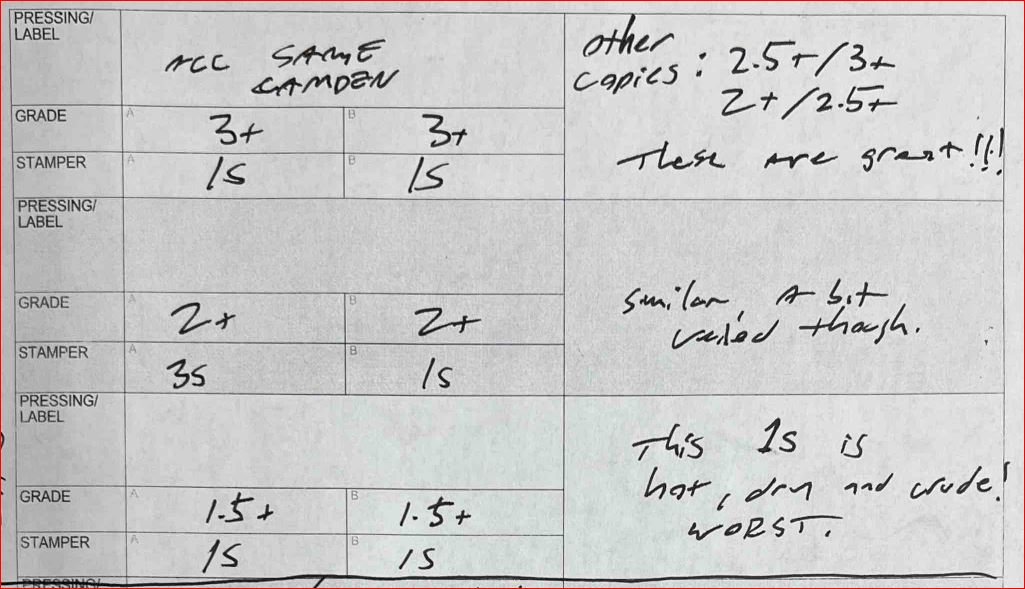
Below you will see the complete stamper sheet for a shootout we did recently.

Note that the album you see pictured is not the record we did the shootout for.

We are not revealing what record had these stampers and earned these grades for the simple reason that we rarely if ever give out the specific information that identifies the best sounding pressing of any album.

As I’m sure you can understand, we want you to buy the copy with the Hottest Stampers from us, not find one on your own! We’re happy to be moderately helpful, but naturally we find it necessary to draw the line somewhere, and giving out “the shootout winning stampers” is where we choose to draw it.

How Come?

Since, as we discovered recently, 1s wins, and handily, why would any 1s pressing sound as bad as the one at the bottom does?

(Which by the way is not actually bad — just far from the best.)

If the 1s wins the shootout as it did here, that means that the received knowledge about RCA Living Stereo pressings being better on the first pressing is correct.

But if you are the unlucky buyer of the 1s that did not do nearly as well, you might say to yourself “Hey, I thought the 1s pressing was supposed to be the hot ticket. Wha’ happen?” (Assuming you don’t conclude that the recording is at fault, which is what most audiophiles and record collectors would be likely to do. I did it and I bet you did too.)

We noted in a commentary from many years ago that the record collecting theories we see commonly promoted by those who consider themselves “in the know” seem to have a great deal of trouble accounting for these anomalies.

We had two copies of Court and Spark, each with one good side opposite a bad side on the same pressing. An excerpt:

(more…)

The Earliest Stampers Often Just Cannot Be Beat

Hot Stamper Pressings on Decca & London Available Now

We recently posted a lengthy commentary about conventional wisdom, attempting to make the case that, although the most common record collecting approaches are more often right than wrong, there is simply no way to know what approach will produce the best results for any given title.

Rather than post one exception after another — easily done, since we know literally hundreds of them — we are happy to admit that the generally accepted record collecting rules of thumb* work well for most records, with the definition of “most” being “more than half the time.”

In the case of this Mystery London, the received wisdom turns out to be right on the money. (As per our policy, please note that the Mahler album you see pictured is not the record we are discussing in this post.)
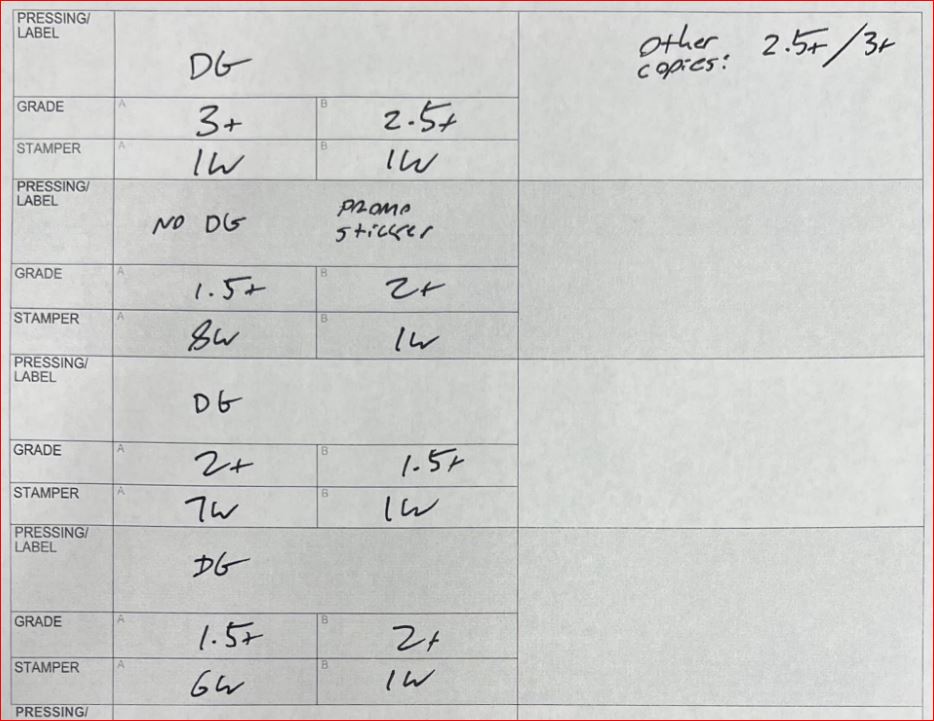
What conclusions can we draw from this information?

We would be very surprised if the earlierst pressings cut by Harry Fisher (1W/1W) can be beaten for sound. It’s possible, of course, and we will naturally continue to buy pressings with other stampers, if for no other reason than the fact that they are far more plentiful than the first pressings.

But if a 1W/1W gets offered to us at a high price, you can be sure we will jump at the opportunity to buy it and put it into a shootout.

The second one that comes to mind is that some vintage originals are not particularly well-mastered or pressed. (The 1W side twos should have sounded better than the 2+ grades they earned, but my guess is that the metal work by then was older and morn worn and just could not compete with the fresher, earlier copies, the ones with 1W side ones.)

All three of the early Deep Groove pressings with stampers other than 1W/1W did not earn Super Hot stamper grades (2+) on both sides. The only way to get top quality sound for this title is with the first pressing. And both of our 1W/1W pressings had Shootout Winning sides. (Here are some of the other albums we’ve discovered in which one set of stampers consistently win our shootouts.)

Now imagine that some company has come along and remastered the album on Heavy Vinyl for the benefit of audiophiles and music lovers alike.

If the vintage pressing you own just happens to have anything but 1W/1W stampers — you picked it up years ago because it’s an original on the Deep Groove early label and appears to be as vintage as vintage can be — you would be jumping for joy that finally the sound of the master tape has been transferred to vinyl properly after all these years.

Thank god for Kevin Gray / Bernie Grundman / Krieg Wunderlich / Chris Bellman or somebody else — pick any name you like — for the wonderful mastering work they do, bringing old records back to life.

What a service they do for the audiophile community!

Their critics must be idiots.

Sample Sizes and One Man Bands

Those of us who play a variety of pressings of the same album know where judgments of this kind come from.

They are mostly the result of sample sizes that are too small.

If you’re an audiophile reviewer operating as a one man band, which, as far as we know, is the only way any of them currently operate, your chances of getting it wrong are fairly high indeed. Here is one obvious example from a long time ago, but there are plenty more to be found under the heading of shootout malpractice here on the blog.

Just as an aside, please note that many of our customers do their own shootouts and seem to come to much more accurate assessments of the various pressings they play than any reviewers we’ve encountered. Perhaps we can take some small credit for showing them the way? I would like to think so.

How Did We Figure All of This Out?

(more…)

The Dutch Pressings Can Sound Good, Sure, But Great? Not a Chance

Hot Stamper Pressings of British Blues Rock Albums Available Now

Below you will see part of a stamper sheet that was generated for a shootout we did recently.

Please note that the album you see pictured — Cream’s Goodbye — is not the one we are discussing here. What it has in common with the mystery record we are writing about is both albums were made by British rock bands, both were recorded in England, and both sound their best on the pressings that were made in the UK.

For years we would buy any and all copies of this album on the early Polydor label as long as they looked original and had TML in the dead wax. The band was British, the production was British, but for some reason all the early pressings were mastered by The Mastering Lab right here in the states. Apparently somebody involved in the production thought they could do the best job, and they were probably right.

(The Mastering Lab was one of the great mastering houses in the 70s and 80s. There is no one alive today who can make a record remotely as good sounding as the ones they produced by the thousands in those days. If you know of any, please contact me at tom@better-records.com.)

Woops

Then we noticed that some of the Red Polydor pressings said “Made in Holland” on the label. We also noticed that the Holland pressings were never the winners of our shootouts.

It’s not as if they weren’t very good sounding pressings. They could earn grades of 2+ on both sides, as two of the seven copies shown below did, but most of the time their grades were a bit lower than those, and never as good as the best Brits.

Our appreciation of these facts, facts that had been staring us in the face for a decade or more, was lacking. We didn’t connect dots that were so obvious it was hard to miss them. Why I have no idea.

Eventually, after more shootouts had shown us again and again the limitations of the Dutch pressings, the penny dropped and we finally saw the labels for what they were: a clue to what pressings could win and what pressings couldn’t. Mind you: Every record still had to go through a shootout, and the person hearing and evaluating the record had no idea which of the two countries it might have been made in. But now we knew to pay a premium for the Brit-pressed records and only buy the Dutch at the right price.

Why did we keep at it until we had if figured out? Because we get paid to.

(more…)

When All the Stampers Are the Same, What’s a Mother to Do?

Hot Stamper Pressings of Blue Note Albums Available Now

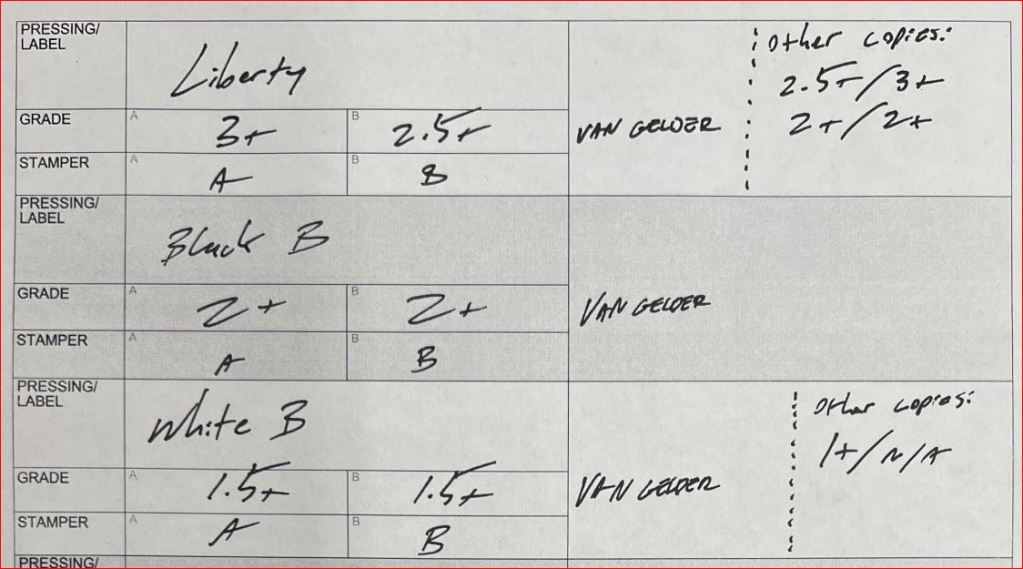
What happens when all the stampers are A and B and every one of them is cut by Rudy Van Gelder?

This is precisely the problem we were faced with on the mystery Blue Note album whose stampers can be seen below.

It’s not Cornbread — those are really hard to find! We did a shootout last year and hope to have another one coming before long, but most of what we buy ends up going back to the seller for noise issues, so it may be a while before we can get it going.

In the meantime, whatever you do, don’t waste your money on the Tone Poets reissue — it’s ridiculously bad.

What information can you rely on when trying to find the best sounding pressings?

The stamper numbers are no help.

And you can’t look for the VAN GELDER stamp in the deadwax since they all have it.

Of course, now that we’ve done the shootout, we know to buy the Liberty label pressings, but that could hardly have been predicted beforehand. Plenty of later labels beat the early label pressings on Blue Note’s albums.

But readers of this blog surely know that we are being facetious when we say we faced a lack of stamper information with the title above.

We have no way of knowing what the label is for any copy that is playing on our turntable, so how could the stamper information possibly matter, ever, under any circumstances?

We judge records by their sound quality, then grade them on that single metric, ignoring all others.

Only later do we learn which labels and stamper numbers correspond with which sonic grades, assuming they actually correspond at all. (Some don’t.)

If you are buying certain pressings because they have earlier labels, rather than pressings with later labels, predicated on the theory that the earlier labels should have better sound, this blog will be a godsend — because it will prove to you that the approach you are taking is not a particularly good one.

You are only fooling yourself if you think it is. It might work more often than not, but do you really want to be wrong about four records out of ten? Forty out of a hundred. Four hundred out of a thousand? With no way of knowing which group — good or bad — any given title happens to fall into?

A record collection of a thousand records is a decent sized collection. But with four hundred titles having second-rate or worse sound? Nobody wants that.

Buying originals is just not a good way to insure your collection will have top quality sound. Fortunately we know of a way that does.

(more…)

Most of the Time the Conventional Wisdom Turns Out to Be Right

Hot Stamper Pressings of Contemporary Jazz Albums Available Now
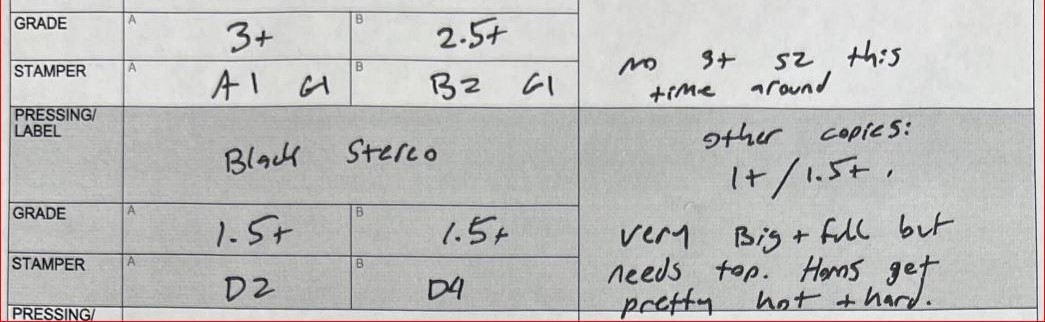
Recently we conducted a shootout for yet another superb Contemporary title. We’d played quite a collection of copies of this particular album over the years, on every label, starting back in the 90s when we first discovered how amazing sounding Contemporary records could be when you get hold of a good one.

We felt we had a solid understanding of both the music and the key aspects of the sound we might expect to hear — Tubey Magic, space, dead-on tonality, top end extension, all the stuff we’ve come to love in these live-in-the-studio, all-tube-chain Contemporary jazz recordings from their heydey throughout the 50s and 60s.

However, it’s not the record you see pictured. For now, the title of this album will have to remain a mystery, along with a great many others for which we’ve been reprinting our shootout stamper sheets so as to discuss their meaning on the blog.

As you can see, the original first pressings earned White Hot Stamper grades and were declared the winner of our shootout. With Nearly White Hot Stamper grades, the early Green second label did very well, followed by an OJC with respectable sound overall.

We recently posted a lengthy post discussing the pros and cons of conventional wisdom. In it we attempted to make the case that, although the most common record collecting tenets are more often right than wrong, there is simply no way to know which standard approach will work for the specific title at hand.

Rather than post one exception after another — easily done, since we have documented literally hundreds of them — we are happy to admit that the standard record collecting rules of thumb work well for most records, with the definition of “most” being “more than half the time.”

That leaves a lot of room for misses, and if those misses happen to be favorite albums of yours, tough luck. Unless…

Unless you know how to test records properly.

(more…)

When Fisher Took Over from Goodall, He Really Let the Side Down

Hot Stamper Pressings of Recordings by Decca Available Now

Please keep in mind that, as per our usual, the record you see pictured is not the record we are discussing in this posting.

The stamper numbers you see below belong to a different album.

The quick takeaway: Stan Goodall (“E”) cut the Shootout Winning early pressings.

Then, for reasons known only to the folks at Decca, Harry Fisher (“W”) took the reins and managed to cut some side twos that were very good. Not as good, but still very good: 2+ most of the time, some slightly worse. They were not as weighty or rich, and we take a lot of points off for records that are not as weighty or rich as they should be.

By the time Decca had changed its label to the Decca in a Box design, Mr. Fisher was cutting all the pressings, and, in our experience, not doing an especially good job. We do not even offer records with grades that low.

The sound might be passable, and would probably still be better than whatever Heavy Vinyl pressings might have been made from the tapes in the last twenty years, but that’s not good enough for us here at Better Records, not at the prices we charge anyway.

We described Fisher’s sound as dry and hot on side one, and thin and very small on side two of the 5W-stamped pressing we played. We only had the one, and the reason we had even one after having heard other Boxed Decca pressings do poorly, is that it’s a good way to stay honest and to have a better baseline to work with.

If we played nothing but 3E/1E originals, most of those 1E side twos would have earned a 2+ grade, but they would have sounded much better than the 2W-graded copies, and that seriously screws up the grading scale, especially when clean originals cost us a hundred bucks or more these days.

(more…)