Hot Stamper Pressings of Living Stereo Recordings Available Now
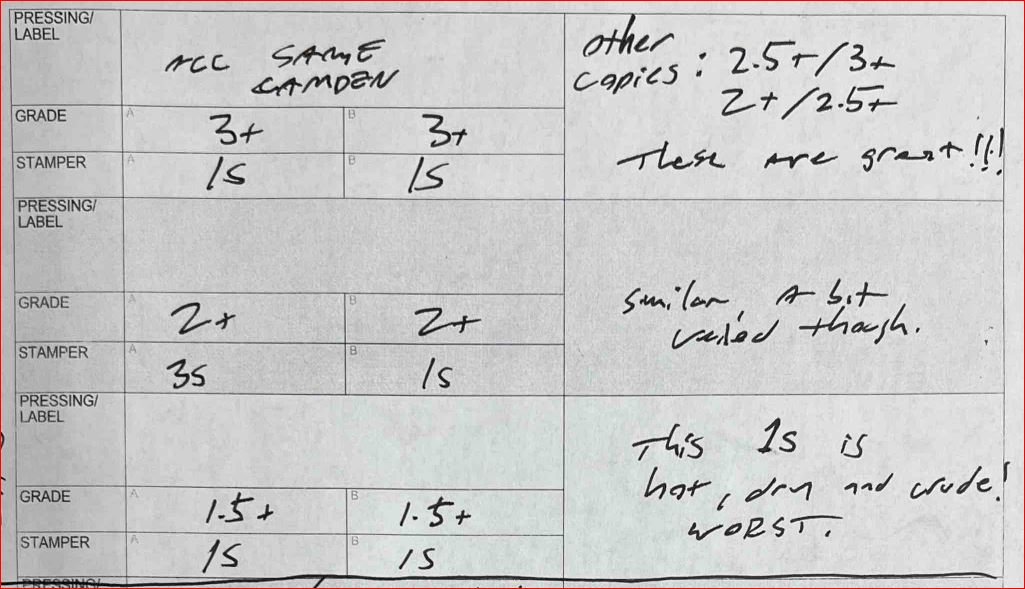
Below you will see the complete stamper sheet for a shootout we did recently.
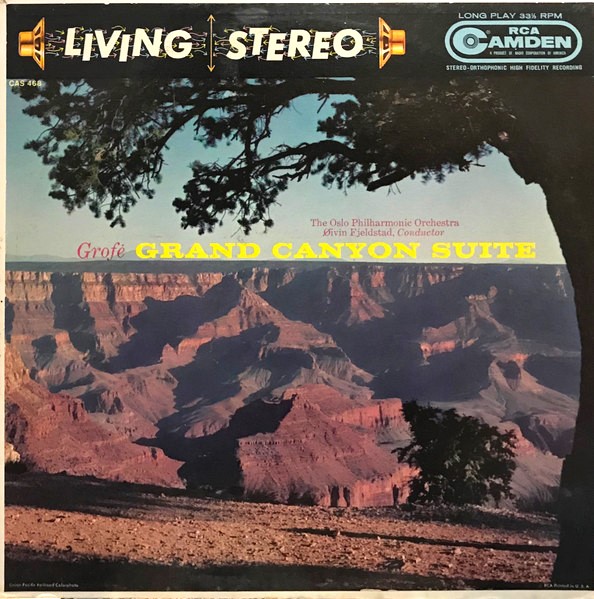
Note that the album you see pictured is not the record we did the shootout for.
We are not revealing what record had these stampers and earned these grades for the simple reason that we rarely if ever give out the specific information that identifies the best sounding pressing of any album.
As I’m sure you can understand, we want you to buy the copy with the Hottest Stampers from us, not find one on your own! We’re happy to be moderately helpful, but naturally we find it necessary to draw the line somewhere, and giving out “the shootout winning stampers” is where we choose to draw it.
How Come?
Since, as we discovered recently, 1s wins, and handily, why would any 1s pressing sound as bad as the one at the bottom does?
(Which by the way is not actually bad — just far from the best.)
If the 1s wins the shootout as it did here, that means that the received knowledge about RCA Living Stereo pressings being better on the first pressing is correct.
But if you are the unlucky buyer of the 1s that did not do nearly as well, you might say to yourself “Hey, I thought the 1s pressing was supposed to be the hot ticket. Wha’ happen?” (Assuming you don’t conclude that the recording is at fault, which is what most audiophiles and record collectors would be likely to do. I did it and I bet you did too.)
We noted in a commentary from many years ago that the record collecting theories we see commonly promoted by those who consider themselves “in the know” seem to have a great deal of trouble accounting for these anomalies.
We had two copies of Court and Spark, each with one good side opposite a bad side on the same pressing. An excerpt:
What accounts for the amazing sound of one side and the mediocre sound of its reverse?
If your theory cannot account for these huge differences in sound, your theory is fatally flawed.
Can anything be more ridiculous than the ad hoc, evidence-free theories of some audiophile record collectors desperately searching for a reason to explain why records — even the two sides of the same record — sound so different from one another?
The old adage “the proof of the pudding is in the eating” couldn’t be more apt. If you want to know if a pudding tastes good, a list of its ingredients, the temperature it was cooked at, and the name of the person stirring it on the stove is surely of limited value. To know the taste one need only take a bite.
If you want to know the sound of a record, playing it is the best way to find out, preferably against other pressings, under carefully controlled conditions, on good equipment, while listening critically and taking notes.
The alternative is to… Scratch that. There is no alternative. Nothing else will ever work. In the world of records there are no explanatory theories of any value, just as there are no record gurus with all the answers. There are only methods that will help you find the best pressings, and other methods that will not.
The good news is that these methods are explained in detail on this blog, free of charge.
We’ve made it clear to everyone how to go about finding better sounding LPs. Once you see the positive results our methods produce, we suspect you will no longer be wasting time theorizing about records.
You will have learned something about them, at least about some of them, and that hard-won knowledge is the only kind that counts for much in the world of records.
Our Pledge of Service to You, the Discriminating Audiophile
We play mediocre-to-bad sounding pressings so that you don’t have to, a free service from your record-loving friends at Better Records.
You can find this one in our hall of shame, along with others that — in our opinion — are best avoided by audiophiles looking for hi-fidelity sound. Some of these records may have passable sonics, but the music is weak. These are also titles you can safely avoid.
We also have an audiophile hall of shame for records that were marketed to audiophiles with claims of superior sound. If you’ve spent much time on this blog, you know that these records are some of the worst sounding pressings we have ever had the misfortune to play.
We routinely put them in our Hot Stamper shootouts, head to head with the vintage records we offer. We are often more than a little surprised at just how bad an “audiophile record” can sound and still be considered an “audiophile record.”
If you own any of these so-called audiophile pressings, let us send you one of our Hot Stamper LPs so that you can hear it for yourself in your own home, on your own system. Every one of our records is guaranteed to be the best sounding copy of the album you have ever heard or you get your money back.