struggle

Our First Shootout for Crime of the Century Was a Disaster

Hot Stamper Pressings of the Music of Supertramp Available Now

Those of you who’ve watched the site over the years may know this, but it bears repeating — it was rare for us to have Hot Stamper copies of Crime of the Century to offer our customers back in the early days of shootouts.

The first White Hot Stamper copy went up in 2008 and the next one didn’t go up for another three years. Even though we had learned what many of the best stampers for the album were, finding them in good shape turned out to be a lot harder than we imagined it would be.


Here’s what we had to say about the album in 2008.

We actually attempted an all-day shootout late in 2007 that we had to abandon after every copy we played — without exception, mind you — either sounded bad or was too noisy to sell. We must have tried at least ten good-looking British pressings,only to come up empty-handed at the end of the day.

The Speakers Corner pressing beats the average original, I can tell you that without fear of contradiction.

Of course, all Speakers Corner copies are going to sound different — perhaps our review copy is one of the Hot ones.

By 2011 we had gained more perspective.

The bit about the Speakers Corner pressings sounding different has now been proven beyond any doubt. The copy we cracked open for one of our later shootouts didn’t sound nearly as good as the one we played in 2007.


UPDATE 2026

It’s important to remember that the stereo, our cleaning technologies, and, most importantly, even our ears were different 15 years ago.

And, during our formative shootout years, lots of audio progress was made, especially from 2007 to 2011.

2007 is when we discovered the 324p phono stage and the Prelude Record Cleaning System, and those two pretty much changed everything for us.

(more…)

Compromised Recordings – If It’s About the Music, the Choice Is Clear

Skeptical Thinking Is Key to Finding Better Sounding Records

UPDATE 2026

This commentary was written circa 2006. The Hot Stamper world was very different in those days. A few dozen had been done starting in 2004, and probably not nearly as well as they should have been, truth be told.

This was unexplored territory, a new world. At the time we had no way of knowing how much there was to learn and how much time and effort would go into learning it.

Thousands of shootouts later we have a pretty firm grip on how to go about finding the best sounding pressings of the greatest music ever pressed on vinyl. Those recordings, with sound that is dramatically superior to those that have come along since, are why this blog exists. (The blog also allows me to promote 100+ personal favorites that I think should be more popular with my fellow audiophiles.)


Our Story, Circa 2006

Years ago one of our good customers wrote to tell us how much he liked his Century Direct to Disc recording of the Glenn Miller big band, one of the few truly amazing sounding direct discs that offered music actually worth listening to. This was an actively touring big band, not a group of studio cats trying to make a record out of some charts somebody managed to cook up.

And you can read all about the killer copy we discovered a few years back here, complete with our shootout notes. (The notes can also be seen at the bottom of this post.)

Which brought me to the subject of Hot Stampers. (For those new to the idea, here are the short versions of what they are and how one goes about acquiring them.)

Hot Stamper pressings of jazz or popular music are almost always going to be multi-track, tape recordings with plenty of overdubbing and processing, about as far from purist live-in-the-studio performances recorded directly to disc as you can get.

They will invariably suffer a great many compromises, especially when compared to the approach of an audiophile label trying to eliminate all sources of distortion in the pursuit of higher fidelity. In the case of direct to disc recordings, this means the losses that result from the use of analog tape.

But when they do that, they almost always fail.

(more…)

Anatomy of a Failed Shootout

Hot Stamper Pressings of the Music of Beethoven Available Now

By the early 2000s we had finally come to the conclusion that the RCA pressings of the Beethoven 7th offered the best combination of sound and performance we could find.

By 2024 we had enough copies — seven in total — to do a shootout. The best copy we were able to salvage from this debacle is described, perhaps too generously, below.

This Decca-recorded, Shaded Dog pressing of Beethoven’s Symphony No. 7 debuts on the site with big, spacious, and lively Double Plus (A++) Living Stereo sound or close to it.

Side one is doing just about everything right – it’s rich, clear, undistorted, open, and has depth and transparency to rival the best recordings you may have heard, and side two is not far behind in all those areas.

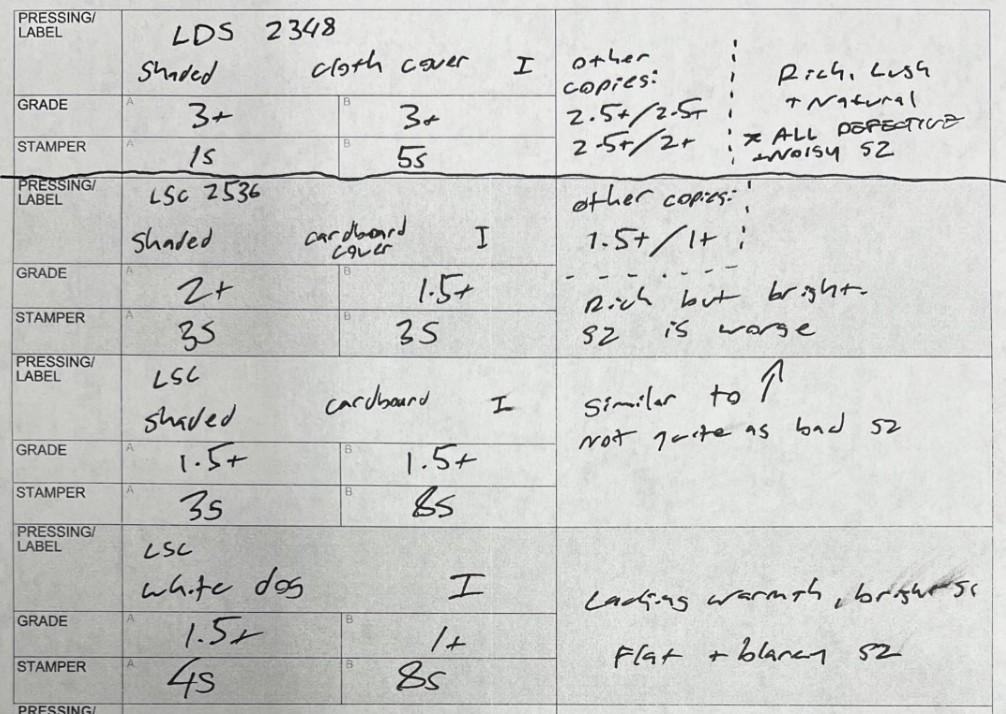
The full stamper sheet shown below makes clear what happens when your luck just plain runs out. The Soria pressings were by far the best — they were the only ones to earn 3+ on either side — but side two of all three copies we played was defective, rendering them all but worthless.

When RCA recut the record for their regularly priced Living Stereo release, LSC-2536, the dropoff in sound quality was profound, a fact readily seen from our notes. (“Rich but bright, side two is worse.”)

(more…)

Comparing Witches’ Brew on RCA with Danse Macabre on Decca

danseHot Stamper Pressings of the Music of Saint-Saens Available Now

UPDATE 2026

The review below was written a very long time ago, around 2010 I think. Our understanding of  Witches’ Brew has changed radically over the last fifteen years, as you can see from our most recent Hot Stamper offering of the album.

In 2010 we would have struggled mightily to reproduce the Shaded Dog pressings of Witches’ Brew. We had yet to make many of the most important improvements to our system that difficult to reproduce records require in order to sound their best.


Our 2010 Review

The Decca reissue above just happens to have the material found on one of the most famous and sought-after Shaded Dog pressings in the world, Witches’ Brew (shown below), along with one track added, The Sorcerer’s Apprentice, conducted by Ansermet. (As a budget reissue, they felt they needed to give you more music in order to get you to buy performances that were no longer current.)

The Decca pressing is tonally much more natural from top to bottom. I used to think that it was the best way to hear the music on Witches’ Brew. Like so much of what happens in the world of records, it is and it isn’t.

Huh?, you say. Okay, here is what I mean. We played a handful of Witches’ Brews over the last year or two, and most of them left a lot to be desired. More than that — most of them were just plain awful. One, and only one, lived up to the hype that surrounds the record.

It was so big and so powerful that I would have had no trouble ranking it with the five best sounding classical recordings I’ve ever heard.

It was a real WOW moment when the needle hit the groove on that one.

This later Decca pressing is made from a copy tape, but it’s CORRECTLY mastered from that tape and therefore sounds worlds better than most originals and all the heavy vinyl reissues. This record I can play and enjoy. Those I cannot.

(A great deal more on the Classic Records repress of LSC 2225 can be found here and here.)

(more…)
It Only Took Us Six Years to Find Another Killer Copy of Down In L.A.

Hot Stamper Pressings of Hippie Folk Rock Albums Available Now

UPDATE 2025

Our comments about our Hot Stamper winner from 2019 appear below.

Note that we could not even find White Hot sound on either side, and side two, at 1+, does not even qualify as a Hot Stamper these days, which means it would never be offered for sale on the site.

This was a tough shootout!

We had a lot more research and development to do, and six years later we had the killer copy to prove that it could be done. In 2025, we found a pressing that made it all worthwhile.


This is one of the BEST copies we’ve played in many years, close to five I would guess. Brewer and Shipley’s first and only release for A&M has long been a Desert Island disc in my world. I consider it one of the top debuts of all time, although it’s doubtful many will agree with me about that since I have yet to meet anyone who has ever even heard of this album, let alone felt as passionate as I do about it.

To me this is a classic of Hippie Folk Rock, along the lines of The Grateful Dead circa American Beauty, surely a touchstone for the genre. It’s overflowing with carefully-crafted (B and S apparently were obsessive perfectionists in the studio) inspired material and beautifully harmonized voices backed by (mostly) acoustic guitars. The Beatles pulled it off masterfully on Help and Rubber Soul. (more…)

It Took Us Three Attempts to Get The Captain and Me Going

Hot Stamper Pressing of the Music of The Doobie Brothers Available Now

UPDATE 2026

By 2009 I had been randomly buying clean copies of The Captain and Me for two decades, with the expectation that one day I would play them and find the mysterious deadwax and other clues that would lead me to the potentially best sounding copies.

Even though I had learned a fair bit about stamper numbers by that time, there was no getting around the fact that the best stamper numbers cannot be predicted for any given title. I didn’t know any especially good ones, which means that I needed to learn them for this title the way I learned them for all the others — one album at a time.

As I was not a fan of the pre-McDonald Doobies, I confess I really had no idea what to look for. I probably had picked up a few of the exceedingly rare Green Label pressings, but were they the best? I couldn’t say. I just hadn’t spent enough time with the album. And I had disproved that old canard that the originals are always the best sounding so many times by then that believing that nonsense was out of the question.

We had tried twice before to get something going, but could not find the sound we were looking for and had simply given up and moved on to greener pastures. This is long before Prelude Enzyme Record Cleaning System had come our way in 2007. It, along with our Odyssey record cleaning machine and some other tricks we learned about record cleaning, allowed us to get a shootout going a couple of years later.

The failed attempts to understand the album mentioned above happened long before we had turned the business over to carrying out shootouts all day, every day, which is all we were doing by 2009. We had stopped promoting Heavy Vinyl in 2007, and by 2009 we were on our way to selling nothing but records we had cleaned and played and evaluated for their sound quality with our own ears.

Eventually we sat down with the copies of The Captain and Me that we had — more than thirty according to the listing you see below, the one we wrote at the time — and gave it our best shot.

(more…)

Not that Long Ago Blue Was a Nut We Just Could Not Crack

Hot Stamper Pressing of the Music of Joni Mitchell Available Now

This commentary was written in 2006 or thereabouts.

Allow me to tell you about a Blue shootout I tried to do at a friend’s house. The system he owns has some nice equipment in it (the EAR 864, a $4200 tube preamp, for one) and can sound very good — if not wonderful — on certain program material.

But it’s the kind of audiophile system that is easily overwhelmed by difficult to reproduce material. On my copy of Blue his stereo was a complete disaster: grainy, shrill, thin, flat, harsh, compressed, unmusical, no real extension at either end; in short, no magic, tubey or otherwise.

My copy of Blue, which had earlier in the day sounded so good at my house, now sounded so bad at his that I could hardly recognize it as the same LP.

Pieces of the Puzzle

Of course it was the same LP, and by the time I got home the pieces of the puzzle had all fallen into place. It takes a very special stereo to overcome the shortcomings of even the best domestic pressings of Blue in order to reveal the beauty of this music.

The new one isn’t better. It’s just easier to play on the average audiophile system.

Do you have one of those? Most audiophiles do; that’s what being average means. If you’ve been in this hobby for less than five years it’s almost certain you do. I would say a decade of serious dedication to home audio would be the minimum needed to acquire the knowledge and skill to build a truly hi-fidelity system.

(more…)

When We First Started Doing Shootouts, They Would Sometimes Go on for Days

Hot Stamper Pressings of the Music of Neil Young Available Now

Our first Hot Stamper listing for After the Gold Rush from back in 2005 talked about what a struggle it was doing them at first.

Back then, with not much in the way of staff, I often had to put the records on the table one at a time and do all the listening and note-taking myself.

For our first Hot Stamper listing I wrote:

A record like this might go through 4 or 5 stages of cleaning and listening and cleaning again. I spent many hours listening to the various copies I played over the course of two days, first one track, then another, this copy, then that one. There’s no other way to do it. There’s no shortcut. There’s no substitute for hard work.

If you can call it that. It ain’t too hard playing a great album over and over again. Some people — myself included — might even call it fun. And now I love this album more than I ever did. I feel like I have come to know it. I’m positively thrilled to finally know how good it really is!

Isn’t that why we audiophiles go through all this shite, as the Brits say? When I hear a piece of familiar music sound better than I ever thought I would hear it, better than I ever imagined it, it’s everything to me. It’s the biggest thrill I know of in audio. It’s what I live for. If you like that feeling, this is the record for you!

I don’t know how long it’s going to be before I find another copy that sounds like this one, but I’m guessing it’s going to be a long time. How many bad domestic rock records did I have to play in order to find a record that sounds like this? A hundred? More?! Who knows? It was a lot, that’s for damn sure.

Speaking of Thrills

We admit to being thrillseekers here at Better Records, and make no apologies for it.

The better the system and the hotter the stamper, the bigger the thrill.

(more…)

The Insufficiently Dedicated Will Have a Fight on Their Hands with This One

A spectacular orchestral dreadnought such as this requires mastering and pressing of the highest quality.

Herrmann’s music taxes the limits of LP playback itself, with deep organ notes (listen for the famous Decca rumble accompanying the organ if you have the deep bass reproduction to hear it); incredible dynamics from every area of the stage; masses of strings playing at the top of their registers with abandon; huge drums; powerful brass effects everywhere — every sound an orchestra can produce is found on this record, and then some.

You will hear plenty of sounds that defy description, that’s for sure. Some of the time I can’t even imagine what instrument could possibly make such a sound!

Your Hard Work Pays Off

A recording of this size and scope will bring virtually any stereo system to its knees. This is the real Power Of The Orchestra! You had better have a top quality front end if you want to play this record properly, not to mention plenty of power and big speakers.

This is not the record for the weekend budget audiophile. If you haven’t put in the years of effort and invested the tens of thousands of dollars in equipment and room treatments it takes to play records of great difficulty such as this one, your system is probably not up to the challenge this album represents.

If, on the other hand, you’ve done the work and spent the money, this is the album that will show you what you have achieved.

Side One

Journey to the Center of the Earth

All those lovely harps! You can practically feel the cool air of the cave as you descend into the blackness.

The Seventh Voyage of Sinbad

Side one boasts some wonderful material from Jason and the Argonauts, including the fight with the skeletons that we all remember from our Saturday matinee movie days. Who else could have orchestrated such a film?

Side Two

The Day the Earth Stood Still

Astonishingly powerful deep bass and drum sounds!

Fahrenheit 451

One of our key tests for side two is the string tone on the Fire Engine sequence.

(more…)

Listening for a Bit Too Much Tubey Magic Down Low on Buffalo Springfield

Hot Stamper Pressings of Personal Favorites Available Now

Note to customers: We rarely have Hot Stamper pressings of Buffalo Springfield available on the site, so albums with Stephen Stills or Neil Young playing on them are about the best we can do these days. We regret we must go many years between shootouts for this seminal band’s albums, two of which are personal favorites of mine and have been since they were first released, 1968’s (Again) and 1969’s (Last Time Around) Thank god my older stepbrother had good taste in music. I doubt that many 14-year-olds were playing Buffalo Springfield albums, but I was, even though most of the time it was on 8-track tape.


On even the best copies I regret to say there’s a bit too much Tubey Magic in the bass. Tubbiness and bloat were par for the course. This may explain why so many copies have rolled off bass; the engineer cut the bass because he heard how tubby it was and figured no bass is better than bad bass. 

Which is just not true. Cutting the bass leans out and “modernizes” the sound, making the voices sound thinner and dryer. Less rich. This pretty much ruins everything on this album, just the way it ruins everything in many of the modern recordings I hear.

Having your bass under control on the playback side isn’t easy — in fact it’s probably the hardest thing to achieve in audio — but it can be done, and with good bass control the slightly wooly bass is just a part of the sound you learn to accept.

It doesn’t actually interfere much with your enjoyment of the music, mostly because all the other instruments and voices sounds so magical.


The post-it notes you see are very old, probably from the early 2000s.

Until we got our cleaning system sorted in 2007, shootouts for any of this band’s first three albums were going to be tough sledding, if not downright impossible.

In this commentary we describe what needed to change in order to make Buffalo Springfield shootouts a reality.


Want to find your own killer copy?

Consider taking our moderately helpful advice concerning the pressings that tend to win our shootouts. This album sounds its best:

(more…)