gritty-sound

With The Beatles on Mobile Fidelity

Sonic Grade: C+

The MoFi pressing of With the Beatles has so many problems it would take an hour to describe them all. Suffice it to say, it’s thinner and brighter, with voices that are grittier and grainier. The overall effect is the sinking feeling that you are listening to a cheap reissue and not the real thing. Don’t the Beatles sound better than this? To be fair, some tracks are okay, others a disaster.

If you own the MoFi, play it. Listen to it carefully. Make notes of which songs sound better than others and why. That’s how we spend our days, evaluating the relative merits of various pressings, and it’s that and that alone that has given us the critical listening skills necessary to recognize and appreciate the differences among the records we play.

One of the biggest problems with the average Parlophone copy is just the reverse of the MOFI. They tend to have rolled off highs, which emphasizes the harshness in the upper midrange and causes a loss of transparency. (The best Hot Stamper copies are of course as smooth, sweet, and transparent as they come.) Even with those shortcomings though, I would still rather listen to a typical Parlophone pressing. I wouldn’t be frustrated by the sound of somebody fooling with the EQ and screwing it up.  (more…)

Not that Long Ago Blue Was a Nut We Just Could Not Crack

Hot Stamper Pressing of the Music of Joni Mitchell Available Now

This commentary was written in 2006 or thereabouts.

Allow me to tell you about a Blue shootout I tried to do at a friend’s house. The system he owns has some nice equipment in it (the EAR 864, a $4200 tube preamp, for one) and can sound very good — if not wonderful — on certain program material.

But it’s the kind of audiophile system that is easily overwhelmed by difficult to reproduce material. On my copy of Blue his stereo was a complete disaster: grainy, shrill, thin, flat, harsh, compressed, unmusical, no real extension at either end; in short, no magic, tubey or otherwise.

My copy of Blue, which had earlier in the day sounded so good at my house, now sounded so bad at his that I could hardly recognize it as the same LP.

Pieces of the Puzzle

Of course it was the same LP, and by the time I got home the pieces of the puzzle had all fallen into place. It takes a very special stereo to overcome the shortcomings of even the best domestic pressings of Blue in order to reveal the beauty of this music.

The new one isn’t better. It’s just easier to play on the average audiophile system.

Do you have one of those? Most audiophiles do; that’s what being average means. If you’ve been in this hobby for less than five years it’s almost certain you do. I would say a decade of serious dedication to home audio would be the minimum needed to acquire the knowledge and skill to build a truly hi-fidelity system.

(more…)

Listening in Depth to So Far

Hot Stamper Pressings of the Music of Crosby, Stills and Nash Available Now

This is a very difficult record to find with proper mastering (and good vinyl, ouch!). It seems that all of Crosby, Stills and Nash’s albums are that way. The average domestic pressing rarely even hints at how well recorded this band really was (and the imports are even worse — we’ve never heard one that didn’t sound dubby, veiled and compressed).

In my experience not even one out of ten LPs sounds right; I put the figure at one out of twenty. Most of them are shrill, dull, grainy, flat, opaque, harsh and in varying degrees suffer from every other mastering and pressing malady known to man.

But the best ones have some tracks in superb sound. When you hear the Hot Stampers for records like this you will simply be AMAZED. If you’ve ever heard a really good If Only I Could Remember My Name, an album that CAN be found with proper mastering, that should give you some idea of how good the first two albums can sound.

Side One

Déjà Vu

When you get a good copy of this album, this song sounds like it was lifted right off of a Hot Stamper copy of Deja Vu itself. It’s so rich and Tubey Magical you’d swear it couldn’t get any better. Huge amounts of deep bass. Acoustic guitars that ring for days. Midrange magic to die for. Not many of them sound this way, unfortunately.

If I could indulge in some more MoFi and Half-Speed bashing for a moment, the bass “solo” at the end of this song is a great test for bass definition. The notes are relatively high, and it’s easy for them to sound blurred and wooly. The MoFi, like virtually all Half-Speed mastered records, has a problem with bass definition. If you own the MoFi, listen for how clearly defined the notes are at the end of this track. Then play any other copy, either of So Far or Deja Vu. It’s a pretty safe bet that the bass will be much more articulate. I know how bad the MOFI is in this respect. Rarely do “normal” records have bass that bad.

(more…)

Stick with the Tri-Tone Stereo Originals on Swing Along with Me

Hot Stamper Pressings of the Music of Frank Sinatra Available Now

When advising our fellow audiophiles about how to find the best sounding pressings, we tend to favor discussions about records in which the original is not the best over records in which the right reissue is not the best. (And there are practically discussions for when the modern reissue is the best. Just one so far!)

The same would be true for English bands whose records sound better when they are made in any country other than England, bands whose recordings you may think you know well, such as Led Zeppelin or Black Sabbath.

You might say our record collecting philosophy revolves aroung the contrarian idea that rules were made to be broken.

But let’s face it, most record collecting rules hold up most of the time. That’s how they got to be rules.

In the case of Sinatra’s Swing Along with Me album from 1961, the second label reissues which came along later in the 60s are not merely a shadow of the originals. They’re nothing like the originals.

Side one was so gritty and hot (bright) that we couldn’t even be bothered to play side two. Trust me, you do not want to play a vintage Sinatra record that is gritty and hot.

(more…)

On the Concerto in F, String Tone Is Key

Hot Stamper Pressings of the Music of George Gershwin Available Now

I must admit Classic Records did a passable job with LSC 2586, RCA’s recording of Gershwin’s Concerto in F, with Fiedler conducting the Boston Pops.

The two things that separate the good originals from the Classic reissue are in some ways related.

Classic’s standard operating procedure is to boost the upper midrange, and that, coupled with their transistory mastering equipment, results in strings that are brighter, grittier, and yet somehow lacking in texture and sheen compared to the originals,

This to us is a clear sign of a low-resolution cutting chain.

Once you recognize that shortcoming in a pressing, it’s hard to ignore, and I hear it on every Classic Record I play. (This commentary has more on the subject.)

RCA is more famous for its string tone than anything else.

If the strings on the Classic Records LPs don’t bother you, you can save yourself a lot of money by not buying authentic RCA pressings — and get quieter vinyl to boot.

Here are some other records that are good for testing string tone and texture.

(more…)

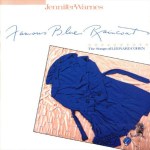
Listening in Depth to Famous Blue Raincoat

Hot Stamper Pressings of the Music of Leonard Cohen Available Now

I’m a huge fan of this FBR. It’s the only album Jennifer Warnes ever made that I would consider a Must Own recording or a Desert Island Disc. Without question this is her Masterpiece.

Key Test for Side One

Listen to the snare drum on Bird on a Wire. On most copies it sound thin and bright, not very much like a real snare. Let’s face it: most copies of this record are thin and bright, and that’s just not our sound here at Better Records. If the snare on Bird sounds solid and meaty, at the very least you have a copy that is probably not too bright, and on this album that puts it well ahead of the pack.

While you’re listening for the sound of that snare, notice the amazing drum work of Vinnie Colaiuta, session drummer extraordinaire. The guy’s work on this track — especially with the high hat — is genius.

Key Test for Side Two

Listen to the sound of the piano on Song of Bernadette. If it’s rich and full-bodied with the weight of a real piano, you might just have yourself a winner. At the very least you won’t have to suffer through the anemically thin sound of the average copy.

Side One

First We Take Manhattan

Don’t expect this song to be tonally correct. It runs the gamut from bright to too bright to excrutiatingly bright. Steve Hoffman told me that he took out something like 6 DB at 6K when he mastered it for a compilation he made, and I’m guessing that that’s the minimum that would need to come out. It’s made to be a hit single, and like so many hit single wannabes, it’s mixed brighter than we audiophiles might like.

(more…)

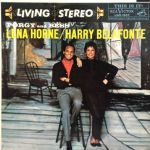
On Porgy and Bess, Stick with the Early Pressings on the Black Label

Hot Stamper Pressings of the Music of Harry Belafonte Available Now

A Living Stereo knockout! We sometimes forget to spend time with records like this when there are so many Zeppelin and Floyd records waiting to be played (and a lot more customers waiting to get hold of them to add to their collection).

We’ve always enjoyed Belafonte At Carnegie Hall, but when we’ve dug further into his catalog we’ve been left cold more often than not. However, when we finally got around to dropping the needle on a few of these many years ago we were very impressed by the music and blown away by the sound on the better pressings.

Just make sure that you avoid the orange label reissues.

They are dry, gritty and spitty. The notes below show a side one earning a single plus (1+) not-quite-Hot Stamper grade. We discuss its faults on the far right, and the other orange label pressing we played was even worse, earning a grade of NFG.

(more…)

Dream Weaver – A Good Test Record for Gritty, Grainy Sound

More Records that Are Good for Testing Grit and Grain

Most pressings of this album tend to err in one of two ways: either they’re a little bright and get hard and gritty in the upper mids, or they’re wrong in the opposite direction, with sound that is smeary and dull.

Our best copies get the balance right — plenty of texture on the keyboards and drums, with vocals that still have presence and breathiness — and not too much grit.

An all-keyboard pop record like this was a rarity at the time. The only other instruments besides drums (and one track with guitar) are keyboards. Every song is layered with multi-tracked clavinets, organs, and Moogs — it was a remarkable feat in 1975 to create an album with nothing but keys.

Listen to the title track, the most dynamic song on the record, and you will hear just how well all of those stacked keyboards and synths work together. (Steve Winwood’s Back in the High Life borrowed a page or two from Gary’s solo debut here.)


  • If you’re a Gary Wright fan, or perhaps a fan of mid-’70s synth-pop, this title, a personal favorite of mine from 1975, is surely a Must Own.
  • In our opinion, Dream Weaver is his best sounding album, and probably the only Gary Wright record you’ll ever need. Click on this link to see more titles we like to call one and done.
  • The sound may be too heavily processed for some, making it fairly difficult to reproduce, but the best sounding pressings, played at good, loud levels on big dynamic speakers in a large, heavily-treated room, are a fun listen. They sound just fine to us.
  • 1975 was a good year for music on vinyl — here are some excellent pressings of well-recorded albums available for purchase now.

(more…)

These Are the Stampers to Avoid on A Hard Day’s Night

Hot Stamper Pressings of the Music of The Beatles Available Now

In our experience, the stereo pressings with -2/-2 stampers are terrible sounding.

We do not have any on hand, but we doubt that -1/-1 — the original, the first, the one approved by George Martin himself! — is any better.

With -2 stampers this is a hall of shame pressing, as well as another early Beatles LP reviewed and found seriously wanting.

You may know that the pressings with -2 stampers are the ones that come in the original BC-13 Beatles Box from 1978.

Some of the titles in that set can sound very good, but this is not one of them. To recognize a mid-70s pressing, note that the back of the jacket will have a laminate strip on the side. At the bottom of this post you can find a picture of it.

Avoid that cover and the record inside it if you want a good sounding pressing of A Hard Day’s Night.

That Old Canard

The early pressings are consistently grittier, edgier and more crude than the later pressings we’ve played. So much for that old canard that “the original is better.” When it comes to A Hard Day’s Night it just ain’t so, and it doesn’t take a state-of-the-art system or a pair of golden ears to hear it.

The audiophile community seems not to have caught on to the faults of the early Beatles pressings, but we here at Better Records are doing our best to correct these and other misconceptions, one Hot Stamper pressing at a time.

It may be a lot of work, but we don’t mind — we love The Beatles! We want to find the best sounding copies of ALL their records, and there is simply no other way to do it than to play them, preferably by the dozens.

(more…)

We Review the Classic Records Pressing of SR 90212

The Classic Records pressing of the famous Mercury is a gritty, shrill piece of crap.

I used to have a less-than-revealing all-tube system back in the 90s, but even that system, limited as it was and not remotely as revealing as the one we have now would have had a hard time hiding the faults of this awful record.

I don’t know how dull and smeary a stereo would have to be in order to play a record this phony and modern sounding in order to make it listenable, but I know that it would have to be very dull and very smeary, with the kind of vintage sound that might work for Classic’s Heavy Vinyl pressings but not much else.

It’s a disgrace, and the fact that it’s on the TAS Super Disc list is even more disgraceful.

Which all adds up to an audiophile hall of shame pressing and a record perfectly suited to the stone age stereos of the past.

Argenta and Ansermet

I much prefer Ansermet’s performances on London to those of Paray on Mercury.

As of 2022 we actually prefer the famous Argenta recording for Decca that’s on the TAS List, CS 6006.

Both are excellent and clearly superior to the Paray, even on the original Mercury pressings we’ve played.


UPDATE 2024:

This recording is no longer on the TAS Super Disc list. Our favorite, the London with Argenta, is however.

We call that progress! Maybe there’s hope for the TAS List yet.


(more…)