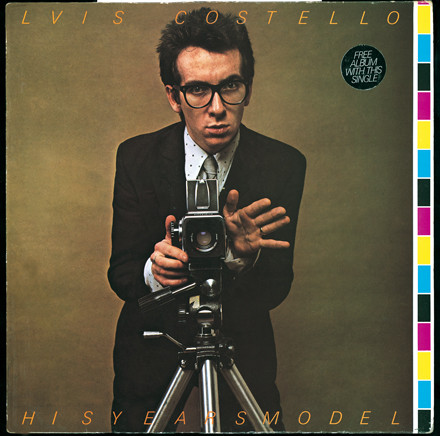
- Wow — Solid Double Plus (A++) grades on both sides of this Elvis Costello classic!
- You’re gonna love the sound here – full-bodied and punchy with a solid low end and excellent presence for Elvis’s vocals
- The bass is right – the moment-to-moment rhythmic changes in the songs are clear and the band swings the way it’s supposed to
- Marks and problems in the vinyl are sometimes the nature of the beast with these vintage LPs – there simply is no way around them if the superior sound of vintage analog is important to you
- 5 stars: “The most remarkable thing about the album is the sound — Costello and the Attractions never rocked this hard, or this vengefully, ever again.”
Pump it up! This British import Radar LP has two outstanding sides that brilliantly and powerfully convey the energy of this hard rockin’ music.
The overall sound is punchy, lively, and dynamic with plenty of tight, note-like bass. This is key to the better copies.
This vintage pressing has the kind of Tubey Magical Midrange that modern records can barely BEGIN to reproduce. Folks, that sound is gone and it sure isn’t showing signs of coming back. If you love hearing INTO a recording, actually being able to “see” the performers, and feeling as if you are sitting in the studio with the band, this is the record for you. It’s what vintage all analog recordings are known for — this sound.
If you exclusively play modern repressings of vintage recordings, I can say without fear of contradiction that you have never heard this kind of sound on vinyl. Old records have it — not often, and certainly not always — but maybe one out of a hundred new records do, and those are some pretty long odds.
What The Best Sides Of This Year’s Model Have To Offer Is Not Hard To Hear
- The biggest, most immediate staging in the largest acoustic space
- The most Tubey Magic, without which you have almost nothing. CDs give you clean and clear. Only the best vintage vinyl pressings offer the kind of Tubey Magic that was on the tapes in 1978
- Tight, note-like, rich, full-bodied bass, with the correct amount of weight down low
- Natural tonality in the midrange — with all the instruments having the correct timbre
- Transparency and resolution, critical to hearing into the three-dimensional studio space
No doubt there’s more but we hope that should do for now. Playing the record is the only way to hear all of the qualities we discuss above, and playing the best pressings against a pile of other copies under rigorously controlled conditions is the only way to find a pressing that sounds as good as this one does.
The Low End Theory
A correct bottom end is absolutely critical for this album. Like Trust and Armed Forces, there’s a ton of low-end on this record; regrettably, most copies suffer from either a lack of bass or a lack of bass definition. I can’t tell you how much you’re missing when the bass isn’t right on this album. (Or if you have the typical bass-shy audiophile speaker, yuck.)
It’s without a doubt the single most important aspect of the sound on this album. When the bass is right, everything falls into place, and the music comes powerfully to life. When the bass is lacking or ill-defined, the music seems labored; the moment-to-moment rhythmic changes in the songs blur together, and the band just doesn’t swing the way it’s supposed to.
Shooting Out the Tough Ones
Big rock records always make for tough shootouts. Their everything-but-the-kitchen-sink approach to recording make it difficult to translate so much sound to disc, vinyl or otherwise. Everything has to be tuned up and on the money before we can even hope to get the record sounding right. (Careful VTA adjustment could not be more critical in this respect.)
If we’re not hearing the sound we want, we keep messing with the adjustments until we do. There is no getting around sweating the details when sitting down to test a complex recording such as this. If you can’t stand the tweaking tedium, get out of the kitchen (or listening room as the case may be). Obsessing over every aspect of a record’s reproduction is what we do for a living. This kind of big rock recording requires us to be at the top of our game, both in terms of reproducing the albums themselves as well as evaluating the merits of individual pressings.
When you love it, it’s not work, it’s fun. Tedious, occasionally exasperating fun, but still fun. And the louder you play a record like this, the better it sounds.
Domestic Elvis: No Action
Domestic Elvis Costello pressings don’t usually do all that much for us. Boosted highs, poor bass definition and copious amounts of grit and grain — 70s Columbia at their best, what else is new? The first album and Spike are the only Elvis records I know of that sound good on domestic vinyl. Forget the rest.
If you love Elvis Costello as much as we do around here, we suggest you do yourself a favor and trash your domestic LPs — you need a British copy to even get in the ballpark, and that’s far from a guarantee of good sound. Elvis is “Still the King,” but you would never know it without the right pressing — like this one.
What We’re Listening For On This Year’s Model
- Energy for starters. What could be more important than the life of the music?
- Then: presence and immediacy. The vocals aren’t “back there” somewhere, lost in the mix. They’re front and center where any recording engineer worth his salt would put them.
- The Big Sound comes next — wall to wall, lots of depth, huge space, three-dimensionality, all that sort of thing.
- Then transient information — fast, clear, sharp attacks, not the smear and thickness so common to these LPs.
- Tight punchy bass — which ties in with good transient information, also the issue of frequency extension further down.
- Next: transparency — the quality that allows you to hear deep into the soundfield, showing you the space and air around all the instruments.
- Extend the top and bottom and voila, you have The Real Thing — an honest to goodness Hot Stamper.
Side One
No Action
This Year’s Girl
The Beat
Pump It Up
Little Triggers
You Belong to Me
Side Two
Hand in Hand
(I Don’t Want to Go To) Chelsea
Lip Service
Living in Paradise
Lipstick Vogue
Night Rally
AMG 5 Star Rave Review
After releasing My Aim Is True, Costello assembled a backing band called the Attractions, which were considerably tougher and wilder than Clover, who played on his debut. The Attractions were a rock & roll band, which gives This Year’s Model a reckless, careening feel. It’s nervous, amphetamine-fueled, nearly paranoid music — the group sounds like they’re spinning out of control as soon as they crash in on the brief opener, “No Action,” and they never get completely back on track, even on the slower numbers.
Costello and the Attractions speed through This Year’s Model at a blinding pace, which gives his songs — which were already meaner than the set on My Aim Is True — a nastier edge. “Lipstick Vogue,” “Pump It Up,” and “(I Don’t Want to Go To) Chelsea” are all underscored with sexual menace, while “Night Rally” touches on a bizarre fascination with fascism that would blossom on his next album, Armed Forces.
Even the songs that sound relatively lighthearted — “Hand in Hand,” “Little Triggers,” “Lip Service,” “Living in Paradise” — are all edgy, thanks to Costello’s breathless vocals, Steve Nieve’s carnival-esque organ riffs, and Nick Lowe’s bare-bones production.
Of course, the songs on This Year’s Model are typically catchy and help the vicious sentiments sink into your skin, but the most remarkable thing about the album is the sound — Costello and the Attractions never rocked this hard, or this vengefully, ever again.