compressed-sound

These albums tend to suffer from exceptionally compressed sound.

They are often Half-Speed mastered and/or pressed on Heavy Vinyl. Many of them are orchestral recordings from the Golden Age.

Our Hot Stamper pressings of these same albums will be dramatically more lively and dynamic than any of the records on this list.

Chad and Bernie Step on Another Rake

Hot Stamper Pressings of the Music of Art Pepper Available Now

Just in time for Record Store Day — what could be better?

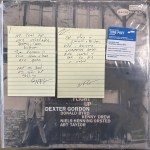
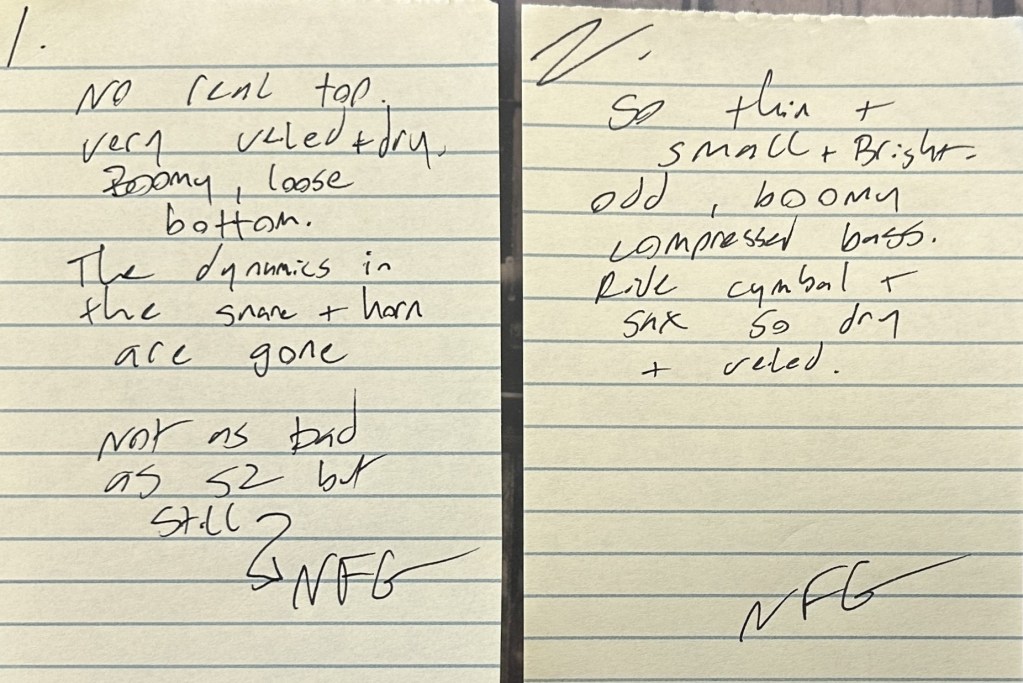
In the interest of streamlining the process of getting reviews like this up on the blog, we’ll try to stick mostly to the facts and let the description of the strengths and weaknesses of the pressings speak for themselves.

One quick note: the sonic qualities you see described below are the ones we heard with the mono switch on our EAR 324P phono stage activated.

Without the switch set to mono, the sound is even thicker and darker.

Yes, as bad as this pressing sounds, you can make it worse if you don’t switch your preamp or phono stage to mono. Hard to believe but it’s true!

The notes for side one can be seen below. For side one we started with the second track.

Side One

Track Two / Red Pepper Blues

  • Boomy low end
  • Sax is stuck [in the speakers]
  • And lacking in breath and space

(more…)

The Power of the Orchestra – Remastered by the Brain Trust at Chesky

Hot Stamper Pressings of Pictures at an Exhibition Available Now

Sonic Grade: F

Lifeless, compressed and thin sounding, here you will find practically none of the weight and whomp that turn the best Living Stereo pressings into the powerful listening experiences we know them to be.

We know that because we’ve played them by the hundreds on big speakers at loud levels.

It’s clean and transparent, I’ll give it that, which is no doubt why so many audiophiles have been fooled into thinking it actually sounds better than the original.

But of course there is no original. There are thousands of them, and they all sound different. (A concept we embraced many years ago and have never found any reason to doubt.)

The commentary reproduced below, from way back when, discusses a pair of records that proves our case in the clearest possible way.

We sold a 2-pack of Hot Stamper pressings, one with a good side one and one with a good side two. Why? Because the other sides were terrible! If you have a bad original, perhaps the Chesky will be better.

Our advice is not to own a bad original, or this poorly-mastered Chesky reissue, but instead we advise that you make the effort to find a good original, or two or three, as many as it takes to get two good sides.

(more…)

Today’s Half-Speed Mastered Mess Is Meddle on Mobile Fidelity

Hot Stamper Pressings of the Music of Pink Floyd Available Now

Sonic Grade: D

Same sonic shortcomings as the MoFi Thick As a Brick. Twenty years ago we wrote:

“The MoFi is TRANSPARENT and OPEN, and the top end will be lush and extended. If you prize clarity, this is the one.”

But if you prize clarity at the expense of everything else, you are seriously missing the boat on Meddle (and Thick As A Brick too).

The MoFi is all mids and highs with almost nothing going on below.

This is a rock record, but without bass and dynamics, the MoFi pressing doesn’t rock, so why would anyone want to own it or play it?

I suppose you could argue that on small speakers the shortcomings of this pressing would be much less bothersome, but on the reference system we use — including the one we had twenty years ago — the lack of low end is a real dealbreaker.

The One Thing They Do

The one thing these pressings have going for them is that they tend to be transparent in the midrange.

It sounds like someone messed with the sound, and of course someone did. They took out the bottom end so that the midrange would be clearer.

That’s one of the tricks these labels use to get their records to impress the audiophiles with small speakers, or ones that are pressed up against the wall, perhaps with a television screen mounted between them.

For some reason, some audiophiles like their records to sound pretty and lifeless with blurry bass.

That is not our sound here at Better Records. We don’t offer records with those qualities and we don’t think audiophiles should be paying good money for records that sound like that.

(more…)

Who in His Right Mind Thinks The Sheffield Track Record Is a Super Disc?

Subtitled: Rock Instrumental Tracks For Audio Component Testing and Evaluation.

Harry Pearson calls this absolutely the best sounding rock record ever made.

If you don’t know anything about rock music, this is the kind of rock music you like.

Harry seems to have known very little about rock. Just check out the TAS List while he was still in charge and see how many real rock albums could be found there back in the day. He mistook these lame instrumentals for actual music with good sound, yet they have neither good sound, nor are they good music.

We cannot agree with HP as to the recording quality of the album either. The sound is surprisingly compressed, and the music is every bit as lifeless as the sound.

Some of the audiophile records I’ve played since I started Better Records in 1987 pissed me off so badly, what with their crappy sound and sometimes even crappier music, as is the case here, I felt they deserved to have their very own special audiophile sh*t list.

Now that I have a blog with unlimited amounts of space to review and categorize the awful records some audiophiles like, that is exactly where this hopeless release can be found.

(more…)

Analogue Productions and Sterling Produce a Disastrous Scheherazade

Hot Stamper Pressings of the Music of Rimsky-Korsakov Available Now

Wikipedia has a nice entry for some of Rimsky-Korsakov’s ideas behind the final movement of the piece:

These [later] works resemble brightly colored mosaics, striking in their own right and often scored with a juxtaposition of pure orchestral groups. The final tutti of Scheherazade is a prime example of this scoring. The theme is assigned to trombones playing in unison, and is accompanied by a combination of string patterns. Meanwhile, another pattern alternates with chromatic scales in the woodwinds and a third pattern of rhythms is played by percussion.

Wikipedia

Could not have said it better myself!

We’ve written at length about the thrills to be had when playing the last movement of Scheherazade — not brilliantly, to be sure, as the writer for Wikipedia has done, but serviceably I hope. Unfortunately, not every pressing of Reiner’s performance is able to communicate the musical values of the work the way the best pressings can.

As you can see from our notes for the this Heavy Vinyl Analogue Productions pressing, the thrill was barely there on the first side, and by the second side it was completely gone.

The notes from our 2024 shootout read:

  • Not dry or squawky
  • Really lacking depth and dynamics.
  • Big, thick bass gets annoying.
  • Big brass not too bright but it is over-textured and flat.

Plenty of modern records suffer from these as well as lots of other shortcomings. For some reason, the writers for The Absolute Sound who put this crappy LP on their Super Disc list didn’t seem bothered by them the way we were.

If you own this pressing, here are the kinds of things you might want to listen for in order to recognize its many, and quite serious, failings.

When played head to head against any properly-mastered vintage vinyl LP, this pressing will fall short in a number of important areas. Linked below are titles we’ve found to be good for testing these same qualities in a recording.

(more…)

Ziggy Stardust – MoFi Reviewed

Hot Stamper Pressings of the Music of David Bowie Available Now

Sonic Grade: C-

The MoFi pressing is decent, probably better than the average domestic copy I suppose, since those are clearly made from dubbed tapes.

The colorations and limitations of their cutting system would make it far too painful for me to listen to it though, especially the sloppy bass and dynamic compression.

You can do worse but you sure can do a whole lot better, hence the C grade.

MoFi did two of the greatest Bowie albums of all time, Ziggy and Let’s Dance, and neither one of them can hold a candle to the real thing. If you want to settle for a mediocre imitation of either or both of those albums, stick with Mobile Fidelity.

If you want to hear the kind of Demo Disc sound that Bowie’s records are capable of, try a Hot Stamper pressing. It’s guaranteed to blow your mind or your money back.

(more…)

Remind Me, What Is the Point of Listening to a Quiet Record with Mediocre Sound?

Hot Stamper Pressings of the Music of Igor Stravinsky Available Now

A lackluster reissue from Philips, bad enough to qualify for our hall of shame.

This is some truly dead as a doornail sound, sound which is not remotely competitive with the real Mercury pressings we’ve played. The FR pressings of the recording can be phenomenally good.  Even the later M2 pressings from Philips can be excellent. 

Back in the 80s and 90s, I actually used to like some of the Golden Import pressings.  That was a long time go, and thankfully our playback system is quite a bit more revealing than the one I had back in those days.

After playing literally tens of thousands of records since then, my critical listening skills are better too.

Now when I play these imports, they sound veiled, overly smooth, smeary and compressed, not too different from the average Philips pressing, which of course is exactly what they are. They’re all remastered by Philips, to give the Mercury tapes the sound that Philips thinks they should have. Sadly, not much of the Mercury Living Presence sound has survived.

We complain about mixing and mastering engineers who felt compelled to bring a new sound to old favorites.

The Philips label that produced the Golden Import series are serial offenders in this regard.

The Golden Import pressings might be good for audiophiles who care more about quiet surfaces than good sound.  We are firmly staked at the opposite side of that trade-off.

Quiet vinyl means nothing if the sound is poor, or, at the very least, wrong for the recording.

(more…)

How Can Sound This Bad Possibly Earn a 10?

Hot Stamper Pressings of the Music of Bob Dylan Available Now

Maybe if the scale goes from 1 to 100, sure, I could see it. Yeah, 10 out of 100 sounds about right.

But the scale goes to 11, which makes a grade of 10 risible to anyone who has played this seriously flawed pressing. Here is how we described its sound many years ago:

We found this mono reissue to be flat as a pancake and dead as a doornail, like most of the Sundazed records we’ve played, starting way back in the early 2000s. No, they never got any better.

In our experience, Sundazed is one of the worst record labels of all time. This pressing is just more evidence to back up our low opinion of them.

Obviously we may have a low opinion of them, but a famous audiophile reviewer seemed to find the sound to his liking. He wrote:

Sundazed’s reissue gives the original a run for the money and remains true to the original, though it suffers in the bass, which while deep and reasonably well defined, is not as tightly drawn or focused. The upper mids on the original also bloom in a way that the reissue’s don’t, giving the reissue a slightly darker, recessed sound, but there’s still sufficient energy up there since Dylan’s close-miked vocals pack an upper midrange punch. If the vocals or harmonica sound spitty and unpleasantly harsh, it’s your system, not the record [!] – though there’s plenty of grit up there. On the plus side, the overall clarity and transparency of the reissue beats the original. [!] A really fine remastering job.

Of course we find every word of this review arrant nonsense, except the discussion of the qualities he praises in the original relative to the reissue. It’s been twenty years since this remastered pressing came out, does anybody still like the sound of it? Anybody? Let’s hope not.

The intro to his review boldly declares a respect for Sundazed (and Classic Records and Analogue Productions) that we find puzzling after playing so many of their rarely-better-than-awful-sounding records. (Here is a commentary from 2007 that puts our antipathy in perspective. And no, modern records have no improved since then, if the releases from 2024 are any indication.)

Sundazed’s decision to issue Blonde on Blonde using the much sought after mono mix is indicative both of the company’s dedication to doing what’s musically correct, and of the vinyl marketplace’s newfound maturity. There was a time a few years ago when no “audiophile” vinyl label would dare issue a mono recording; audiophiles wouldn’t stand for it was the conventional wisdom. Perhaps back then it was even true. Today, with Sundazed, Classic, Analogue Productions and others issuing monophonic LPs on a regular basis (and one has to assume selling them as well) listeners are appreciating the music for music’s sake, and equally importantly, for the wonderful qualities of monophonic sound reproduction.

My grade might be 2 out of 11. No audiophile should be fooled by the crap sound of this pressing, and no audiophile should believe a word of this review.

Reviewer incompetence? We’ve been writing about it for more than 25 years. From the start we knew we could never begin to do much more than scratch the surface of preposterous record reviews in need of rebuttal. The audiophile world is drowning in this sh*t.

(more…)

Time Loves a Hero May Be Transparent in the Midrange, But So What?

Hot Stamper Pressings of the Music of Little Feat Available Now

Sonic Grade: D

After playing a killer Hot Stamper pressing of the album many years ago, we wrote the following: 

If you own the Nautilus Half-Speed, a record we actually liked years ago even after we had forsworn those kinds of pressings, you are really in for a treat. THIS is what the band sounds like in the REAL world, not the phony audiophile world that so many of our fellow hobbyists appear to be perfectly happy living in.

Just listen to how punchy the drums are on the real pressings, a perfect example of what proper mastering does well and Half-Speed mastering does poorly.

When you listen to a top quality pressing, you feel that you are hearing this music EXACTLY the way Little Feat wanted it to be heard. I just don’t get that vibe from the Half-Speed.

I was fooled back in the day myself. The one thing these pressings have going for them is that they tend to be transparent in the midrange.

It sounds like someone messed with the sound, and of course someone did. That’s how they get those audiophile records to sound the way they do.

For some reason, some audiophiles like their records to sound pretty and lifeless with sloppy bass.

That is not our sound here at Better Records. We don’t offer records with those qualities and we don’t think audiophiles should have to put up with sound like that.


Further Reading on the subject of Half-Speed mastering

(more…)

Add Made in Japan to the List of Ridiculously Bad DCC Titles

Hot Stamper Pressings of the Music of Deep Purple Available Now

What a murky mess. The sound is dead as a doornail.

It’s yet another audiophile record hall of shame pressing, a Heavy Vinyl disaster if there ever was one.

Is it the worst version of the album ever made?

That’s hard to say. But it is the worst sounding version of the album we’ve ever played, and that should be good enough for any audiophile contemplating spending money on this kind of trash. Take our advice and don’t do it.

If you like the sound of old McIntosh tube equipment such as the Mac 30s shown here, a sound Steve Hoffman apparently cannot get enough of, DCC is the label for you.

We don’t sell junk like this, but every other audiophile record dealer does, because most of the current group of mastering engineers making records for audiophiles have somehow gotten into their heads that this is the way records should sound.

We’ve been telling them they are wrong about that for years now, that good records have never sounded this way, but the collectors and audiophiles of the world keep buying their wares, so why should they listen to us?

What a Fool Believes

I used to like some of the DCC vinyl titles just fine too. Didn’t play them very often, but I liked what I heard when I did.

Then my stereo got a lot better. Eventually it became obvious to me what was wrong with practically all of the Heavy Vinyl pressings put out by that label. (That story from 1998 gets told in some detail here.)

Heavy Vinyl

The good Heavy Vinyls can be found in this group, along with other Heavy Vinyl pressings we liked or used to like.

The bad Heavy Vinyls can be found in this group. And those in the middle end up in this group.

Audio and record collecting (they go hand in hand) are hard. If you think either one is easy you are very likely not doing it right, but what makes our twin hobbies compelling enough to keep us involved over the course of a lifetime is one simple fact, which is this: Although we know so little at the start, and we have so much to learn, the journey itself into the world of music and sound turns out to be both addictive and a great deal of fun.

(more…)