Pressings with Weak Sound or Music

These vintage records didn’t sound very good to us. Additionally, some made the list because the music or performances were not to our liking.

As to their sound quality, some of them are bad recordings, but some are no doubt just bad pressings of good recordings. Either way, audiophiles should avoid them.

Bad sounding Heavy Vinyl and Half-Speed mastered pressings can be found in their own sections.

Some Pressings of Tchaikovsky’s Piano Concerto No. 1 Can Sure Be a Letdown

Hot Stamper Pressings of the Music of Tchaikovsky Available Now

I don’t know of another recording of the work that gets the sound of the piano better. On the properly-mastered, properly-pressed copies, the percussive quality of the instrument really comes through.

But that quality (along with lots of others) is only heard on the better copies.

The reissues (one with the later Tulips label, one with the earlier Large Tulips label) described below are at best passable, and some of them were just awful.

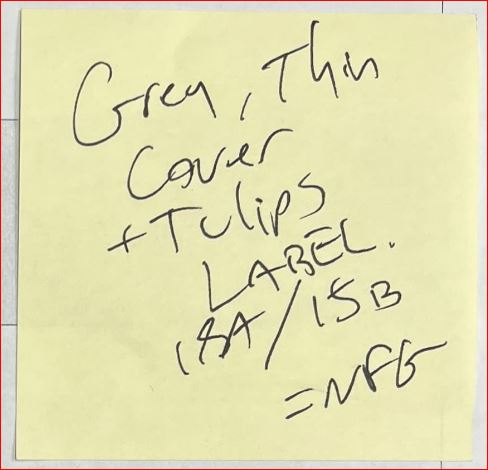
The note to the left makes clear that even some of the early Large Tulips label pressings had very bad sound. Watch out especially for 18A/15B stampers. They’re NFG: No F***ing Good.

As you can see from the notes above for this particular recording in the Black and White cover, one side was passable, earning our 1.5+ grade. That makes it a decent sounding record, I suppose, but it’s a long, long, long way from the best.

1.5+ is four grades down from the top copy. That’s a steep dropoff as far as we’re concerned. 1.5+ only hints at how good a recording this DG can be on the best pressings.

To see more records that earned the 1.5+ grade, please click here. (Incidentally, some of them are even on Heavy Vinyl. The better modern pressings have sometimes, if rarely, been known to earn Hot Stamper grades, and two recently shocked the hell out of us by actually winning a shootout. Wouldn’t you like to know which two!)

One Plus (1+) is a sub-Hot Stamper grade. We do not sell records that do not earn a grade of at least 1.5+ on both sides.

For those who might be interested, there’s more on our grading scale here.

Our Favorite Performance with Sound to Match

A recent listing for the album can be found here.

Without question this is a phenomenal piano recording in every way.

On the best copies the rich texture of the strings is out of this world — you will have a very hard time finding a DG with better string tone. This record does not have the shortcomings of the average DG: it’s not hard, shrill, or sour.

DG made plenty of good records in the 50s and 60s, then proceeded to fall apart, like most labels did. This is one of their finest. It proves conclusively that at one time — 1962 to be exact — they clearly knew exactly what they were doing.

It’s amazing how many piano recordings have poorly-miked pianos. The badly recorded pianos are either too distant, lack proper reproduction of the lower registers, or somehow smear the pounding of the keys into a blurry mess.

Are they badly recorded?

Or is it a mastering issue?

Perhaps a pressing issue?

(more…)

Are All the Masterdisk Pressings of 2112 Good Sounding?

Hot Stamper Pressings of the Music of Rush Available Now

Even though many of the original pressings are mastered at Masterdisk (by HW, BK and GK), some of the reissues from 1979 on the “skyscraper” label are too.

But none of the later pressings we played sounded very good. Audiophiles looking for top quality sound should stick to the domestic originals.

What We’re Listening For On 2112

  • Energy for starters. What could be more important than the life of the music?
  • Then: presence and immediacy. The vocals aren’t “back there” somewhere, lost in the mix. They’re front and center where any recording engineer worth his salt would put them.
  • The Big Sound comes next — wall to wall, lots of depth, huge space, three-dimensionality, all that sort of thing.
  • Then transient information — fast, clear, sharp attacks, not the smear and thickness so common to these LPs.
  • Tight punchy bass — which ties in with good transient information, also the issue of frequency extension further down.
  • Next: transparency — the quality that allows you to hear deep into the soundfield, showing you the space and air around all the instruments.
  • Extend the top and bottom and voila, you have The Real Thing — an honest to goodness Hot Stamper.

(more…)

RCA Released This Awful Living Stereo with Reiner in 1958

Hot Stamper Pressings of Living Stereo Recordings Available Now

Some audiophiles buy albums with their favorite labels. For example, this pressing from the Golden Age of RCA Living Stereo might appeal to a certain kind of audiophile who treasures LSC’s on the Shaded Dog label.

More than that, he might even limit himself to 1S Indianapolis pressings.

However, many records from this era simply do not sound good, and this is one of them.

We have never heard a good sounding copy of LSC 2112, and we’ve played plenty of them over the decades we’ve been in the business of selling Golden Age classical records.

A copy came in just last week [which was many, many years ago] and I figured it was time to give it a spin and see if there was any reason to change my opinion. Hey, maybe this one had Hot Stampers! Can’t say it wouldn’t be possible. Unlikely, yes, impossible, no.

So here’s what I heard: A wide stage. A bit dry.

But then the trouble started: Shrill strings?!

That’s all she wrote.

A Johann Strauss record with shrill strings is a non-starter. All is not lost however. Decca knew how to record Strauss, and they had halls with wonderful acoustics to do it in.

(more…)

Don’t Waste Your Money on this RCA from 1960

Hot Stamper Pressings of the Music of Modest Mussorgsky Available Now

Never liked the performance. The sound can be quite good on the best pressings, but too many copies are congested in the loudest passages.

We recently found a pressing that was quite a bit better than the other Reiner pressings we had on hand, which simply means that good pressings exist, but they are very hard to find.

However, without a good cleaning, this record is very unlikely to sound right on high quality modern equipment.

There are quite a number of other vintage classical releases that we’ve run into over the years with similar shortcomings.

For fans of vintage Living Stereo pressings, here are some to avoid.

Some audiophiles may be impressed by the average Shaded Dog pressing, but I can assure you that we here at Better Records are decidedly not of that persuasion.

Something in the range of five to ten per cent of the major label Golden Age recordings we play will eventually make it to the site. The vast majority just don’t sound all that good to us. (Many have second- and third-rate performances and those get tossed without ever making it to a shootout.)

It may be on the TAS super disc list, but that doesn’t mean the sound is up to our standards.

We much prefer Muti’s performance from 1979 for EMI.

(more…)

These Are the Stampers to Avoid on The Doors’ Debut

Hot Stamper Pressings of the Music of The Doors Available Now

In our experience, the Gold Label stereo originals with 1B/1B stampers are terrible sounding.

With 1B stampers it’s bad enough to go into our hall of shame for vintage pressings.

(Bad sounding audiophile records, being so plentiful, especially these days, have their own hall of shame.)

No surprise there; it’s just another bad sounding original pressing that ended up doing poorly in one of our shootouts.

We’ve auditioned countless pressings like this one in the 37 years we’ve been in business — buying, cleaning and playing them by the thousands. This is how we find the best sounding vinyl pressings ever made.

Not the ones that should sound the best. The ones that actually do sound the best.

If you’re an audiophile looking for top quality sound on vintage vinyl, we’d be happy to send you the Hot Stamper pressing guaranteed to beat anything and everything you’ve heard, especially if you have any pressing marketed as suitable for an audiophile. Those, with very few exceptions, are the worst.

(more…)

Don’t Waste Your Money on this Living Stereo from 1962

Hot Stamper Pressings of Living Stereo Titles Available Now

LSC 2612, released in 1962 on the Shaded Dog label, offers Handel’s Water Music and Royal Fireworks with Stokowski conducting, engineered by one of the greats, Robert Simpson.

The sound is terrible however.

The copies we had on hand were loud and crude, with steely strings and not much in the way of hall space. In other words, LSC 2612 seems to suffer from the “old record” sound that we’ve found on many of the hundreds of vintage pressings we’ve auditioned over the years as we were looking for top quality recordings to put in our Hot Stamper shootouts.

If you want a good Water Music, the right stamper pressings of the Philips recording with Leppard are the best we’ve ever played.

The Shaded Dog of LSC 2612 might be passable on an old school system, but it was too unpleasant to be played on the high quality modern equipment we use.

Leave this RCA to the collectors. Some audiophiles are of the opinion that vintage Living Stereo recordings on the original label can do no wrong, but we have never subscribed to that view.

There are quite a number of other records that we’ve run into over the years with similar shortcomings. Here are some of them, a very small fraction of what we’ve played, broken down by label.

  • London/Decca records with weak sound or performances
  • Mercury records with weak sound or performances
  • RCA records with weak sound or performances

1962 was a phenomenal year for audiophile quality recordings – we’ve auditioned and reviewed more than one hundred and twenty titles as of 2024, and there are undoubtedly a great many more that we’ve yet to discover.

When it comes to classical and orchestral titles, more than a dozen are so good that we would consider them Must Owns.

(more…)

These Are the Stampers to Avoid on A Hard Day’s Night

Hot Stamper Pressings of the Music of The Beatles Available Now

In our experience, the stereo pressings with -2/-2 stampers are terrible sounding.

We do not have any on hand, but we doubt that -1/-1 — the original, the first, the one approved by George Martin himself! — is any better.

With -2 stampers this is a hall of shame pressing, as well as another early Beatles LP reviewed and found seriously wanting.

You may know that the pressings with -2 stampers are the ones that come in the original BC-13 Beatles Box from 1978.

Some of the titles in that set can sound very good, but this is not one of them. To recognize a mid-70s pressing, note that the back of the jacket will have a laminate strip on the side. At the bottom of this post you can find a picture of it.

Avoid that cover and the record inside it if you want a good sounding pressing of A Hard Day’s Night.

That Old Canard

The early pressings are consistently grittier, edgier and more crude than the later pressings we’ve played. So much for that old canard that “the original is better.” When it comes to A Hard Day’s Night it just ain’t so, and it doesn’t take a state-of-the-art system or a pair of golden ears to hear it.

The audiophile community seems not to have caught on to the faults of the early Beatles pressings, but we here at Better Records are doing our best to correct these and other misconceptions, one Hot Stamper pressing at a time.

It may be a lot of work, but we don’t mind — we love The Beatles! We want to find the best sounding copies of ALL their records, and there is simply no other way to do it than to play them, preferably by the dozens.

(more…)

Sterling Cut By Far the Best Sounding Pressings of I’m Ready

Hot Stamper Pressings of Soul, Blues, R&B, etc. Available Now

Forget the reissue copies that come in the cover you see to the left, the one with a thin black border.

If you want to hear this album right, a Hot Stamper early domestic pressing is the only way to go.

And take it from us, you need to see the Sterling mark in the dead wax of your pressing to have any hope of hearing audiophile-quality sound.

As you can see from the notes above, the two reissue non-Sterling copies we played had hopelessly bad sound.

One was smeary, hard and hot.

The other was the brightest and most spitty.

Note that we didn’t deem it necessary to play side two of either copy. A one plus side one rules out the possibility of it being a Hot Stamper pressing.


Consider taking our moderately helpful advice concerning the pressings that consistently win our shootouts.

Based on our experience, I’m Ready sounds its best:

(more…)

Analogue Productions and Sterling Produce a Disastrous Scheherazade

Hot Stamper Pressings of the Music of Rimsky-Korsakov Available Now

Wikipedia has a nice entry for some of Rimsky-Korsakov’s ideas behind the final movement of the piece:

These [later] works resemble brightly colored mosaics, striking in their own right and often scored with a juxtaposition of pure orchestral groups. The final tutti of Scheherazade is a prime example of this scoring. The theme is assigned to trombones playing in unison, and is accompanied by a combination of string patterns. Meanwhile, another pattern alternates with chromatic scales in the woodwinds and a third pattern of rhythms is played by percussion.

Wikipedia

Could not have said it better myself!

We’ve written at length about the thrills to be had when playing the last movement of Scheherazade — not brilliantly, to be sure, as the writer for Wikipedia has done, but serviceably I hope. Unfortunately, not every pressing of Reiner’s performance is able to communicate the musical values of the work the way the best pressings can.

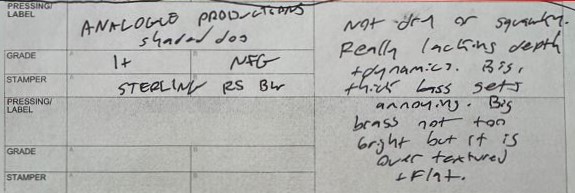
As you can see from our notes for the this Heavy Vinyl Analogue Productions pressing, the thrill was barely there on the first side, and by the second side it was completely gone.

The notes from our 2024 shootout read:

  • Not dry or squawky
  • Really lacking depth and dynamics.
  • Big, thick bass gets annoying.
  • Big brass not too bright but it is over-textured and flat.

Plenty of modern records suffer from these as well as lots of other shortcomings. For some reason, the writers for The Absolute Sound who put this crappy LP on their Super Disc list didn’t seem bothered by them the way we were.

If you own this pressing, here are the kinds of things you might want to listen for in order to recognize its many, and quite serious, failings.

When played head to head against any properly-mastered vintage vinyl LP, this pressing will fall short in a number of important areas. Linked below are titles we’ve found to be good for testing these same qualities in a recording.

(more…)

Remind Me, What Is the Point of Listening to a Quiet Record with Mediocre Sound?

Hot Stamper Pressings of the Music of Igor Stravinsky Available Now

A lackluster reissue from Philips, bad enough to qualify for our hall of shame.

This is some truly dead as a doornail sound, sound which is not remotely competitive with the real Mercury pressings we’ve played. The FR pressings of the recording can be phenomenally good.  Even the later M2 pressings from Philips can be excellent. 

Back in the 80s and 90s, I actually used to like some of the Golden Import pressings.  That was a long time go, and thankfully our playback system is quite a bit more revealing than the one I had back in those days.

After playing literally tens of thousands of records since then, my critical listening skills are better too.

Now when I play these imports, they sound veiled, overly smooth, smeary and compressed, not too different from the average Philips pressing, which of course is exactly what they are. They’re all remastered by Philips, to give the Mercury tapes the sound that Philips thinks they should have. Sadly, not much of the Mercury Living Presence sound has survived.

We complain about mixing and mastering engineers who felt compelled to bring a new sound to old favorites.

The Philips label that produced the Golden Import series are serial offenders in this regard.

The Golden Import pressings might be good for audiophiles who care more about quiet surfaces than good sound.  We are firmly staked at the opposite side of that trade-off.

Quiet vinyl means nothing if the sound is poor, or, at the very least, wrong for the recording.

(more…)