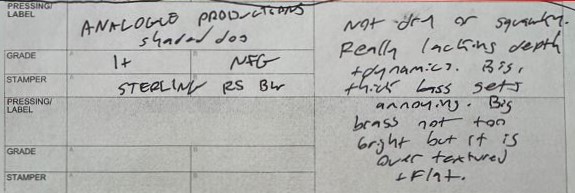
Pressings with Weak Sound or Music

These vintage records didn’t sound very good to us. Additionally, some made the list because the music or performances were not to our liking.

As to their sound quality, some of them are bad recordings, but some are no doubt just bad pressings of good recordings. Either way, audiophiles should avoid them.

Bad sounding Heavy Vinyl and Half-Speed mastered pressings can be found in their own sections.

Looking For a Top Quality Jazz Record? Skip the OJC of All Night Long

Hot Stamper Pressings of Outstanding Jazz Recordings Available Now

If you see this OJC pressing in your local record store, best skip it.

The sound is dry and bright. It’s passable, but it’s certainly not very good, and probably the CD is better, assuming you are willing to go through a number of discs until you find one that is mastered properly.

To help you avoid records with this kind of sound, we have linked to others with similar problems on the blog.

Here are some of the titles we’ve found that tend to have dry sound and here are some that tend to have bright sound.

We’ve easily played more than a hundred OJC pressings in the 37 years we’ve been in the record business. Here are reviews for some of the ones we’ve auditioned to date:

(more…)

Strawberry Cut By Far the Best Sounding Pressings of Zenyatta Mondatta

Hot Stamper Pressings of Sting and The Police Available Now

Forget the domestic pressings, forget the lightweight Nautilus Half-Speed, forget whatever lame reissues have come or will come down the pike – if you want to hear this album right, a Hot Stamper UK pressing is the only way to go.

And take it from us, you need to see that little Strawberry marking in the dead wax of your UK pressing to have any hope of hearing audiophile-quality sound.

Why go to all that trouble? Because the album is an absolute classic – it leads off with “Don’t Stand So Close To Me” and never lets up. (Well, toward the end of side two it lets up, but it’s plenty strong before then.)

Consider taking our moderately helpful advice concerning the pressings that tend to win our shootouts.

(more…)

Art Pepper Today – Latest Findings

Hot Stamper Pressings of the Music of Art Pepper Available Now

UPDATE 2024

In 2010 we wrote a commentary about the album which can be found here.

It’s a long story that goes into great detail comparing the sound of the original Galaxy pressings with those of the much more common OJC’s.

Fourteen years later (!) and here we are, finally getting to the point where we have enough copies of Art Pepper Today to do a proper shootout.

Since this is a title we have not played in a very long time, we took the opportunity to give a quick listen to both kinds of pressings just to make sure that both could be expected to do well enough to be included in the shootout.


The OJCs Fall Short in a Different Way

Well, it turns out that the OJC pressings are no longer cutting it. That’s money down the drain.

It seems to be the case that they are dark and hard sounding compared to the Galaxy pressings.

This is a bit surprising because most of the OJC pressings that we don’t like are thin and bright, not dark and hard.

That’s not the way OJC’s typically sound, but in the world of records, when has that ever counted for anything?

Patterns are helpful up to a point, but on this album, the patterns we see across the label have broken down, which is why our business is built upon a foundation of playing every record we sell and judging it strictly on its own merits.

There are just too many exceptions to whatever patterns we may think we have detected.

(more…)

Audiophiles Should Give Reiner’s Rossini Overtures a Miss

More of the music of Gioachino Rossini (1792-1868)

None of the pressings we played of this RCA were remotely competitive with Maag and the PCO on London.

The sound of this RCA was consistently boxy and congested, a case of the “old record” sound we find on countless vintage pressings. The world is full of bad records. We’ve suffered through them by the thousands.

Only an old school audio system can hide the faults of a pressing such as this. The world is full of those too, even though they might comprise all the latest and most expensive components.

There are quite a number of Golden Age pressings that we’ve run into over the years with obvious shortcomings.

Here are some of them, a very small fraction of what we’ve auditioned, broken down into the three major labels that account for most of the best classical and orchestral titles we’ve had the pleasure to play.

  • London/Decca records with weak sound or performances
  • Mercury records with weak sound or performances
  • RCA records with weak sound or performances

We’ve auditioned countless pressings in the 37 years we’ve been in business — buying, cleaning and playing them by the thousands.

This is how we find the best sounding vinyl pressings ever made, through trial and error. It may be expensive and time consuming, but there is simply no other method for finding better records that works. If you know of one, please write me!

We are not the least bit interested in records that are “known” to sound the best.

Known by whom? Which audiophiles — hobbyists or professionals, take your pick — can be trusted to know what they are talking about when it comes to the sound of records?

I have never met one, outside of those of us who work for Better Records. I remain skeptical of the existence of such a creature. The audiophile experts and reviewers I’ve encountered on the web seem hopelessly lost to me.


UPDATE: 2024

Woops, I take that back. I have met one, a certain Mr. Robert Brook. He has been conducting his own shootouts for a few years now and has made his findings available on his blog, The Broken Record. This is information you can trust.


(more…)

Audiophiles Should Give Monteux’s Surprise and Clock Symphonies a Miss

Hot Stamper Pressings of the Music of Joseph Haydn Available Now

None of the pressings we played of this RCA (LSC 2394) were remotely competitive with Fjelstad’s recording for RCA from 1959.

The sound of the RCA Shaded Dog we played was consistently compressed and veiled, a case of the “old record” sound we find on far too many vintage pressings.

The world is full of old records that just sound like old records. We’ve suffered through them by the tens of thousands.

Our website, as well as this blog, are devoted to helping audiophiles find pressings that don’t sound anything like the millions of run-of-the-mill LPs that have been stamped out for the last seven decades.

Even a million dollar stereo can’t make the average record sound good, and the more accurate and revealing the system, the more limited and lifeless the average record will show itself to be.

The White Dog pressing was even worse. It was hot, dry and flat. Who wants to play a record that sounds like that?

Only an old school audio system can hide the faults of pressings such as these. The world is full of those too, even though they might comprise all the latest and most expensive components.

(more…)

RCA Released this Awful Living Stereo Recording in 1958

Hot Stamper Pressings of the Music of Tchaikovsky Available Now

Some audiophiles buy albums based on their labels. For example, this pressing from the Golden Age of Living Stereo might appeal to a certain kind of audiophile who treasures LSC’s with the original Shaded Dog label.

More than that, he might limit himself to 1S Indianapolis pressings. Hoorah! What could be better?

However, many records from this era simply do not sound good, and this is one of them. We have never heard a good sounding copy of LSC 2216, and we’ve played quite a number of them over the decades we’ve been in the business of selling Golden Age classical records.

A copy came in just last week so I figured it was time to give it a spin and see if there was any reason to change my opinion. Hey, maybe this one had Hot Stampers! Can’t say it wouldn’t be possible. Unlikely, yes, impossible, no.

So here’s what I heard. No real top above 6k, hardly any bottom, dry and thin, but with a very wide stage – the textbook definition of “boxy sound.”

If you are a fan of Living Stereo pressings, have you noticed that many of them – this one for example – don’t sound good?

If you’re an audiophile with good equipment, you should have. But did you? Or did you buy into the hype surrounding these rare LSC pressings and just ignore the problems with the sound?

(more…)

The Wrong Stampers on Some Albums Are Shockingly Bad

Hot Stamper Pressings of the Music of Carly Simon Available Now

Below you will see the bottom part of the stamper sheet for a shootout we did recently.

Please note that the album you see pictured is not the record we are discussing here. It very well could have been been a Carly Simon album, or something from some other artist, but all we can say for sure is that it was definitely an album from the 70s on Elektra.

We are not revealing what record had these stampers and earned these grades for the simple reason that avoiding these bad labels for the record in question would make it fairly easy to figure out what the better pressings of the album might be.

As I’m sure you can understand, we want you to buy the copy with the Hottest Stampers from us, not find one on your own.

We’re happy to be moderately helpful, but naturally we find it necessary to draw the line somewhere, and giving out the kind of information that makes it is easy to find the best pressings is where we have chosen to draw it. The top copies are the ones that pay the bills around here, and with a staff of ten, in California no less, the bills are sizable.

We appreciate your understanding.

(more…)

How Do the Columbia Special Products Reissues Sound on Mingus Dynasty?

Hot Stamper Pressings of the Music of Charles Mingus Available Now

In general it is best to avoid pressings with the round sticker you see to the left, the one attached to the Columbia Special Products bargain reissue series.

They are rarely much better than awful, although there are a few exceptions to that rule. (There are almost always exceptions to the kinds of rules collectors use to find the best sounding records.)

The 6 Eye label domestic stereo pressings of Mingus Dynasty win our shootouts, in this case without exception.

On this title, the 360 label pressings, Black Print or White Print, can sound very good, but they never win shootouts.

We’ve identified a select group of reissues with the potential to do well in shootouts, typically earning a grade of Super Hot (A++) when up against the best originals, which are the only ones that seem to have the potential to earn our top grade, White Hot (A+++).

(more…)

Neither of These Tchaikovsky 5ths Made the Grade

More of the music of Peter Ilyich Tchaikovsky (1840-1893)

We’ve been playing quite a number of different pressings of Tchaikovsky’s Symphony No. 5 lately, hoping to find a 5th that would really knock us out.

Most have left us unimpressed with the quality of the sound, and in the case of this Solti on London, the performance.

London CS 6117. Solti conducts the Paris Conservatory Orchestra.

The sound is OK. It’s fairly tubey and there’s a decent amount of energy to the recording.

The problem is not the sound, the problem is that the performance is terrible. Our main listening guy said he could hardly recognize the music!

DG SLPM 138 658. Mravinsky conducting the Leningrad Phil on an early pressing from 1961.

Big energy and a great performance but the string tone is shrill and smeary.

We are very used to hearing this kind of sound on Deutsche Grammophon records. This is why you see so few of that label’s pressings on our site.

How Did We Figure All of This Out?

There are more than 2000 Hot Stamper reviews on this blog. Do you know how we learned so much about so many records?

Simple. We ran thousands and thousands of record experiments under carefully controlled conditions, and we continue to run scores of them week in and week out to this very day.

(more…)

A Pink Label Island LP Left Us with Egg on Our Face

Hot Stamper Pressings of the Music of Traffic Available Now

We used to think that The Best of Traffic had better sound than the early pressings of Mr. Fantasy, but in a head to head comparison with a killer copy we played not long ago, we were proved wrong, or, perhaps more accurately, we proved ourselves wrong, something we pride ourselves in being able to do by carrying out regular shootouts for records we’ve been listening to for more than twenty years.

Oddly enough, in our shootouts we often learn new things about records we thought we knew well.

Here is what we had to say about one of the tracks on Mr. Fantasy that we thought sounded dramatically better on The Best of Traffic back around 2005:

Best evidence: Heaven Is In Your Mind, the second track on side one. It is amazing sounding here and such a disappointment on every Pink Label Island original we’ve played.

Once you know how good that song can sound — by playing a Hot Stamper copy of Best of Traffic like this one — going back to the original version of the song found on the album is not just a letdown, it’s positively painful. Where’s the analog magic? The weight to the piano? The startling clarity and super-spaciousness of the soundfield? The life and energy of the performance?

They’re gone, brother. Not entirely gone, mind you, more a shadow of what they should be, but once you’ve heard the real thing it’s not a lot of fun listening to a shadow.

You can be sure that we did not know what we were talking about when we wrote all that.

What we had done is assumed that all the pink label pressings of Mr. Fantasy sounded like the one we played, something we’ve been telling audiophiles for twenty years not to do, because collecting records by label is a fool’s game.

In this case, clearly we are the fools.

It probably — probably, since all the evidence points in the same direction — had the stampers you see below, apparently known as an Orlake Pressing, something I knew nothing about until reading about it on Discogs just now.

  • Matrix / Runout (Side A, stamped): ILPS+9061+A
  • Matrix / Runout (Side B, stamped): ILPS+9061+B

These same stampers would be used to press the Pink Rim Label copy you see below. We put it into a recent shootout and described it as having “hollow, dubby” sound.

Yes, we heard the very same “dubby” sound on a copy we played about twenty years ago, and thought all the early pressings on Island, pink and pink rim alike, had these same mastering shortcomings.

Back then we didn’t know what we know now, which is that the right UK pressings on Island of Mr. Fantasy are dramatically better sounding.

In fact, they handily win our shootouts, something they have been doing for at least the last ten years or so.

We’ve run into so many sonically-flawed Pink label Island pressings by now that hearing one sound lackluster if not actually awful doesn’t phase us in the least.

Some of the other pink label Island pressings that never win shootouts can be found here.

But before that, back in the dark days of the early 2000s, we clearly were lacking a comprehensive understanding of the sound of the various UK pressings of the album.

There was a great deal of research and development left to be done. Eventually our efforts led to a breakthrough in 2006.

For more than twenty years, this is the kind of work we have undertaken. Why? Because we get paid to do it.

We may be the most knowledgeable experts on the planet when it comes to the best sounding pressings of audiophile-quality recordings — if we’re not I’d like to know who is, and how they came by that information — but that doesn’t mean we know it all.

If we come across that way, it’s the result no doubt of our enthusiastic responses to the hundreds of amazing records we’ve had the pleasure to hear. For example, here’s one, and of course there are literally hundreds and hundreds of others with similarly over-the-top notes. Allow me to apologize for any misunderstanding our commentary may have caused.

One thing we do know: all knowledge, of records or anything else you care to name, is provisional.

If somehow we did know it all, there would not be a hundred entries in our live and learn section.

We regularly learn from our mistakes — like the record reviewed here — and we hope you do too.

However, we learn things from the records we play — not by reading about them, but by playing them. Our record experiments, conducted using the shootout process we’ve painstakingly developed and refined over the course of the last twenty years, produces all the data we need: the winners, the losers, and rankings for all the records in between.

We’ve achieved our results by purposefully ignoring everything there is to know about a record — who made it, how they made it, when they made it — everything, that is, but the sound coming out of the speakers of our reference system.

(more…)