*Arcana – Label Advice

Some of the titles listed here have better sound on labels that many record collectors would probably not assume would be the best.

Other titles have inferior sound based on the labels we’ve identified in these listings.

Keep in mind that all the practical advice you see here is based solely on the numerous experiments we’ve run and the data we’ve collected from them.

An Overview of Beatles Oldies But Goldies

Hot Stamper Pressings of the Music of The Beatles Available Now

This is a Beatles album we think we know well.

We’ve done a number of shootouts for A Collection of Beatles Oldies over the last ten years or so, and our experimental approach using many dozens of copies provides us with strong evidence to support the following conclusions regarding the sound of the originals vis-a-vis the reissues:

  1. The best of the early pressings always win our shootouts. No reissue has ever earned our top grade of A+++ and it is unlikely any reissue ever will.
  2. The reissues can be quite good however. The best of them have earned grades of Double Plus (A++).
  3. The worst of the early pressings also earned grades of Double Plus (A++).
  4. Conclusion: if you have a bad original and a good reissue, you might be fooled into thinking the sound quality was comparable.

(more…)

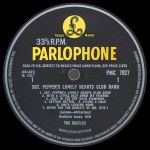
Sgt. Pepper on Yellow and Black Parlophone

Hot Stamper Pressings of the Music of The Beatles Available Now

UPDATE 2026

This commentary was written in 2010, prompted by our good fortune in finding a clean, -1/-1 original pressing of Sgt. Pepper, at a local record store, in stereo no less.

Since that time I believe we have played at least one other early pressing. We are unlikely to play another.

The originals have almost nothing in common with the amazing pressings that end up winning our shootouts, none of which have ever been mastered in the 60s to the best of my knowledge, although it is possible that ten or fifteen years ago, before we really got to know the record the way we know it now, there might have been one or two from that decade.

Since then the cutoff is somewhere in the mid-70s. We leave the specific years for you to figure out.

Of course, if you bought a White Hot Stamper copy from us, you know at least one of the stampers for at least one of the sides that wins a shootout, and perhaps both if you happened to have purchased a 3/3 Top Shelf copy. (At the time of this writing there are a total of seven on the site, out of about 500 records. Needless to say, they are very hard to find.)

Certainly nothing from 1967 and nothing on the original label.

And definitely nothing in mono.


We had the opportunity not long ago to audition a very clean original early pressing of the album and were frankly quite taken aback by how just plain AWFUL it was in every respect. No top end above 8k or so, flabby bass, muddy mids — this was as far from Hot Stamper sound as you could get.

To be fair, we have played exactly one copy on our current system. (Played an early copy or two long ago but on much different equipment, so any judgments we might have made are highly suspect.) Perhaps there are good ones. We have no way of knowing whether there are, and we are certainly not motivated to find out given the price that original Sgt. Pepper’s pressings on the Yellow and Black label in audiophile playing condition are fetching these days.

(more…)

We Don’t Offer Domestic Pressings of Pour Down Like Silver for One Very Simple Reason

Hot Stamper Pressings of the Music of Richard Thompson Available Now

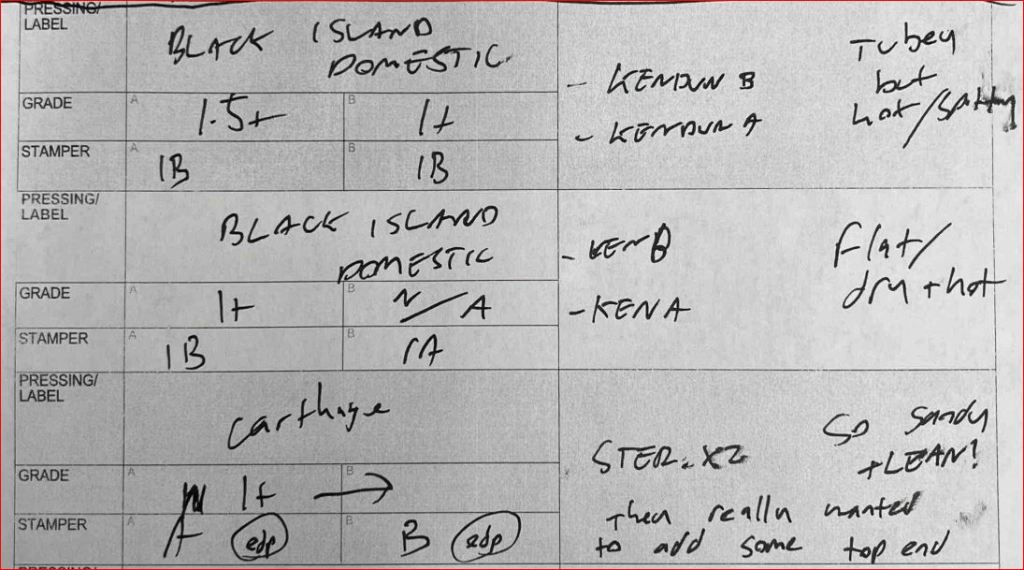
In spite of the fact that the domestic pressings of this Richard and Linda Thompson classic from 1974 were mastered by the likes of Kendun and Sterling — two of the greatest mastering houses of all time, — they have never impressed us with their sound quality.

The biggest problems with this record would be obvious to even the casual listener: gritty, spitty vocals; lack of richness; bright tonality; lack of bass; no real space or transparency, etc.

The domestic Island pressings did not do nearly as well in our shootout as the best Island imports, no surprise there as the early UK records were mastered by one of our favorite engineers.

Avoid the Carthage pressings mastered by Sterling. They came in last in our shootout.

The domestic breakdown follows:

Black Island Domestic #1

  • Tubey but hot and spitty.

Black Island Domestic #2

  • Flat, dry and hot (glary or bright)

Carthage Domestic recut from 1983, Sterling on both sides

  • So sandy and lean! They really wanted to add some top end (!)

Defending the Indefensible

(more…)

Shootout Winning Stampers for Rhythms of the South Revealed

Hot Stamper Pressings of Exotica and Bachelor Pad Recordings Available Now

There are some records that, no matter how amazing the sound, and how good the music is, simply will not find favor with our customers. This is one of them. I happen to like the music, and the sound is shockingly good, a true Demo Disc for those of you with big speakers pulled well out from the back wall in a spacious, heavily treated room like the one you see below.

We are most likely not going to be doing shootouts for this title in the future, so we thought we would share with everyone what we know about the record, which boils down to which stampers have the potential to do well and which do not.

As you can see, Stan Goodall did a much better job mastering the early Blueback London pressings for Decca than Jack Law.

What information can you rely on when trying to find the best sounding pressings?

The originals all have the same Blueback cover.

In this case, the stamper numbers are the only way to separate the potential winners from the sure losers.

11/2023 Ros, Edmundo Rhythms of the South (PS 114 London) early Blueback 3 3 1E 1E other copies: 2.5/2, 2/2.5
11/2023 Ros, Edmundo Rhythms of the South (PS 114 London) early Blueback 1.5 1 2D 2D s1 dry, flat, trashy. s2 smeary, messy, boring
RE ABOVE: I FOUND THIS IN A BOX. THOUGHT IT SOUNDED REALLY GREAT, ESP. T1, S1

Jack Law’s cutting for side one was

(more…)

3s Can Have Amazingly Good Sound, or 3s Can Have Mediocre Sound

Hot Stamper Pressings of Living Stereo Recordings Available Now

But how can you tell which 3s copies sound amazing and which 3s copies don’t?

Below you will see the stamper sheet for a shootout we did not long ago.

A lot of our stamper sheets look like this one, close to half I would guess.

As you can see, the stampers and the sound are all over the map. This is not the least bit unusual in our experience. It’s simply the nature of records — they tend to come off the press with very different sound depending on factors that no one seems to understand very well, not even us!

Note that the album you see pictured is not the record we did the shootout for.

(more…)

Getz Au Go Go on Polygram – Isn’t This Record Supposed to Be Stereo?

Hot Stamper Pressings of Bossa Nova Albums Available Now

As part of our recent [probably from 2011] shootout for the album, one of the pressings we played was a later reissue, most likely from the late 70s or early 80s.   

As a general rule we make a point to go out of our way to play practically any copy we can get our hands on, in the off chance that a reissue will beat the original. It’s happened plenty of times. Those of you with White Hot Stamper shootout winning copies of some of our favorite titles know what I’m talkin’ about.

Imagine our surprise when this pressing — in a stereo jacket, with a label with the word “stereo” printed right on it — turned out to be dead MONO.

The sound was godawful — small, flat, and bereft of the ambience that makes this recording so enjoyable. The same would probably be true for the mono originals, but since I haven’t played one of those in decades I will just say that that would be no more than a guess, albeit an educated one.

Yet another reason not to believe a word you read on an album jacket or label.

A public service from your record loving audiophile friends here at Better Records. (more…)

Hey, Maybe Rudy Van Gelder IS as Bad a Mastering Engineer as They Say

Hot Stamper Pressings of Recordings by Rudy Van Gelder Available Now

It’s certainly a proposition worth considering, mostly because so many audiophiles seem to believe it. Or maybe in spite of their believing it, skeptics such as myself being the troublemakers they always are.

So let’s dig down into the dirt of a record that Rudy both recorded and mastered.

None of the Rudy Van Gelder cuttings we played of Eric Dolphy’s 1961 release of Out There were better than passable, and some had sides that were downright awful sounding, as you can plainly see from our notes.

The copies that won our most recent shootout were mastered by George Horn, and the best of them sound amazing. Here are some comments we made for the album years back as well as the Allmusic review:

Insanely good sound throughout with both sides earning Shootout Winning Triple Plus (A+++) grades. This copy was doing it all right: rich, full-bodied and Tubey Magical yet still super open and spacious.

“A somber and unusual album by the standards of any style of music, Out There explores Dolphy’s vision in approaching the concept of tonality in a way few others — before, concurrent, or after — have ever envisioned.” – 5 stars

As you will see from our notes, we played some very disappointing early pressings. All the early pressings we had on hand were expensive to acquire, the vintage jazz pressing market being what it is: expensive and full of optimistic record graders of questionable skill. (For these kinds of vintage pressings we probably return 70-80% of what comes our way.)

We have to pay top dollar to get copies that are clean, even on the 60s and 70s reissue labels. Noisy old jazz records are simply not saleable to audiophiles no matter how good they sound.

None of the early copies we played earned grades good enough to bother pursuing, not when there are wonderful sounding vintage reissues from the 80s available. On a more positive note, this being our first shootout for the album in many years, we certainly learned a lot, so let’s just chalk up the losses to the cost of doing business. Our newfound knowledge of the best pressings will continue to pay dividends for years to come now that we know what the right stampers tend to be.

The original recording of Out There was released in 1961 and was not available in stereo until 1969. (Prestige was famous for being an anti-stereo holdout long after everyone else in the jazz world had come to terms with the superiority of two channels over one. Apparently the age-old controversy over mono versus stereo is ongoing, which is why we write about it so often.)

The first record you see pictured below is the mono reissue from 1965, released with a different cover and pressed on the lovely dark blue Prestige label. It, like the stereo reissue below it, was mastered by RVG.

A word to the audiophile types who like to do their own hunting: we rarely buy vintage jazz reissue records from the 60s and 70s that were not mastered by RVG. Their track record is poor, with maybe one winner out of ten, if that.

Back to this mono reissue from 1965. It’s a mess on side one, NFG, with side two being passable at best, earning one plus.

The second record you see, the one with a different cover, is the stereo reissue from 1969, also on the dark blue label and mastered by RVG.

It too is a mess, with side one being good, not great, but side two earning a less-than-Hot Stamper grade of 1+.
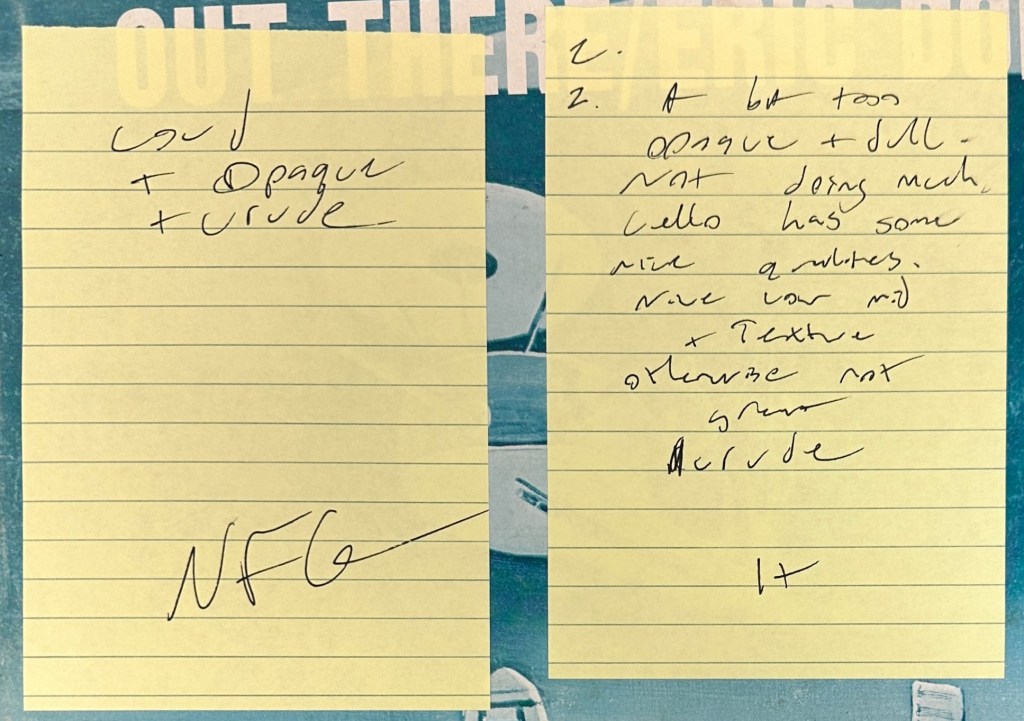
Side One

  • Loud and opaque and crude
  • NFG

Side Two

  • A bit too opaque and dull
  • Not doing much
  • Cello (played by Ron Carter no less!) has some qualities
  • Nice lower mids and texture
  • Otherwise not great
  • Crude
  • 1+

(more…)

Coltrane’s Sound – Forget the 70s Reissues

Hot Stamper Pressings of the Music of John Coltrane Available Now

This is yet another superb Tom Dowd recording of Coltrane in his prime, with support from the brilliant McCoy Tyner and Elvin Jones.

Just don’t bother with the later Red and Green Atlantic pressings.

Every one we’ve ever played was flat, dry, and thin. They sound like most of the cheap reissues that Atlantic churned out in the ’70s.

Don’t get me wrong; there are some good sounding records on the Red and Green label, but you really have to know what you are doing — or be really lucky — to find them.

We’ve played them by the score, and found relatively few winners among a slough of losers. If you want to take your chances on some, knock yourself out, more power to you, but expect to come up with nothing to show for your time and money almost every time. That’s been our experience anyway.

And be very thankful if you happen to run into one of these early Atlantic stereo pressings, especially if it plays quietly. Few Classic Coltrane albums survived the jazz lovers of the day and their awful turntables.

(more…)

Always wanted to have a Plum and Orange pressing? Here’s your chance!

Hot Stamper Pressings of the Music of Led Zeppelin Available Now

We should have titled this one “here was your chance,” since this pressing sold very quickly.

Over the years most Plum and Orange pressings were disposed by us of on ebay for the benefit of collectors and those audiophiles who might be ill-informed enough to think that early British pressings would have the best sound for Led Zeppelin III.

They do not. They can, however, sound reasonably good in some cases with the proper cleaning.

However, they are not even Double Plus (A++) good, which sounds like something from the novel 1984 but is in fact a Very Good grade and guaranteed to trounce any and all copies of the album you have ever heard.

No, the best Zeppelin album we have played to date with the early label in this case earned a grade of Single Plus to Double Plus, which we describe as “[a] wonderful sounding side with many impressive qualities, notably better than a Single Plus copy. A big step up from the typical pressing.”


UPDATE:

We do not even offer Single Plus copies on the site anymore. Although their faults would be less obvious to anyone who went through the shootout process with the album, such faults are much too bothersome to us precisely because we did go through that process.

Once you know what is right, it’s very easy to spot what is wrong.

This is the foundational principle of Hot Stampers.

(more…)

Straight Up – Porky Not So Prime Cut

Hot Stamper Pressings of the Music of Badfinger Available Now

British band, British pressing… right?

Nope. It’s just another mistaken idea.

We had an original British pressing in our shootout, unbeknownst to me as it was playing of course. And guess where it finished: dead last. The most thick, congested, crude, distorted, compressed sound of ALL the copies we played. We love the work of Porky, Pecko, et al. in general, but once again this is a case where a British Band recorded in England sounds best on domestic vinyl. (McCartney’s first album on Apple is the same way.)

Just saw this today (11/29/2021)

On November 18, 2019, a fellow on Discogs who goes by the name of Dodgerman had this to say referencing the original UK pressing of Straight Up, SAPCOR 19:

So Happy, to have a first UK press, of this lost gem. Porky/Pecko

Not sure what those two commas are doing there. Pausing for emphasis? Sure, why not? This is a big deal.

Like many record collectors, he is happy to have a mediocre-at-best, dubby-sounding original pressing, poorly mastered by a famous mastering engineer, George Peckham, a man we know from extensive experience to be responsible for cutting some of the best sounding records we’ve ever played. He is one of the greats.

Is Dodgerman an audiophile? He could be! Many audiophiles employ this kind of mistaken audiophile thinking, believing that a British band’s albums must sound their best on British vinyl for some reason, possibly a cosmic one.

(more…)